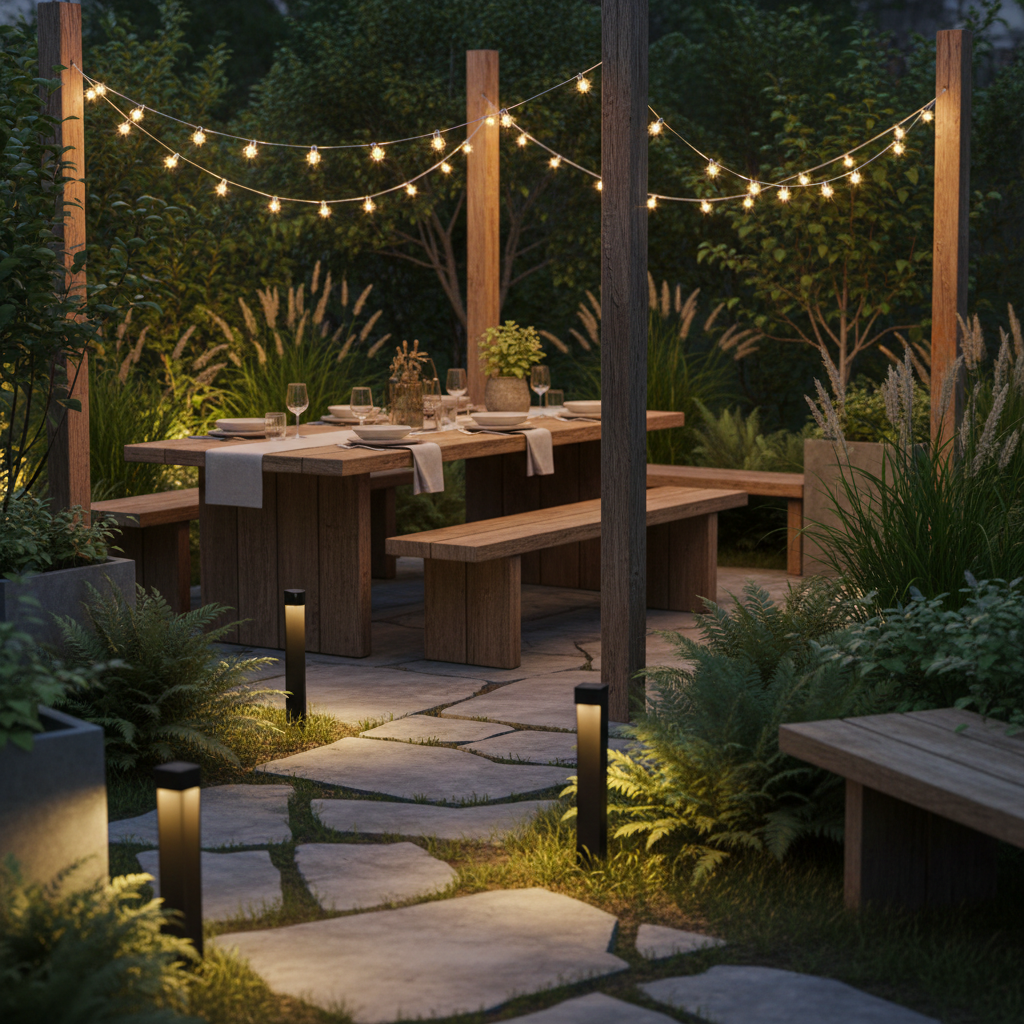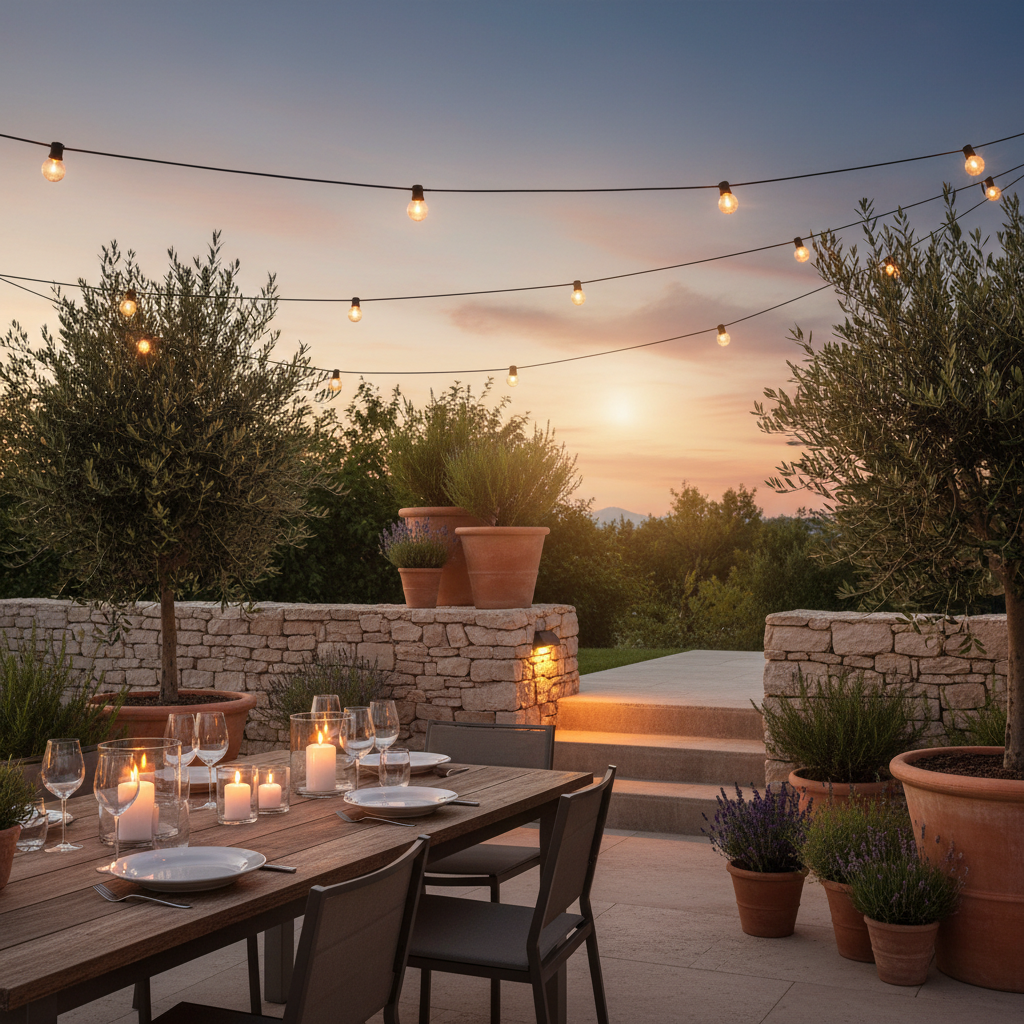
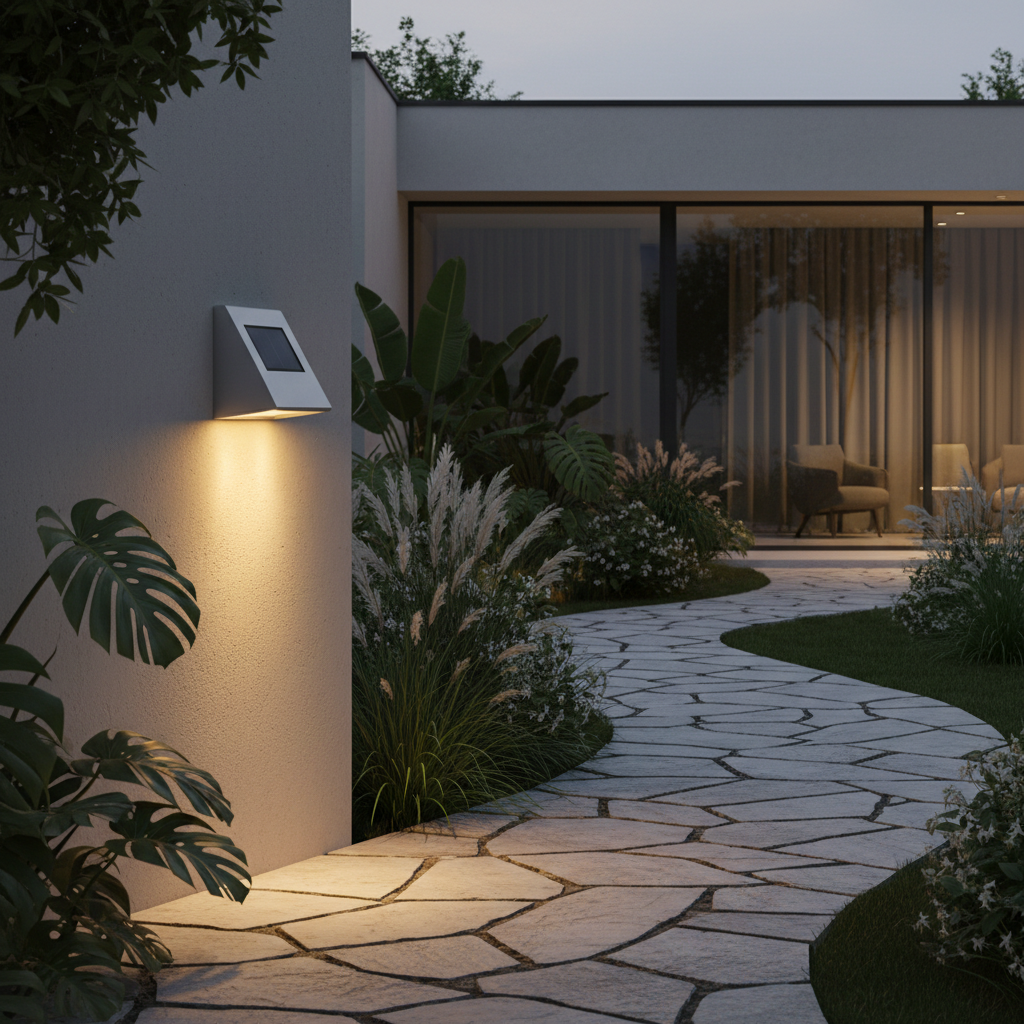
Want to light up your patio, driveway, or gate? No major construction, no trenches to dig, no electrician to call. Just a beautiful, functional light fixture that installs in minutes and gets the job done.
The problem is, the wireless outdoor lighting market mixes very different products: designer lamps that last one evening, solar gadgets that fail by October, and a few real solutions designed to last. This guide helps you sort through them.
Wireless Outdoor Lighting: Two Families, Two Uses
When we talk about wireless outdoor lighting, we first need to distinguish two main categories. They don't address the same uses or the same constraints.
USB Rechargeable Lights: For Tables and Patios
These lights run on an internal battery rechargeable via USB. You place them on a table, railing, or ledge. They are generally designed as decorative objects: LED candles, lanterns, small outdoor table lamps.
Their advantage: the design can be very refined, and you can easily move them from one evening to the next. Their limitation is real: battery life often ranges from 4 to 12 hours in continuous-on mode. This means after a few evenings, you'll need to remember to recharge them. If you forget, the lamp will be off the next night.
This format is well-suited for occasional use: dinner on the patio, an evening in the garden. Less suitable for permanent functional lighting like a driveway or entrance.
Solar Lights: For Walls, Facades, and Driveways
Powered by an integrated solar panel, these lights recharge daily using daylight. Zero cables, zero manual recharging. Once installed, they operate completely autonomously.
This format best matches the "wireless" promise in its most radical version: you install the light, and it does its job. You don't think about it again.
The difference between a good solar light and a bad one? The size of the panel and the battery capacity. Entry-level models—often sold in packs of 4 for less than $20 each—have tiny panels and anemic batteries. Result: they work in summer but fail by September. For reliable year-round use in the US/Canada, technical specifications truly make a difference.
What "Design" Really Means Outdoors
An outdoor light fixture endures conditions indoor lights don't. Rain, frost, UV, humidity, summer heat. Design isn't just about appearance: materials determine what will still look good in 3 years.
Aluminum vs. Plastic: The Game-Changing Criterion
Aluminum is the standard for quality outdoor lighting. It doesn't deform under heat, doesn't yellow with UV, and doesn't crack under frost. A brushed or anodized aluminum fixture maintains its appearance over the years.
ABS plastic may seem fine when purchased, but it ages poorly outdoors. Sunlight discolors it, cold weakens it. Plastic clips and fasteners are often the first points of failure.
When comparing products, check the main housing: is it aluminum or plastic? This is often where the price difference is truly justified.
The IP Rating: The Minimum for Outdoor Use
The IP (Ingress Protection) rating measures resistance to water splashes and dust. For outdoor use, IP65 is the serious minimum. This means it's protected against direct water jets—which covers rain, including horizontal downpours in strong winds.
Below this (IP44, IP54), the light can theoretically go outdoors, but with reservations. Installed under an overhang or a covered pergola, it might suffice. On an exposed facade or gate, it's insufficient in the long term.
IP67 and IP68 indicate immersion resistance—useful for a pool light, overkill for most common uses.
Battery Life: The Minimum One-Week Rule
A wireless outdoor light that needs frequent recharging isn't truly wireless. It's a disguised inconvenience. Recharging becomes a chore, and if you forget once, you're left in the dark.
Why 7 Days of Battery Life is the Minimum Worthwhile Threshold
Imagine a USB rechargeable light with 3 days of battery life. You'd have to plug it in twice a week. In practice, this means bringing it inside to charge, or having a USB cable lying around outdoors. The beautiful setup quickly becomes a logistical hassle.
At 7 days or more, recharging becomes acceptable: once a week is manageable. But beyond that, from a month or more, you enter the category of truly autonomous lights—those that require virtually no intervention.
For truly autonomous outdoor lights, solar technology is the only consistent answer. It completely eliminates the recharging issue.
Motion Sensor Mode vs. Continuous Mode: Battery Life Differs
Almost all serious wireless lights offer two operating modes: motion detection (the light turns on when you pass, turns off after a few seconds) and continuous mode (stays on permanently).
Advertised battery life almost always refers to motion detection mode. In continuous mode, it drops drastically. A product advertised as "20 days" will be "36 hours" in continuous mode. Both figures are correct—but they correspond to completely different uses.
For a driveway or gate: motion detection mode is most logical. For lighting a patio during an evening: continuous mode will be necessary. Check that the product you choose provides both pieces of information, not just one.
How to Choose Based on Location
The location where you want to install your wireless outdoor light completely changes the priority criteria. Here's how to approach each specific case.
Driveway and Pathway
The goal is functional: light up when someone arrives, then turn off. Motion detection mode is perfect. You want light directed towards the ground or sides—not a lamp that blinds you when you come home.
Lumen output matters here: below 400-500 lumens, lighting a 15-20 foot (4.5-6 meter) driveway will be insufficient. Also, orient the motion sensor according to the path taken, not just towards the facade.
For this use, solar is ideal: you don't want to worry about batteries, and the light needs to work even when you come home at 11 PM in the rain in November.
Patio and Social Area
Here, aesthetics take over. You want to create an ambiance, not just see where you're walking. Two approaches coexist: USB rechargeable table lamps for warm, accent lighting, or a wireless wall light with adjustable brightness for general illumination.
Color temperature greatly influences the atmosphere. A warm white around 3000K creates a cozy and inviting ambiance, suitable for a relaxation area. A neutral white (4000K) will be more practical if you use the patio for working or outdoor cooking.
For reliable year-round patio lighting, consult our guide on powerful wireless outdoor lighting—it details brightness criteria based on the area to be lit.
Gate and Property Entrance
An exposed area, often without a nearby power outlet. Wireless solar is the natural solution. The light must be robust (IP65 minimum, aluminum housing) and offer sufficient detection range—ideally 20-26 feet (6-8 meters) to cover the gate approach.
Also, consider the solar panel's orientation: it should face south (or southeast/southwest) for optimal recharging. If your gate is on a north-facing facade, some models offer a remote solar panel connected by cable, allowing you to place the panel in the sun and the light in the desired location.
Facade and Exterior Wall
For a wireless wall light, mounting is a key criterion. A system with screws and anchors will be more stable than adhesive on a wall exposed to weather. But for renters, industrial double-sided adhesive can suffice on some smooth surfaces (patio tiles, conservatory glass), provided the light is lightweight.
Appearance is important here because the light is visible from the street. Opt for a clean, aluminum design with a refined finish. A product with a plastic housing quickly dulls outdoors and eventually detracts from the facade's aesthetics.
Solar in Winter: The True Test of Reliability
The big question about solar lights in the US/Canada is their performance from October to February. Sunlight is reduced, days are short, and temperatures are low. A low-end solar light will fail in these conditions.
Why Some Solar Lights Fail in Winter
Most winter problems stem from two factors: a solar panel too small to store enough energy during a few hours of weak sun, and an insufficient battery capacity to last several consecutive days without solar recharge.
In the US/Canada, you can have 3 to 4 consecutive days without significant sun in winter. A reliable solar light must be able to operate in motion detection mode during this period without failing. This is the true quality criterion.
To understand how to assess this resilience, the guide on autonomous solar lighting provides a solid basis for comparing products in real-world conditions.
Technical Specifications to Check for All-Season Use
Two figures are revealing: the internal battery capacity (in mAh) and the solar panel's power. The higher these values are relative to the LED's consumption, the more resilient the light will be in winter.
A concrete indicator: how many days can the product last without solar recharge in motion detection mode? A good solar light for all-season outdoor use in the US/Canada should last at least 10 to 15 days without sun. Below that, expect performance drops in January.
Comparison Table: Rechargeable vs. Solar Lighting
| Criterion | USB Rechargeable | Solar |
|---|---|---|
| Battery Life | A few hours to a few days | Weeks to months (in motion detection mode) |
| Manual Recharging | Yes, regular | No (automatic via sun) |
| Ideal Use | Patio table, accent decor | Driveway, facade, gate, wall |
| Design | Very varied (table lamps, lanterns) | Wall lights, floodlights |
| Weather Resistance | Variable (often IP44-IP54) | IP65+ for serious models |
| Installation | Freestanding, no mounting needed | Wall mount or stake |
| Renter-Friendly | Yes (no mounting) | Yes if adhesive or light mounting |
| Reliable in Winter | Yes (if charged) | Depends on panel/battery quality |
What a Quality Solar Light is Truly Worth
The question of reliable outdoor solar lighting often comes down to a trade-off between purchase price and actual lifespan. A $12 solar light might work for one summer. A well-built product, with an aluminum housing and adequately sized battery, can last 5 years without issue.
Lumic's SolarGlow: What Truly Sets It Apart
If you're looking for an outdoor solar light that requires no intervention after installation, the SolarGlow is a serious option to consider. Here's what differentiates it from entry-level products:
- 1200 lumens: Real light output, suitable for lighting a driveway or entrance, not just symbolic light.
- 4x larger battery than low-end models on the market, allowing it to last 20 days without solar recharge in motion detection mode, and approximately 36 hours in continuous mode.
- 3x larger solar panel than economic alternatives, for efficient recharging even on cloudy days or in fall.
- Two 180° motion sensors, with a range of approximately 26 feet (8 meters): covers the entire approach to an entrance without blind spots.
- IP65: Resists rain, frost, snow. Aluminum housing, no plastic that ages poorly.
- Cable-free installation, 5-year warranty, 90-day satisfaction guarantee.
This is what we call a wireless outdoor light in its most radical version: you install it once, and you don't think about it again. Recharging is automatic, weather resistance is there, and the aluminum design stays clean over the years.
Who the SolarGlow is For
This light is designed for those who truly want to stop worrying about outdoor lighting. Homeowners or renters (installation requires no wiring), with a need for security or functional lighting at the entrance, on the driveway, along a garage, or on an exposed facade.
If you're looking for a decorative table lamp for your patio evenings, that's a different use—and other products will be better suited. The SolarGlow is made for serious illumination, not occasional decoration.
Common Mistakes to Avoid When Buying
The wireless outdoor lighting market is full of promises difficult to evaluate online. Here are some concrete points to watch out for before ordering.
Relying Solely on Advertised Lumens
The stated lumen count often corresponds to the theoretical peak, not the actual output in normal use. A product advertised at 800 lumens may actually deliver 400 to 500 lumens under normal conditions. Cross-reference lumens with real customer reviews on forums or Trustpilot for a more accurate idea.
Confusing Water Resistance with Waterproofing
IP44 means resistance to multi-directional water splashes—sufficient under an awning, insufficient on an exposed facade. IP65 is the true minimum for outdoor installation. Always check the exact IP rating, not just the generic "waterproof" mention, which means nothing without specifics.
Neglecting Solar Panel Orientation
A solar panel installed on a north-facing facade or partially shaded will see its performance drop significantly. Before buying, look at where you want to install the light and assess the actual sunlight in that location. Some models allow independent panel orientation, which is a real advantage.
Underestimating the Importance of Mounting
A poorly mounted solar light on a wall, which moves in the wind or after a few freeze/thaw cycles, quickly becomes unusable. Prefer screw-in fasteners for permanent installation, and check the solidity of the panel's angular adjustment system.
To adapt your lighting to each outdoor area, the article on solar garden lighting by zone is a good practical complement.
Summary: How to Choose Your Wireless Outdoor Light
Before buying, ask yourself these three questions in order:
- What is the use case? Occasional table decor (USB rechargeable) or permanent functional lighting (solar).
- What is the exposure? IP65 minimum for any exposed outdoor installation. Aluminum rather than plastic if you want it to last.
- What battery life do you expect? Less than 7 days = recharging chore. Beyond = real convenience. Solar eliminates the question.
A successful wireless outdoor light is one that delivers on its promises 12 months a year, in all weather, without you having to worry about it. The design must last as long as the performance. These two criteria go hand in hand, and that's what distinguishes a real light fixture from a gadget sold on a pretty picture.