
Want to light up your outdoor space without running cables, calling an electrician, or touching your electrical panel? Solar LED outdoor lighting is likely the right path. But with garden bollards, motion sensor floodlights, wall sconces, and patio string lights, the choice is far from obvious.
This guide helps you clarify zone by zone: what you truly need, what power, what IP rating, and what product type. No generic product lists. Just concrete recommendations based on use.
Why Choose Solar for Your Outdoors?
Solar is the only outdoor lighting that's self-powered. Zero electricity bills, zero cables to maintain, zero trenches to dig in the yard.
What Really Changes Compared to Wired Lighting
A complete, well-done wired outdoor lighting system, with trenching, cabling, electrical box, and labor, typically costs between $2,000 and $5,000 for a standard home. It's a major project. It requires a qualified electrician, often permits depending on the work, and several days of intervention. Solar? You install it yourself in 20 minutes. And if you change your mind about the location in 6 months, you just move it.
The other often underestimated advantage: maintenance. A wired installation means aging cables, oxidizing connectors, and waterproof outlets to check. Solar is a self-contained unit. You clean the panel occasionally, that's it.
Limitations to Know Before Buying
Solar has real constraints. The first: it needs natural light to recharge. In winter in northern regions, with 4 hours of sunlight per day, a low-end solar lamp with a small panel and battery will quickly disappoint you. This is where panel and battery quality make all the difference. A lamp with a generous battery can operate for several weeks without sufficient sun, whereas a $10 lamp from a marketplace will die by the first of November.
The second limitation: maximum power. For very large spaces or professional use, wired lighting remains superior in terms of light output. But for 95% of residential uses, current solar models are more than sufficient. To learn more on this topic, check out our article on powerful outdoor solar lamps and what truly makes a difference.
Home Entrance: Prioritize Motion Detection and Power
The entrance is the most critical area. You need lighting that turns on immediately when someone approaches, with enough power to clearly illuminate the porch, door, and ideally part of the pathway leading to it.
What Power for a Home Entrance?
For a standard entrance, aim for at least 800 to 1200 lumens in motion detection mode. Below that, the lighting will be too dim to be truly useful at night. Sensor range is also crucial: 15 to 25 feet (5 to 8 meters) minimum, with a wide detection angle (120 to 180 degrees) to cover the entire approach area.
The minimum IP rating for an exposed entrance: IP65. This covers rain and water jets from all directions. If your porch is completely exposed to the elements or you live in an area with frequent freezing, check that the technical specifications mention frost resistance.
The Lumic SolarGlow for Entrances: What it Actually Does
For this area, the Lumic SolarGlow is a relevant option. 1200 lumens, two 180-degree motion sensors, 25-foot (8-meter) range, IP65 rating. In detection mode, battery life reaches 20 days without solar recharge. This kind of reserve makes all the difference in winter. And because everything is in a single housing, there are no external cables to cut or disable, making it difficult to sabotage for someone wanting to act in the dark.
Cable-free installation, 5-year warranty. If you want to delve deeper into solar motion sensor lighting, we have a dedicated guide comparing different sensor types and operating modes.
The Garden: Bollards, Spotlights, and Pathway Lighting
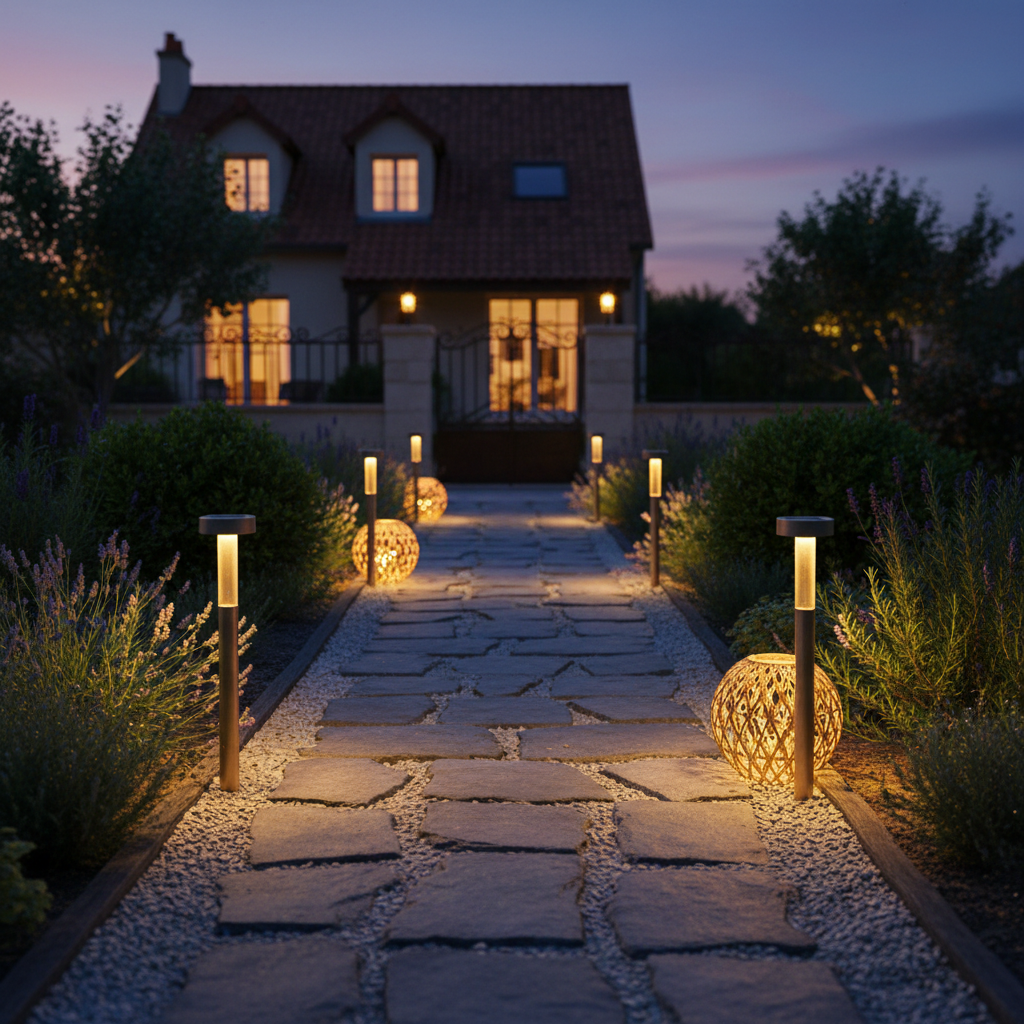
The garden is often where people buy underpowered lights, thinking they are just decorative. A solar garden bollard has two distinct functions depending on the context: marking a pathway or border, or illuminating a passage area. These are not the same product.
Solar Bollards for Pathway Lighting
For marking a pathway or highlighting a flowerbed border, solar bollards are ideal. We're talking ambient lighting here, not security: 20 to 80 lumens per bollard are sufficient. The important thing is regular placement (every 2 to 3 feet (60 to 100 cm) generally) and aesthetic consistency.
For this type of use, casing durability is the real priority. A bollard planted in the ground is constantly exposed to humidity, mowing, and impacts. IP44 minimum, but prefer IP65 if you can. Avoid bollards with panels that are too small or batteries less than 1000 mAh: they often turn off before morning. Our guide on solar garden bollards details selection criteria if you want to go further.
Spotlights and Floodlights for Illuminating a Garden Area
Want to highlight a tree, light up a play area, or create a night effect in a corner of the garden? Here, you need a solar spotlight or floodlight with at least 300 to 600 lumens depending on the area to cover, manually adjustable to target the exact desired zone.
Check that the solar panel is separable from the floodlight by a cable. Some models have the panel integrated into the spot, which forces you to orient the floodlight towards the sun... instead of towards what you want to illuminate. Those with a remote panel are much more flexible. Consult our article on outdoor solar floodlights for comparison criteria.
The Patio: Combining Ambiance and Functionality
The patio is the most versatile area. We eat there, entertain, read, and relax. Lighting must therefore be able to do two things at once: create a pleasant atmosphere and allow you to see what you're doing.
Solar String Lights: Truly Useful or Just Pretty?
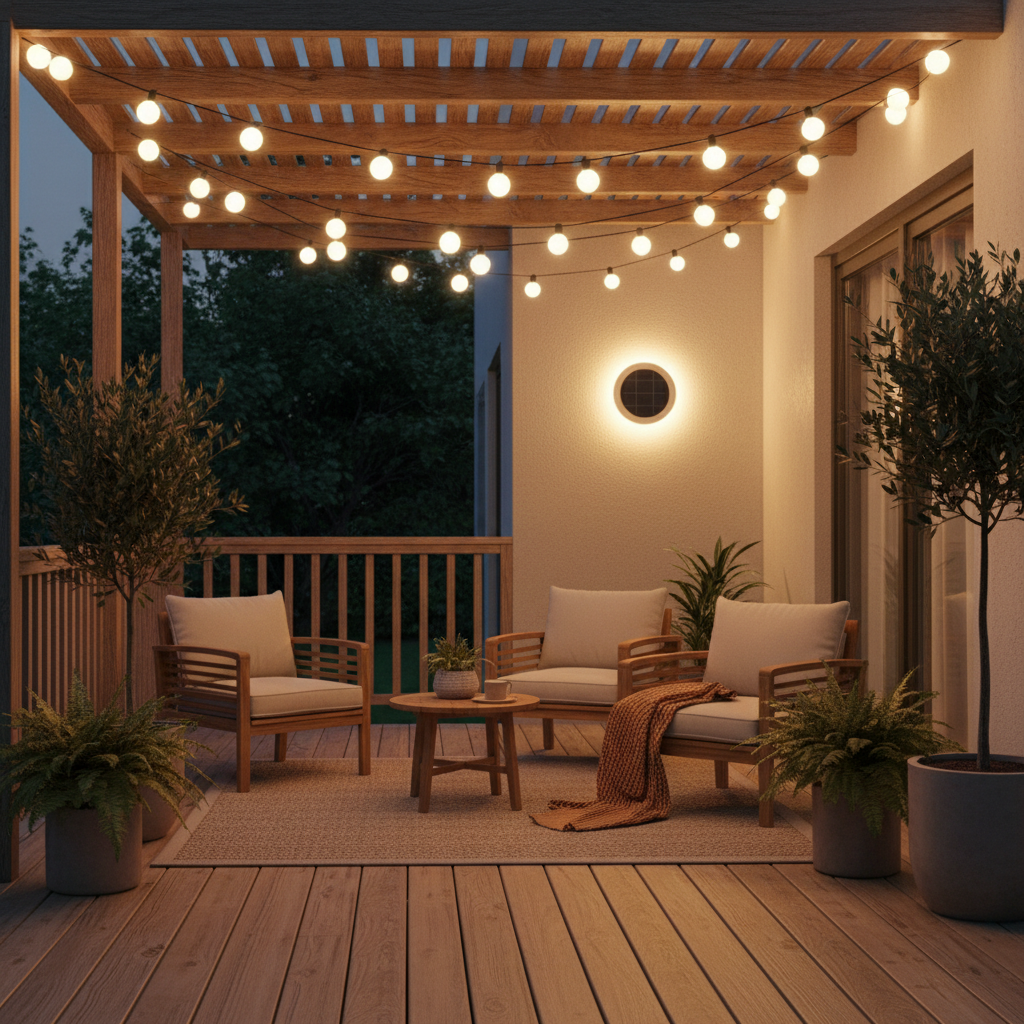
Solar string lights have improved. Current models with Edison bulbs and decent batteries can last a full night on their own, with a warm light at 2700-3000K that truly creates an ambiance. For a 160 to 270 sq ft (15 to 25 m²) patio, a 30 to 50 foot (10 to 15 meter) string with 0.3W bulbs each gives a pleasant result for evenings.
Their limitation: they don't replace functional lighting. If you also want to see to eat or move around without tripping, you need to combine the string lights with a wall sconce or a floodlight. It's not one or the other.
Solar Wall Sconces for Perimeter Lighting
To light the perimeter of the patio, solar wall sconces fixed to walls or pergola posts are very effective. They illuminate downwards, avoid glare, and create regular luminous zones. Aim for 200 to 400 lumens per sconce, with a minimum 120-degree lighting angle.
A practical detail often ignored: the orientation of the sconce must allow the integrated panel (if it's on top of the housing) to capture enough light. If your wall faces north or is constantly in the shade, a sconce with a remote panel will be much more reliable. Our article on powerful solar wall sconces covers this point in detail.
Garage and Outbuildings: Motion Detection First
In a garage, workshop, or shed, solar lighting meets a simple need: turn on when you arrive, light your way while you do what you need to do, then turn off automatically. No ambiance, no aesthetics. Just functional.
What You Really Need for an Outdoor Garage
For the exterior access of a garage, you need a powerful motion sensor (600 to 1200 lumens) with enough range to detect an approaching car or person at 15-25 feet (5-8 meters). The ideal operating mode: immediate full-power illumination upon detection, automatic shutdown after 20 to 60 seconds (adjustable depending on the model).
IP65 is the absolute minimum for anything mounted outdoors on a building. For regions with harsh winters, some models specify resistance down to -4°F (-20°C) for the battery, which is a real criterion to check.
Indoor Garage: Is Solar Possible?
It depends. If your garage has a glass roof or a south-facing window, some solar lamps with a remote panel connected by cable can work. The panel is placed outside, the lamp inside. But in a completely enclosed garage without windows, solar won't work. In this case, mains-rechargeable (or a USB-rechargeable LED light bar) is more suitable. Be honest about the physical constraints of the space before buying.
Fencing and Gates: Security and Deterrence
Fence lighting serves two objectives: marking the property perimeter and deterring intrusions by eliminating shaded areas. The product varies depending on what you want to prioritize.
Fence Lighting for Marking
For aesthetic marking along a fence or hedge, solar stake lights or clip-on fence lights are practical. 50 to 150 lumens are sufficient for this type of use. Aesthetics matter here, and compact metal or resin models are more durable than flimsy plastic.
Gate Lighting for Deterrence
For a gate or fence corner, you're looking at a different category. You need a motion-sensing floodlight aimed at potential entry points, with enough power to clearly reveal a person in the dark. 800 to 1200 lumens, wide detection, solid mounting. The deterrent effect comes from sudden illumination and light intensity, not continuous light. This is exactly the use case for a powerful outdoor solar light.
Summary Table by Zone
| Zone | Recommended Power | Product Type | Minimum IP | Preferred Mode |
|---|---|---|---|---|
| Home Entrance | 800-1200 lumens | Sconce / Wall Floodlight | IP65 | Motion Detection |
| Garden Pathway | 20-80 lumens / bollard | Stake Bollards | IP65 | Continuous (night) |
| Garden Area to Light | 300-600 lumens | Adjustable Spot / Floodlight | IP65 | Continuous or Detection |
| Patio (Ambiance) | Variable by length | Solar String Lights | IP44 min | Continuous (night) |
| Patio (Functional) | 200-400 lumens / sconce | Wall Sconce | IP65 | Continuous or Detection |
| Garage / Outbuilding | 600-1200 lumens | Motion-Sensing Floodlight | IP65 | Motion Detection |
| Fence / Gate | 800-1200 lumens | Wall Floodlight | IP65 | Motion Detection |
How to Choose Your Solar LED Outdoor Lighting?
Beyond specific zones, some overarching criteria apply to all solar LED outdoor lighting purchases.
The Battery: The #1 Criterion No One Looks at Enough
Battery capacity determines how long your lamp will operate without sufficient sun. In many regions, bad weather can last several weeks in winter. A 2000 mAh battery on a 1200-lumen floodlight will last 2 to 3 nights in detection mode. A 4000 mAh battery can last up to 20 days for the same use. This difference completely changes the user experience.
Many cheap solar lamps boast impressive lumen numbers but have tiny batteries. They die at 2 AM. Always check the battery capacity in mAh, not just the lumens.
IP Rating and Resistance to Real Conditions
IP65 is the minimum for any outdoor use. This means: protected against water jets from all directions. IP67 and IP68 add resistance to immersion, useful for very exposed areas or where water accumulation is possible (base of fences, flood-prone areas after storms).
Frost resistance is another separate data point to check. IP concerns water, not temperature. Some lithium batteries lose part of their capacity below 32°F (0°C). Quality models specify an operating temperature range.
Integrated or Remote Solar Panel?
An integrated panel directly in the lamp is simpler to install. But it means the lamp's orientation must face the sun, which isn't always compatible with the lighting direction you want. A remote panel (connected by a cable of a few feet) gives you total flexibility: you orient the panel towards the sun, the lamp towards the area to be lit. For all areas with orientation constraints, it's almost essential.
If you're still unsure about the type of wireless outdoor lighting suitable for your situation, our complete guide to powerful wireless outdoor lighting covers the different technologies available today.
Key Takeaways for Smart Choices
Solar LED outdoor lighting is not a single product. It's a set of different solutions depending on the zone, use, climate constraints, and budget. A few simple rules to summarize:
- For an entrance or garage: focus on motion detection and power (800-1200 lumens, IP65, generous battery).
- For a garden pathway: regularly spaced solar bollards, IP65, sufficient battery to last all night.
- For a patio: combine string lights for ambiance and a functional sconce to see what you're doing.
- For a fence or gate: a motion-sensing floodlight, aimed at approach areas.
- In all cases: check the battery capacity in mAh before the lumen count. That's what determines if your lamp lasts a full night in winter.
And if you want a complete overview of solar offerings by garden zone, our guide on which solar lamp for each garden zone goes further into product comparisons.