Solar LED Garden Lights: Why This Combo is Unbeatable
There's a simple reason why solar LED garden lighting has exploded in recent years: LED technology consumes so little energy that a small solar-recharged battery is more than enough to last all night. No cables to bury. No electrician needed. No electricity bill for your driveway or patio.
To give you a concrete idea: wiring a garden for traditional lighting usually costs between $1,000 and $3,000, depending on the area, trenching complexity, and number of light points. A solar LED spotlight costs zero dollars for installation. And zero dollars per year to operate.
But here's the problem: "solar LED garden lights" covers dozens of different formats, with wildly varying performance. A pathway marker has nothing in common with a security floodlight. Choosing the wrong type for your zone often leads to disappointment. This guide helps you understand the options, format by format.
The Secret to Long-Lasting Solar LED Lighting
Before discussing formats, there's a fundamental principle to understand. Most people who return a solar light, claiming it "doesn't last," unknowingly faced this issue.
Why Does Your Solar Light Die Every Morning?
The golden rule: the solar panel must recharge more energy than the LED consumes. If the panel is too small relative to the battery capacity and bulb consumption, the battery gradually drains night after night. Within two weeks, the light might only last an hour. In winter, with less sunlight, it's even worse.
Low-cost lights found in big box stores or online marketplaces typically have tiny solar panels (sometimes less than 2W) coupled with undersized batteries. The result: they work in summer with good weather but are almost unusable from October to March.
The solution is a significantly oversized panel compared to the LED. The more energy the panel captures on cloudy or short winter days, the longer the battery stays charged. To learn more about what truly differentiates a good solar battery from a bad one, our article on solar light battery life and capacity details the essential technical points.
What IP Rating is Needed for a Garden?
The IP (Ingress Protection) rating indicates a device's resistance to water and dust. For outdoor garden use in the US/Canada, the minimum recommended IP is IP44 (protected against water splashes from all directions). But for areas exposed to rain, frost, or snow, aim for IP65 or higher: the device is waterproof against water jets. For an in-ground fixture or a post light regularly in contact with soil moisture, this is the absolute minimum.
Solar Post Lights: Pathway Lighting for Driveways
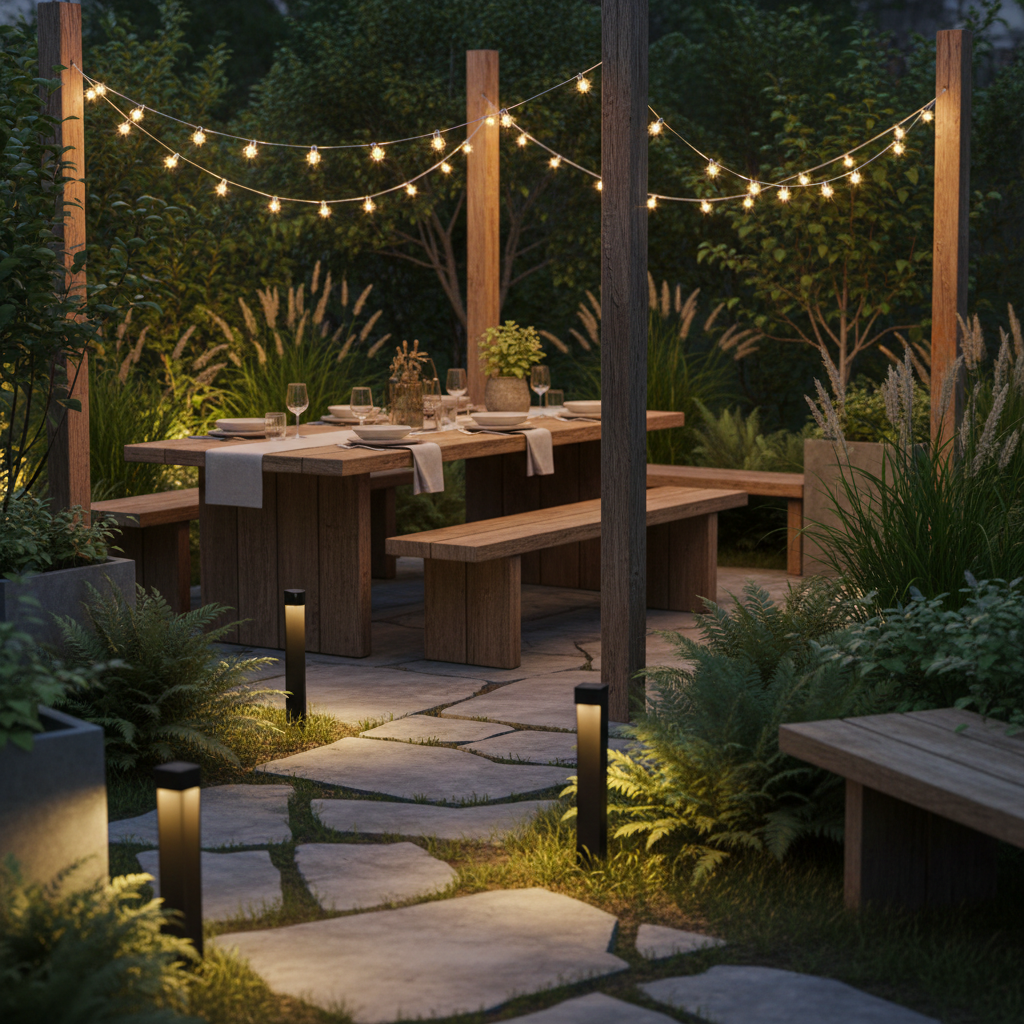
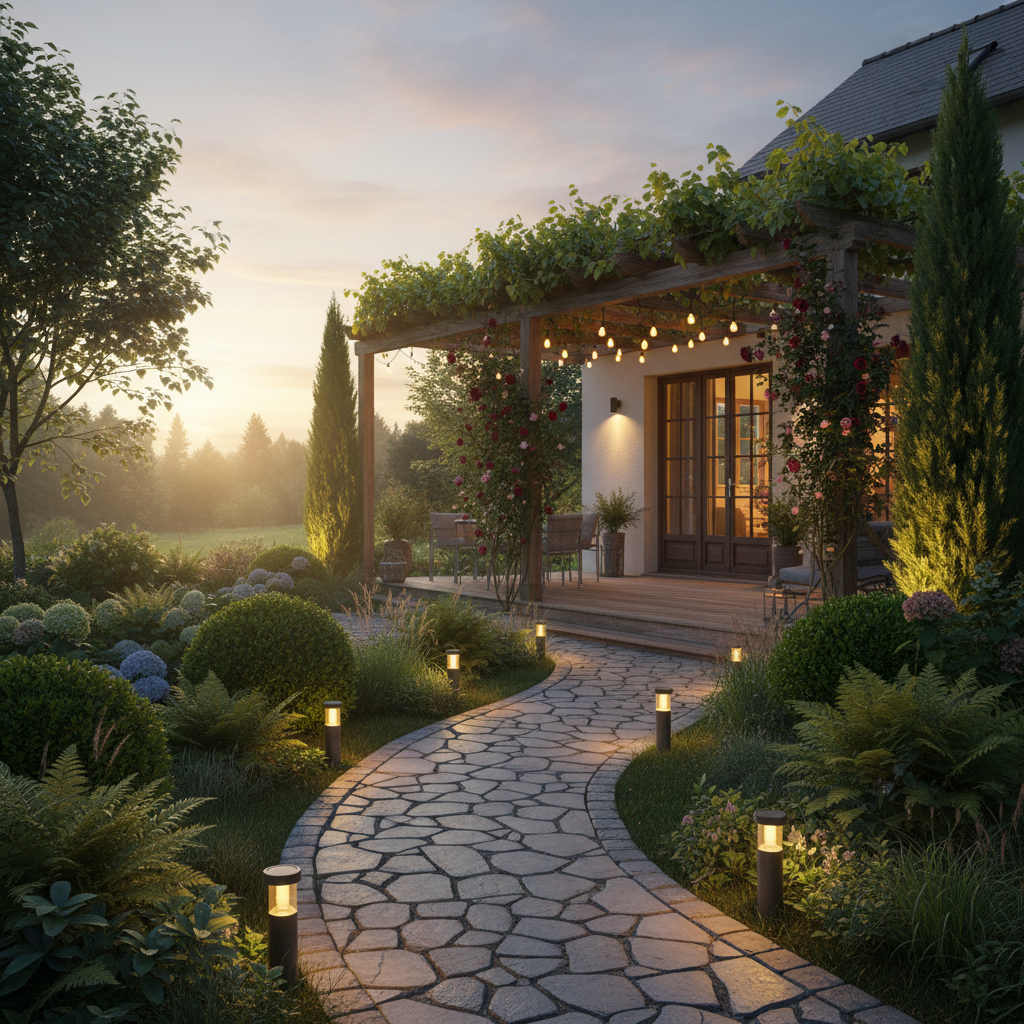
The solar post light is the most common format for marking a driveway or defining a path. It stakes into the ground, shines a soft light downwards or sideways, creating effective visual guidance without glare.
What are Solar Post Lights Best Suited For?
Solar garden post lights are perfect for:
- Marking a pedestrian path to the garage or entrance
- Defining the edges of a lawn or flower bed
- Creating luminous guidance around a pool
- Highlighting outdoor stair steps
This format is not for general illumination; it's for marking. The light output is intentionally low (often between 20 and 80 lumens, depending on the model), because the goal is to make a path visible, not to illuminate a work area. If you need to see what you're doing in your driveway, you need a different type of light.
How Many Solar Post Lights for a Driveway?
Typically, post lights are placed every 5 to 8 feet (1.5 to 2.5 meters) on each side of a path for smooth, consistent marking. For a 30-foot (10-meter) driveway, you'll need between 8 and 14 post lights, depending on the desired effect. The advantage of solar: adding an extra light costs nothing in installation, unlike a wired system where each additional light point means more cable and more work. Our guide on solar garden post lights for pathway marking helps you calculate your exact needs.
Solar Spotlights on Stakes: For Flower Beds and Trees
A solar spotlight on a stake allows you to direct a beam of light towards a specific point: a tree, a flower bed, a statue, a hedge. It's the ultimate accent lighting tool to create depth and dimension in a garden at night.
How to Properly Aim a Solar Spotlight on a Stake?
Spotlight orientation is crucial in two ways. First, the solar panel must receive maximum direct sunlight during the day: aim it south, clear of any shade (tree, gutter, wall). Second, the spotlight itself is aimed at the feature you want to highlight. Many models separate the panel and the light head, allowing you to optimize both orientations independently.
For a tree, position the spotlight 2-3 feet (60-90 cm) from the trunk and angle it upwards to create a whimsical effect through the leaves. For a low flower bed, a 30-45° angle from the ground is sufficient for natural light diffusion.
What Brightness for a Solar Garden Spotlight?
For a flower bed or decorative plant, 100 to 200 lumens are usually sufficient. To illuminate a large tree or create a more powerful light effect, aim for 300 to 600 lumens. Beyond that, you're entering the floodlight category, which has its own specific features. If you're unsure between formats, our comparison of solar garden spotlights: stake, in-ground, or wall-mounted details the practical differences.
Solar Wall Sconces: Security at Entrances and on Facades
A solar wall sconce mounted on a facade or at an entrance is probably the most useful format for security. It illuminates a passage area, can include a motion sensor, and recharges during the day. It's a great alternative to a wired sconce in many setups.
Motion Sensor or Continuous Lighting?
This is the key question for a wall sconce. In motion detection mode, the battery lasts incomparably longer than in continuous mode. For a rarely used entrance, this is clearly the choice: the light turns on when someone approaches and turns off a few seconds later. For a patio where you spend evenings outdoors, continuous mode might be necessary, but it puts more strain on the battery.
Solar lighting with motion detection deserves an article of its own, as there are many parameters to consider: sensor range, detection angle, and off-delay. It's a distinct topic if you're outfitting a security zone.
What Brightness for an Entrance or Facade?
To illuminate a porch or doorway, 400 to 800 lumens are generally sufficient. For a facade or a large area to cover, it's better to opt for a true solar floodlight. Lumic's SolarGlow delivers 1,200 lumens with two 180° motion sensors and an 26-foot (8-meter) range. Its oversized solar panel (3 times the market average) and large-capacity battery allow it to last up to 20 days without solar recharge in detection mode. It's designed for areas where light truly needs to be reliable, summer or winter, with IP65 protection against rain, snow, and frost.
Solar String Lights: Ambiance for the Patio
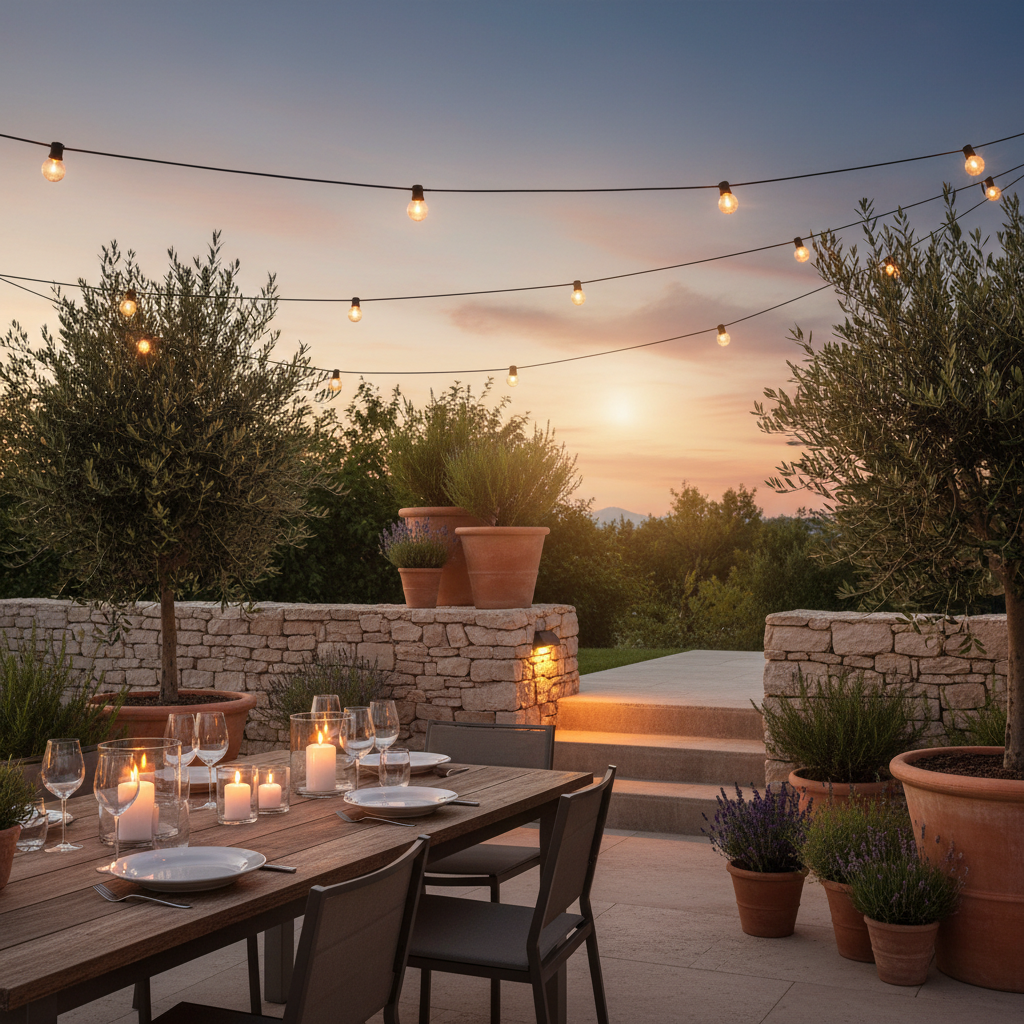
Solar LED string lights for the garden are in a category of their own. This isn't functional lighting; it's ambient lighting. They create a warm patio atmosphere, run along a pergola, fence, or between trees, and consume very little thanks to the micro-LEDs they use.
Do Solar String Lights Last All Night?
Most modern solar string lights do last all night in summer after a day of good exposure. But in fall or with cloudy skies, battery life can drop. The key criterion to check: the length of the cable separating the panel from the bulbs. A 10-16 foot (3-5 meter) cable allows you to place the panel in the sun while the bulbs hang in the shade. This is often the number one reason a string light doesn't recharge: the panel is in the shade of the pergola it's decorating.
Can Solar String Lights Be Used in Winter?
In winter, solar string lights work, but with reduced battery life. If you want reliable patio lighting year-round, it's better to choose a string light with a good-sized panel and opt for an automatic night/day mode rather than a fixed timer. In practice, many people unplug and store them from October to March to preserve the battery.
Solar In-Ground Lights: For Paved Patios
Solar in-ground lights are inserted into the ground or a patio slab to create very clean, low-level pathway lighting. Aesthetically, it's elegant. Technically, it's the most challenging format to use with solar power.
Why are Solar In-Ground Lights the Hardest to Choose?
The main problem: the solar panel integrated into the ground almost never receives enough direct light. On sunny days, the sun is high enough for the panels to capture it correctly. But in the morning, evening, or with cloudy skies, the angle is poor, and the panel captures very little. The result: on low-end models, the battery drains in two to three hours of lighting.
For this format, you absolutely must choose models with a separate panel (connected by a cable) to place the solar cell in an optimized position. All-in-one models with an integrated panel in the base should be avoided except for very light decorative use. The IP rating must be at least IP67 (short immersion) because these devices are in constant contact with ground moisture.
Summary Table: Which Format for Which Zone?
| Format | Main Use | Minimum IP | Key Consideration |
|---|---|---|---|
| Post Light | Pathway marking, driveways | IP44 | Doesn't replace true illumination |
| Stake Spotlight | Highlighting flower beds, trees | IP44 | Panel vs. spot orientation |
| Wall Sconce / Floodlight | Entrance, security, facade | IP65 | Brightness + panel size are critical |
| String Lights | Patio ambiance, pergola | IP44 | Panel often in shade |
| In-Ground Light | Paved patio, aesthetics | IP67 | Integrated panel rarely sufficient |
Common Mistakes with Solar LED Garden Lighting
Finally, here are the pitfalls most first-time buyers fall into. Avoiding them radically changes the experience.
Buying Without Checking Solar Panel Size
This is the number one mistake. Many solar lights boast impressive lumen numbers but have a microscopic panel. LEDs consume little, sure, but if the panel doesn't recharge enough on a cloudy day, the battery declines. Always check the panel surface area (in square inches/cm²) or wattage if indicated. A larger panel means a light that works in winter and on cloudy days.
Placing All Lights in the Shade
It seems obvious, but many solar lights end up under a tree or roof overhang. Six hours of direct sunlight are needed for optimal charging. Some models offer a detachable panel cable precisely to decouple the panel's position from the light's: this feature is definitely worth looking for.
Choosing the Same Format for All Garden Zones
A garden has different needs depending on the zone: security at the entrance, ambiance on the patio, pathway marking, plant highlighting. No single format meets all needs. Often, mixing two or three types of lights achieves a coherent and pleasant result. Our guide on solar garden lighting by zone gives you an overview for smart planning.
Ignoring Winter Needs
Short days and cloudy skies from November to February are the real test of a solar light. If you want functional lighting year-round (not just in summer), this is the most important selection criterion. Powerful solar lights designed for these conditions consistently have a larger battery and a more efficient panel than average. The price is often higher, but that's what makes the real difference.
In Summary: How to Choose Your Solar LED Garden Lighting
The format takes precedence over everything else. Before looking at lumen count or price, define what you want to light and for what purpose. Pathway marking? Post light. Highlighting a tree? Stake spotlight. Entrance security? Floodlight or wall sconce. Patio ambiance? String lights.
Only then, look at the solar panel. Its size is the best indicator of real performance in winter or cloudy conditions. A large-capacity battery without an adequate panel is a tank that never truly fills.
To go further on solar floodlights specifically and how to evaluate them, our article on choosing an outdoor solar floodlight will give you concrete selection criteria. And if you want a solid option without endless searching, Lumic's SolarGlow is designed precisely for uses where reliability matters: 1,200 lumens, oversized panel, IP65, 5-year warranty, and 90-day satisfaction guarantee.