What a Solar Garden Pathway Light Really Does (and Doesn't Do)
Let's start with something product descriptions never clearly tell you: a solar garden pathway light isn't for illuminating. It's for guiding. This nuance is huge, and it's the source of 90% of post-purchase disappointments.
A pathway light emits between 20 and 80 lumens. For comparison, a living room bulb is around 800 lumens. In practice, a garden pathway light produces a soft, visible glow that marks the edge of a path or outlines a flower bed. It won't replace a floodlight, you won't be able to read outdoors with it, and it won't light up a patio for dinner.
If that's what you're looking for, you need something else. But if you want to elegantly line a pathway, visually define your garden at night, or simply avoid tripping on your patio edge, solar pathway lights are exactly what you need. And they do it well, with no wires, no electrician, and no trenching your lawn.
Materials: Stainless Steel or Plastic, The Game-Changing Decision
The material of a solar pathway light directly determines its lifespan. And here, the differences are enormous.
Why Stainless Steel Wins Long-Term
A brushed stainless steel pathway light resists frost, rain, UV rays, and time. In practice, we're talking about a lifespan of around 10 years for the light's body. It won't yellow, crack, or lose its elegant appearance even after several winters. Stainless steel also has a much more refined visual appeal in a garden — it blends well with most styles, from contemporary to natural.
What Happens to Plastic Pathway Lights After 18 Months
UV-stabilized plastic lasts one or two summers. After that, it yellows from sun exposure, becomes brittle, and starts to crack. Cheap plastic pathway lights found at big box stores are often the cheapest to buy... and the most expensive in the long run, as you'll have to replace them entirely. If you see them for less than $8-$10 each and they're plastic, it's usually a reliable indicator of low quality.
Intermediate Materials: Aluminum and Resin
Anodized aluminum offers a good compromise: lightweight, corrosion-resistant, with a clean finish. High-density resin can also last if it's good quality, but it's still more susceptible to impact than metal. For ground installation with children or pets in the garden, metal remains the most robust choice.
Height and Spacing: The Two Numbers to Remember
These two parameters are often overlooked during purchase, yet they completely determine the final visual effect and functionality of your pathway lighting.
Optimal Height for Different Uses
There are two height philosophies for solar pathway lights:
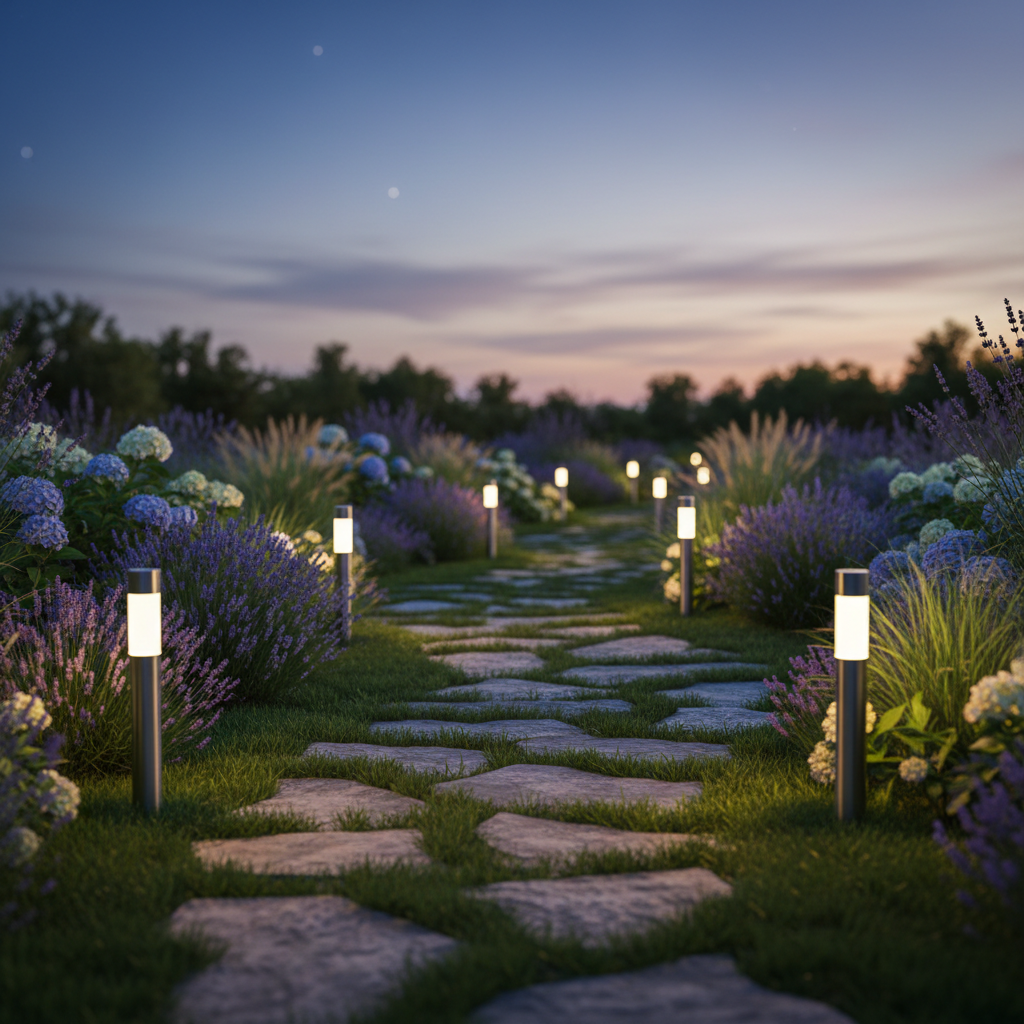
- 8 to 16 inches (20 to 40 cm): For pure pathway guidance. The light spreads towards the ground, marks the edge of the path, and remains very discreet day and night. Ideal for paved walkways, flower bed edges, or patio perimeters.
- 24 to 32 inches (60 to 80 cm): For defining a space or visually structuring a garden area. These taller lights have a more pronounced decorative effect. They are suitable for separating two areas (e.g., lawn and patio) or for bordering a wider pathway.
Recommended Spacing Between Pathway Lights
The generally accepted rule: 6 to 10 feet (2 to 3 meters) between each light for consistent illumination. Below 6 feet, the effect becomes cluttered. Beyond 10 feet, there may be dark spots between the light points, especially with less powerful models.
For a 39-foot (12-meter) pathway, plan for 4 to 6 lights per side, or 8 to 12 lights total if you want to line both sides. It's a simple calculation, but it's best to do it before buying to avoid placing multiple orders.
Concrete Example: 33-foot (10-meter) Garden Path
For a 33-foot (10-meter) path lined on both sides with 8-foot (2.5-meter) spacing: 4 lights per side, so a minimum of 8 lights. If the lights are low power (20-30 lumens), you can reduce the spacing to 6.5 feet (2 meters) for visual continuity. If they are brighter (60-80 lumens), 10 feet (3 meters) is sufficient.
Solar Stake Lights: The Common Format
The solar stake light is the most common form of garden pathway light. It stakes directly into the ground, no mounting, no tools required. In practice, you unbox them, stake them into the soil or grass, and you're done. Installation: a few seconds per unit.
This format offers several practical advantages:
- Easily repositionable for seasonal changes or landscaping adjustments.
- Compatible with all soil types (lawn, gravel, flower beds).
- No screws, no anchoring, no wires.
- Easily storable for winter if needed.
The only caveat: thin plastic stakes can bend or break if the soil is very compact. In this case, slightly pre-moisten the soil before staking, or opt for models with a reinforced metal stake. To learn more about different types of solar stake lights, our article on solar stake lights and their in-ground or wall-mounted alternatives details the options.
What Truly Differentiates Two Solar Pathway Lights
The market for solar LED pathway lights is saturated with similar-looking models. Here are the criteria that truly make a difference in use, not just on the spec sheet.
Solar Panel Size
This is probably the most important criterion. A small solar panel recharges slowly and insufficiently in winter or on cloudy days. Budget models often have a panel the size of a postage stamp, resulting in lights that barely turn on in December. Look for lights with a solar panel well-sized relative to the light body.
Battery Capacity
A battery that's too small will drain in a few hours. For fall or winter nights lasting 14 to 16 hours, you need a battery that can sustain this duration in soft diffusion mode. Good models clearly state their battery life in hours of illumination after a full charge.
Actual Waterproofing
Absolutely look for a minimum IP65 rating. This guarantees resistance to direct water jets, covering everything from heavy rain to snow. An IP44 rating is not sufficient for permanent outdoor installation.
Automatic Light Sensor
The best pathway lights automatically turn on at dusk and off at dawn. This automatic operation has become standard, but some low-end models have imprecise sensors that turn on with the slightest shadow or, conversely, don't turn on early enough in the evening. Read user reviews specifically on this point.
Solar Bollard Lights vs. Pathway Lights: What's the Difference?
The confusion between pathway lights and solar bollard lights is common and understandable. In practice, the difference lies in shape and light output.
A bollard is generally taller, more robust, and can emit a bit more light than a simple pathway light. They are primarily used to define an entrance, gate, or main driveway. They often have a more architectural appearance.
A pathway light is shorter, lighter, and designed to be multiplied in series along a path. If you want to know more about bollards specifically, we have a dedicated guide on how to choose the right solar garden bollard based on your driveway's configuration.
Solar Pathway Lights vs. Wired Lighting: Why Trenching Isn't Worth It Anymore
Before efficient solar panels, installing garden lighting inevitably involved buried cables. The process: dig a trench in the lawn, lay a shielded cable, connect to an electrical panel, and hire an electrician. All for a result that can work very well... but at a cost rarely below $1,000 to $2,000 for a proper installation on a standard driveway.
Modern solar pathway lights have made this choice difficult to justify for simple path lighting. Zero cables, zero trenches, zero electricians. The only compromise: reliance on sunlight. In winter, with less sun, some entry-level models lose performance. This is where the quality of the solar panel and battery makes a difference.
Pathway Lights and Powerful Lighting: Two Complementary Functions
There's an outdoor landscaping logic that works really well: combine soft pathway lights with motion-sensing lighting for arrival areas.
Pathway lights guide along the way. They create visual continuity, mark edges, and set the garden's ambiance. But upon arriving home, at the gate, or at the garage entrance, what you want is clear light as soon as you arrive. Not just soft guidance, but lighting that allows you to see clearly.
This is exactly where a motion-sensing floodlight like the Lumic SolarGlow comes in, with its 1,200 lumens and two 180° sensors for an 26-foot (8-meter) range. It's not a pathway light, and we're not trying to sell it as such. It's the arrival lighting, the logical complement to well-designed path lighting. Together, they cover the entire journey: from the gate to the front door, with continuity and comfort. To learn more about this type of lighting, our comparison of the best outdoor solar lights in 2026 will give you a complete overview of the options.
How to Plan Your Solar Pathway Light Installation: A Simple Method
Step 1: Measure and Calculate the Number of Lights
Start by measuring the length of the path or area to be lit. Divide by the desired spacing (6 to 10 feet / 2 to 3 meters) to get the number of lights per side. Multiply by 2 if you're lighting both sides. Add a 10% buffer if you want to fill in particularly dark areas.
Step 2: Choose the Appropriate Height
For a pathway: 8 to 16 inches (20 to 40 cm). For visual demarcation between two areas: 24 to 32 inches (60 to 80 cm). For an entrance with a more architectural effect: a bollard of 32 inches to 3 feet (80 cm to 1 meter). If your garden has multiple zones with different functions, you can mix heights, but maintain consistency within the same area.
Step 3: Check Solar Exposure
This is often the forgotten step. Before planting anything, observe the sun exposure of the area at different times of the day. A light in the shade of a hedge or tree won't recharge properly. If some points of your path are shaded, plan for lights with a larger battery capacity to compensate.
Step 4: Stake and Orient the Panels
Most solar stakes have their panel facing upwards or slightly tilted. In the US/Canada, a south-facing orientation maximizes recharging. If the lights have an adjustable panel, turn them towards the south or southwest to optimize energy collection, especially in fall and winter.
The Most Common Mistakes with Solar Pathway Lights
Here are the situations that lead to the most dissatisfaction, in order of frequency:
- Buying lights for illumination: As mentioned in the introduction, this is truly the primary cause of disappointment. If your goal is to light a patio for evening gatherings, this isn't the right solution.
- Staking under a hedge or tree: The panel doesn't receive enough sun to properly recharge the battery. Result: the lights turn off before midnight.
- Too wide spacing: With low-power lights and 13 to 16-foot (4 to 5-meter) spacing, you get isolated light points rather than consistent illumination.
- Buying solely based on price: Models costing $2 or $3 each usually don't survive two winters. The total cost over 5 years is often higher than that of a better quality model purchased once.
- Not bringing them in for winter: Some thin plastic models don't tolerate intense cold snaps well. If you opt for plastic, it's best to store them from November to March.
For a more comprehensive approach to solar garden lighting by zone, we have a guide that will help you distinguish what suits each area of your outdoor space.
Key Takeaways Before You Buy
A solar garden pathway light is a guiding tool, not an illumination tool. If you understand this from the start, you'll make the right choice. Here are the essential points:
- Aim for stainless steel or aluminum for a true lifespan (10 years vs. 1 to 2 years for low-end plastic).
- Space them 6 to 10 feet (2 to 3 meters) apart for visually consistent lighting.
- Height: 8-16 inches (20-40 cm) for guiding, 24-32 inches (60-80 cm) for demarcation.
- Check for a minimum IP65 rating for permanent installation.
- Verify solar exposure before choosing the location.
- Supplement with a motion-sensing floodlight if you want real illumination at arrival points.
With these basics, you'll avoid disappointing purchases and create an outdoor space that functions as well as it looks. And if you're still unsure which type of solar light suits your project, our guide to choosing the right outdoor solar light will help clarify things.