Looking for a powerful solar path light for your driveway, patio, or garden? You want something that truly illuminates, not just a faint decorative glow. This is where most people fall into the same trap — and end up disappointed.
Let's clarify what solar path lights can and cannot do, and how to combine the right formats for a well-lit outdoor space without breaking the bank or requiring extensive work.
Why Solar Path Lights Aren't Designed for Power
Here's the truth few manufacturers tell you: a solar path light is designed for marking paths, not functional lighting. Its primary mission is to delineate a path, highlight a border, or create an ambiance. Not to illuminate an area like a floodlight would.
How many lumens can a solar path light really produce?
In practice, most solar path lights on the market deliver between 20 and 80 lumens. Models considered "powerful" in this category reach 100 to 200 lumens. For context: a candle produces about 12 lumens. A standard desk bulb, 800 lumens.
A 150-lumen path light is enough to see where you're stepping. It's not enough to secure an entrance, illuminate a garage access, or see what's happening in your yard.
Why are path lights still limited in power?
The physics are simple. A solar path light is compact, placed on the ground, with a small solar panel facing the sky. The collection surface is small. The battery is small. Result: the energy budget available for the LED is low.
Manufacturers can play with visual perception using colored diffusers or lenses that give the impression of a brighter product. But in terms of actual light output, the limitation is physical — and hard to overcome in this format.
How to Identify a Quality Solar Path Light
If you still want path lights for your garden or driveway, choose wisely. Here are the criteria that truly differentiate a product that lasts two seasons from one you'll toss after a few months.
What criteria should you look for when choosing a quality solar path light?
The first thing to check is the IP rating. For outdoor use, you need at least IP44 (splash protection), and ideally IP65 or IP67 if the light is placed on the ground where it might receive intense rainwater or be in contact with lawn moisture.
- Battery capacity: Low-end path lights have tiny batteries. Look for information on actual battery life, not just the duration advertised under ideal conditions.
- Materials: Aluminum or stainless steel last much longer than cheap ABS plastic, which becomes brittle from UV exposure in a few summers.
- Solar panel: The collection surface and tilt angle determine efficiency in winter or on cloudy days. A panel that's too small or poorly oriented won't charge sufficiently in less sunny regions.
- Operating mode: Some path lights operate continuously all night (constant consumption), while others activate only with a motion sensor or at dusk. A motion-sensing system will preserve the battery better.
Should you be wary of lumen ratings on packaging?
Yes, always. The lumen figures on packaging often correspond to the raw lumens of the LED, not the lumens actually emitted after losses in diffusers and housing. A product advertised at 200 lumens might only emit 120 to 140 lumens into the environment. For solar path lights you're seriously considering, look for user reviews rather than relying solely on manufacturer specifications. To better understand how to read these figures, the article on the real power of outdoor solar lighting provides concrete benchmarks.
The Real Problem: Confusing Path Marking with Functional Lighting
The most common disappointment with solar path lights is expecting them to do something they're not designed for. People install four path lights along a driveway hoping they'll illuminate like a streetlamp. It doesn't work that way.
What are solar path lights really for in a garden?
Path lights have three real uses:
- Visually delineate a space: driveway, flowerbed, lawn edge, outdoor stairs. They indicate where to go, not what to look at.
- Create an atmosphere: soft, warm light that adds character to a garden in the evening. Decorative effect, not utilitarian.
- Secure pathways: prevent tripping on a step or straying off the path. For this, 50-80 lumens, well-placed, are sufficient.
If your goal is to clearly see a garage entrance, monitor an area, deter unwanted visitors, or functionally light a patio, you need a different format.
For Power, Wall-Mounted Lights Change Everything
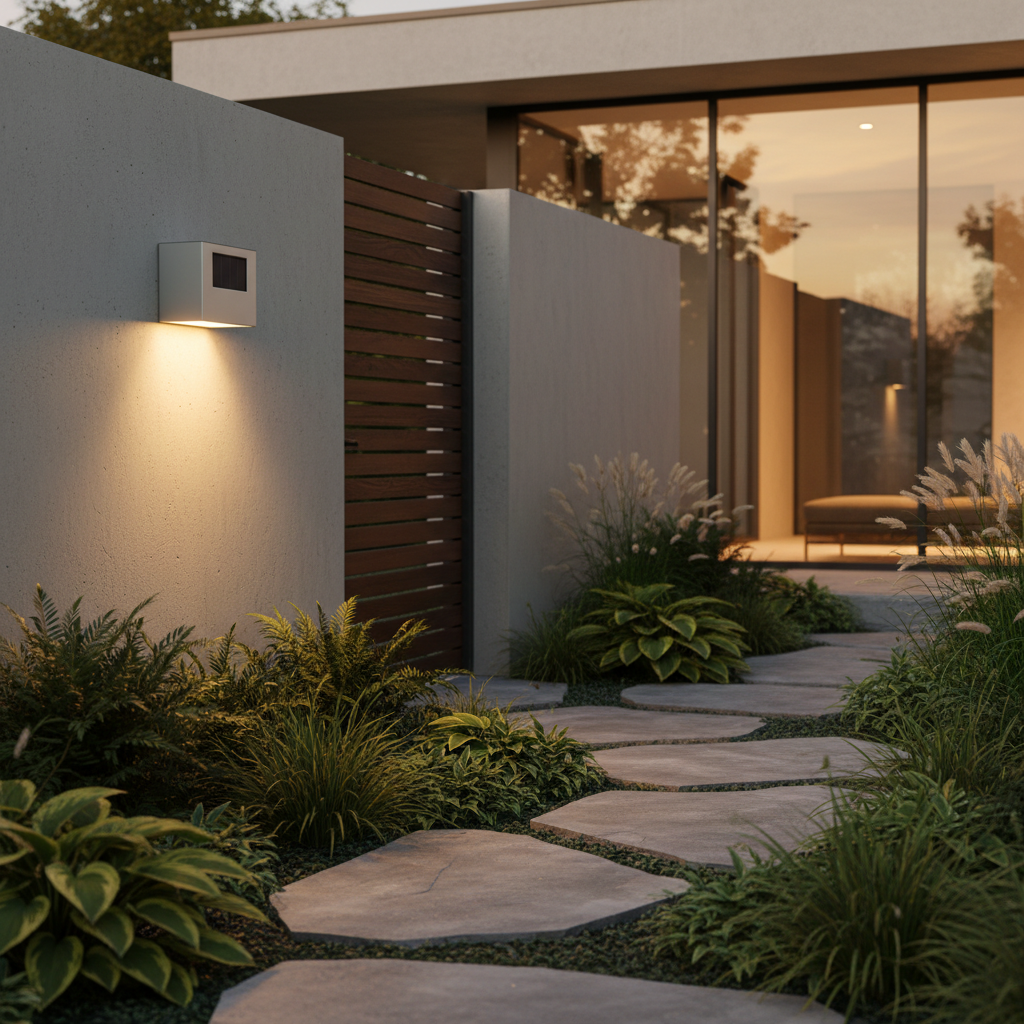
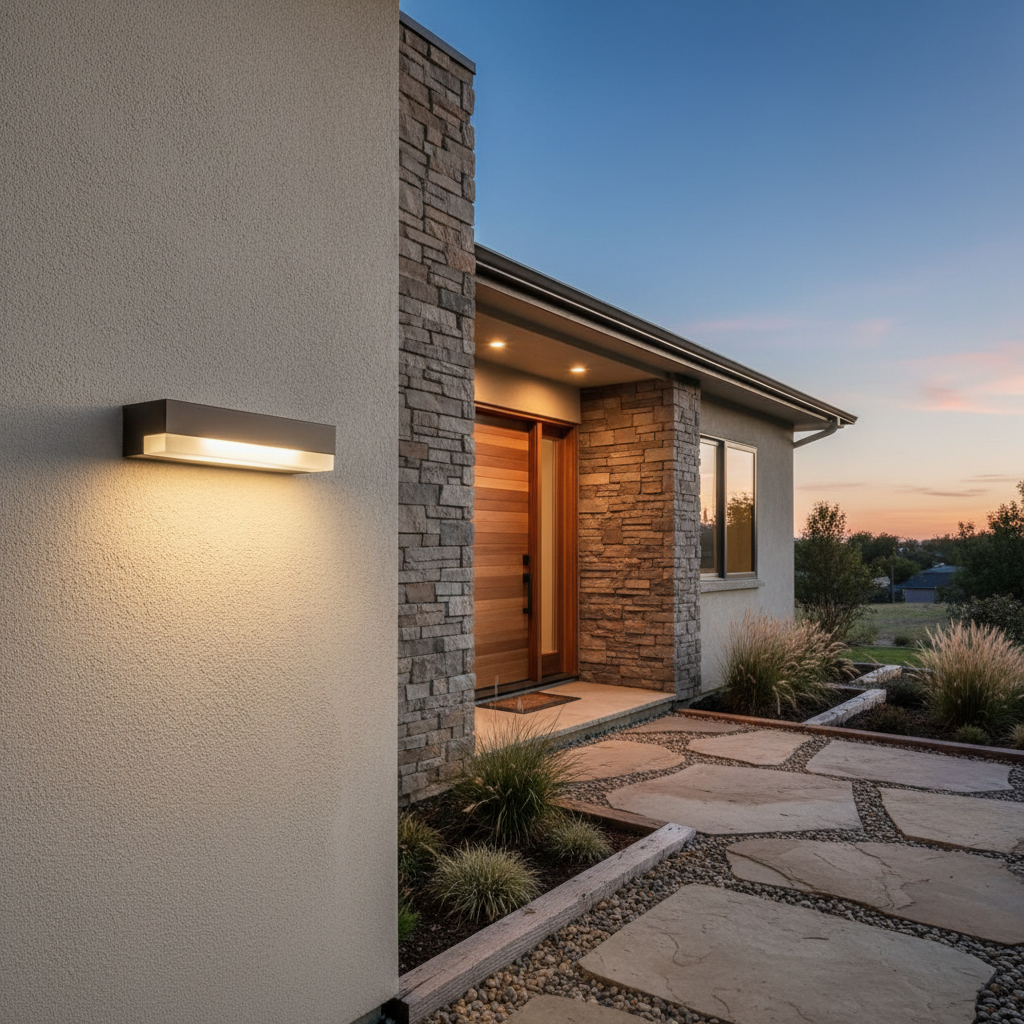
This is where we get to the real point. A solar wall light with a motion sensor can produce 800 to 1200 lumens — 6 to 12 times more than a so-called "powerful" solar path light. The difference is huge in practice.
Why are solar wall lights so much more powerful?
Because the format allows it. A solar wall light is mounted higher up, its solar panel can be optimally oriented south, and its collection surface is much larger. The battery can have a greater capacity. The LED is more powerful. And the elevated position diffuses light over a much wider area.
For areas requiring intense brightness, solar floodlights offer a serious alternative, with even higher power levels depending on the model.
Is Lumic's SolarGlow a solar path light?
No, and it's important to state this clearly. Lumic's SolarGlow is a solar wall light, not a path light. We tell you this honestly because it's a distinction that matters for your project.
It produces 1200 lumens with two 180° motion sensors and a range of about 26 feet (8 meters). It's weather-resistant (IP65), making it suitable for rain, snow, and frost. Its oversized solar panel and large-capacity battery allow it to last about 20 days without solar recharge in motion-sensing mode.
For real outdoor power, this is the format that meets the need. Not a path light.
The Winning Strategy: Combine Both Formats
The best approach for a well-lit garden or driveway is often not to choose between path lights and wall lights, but to use them together for different functions.
How to combine path lights and wall lighting for optimal results?
The most effective setup:
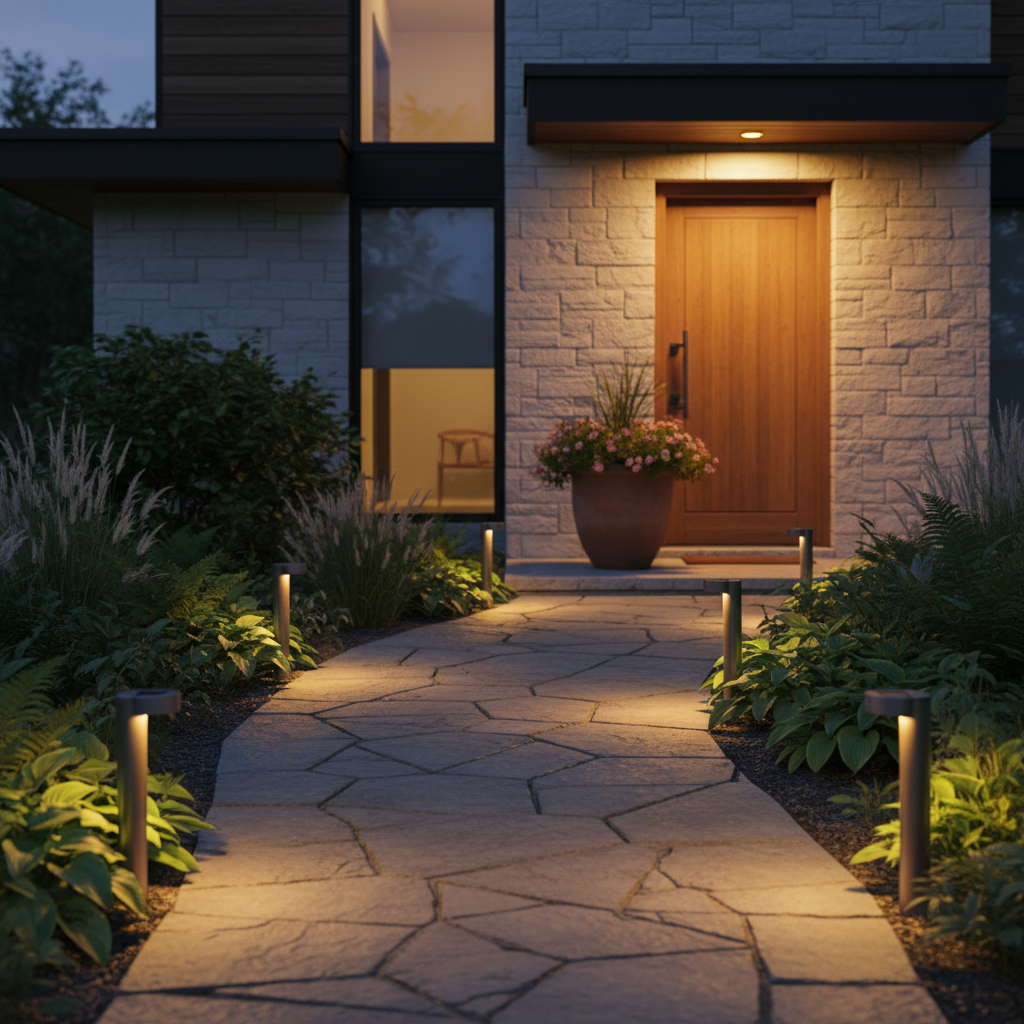
- Path lights along the walkway: every 5 to 6.5 feet (1.5 to 2 meters), they visually guide to the entrance and create a warm ambiance. 50 to 100 lumens per path light are ample for this use.
- Powerful wall light at the arrival point: mounted above the front door, gate, or garage, it activates with motion and brightly illuminates the area. This is where you need real power.
- High-mounted security lighting: on the corners of the house, one or two motion-sensing wall lights cover access areas without leaving blind spots.
This combo provides both aesthetic and functional results, without over-investing. Path lights do their decorative job, wall lights do the security job. Each in its role.
To further explore outdoor lighting organization, the guide on solar garden lighting solutions details what works best for each zone.
What's on the Market: An Honest Overview
Before buying, it's good to know what different distribution channels offer and what to expect.
| Product Type | Estimated Real Power | Durability | Indicative Price | Ideal For |
|---|---|---|---|---|
| Low-end decorative path lights (Amazon, supermarkets) | 20-50 lumens | Low (plastic, UV) | Less than $20 per pack | Ambiance only |
| Mid-range solar path lights (Home Depot, Lowe's) | 50-120 lumens | Fair (18-24 months) | $15-$40 per light | Path marking, garden |
| High-end solar path lights | 100-200 lumens | Good (aluminum, IP65+) | $40-$80 per light | Path marking + subtle ambiance |
| Solar wall lights (wall-mounted format) | 400-1200 lumens | Excellent | $30-$100 | Functional lighting, security |
This table clearly illustrates why searching for a "powerful solar path light" often leads to a dead end: the best product in this category reaches a maximum of 200 lumens, while a mid-range wall light starts at 400 lumens.
To understand how to choose the right outdoor solar light for your specific use, the dedicated guide provides practical benchmarks to avoid unpleasant surprises.
Installation and Maintenance: Key Points
Whether you choose path lights, a wall light, or both, a few installation principles make a real difference in lifespan and performance.
Where to position a solar path light for optimal performance?
The solar panel should receive at least 6 hours of direct sunlight per day in summer for optimal charging. In winter, aim for a minimum of 4 hours. This is the #1 criterion to check before choosing the location. Avoid areas shaded by trees, hedges, or buildings late in the day.
Slightly dig into the ground to stabilize path lights (especially if you have kids or a dog). A light that gets knocked over after every pass won't charge properly. For gravel driveways, weighted bases or buried fixings help maintain verticality.
How to maintain your solar path lights for longevity?
The main enemy of solar path lights isn't rain, it's dirt on the panel. A panel covered in dust, leaves, or mud significantly reduces its performance. A monthly wipe with a damp cloth on the panel is enough to maintain proper performance.
In late fall, check the seals if your model has them. Water infiltration into the housing during winter is the primary cause of failure for entry-level path lights. If your model isn't IP65, bring the lights indoors during intense frost periods.
Summary: What to Remember
Before making your choice, here are the essential points to keep in mind to avoid disappointment:
- A powerful solar path light produces a maximum of 100-200 lumens. This is sufficient for path marking, not for functional lighting.
- If you want real outdoor power, a wall-mounted fixture (wall light or floodlight) is the right answer, not a path light.
- Combining path lights (for pathways) + wall lights (for entrance/security) yields the best overall result.
- Prioritize the IP rating, material quality, and actual battery life over marketing lumen claims.
- Verify the solar exposure of the location before any purchase.
To deepen your understanding, the guide on choosing a powerful solar garden light details the criteria to weigh based on your outdoor space type and priorities.