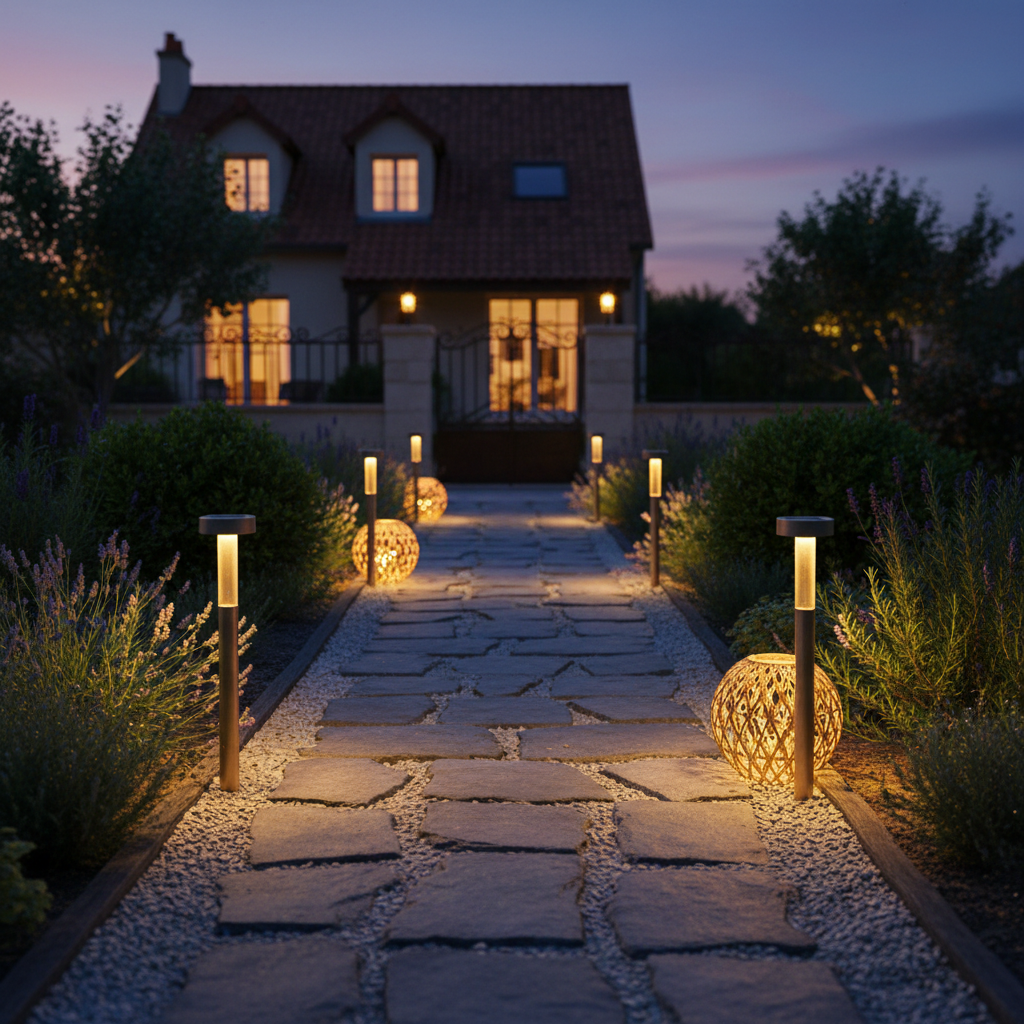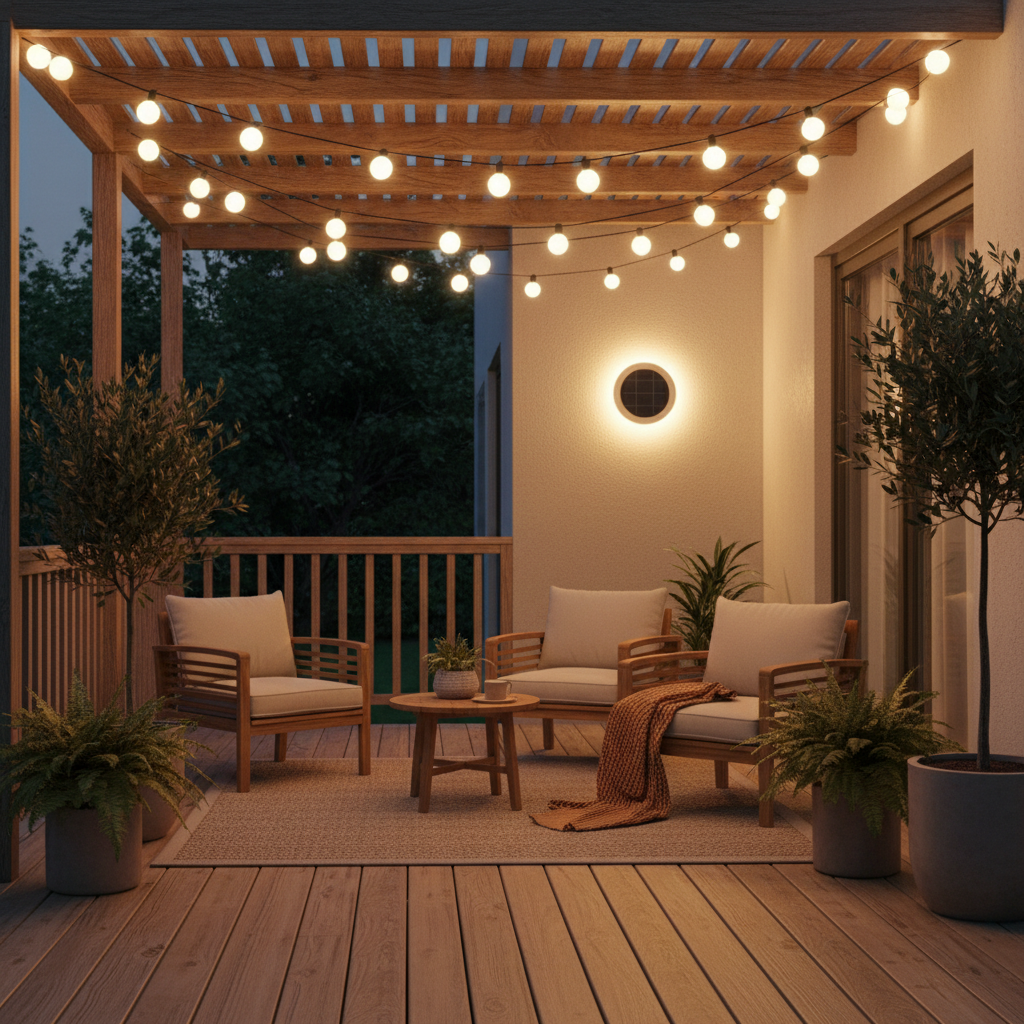
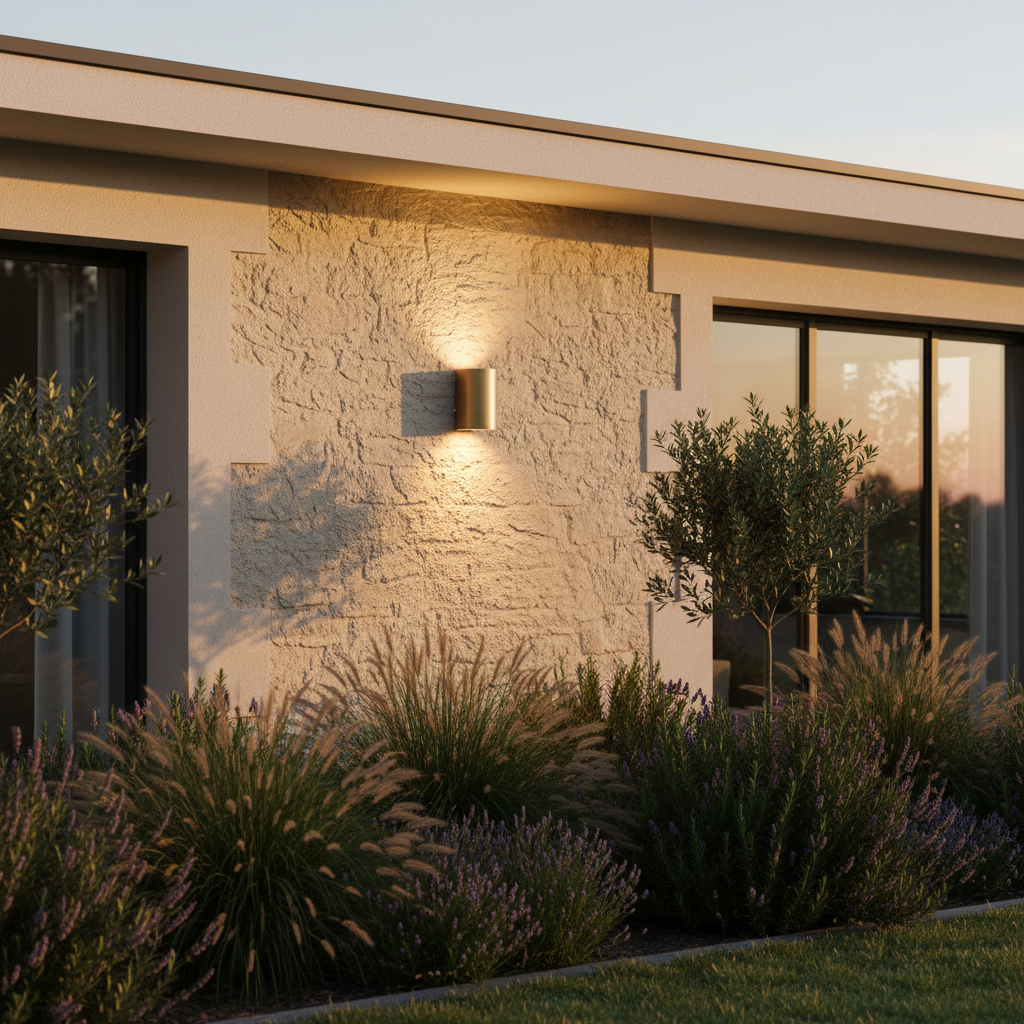
Looking to light up an outdoor wall – facade, fence, garden wall – but not sure where to start? Wall-mounted sconce? Ground spotlight aimed at the wall? Wired or solar? This guide starts with practical considerations: your wall type, what you want to highlight, and how much you want (or can) invest in installation.
Two Approaches for a Well-Lit Outdoor Wall
Before choosing a fixture, the first question is simple: do you want to light from the wall, or towards the wall?
Lighting from the Wall: Outdoor Wall Sconce
A wall sconce mounts directly onto the facade or fence. It shines downwards, sometimes upwards for a “halo” effect, and often in both directions. This is the cleanest option visually: no cables on the ground, no stakes to plant, no visible spotlight in the garden.
It’s also the most practical approach for entrances, gates, and garage doors: the light is exactly where you need it, at eye level. A sconce with a motion sensor on an entry facade is one of the best security/comfort investments you can make without major work.
The constraint? Mounting a sconce on a wall requires at least 2 to 4 screws, and if it’s wired, you need to run a cable through or along the facade. We’ll cover this in the section on materials.
Lighting Towards the Wall: Ground or Surface-Mounted Spotlight
The other approach is to place a light source in front of the wall, aimed at it. This technique highlights a stone facade, a green fence wall, or a beautiful stucco texture. The result is spectacular at night: the wall becomes an architectural feature in itself.
Here, options include ground bollards, recessed ground spotlights, or staked spotlights. The cable must run along the ground (either buried or protected), which can be a significant project if you’re connecting to the electrical grid. The solar solution is particularly relevant here: a solar spotlight with a stake, positioned 6-10 feet (2-3 meters) from the wall, aimed at the facade, and you’re set without trenching.
Which Wall Material for Which Installation?
Many guides overlook this point, yet it’s where projects often get stuck. The type of wall directly dictates the hardware needed and the complexity of installation.
Concrete or Cinder Block Wall
The easiest material to work with. A standard expansion anchor, a concrete drill bit, and the sconce will hold securely. If you want to run a cable through the wall, it’s feasible with a hammer drill — but it still requires some experience.
Old Stone Wall
This is a different story. Old stone (granite, limestone, schist) can be very hard or very brittle depending on the mortar joints. Drilling into stone without damaging the joints often requires specific tools and patience. In some cases — historic walls, soft stone, fragile mortar — it’s best to avoid drilling and opt for a solution with minimal or no deep fastening, or even 100% wireless.
This is typically where a wireless outdoor wall light makes perfect sense: industrial adhesive mounting on a clean, flat surface, zero drilling into old masonry.
Wood Wall (Siding, Fence)
Wood is easy to screw into, but you must use stainless steel or galvanized screws to prevent corrosion. Siding can also expand and contract with the seasons, which can weaken fasteners over time. Use long screws and sufficient spacing. If the fence is raw, untreated wood, consider waterproofing at the mounting point if you’re running a cable.
Stucco or Rendered Wall
Stucco is deceptive: it holds on the surface, but the fastener must reach the substrate (concrete, brick) underneath. An anchor that only grips the stucco risks failing under the weight of a sconce, especially in a windy area. Plan for long anchors suitable for the substrate type.
Wired or Solar: The Real Calculation
This question often determines everything. And the answer is less obvious than you might think.
Wired Lighting: When It’s Worth It
A wired light fixture on a facade is the most durable long-term solution. No battery to monitor, no panel to clean, consistent light regardless of the weather. If you’re building or renovating and the walls are open, it’s the perfect time to install conduit and plan for power.
However, if the walls are finished, the project becomes substantial. Running a cable through an already rendered exterior wall involves drilling, waterproofing the cable entry, installing conduit, patching, and repainting. Depending on the configuration, electricians typically charge between $200 and $400 per light point for this type of work — sometimes more depending on access complexity. This cost can quickly tip the scales.
Solar Wall Lighting: An Unbeatable Logic
An outdoor wall exposed to the sky is the ideal location for a solar lamp: the photovoltaic panel faces upwards to capture light, while the lamp shines downwards. There’s no more efficient setup for a solar lamp than this.
Mounted on the wall at the right height — typically between 6.5 and 10 feet (2 and 3 meters) — a solar sconce only needs 2 screws in the wall and proper exposure. No cables, no electrical panel modifications, no electrician. To understand the subtleties of this type of installation, our guide on outdoor solar wall lights details the selection criteria and step-by-step installation.
The nuance to keep in mind: solar depends on sunlight. In winter in less sunny regions, a low-end solar lamp with a small battery will quickly run out of power. This is where battery quality truly makes a difference.
What We Really Expect from Outdoor Wall Lighting
Before comparing products, clarify what you expect from your lighting. Uses vary greatly and require different performance levels.
Security and Deterrence
If the primary goal is to secure an entrance or access point, a motion sensor is essential. A light that turns on when someone approaches has an immediate deterrent effect, and it signals a presence without you having to monitor anything. To choose this type of device well, our guide on outdoor motion sensor lighting covers what truly matters.
For this use, light output is important: a security light must be bright enough to clearly illuminate an access area, not just indicate a presence.
Architectural Enhancement
Do you want to highlight the texture of a stone facade, the effect of a green wall, or the aesthetic of a wooden fence? In this case, light quality matters as much as intensity. Warm light (around 3000K) will reveal stone textures and create a welcoming ambiance. Cooler light will be more stark and technical — suitable for contemporary concrete or metal siding facades, less so for older materials.
Functional Pathway Lighting
Driveways, outdoor stairs, garden paths along a wall — here, the goal is simply to see where you’re walking. The light should be diffuse, glare-free, and consistent enough to avoid alternating dark and bright spots. Low-power sconces spaced every 6.5-10 feet (2-3 meters) are often more effective than a single powerful lamp.
Comparison Table: Which Solution for Which Wall?
| Situation | Recommended Solution | Installation Complexity | Cable Needed |
|---|---|---|---|
| Entrance, facade accessible to power grid | Wired sconce with sensor | Medium | Yes |
| Facade without nearby power access | Solar sconce with sensor | Low | No |
| Old stone wall or historic wall | Adhesive or no-drill solar lamp | Very Low | No |
| Nighttime architectural enhancement | Spotlight aimed at the wall | Medium to High | Depends on option |
| Wood fence, garden | Screwed solar sconce | Low | No |
| Pathway along a wall | Ground bollards or low-power sconces | Low to Medium | Depends on option |
Technical Criteria Not to Overlook
IP Rating
An outdoor light fixture must have an appropriate IP rating. For a wall exposed to weather — rain, frost, splashes — IP65 is the minimum recommended. This means the device is protected against water jets from all directions. Below this, you risk premature failure, especially in winter.
Color Temperature
Three main families: warm white (2700-3000K) for a cozy, residential ambiance; neutral white (4000K) for functional lighting without bias; cool white (5000-6000K) for a very bright but more clinical look. For a house facade or garden, warm white is generally more pleasant. For security lighting or a business entrance, neutral or cool white may be preferable.
Solar Battery Life
For a solar lamp, the battery is often the weak point. Entry-level models have small batteries that don’t perform well in winter. In practice, a solar lamp with a large battery can operate for several weeks without direct sun in detection mode — this is where manufacturing quality truly matters.
Lumic’s SolarGlow, for example, is designed to withstand this: solar panel and battery sized to last even during prolonged cloudy periods, with an IP65 rating for frost and rain. It delivers 1200 lumens with two 180° motion sensors and a range of about 26 feet (8 meters) — making it a serious option for facades and outdoor access points. 5-year warranty. To compare available options, our guide on types of outdoor solar lighting will give you a structured overview.
Installing a Sconce on an Outdoor Wall: What You Need to Know
Minimum Tools for a Clean Installation
For a standard sconce on concrete or cinder block: a drill-driver with a concrete bit suitable for anchor diameter, expansion anchors (or nylon anchors for light loads), stainless steel or treated outdoor screws, and a spirit level for straight mounting. For wood siding, self-tapping stainless steel wood screws are usually sufficient.
The Question of Waterproofing at the Mounting Point
If you’re running a cable through the wall, the cable entry must be sealed with appropriate outdoor caulk. This is a step many skip — and it can cause water infiltration into insulation or load-bearing walls. Taking the time to do this properly avoids a much more costly repair later.
Ideal Mounting Height
For an entrance or security sconce: between 6.5 and 8 feet (2 and 2.5 meters) from the ground is the standard height. High enough to illuminate a wide area, accessible enough for potential maintenance. For ambient lighting on a garden wall, you can go down to 5 feet (1.5 meters) depending on the desired effect. For a solar lamp on a wall, ensure the panel is well-exposed above obstacles (eaves, vegetation).
Budget and Return on Investment
The budget question differs depending on the chosen approach.
A decent quality wired sconce costs between $30 and $150 depending on design and features. But if you need to hire an electrician for installation — which is often the case for an already finished wall — the cost quickly adds up. Electrician hourly rates vary, but an intervention for an outdoor light point with cable routing usually represents several hours of work.
A quality solar sconce or lamp generally costs between $40 and $200. Installation is DIY in less than an hour, without special tools (other than a drill for the 2 screws). No electrician fees, no electricity consumption afterward. Over 5 years, the total cost difference can be significant.
To delve deeper into wireless options for the entire garden, our guide on wireless outdoor lighting by zone will give you a comprehensive approach.
Checklist Before Buying Your Outdoor Wall Lighting
- Wall Type: Concrete, stone, wood, stucco — each material dictates fastening.
- Electrical Access: Is a cable available nearby? Is work needed or not?
- Solar Exposure: Does the wall or immediate surroundings receive good sunlight for most of the day?
- Main Use: Security/motion, architectural enhancement, nighttime circulation?
- IP Rating: IP65 minimum for an area exposed to weather.
- Color Temperature: Warm white for ambiance, neutral for functionality.
- Total Budget: Include installation cost, not just the product.
Lighting an outdoor wall isn’t a complex project — but it’s one where bad choices are costly: poor fastening on fragile stone, wrong IP for an exposed facade, incorrect solar panel orientation. Taking the time to ask the right questions upfront avoids reinstallation six months later.