Ever bought a solar light that died after the first cloudy fall day? Or a "1000 lumen" model that barely lights your doorstep? This is a common experience with entry-level outdoor solar lights. Not because solar doesn't work, but because key figures are often hidden or exaggerated in product descriptions.
This guide explains exactly what to look for to make the right choice, no matter your use: driveway, patio, gate, garden. We'll start with the three numbers that separate a good solar light from a bad one, then move on to product types.
The 3 Numbers That Make All the Difference
Before you even look at a product, memorize these three criteria. They are the only ones that truly matter when comparing outdoor solar lights.
1 — Real Lumens, Not Marketing Lumens
The number on the box and the actual brightness you'll get in your driveway are often very different. Many manufacturers list peak theoretical lumens, measured in ideal lab conditions with a full battery and LEDs at 100%. In practice, with a half-charged battery and normal viewing angles, you often get two to three times less.
As a benchmark: 300-500 real lumens are enough to mark a path. 800-1000 real lumens will comfortably illuminate an entrance or patio. Below 200 real lumens, it's a marker light, not functional lighting.
How to spot the difference? Look for customer reviews that discuss brightness in real-world conditions, not just manufacturer specs.
2 — Solar Panel Surface Area (in sq inches)
This is the most overlooked criterion, yet it determines if your light will survive a cloudy November. The larger the panel, the more energy it captures, even on overcast days. A tiny panel will quickly saturate on sunny days but collect almost nothing in fall or winter.
The problem: manufacturers often don't specify the surface area in square inches. But you can see it in product photos. A light with a tiny 2-inch (5 cm) integrated panel will never work correctly in winter in northern climates. For powerful and reliable garden solar lighting, panel surface area is the number one criterion.
3 — Battery Capacity in mAh
The battery determines how many days your light can function without solar recharging. In mid-summer, this isn't an issue. But between October and March, you can easily have 4 to 6 consecutive days without enough sun to recharge. If your battery is 600 mAh, it will last 2-3 days max. With 3000-4000 mAh, you get 2-3 weeks of autonomy in motion detection mode.
This figure explains why cheap solar lights die in winter: the battery is too small to buffer sunless days.
Different Types of Outdoor Solar Lights
There isn't just one type of solar light. Each format serves a specific purpose. Here are the main ones.
Solar Wall Sconces
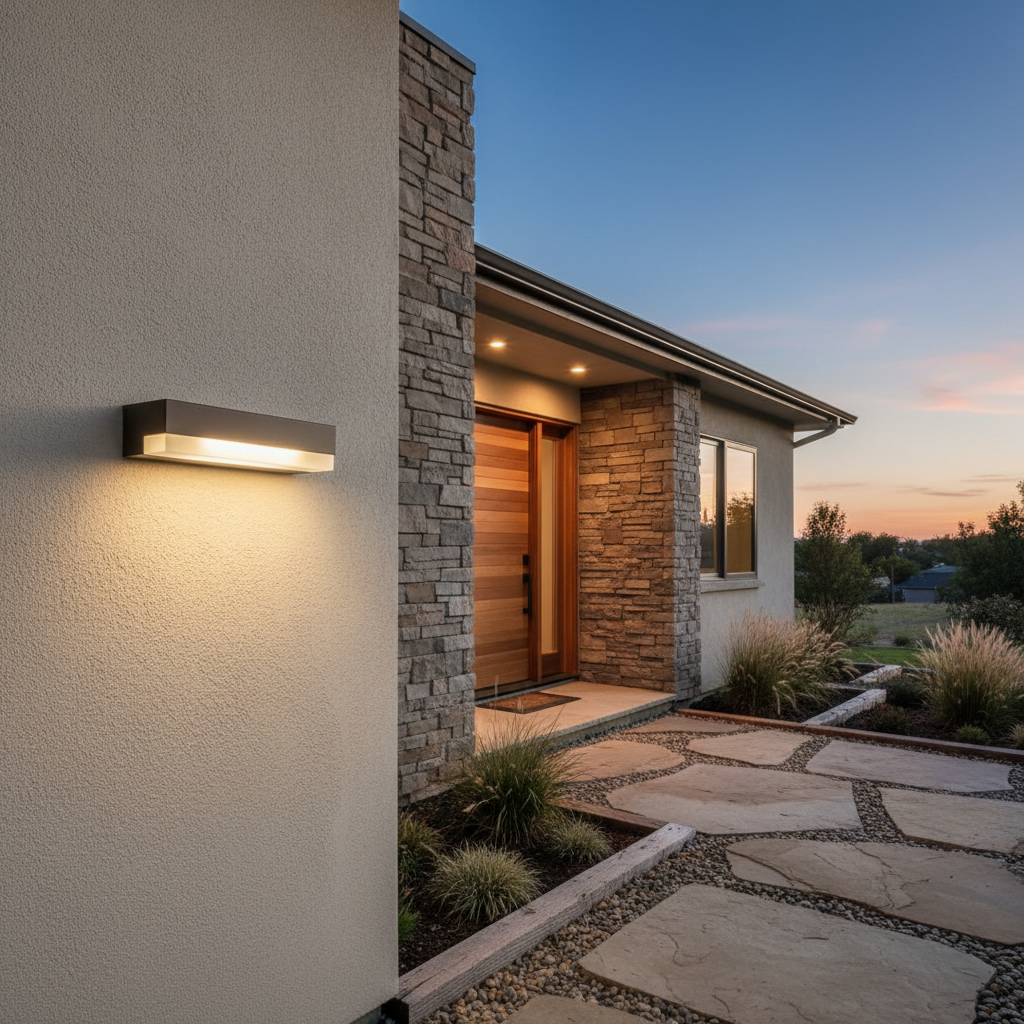
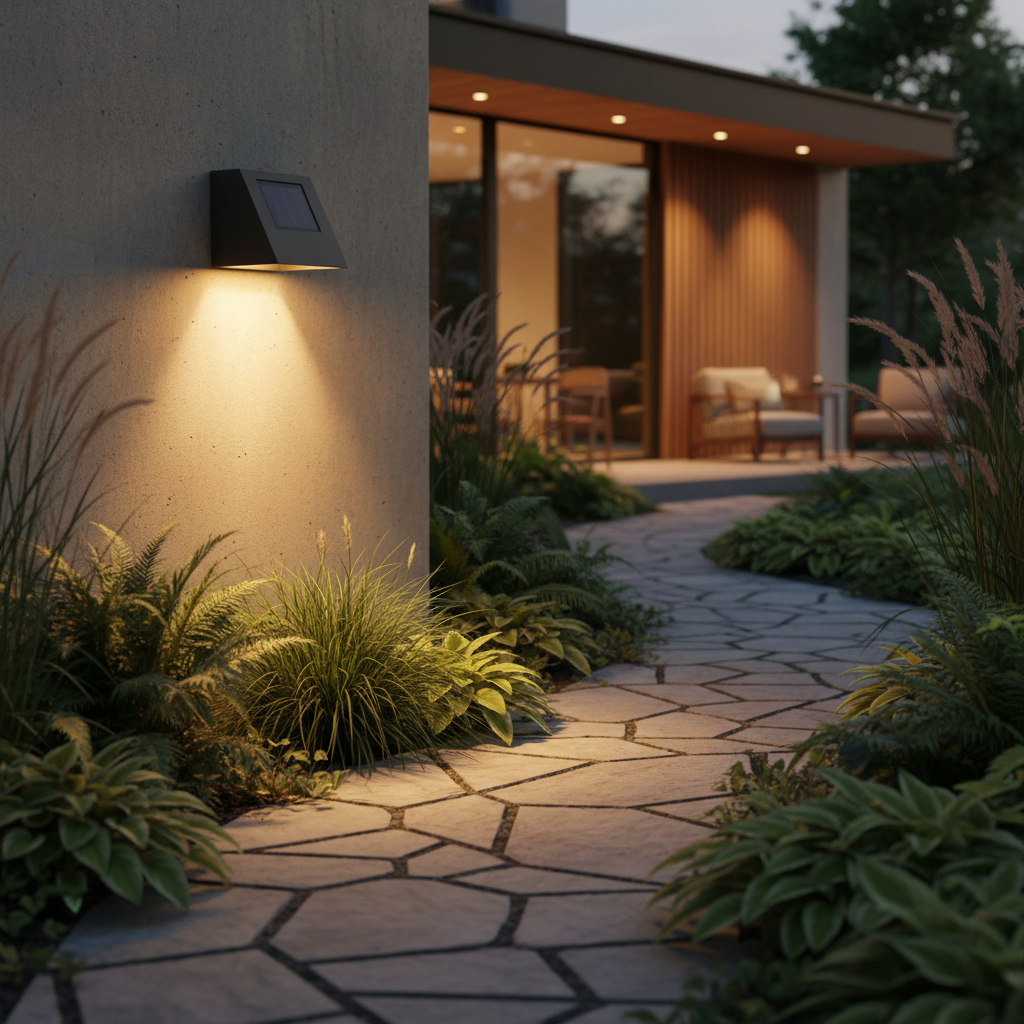
The wall sconce is the most classic form for lighting an entrance, gate, or garage. It mounts on a wall, post, or facade. Its main advantage: it's discreet, integrated into your home's architecture, and the solar panel is often built directly into the light fixture.
Its drawback: if your wall is shaded part of the day (north-facing facade, wall behind trees), the panel collects little energy. Some models offer a remote panel connected by cable, allowing you to place the light on the facade and the panel in the sun. For all aspects of selection and installation, our article on outdoor solar wall lights details the points to check.
Solar Floodlights
A solar floodlight is designed to illuminate a specific surface or area: a garage entrance, a tree, a fence wall. It directs a focused beam rather than diffused light. This type generally offers the highest light output (800 to 2000 advertised lumens).
Beware: this is also the type most prone to inflated lumen claims. A low-end "2000 lumen" floodlight often delivers only 300-400 lumens in real-world use. If you're looking for a truly powerful solar floodlight, the panel and battery criteria are even more critical than for other formats.
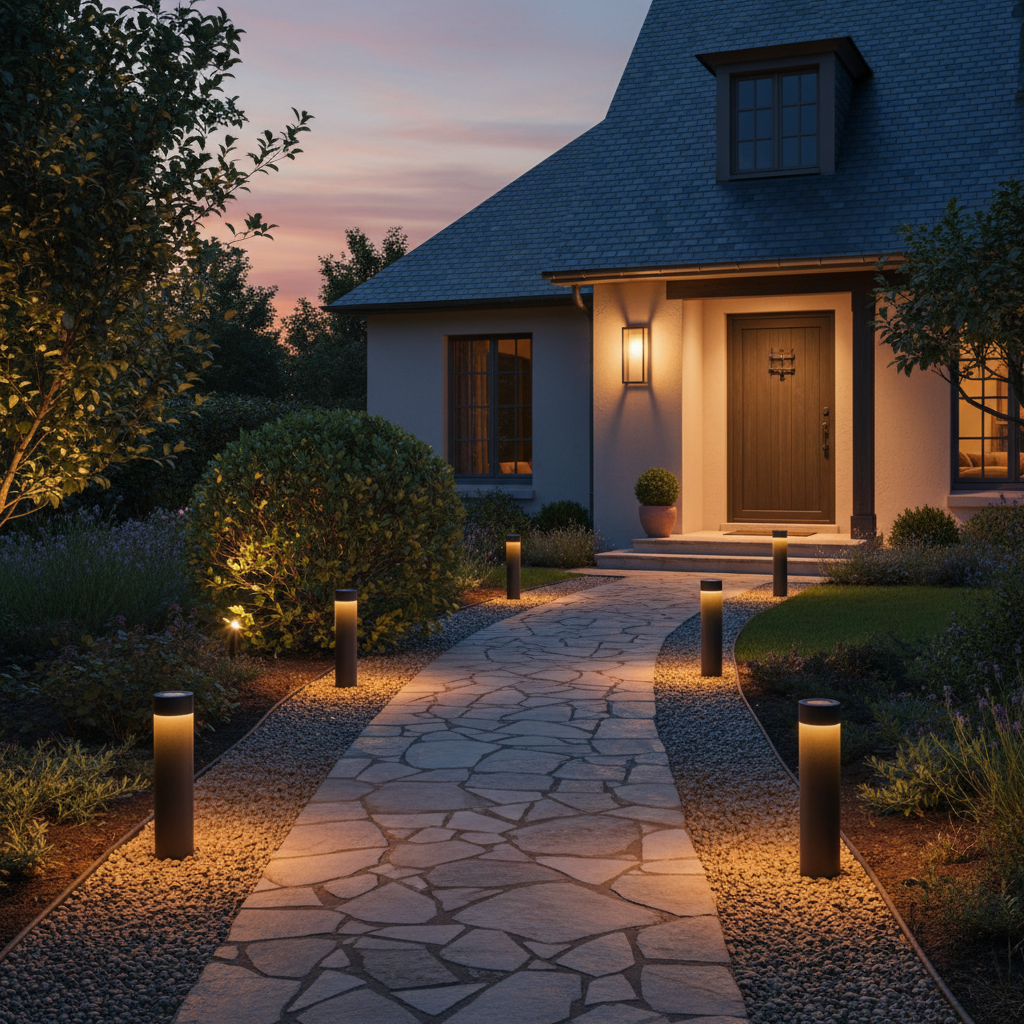
Garden Spots and Bollards
Solar spots are staked directly into the ground to mark a path, highlight a border, or accent plantings. Garden bollards are their taller version, often with a shade to diffuse a wider light.
These two formats generally require less light output: the goal is to create ambiance or mark, not to provide functional lighting. But the same battery rules apply: a garden spot with a 400 mAh battery will be dead by November.
Solar Motion Sensor Lights
This category offers the best battery life. Instead of staying on all night, the light only activates when someone passes by. Result: the battery lasts much longer because the LED is only on 5-10% of the time. It's also the most useful for security: a visitor arriving is met with a bright light rather than darkness or a permanent nightlight.
If you want to delve deeper before buying, our guide on motion sensor solar lighting covers settings, range, and pitfalls to avoid.
Where to Install Your Solar Light: Practical Questions
Does a solar light work without direct sunlight?
Yes, provided the panel is large enough. Modern solar panels capture energy even under cloudy skies: about 10-30% of their capacity compared to direct sunlight. This is why the panel surface area in square inches is the key criterion for climates like the northern US/Canada or for partially shaded locations.
A panel that's too small will never make up for the charging deficit during a cloudy week. A larger panel will accumulate enough diffuse energy to keep the battery charged. The direct consequence: a light with a large panel works in fall and winter, where low-end models die out by September.
Should the solar panel face due south?
The ideal orientation is due south, tilted at 30-45° from horizontal, to maximize solar capture. But in practice, a southeast or southwest orientation with a reasonable angle remains very effective. The problem starts when the panel faces due north, or when it's shaded by a tree or roof overhang for a large part of the day.
Before buying, observe the intended location at different times of day. If the panel will be in the shade between 10 AM and 3 PM (the most productive hours), a light with a remote panel will be more suitable.
How do I know if the installation is weather-resistant?
Look for the IP rating. For standard outdoor use (rain, snow, frost), the minimum useful rating is IP65. This means the device is protected against water jets from all directions. IP44 is insufficient for year-round outdoor use. IP67 or IP68 offer even more protection (short immersion), but are rarely necessary for a garden light.
Lights without an advertised IP rating or with only IP44 should be avoided if you plan to leave them outdoors all year.
Why Cheap Solar Lights Disappoint
The scenario is always the same: bought in summer, works perfectly for 3 months, and as soon as days shorten and clouds arrive, the light becomes useless. Sometimes it stops charging altogether after the first winter.
The reason is consistently a combination of two problems:
- Battery too small to buffer days without solar recharge
- Panel too small to collect diffuse energy on gray days
The cost of a quality solar light is a fraction of the price of an electrician to run an outdoor lighting cable, which typically ranges from $400 to $800 depending on length and configuration. This puts things in perspective when you're choosing between a $15 model and a $60-$80 model.
For everything concerning battery life and technologies used, our article on solar light autonomy and battery explains in detail why some last 5 years and others fail in 18 months.
Motion Sensor Solar Lights: The SolarGlow
If you're looking for an outdoor solar light with a motion sensor that checks all three boxes mentioned earlier, the SolarGlow by Lumic deserves special attention.
Here are the concrete figures: 1200 lumens, a solar panel 3 times larger than comparable alternatives, and a battery 4 times larger (which translates to 20 days of autonomy without sun in detection mode). It features two motion sensors with 180° coverage and a range of about 26 feet (8 meters), is resistant to rain, snow, and frost (IP65), and installs without cables or drilling.
Revisiting the three initial criteria: high real lumens, large panel, large battery. The SolarGlow passes all three. You be the judge, not us.
It comes with a 5-year warranty and a 90-day satisfaction guarantee. Customer support is based in the US with a response within 24 hours.
Comparative Table of Outdoor Solar Light Types
| Type | Ideal Use | Useful Lumens | Installation | Winter Autonomy |
|---|---|---|---|---|
| Wall Sconce | Entrance, gate, facade | 300-800 lumens | Simple wall mounting | Varies by battery |
| Floodlight | Garage, directional lighting | 500-1200 real lumens | Mounting + aiming | Better with large panel |
| Garden Spot / Bollard | Paths, marking, ambiance | 50-300 lumens | Stake into ground | Low (small battery) |
| Motion Sensor | Security, entrance, patio | 600-1200 lumens | Wall, post, no cable | Excellent (LED rarely on) |
Frequently Asked Questions About Outdoor Solar Lights
Do outdoor solar lights really work in winter in the US/Canada?
It depends on the model, not the technology. Lights with a large solar panel and a large battery work in winter: they capture diffuse energy on gray days and store enough to last through sunless days. Lights with a mini-panel and 400-600 mAh battery will die by November. This is the difference between a good and a bad product, not between solar and wired. If you want to know more, our guide on solar lights that work in winter covers this in detail.
How many lumens are needed to light a patio or driveway?
To mark a path or create ambiance in a garden, 200-400 real lumens are sufficient. For functional lighting of a patio or entrance (reading, cooking outdoors, seeing what you're doing), you need at least 600-800 real lumens. For securing a large area (garage, yard), aim for 1000 real lumens or more. Reminder: the manufacturer's figure is often 2 to 3 times higher than the actual usable light output.
How to choose between a solar light with a motion sensor and one without?
A motion sensor light is generally better for two reasons: it lasts much longer on battery (the LED is only on 5-10% of the time) and it's more useful for security (the sudden light signals a presence). A light without a sensor is better for decorative ambiance or permanent path marking. If your goal is functional (entrance, garage, gate), the motion sensor is almost always the right choice.
Does a solar light require electrical installation?
No. That's the whole point of solar: no cables, no electrical connections, no electrician. The light charges via the solar panel and stores energy in its integrated battery. Installation simply involves mounting the light (screws, adhesive, or stake depending on the model) and orienting the panel south. This can be done in under 15 minutes in most cases, without special tools.
How long does the battery of an outdoor solar light last?
In motion detection mode, a good solar light with a large capacity battery can last between 2 and 4 weeks without solar recharge. In continuous all-night lighting mode, the same battery will last between 1 and 3 nights depending on brightness. This is why detection mode is recommended to maximize battery life. Battery capacity in mAh is the figure to look at when comparing products.
In Summary: Key Takeaways
Choosing an outdoor solar light that lasts and actually works comes down to 3 criteria: real lumens (not marketing), a solar panel large enough for gray days, and a battery large enough for sunless days. Everything else is secondary.
The type of light (sconce, floodlight, spot, sensor) depends on your use. But no format will save you if these 3 fundamentals aren't up to par.
If you want to compare the best options on the market side-by-side before deciding, our best outdoor solar light comparison gives you a complete overview of available models with their true characteristics.