Outdoor Pool Lighting: Two Zones, Two Approaches
A poorly lit pool at night is both a fall hazard on wet surfaces and a missed opportunity for summer evening ambiance. But before you buy anything, there's a fundamental distinction to understand: lighting in the water and lighting around the water have different constraints, equipment, and budgets.
This guide provides concrete information to help you choose wisely, without overpaying, and most importantly, without electrical risk in an area where water and electricity meet daily.
In-Pool Lighting: Wired, Mandatory, Complex
Submerged lights inside the pool are subject to strict safety standards. This is not an area for improvisation.
Why Can't Submerged Lighting Be Installed Without an Electrician?
US electrical codes (like the NEC) define safety zones around pools. In the zone closest to the water, only specific extra-low voltage (ELV 12V) equipment or certain 230V equipment with enhanced protection is permitted. Installation must be performed by a qualified professional.
Specifically, this involves:
- An isolation transformer (for 12V systems)
- Sheathed cables resistant to moisture and chemicals (chlorine, salt)
- Lights certified IP68 minimum (total and prolonged immersion)
- Rigorous grounding of the entire installation
What's the Budget for Submerged Lights?
Interior pool lighting is a significant investment. In practice, between materials (IP68 submerged LED lights, cabling, transformer) and the labor of a qualified electrician, budgets typically range from $500 to $2,000 depending on pool size and the number of desired light points. For a standard-sized pool with 4 to 6 lights, expect the higher end of that range.
This is an expense to anticipate during construction or a major renovation, not something you add at the end of the season.
LED Submerged Lights: What to Check
Not all lights are created equal. Key criteria to check:
- IP68 mandatory: Resistance to permanent immersion.
- Compatibility with chlorinated or saltwater, depending on your pool type.
- LED technology (lower consumption than halogen, longer lifespan).
- Color-changing (RGB) options if you want to vary the ambiance.
In this segment, specialized pool lighting brands (Hayward, Pentair, Astral) are the benchmarks. Generic alternatives should be avoided for immersion: a failure in the water poses a real risk.
Surrounding Area Lighting: Where Solar Changes Everything
Poolside areas are a different story. Decks, coping, walkways, adjacent patios: here, the goal is twofold. Ensure safe movement at night (wet surfaces around a pool are particularly slippery) and create an inviting ambiance for evening enjoyment.
And it's precisely around the pool that solar lighting makes perfect sense.
Why Avoid Electrical Cables on the Ground Around a Pool?
Running electrical cables in an area regularly wet and frequented by bare feet is a high-risk combination. Even with a compliant installation, a damaged sheath, a poorly protected connector, or temporary flooding of the cable conduit can create a dangerous situation.
Solar eliminates this risk at the source: no cables, no connection to the electrical grid, zero risk of water-related short circuits. It's the most suitable solution for an outdoor area that is inherently wet.
To delve deeper into the differences between wired and solar solutions with motion sensors, our article on motion sensor lighting explains the advantages of each approach depending on the context.
IP65 Minimum: The Non-Negotiable Standard
For any outdoor lighting near a pool, IP65 certification is the absolute minimum. It guarantees:
- IP6: Total protection against dust.
- IP5: Resistance to water jets under pressure (splashes, rain, irrigation).
Low-end products sold as "outdoor" with IP44 or IP54 ratings are not suitable for use near a pool. They last one season, then the internal LED fails due to moisture infiltration.
The Cost of a Traditional Electrical Installation for Pool Surrounds
If you're considering wired lighting for the surrounds (pathway bollards, recessed deck lights, fence sconces), the cost for an electrician to perform a complete installation with trenches, buried cabling, and panel connection typically ranges from $1,000 to $3,000, depending on the area and number of light points. This doesn't include excavation work if cables need to run under concrete.
Solar completely eliminates this installation cost.
What Types of Solar Lighting for Pool Surrounds?
Several formats are suitable for pool surrounds. The choice primarily depends on the desired effect and your space's configuration.
Solar Bollard Lights for Walkways and Decks
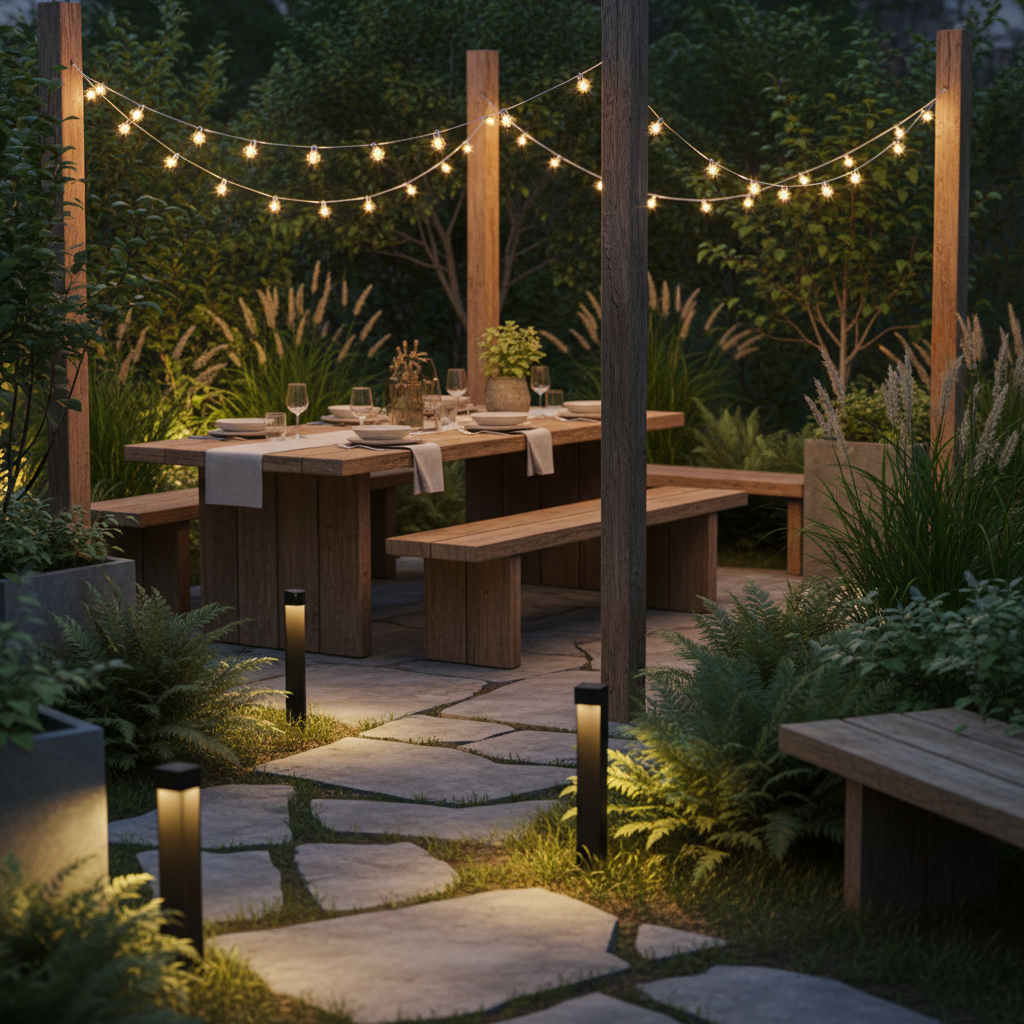
Solar bollard lights can be staked or screwed into the ground. They emit a soft, downward light, ideal for marking the pool perimeter and guiding movement at night. Their height (typically 12 to 32 inches) places them exactly where needed: at foot level, in risky areas.
They work well for concrete decks, wide coping, or pathways leading to the pool. Premium versions offer a refined aesthetic and blend discreetly into the landscaping.
Recessed or Ground Solar Spotlights
Outdoor solar spotlights sit flush on the patio or recess into the deck. They create a very elegant grazing effect and highlight the deck materials (wood, stone, tile).
A point of attention: some models have their solar panel integrated directly into the light. In this case, sun exposure depends on the light's location. Ensure the area gets good sun exposure for most of the day. Other models have a remote panel, offering more installation flexibility.
Solar Wall Sconces and Floodlights for Fences and Patios
If your pool is surrounded by a fence, wall, or hedge, solar wall sconces are perfectly suited. Mounted higher up, they illuminate the surrounds from above, providing a more traditional lighting feel.
Solar floodlights with motion sensors are particularly useful for security: they light up as soon as someone approaches the pool at night, signaling presence and deterring intruders. To learn more about choosing such a device, our article on choosing a solar motion sensor covers important criteria.
Create a True Pool Ambiance with Outdoor Solar Lighting
Perimeter lighting isn't just for avoiding trips. Well-designed, it completely transforms the atmosphere of a pool party.
What Color Temperature to Choose for a Successful Pool Ambiance?
This is a question many underestimate. Light color temperature radically changes the perceived ambiance:
- Warm white (2700-3000K): Golden light, cozy ambiance, ideal for relaxed evenings. This is the number one choice for patios and pool surrounds focused on conviviality.
- Neutral white (4000K): Brighter light, good visibility, suitable for pathways or service areas (barbecue, outdoor countertop).
- Cool white (6000K): Bluish light, "spotlight" effect, less suitable for evening ambiance but useful for perimeter security.
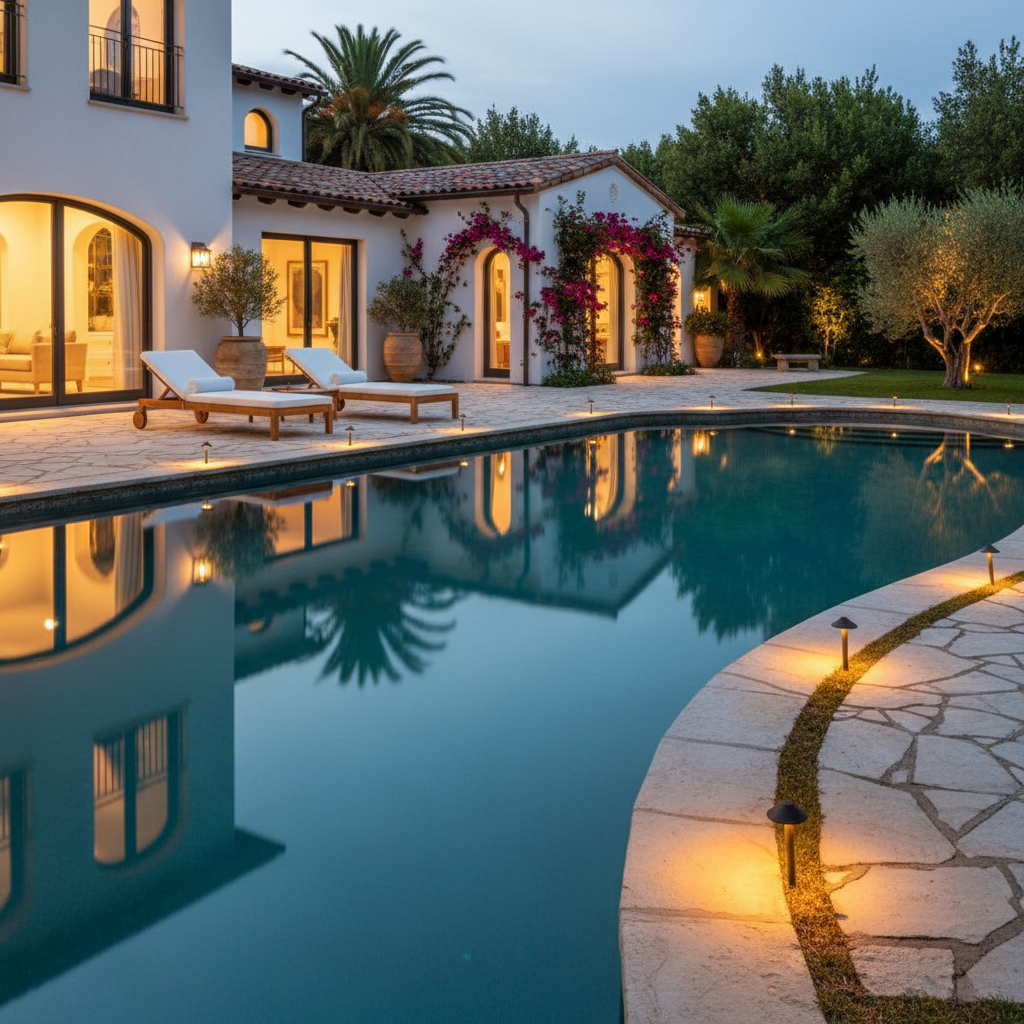
For a pool, warm white on the immediate surrounds creates a pleasant contrast with the water's reflection, significantly enhancing evening quality.
How to Place Lights for a Beautiful Effect Around the Pool?
Some practical rules that make a difference:
- Don't just light from above: A single overhead floodlight creates harsh shadows and a flat look. The ideal is a combination of low sources (bollards, ground lights) and high sources (sconces, string lights on a pergola).
- Mark the pool perimeter without glare: Lights should guide the eye to the edges, not blind those in the water.
- Highlight vegetation with a few spotlights aimed at flowerbeds or hedges: this adds depth to the space.
- Plan for shaded areas: A uniformly lit patio feels like a parking lot. Light contrasts create volume.
What You Need to Know Before Buying Solar Lighting for Pool Surrounds
Not all "solar lighting" is equal. The difference between a product that lasts three seasons and one that fails after eight months often comes down to a few details.
The Internal Battery: The Game-Changer at Season's End
Low-end solar lights have small capacity batteries. Result: by late autumn (less sunlight), they barely light up for an hour and turn off long before your evening is over. A generous battery guarantees illumination throughout the night, even when the sun hasn't been out all day.
This is one of the points that truly differentiates products in this market. To go further, our article on powerful outdoor solar lights details the criteria that make a practical difference.
The Solar Panel: Surface Area and Orientation
A solar panel that's too small won't sufficiently recharge the battery on a normal day (clouds, partial shade). On premium models, the panel is significantly larger than on entry-level alternatives, directly translating to better autonomy.
Orientation is also critical: a solar panel facing north will almost never recharge properly. If the installation area has limited exposure, orient the panel separately if the model allows.
Lumic's SolarGlow: An Option for Pool Surrounds
For pool surrounds, the SolarGlow is an IP65 solar floodlight with two motion sensors covering 180° each, a range of about 26 feet (8 meters), and 1200 lumens of illumination. It operates completely wirelessly, installs in minutes, and is resistant to rain, snow, and frost (IP65).
Its battery allows it to last approximately 20 days without solar recharge in detection mode, which is useful during cloudy spring or fall periods when the pool season begins or ends. It comes with a 5-year warranty and a 90-day satisfaction guarantee.
Important: The SolarGlow is designed for surrounds, walkways, fences, and patios. It is not submersible equipment and does not replace internal pool lights.
For a complete overview of available options, our complete guide to solar pool lighting details different possible configurations based on pool type and desired layout.
Outdoor Pool Lighting: Quick Decision Summary
If you take one thing away from this guide, it's the distinction between these two zones:
| Zone | Adapted Technology | Minimum Standard | Installation | Estimated Budget |
|---|---|---|---|---|
| In-pool (submerged) | Wired LED lights ELV or 230V pool standard | IP68 | Qualified electrician mandatory | $500 to $2,000+ |
| Surrounds, deck, walkways | Bollards, solar lights, sconces (wired or solar) | IP65 minimum | Solar: wireless, DIY | Wired: $1,000-$3,000 / Solar: no installation cost |
The two zones require different approaches. For surrounds, solar is not only more economical to install but also better suited for an area regularly in contact with water. For the inside of the pool, always use a professional.
If you want to compare the different formats of solar outdoor lights available before deciding, our general guide to outdoor solar lighting lists options by use and configuration.