Looking for an outdoor motion sensor light but unsure whether to go wired or solar? This question deserves a deep dive. These two options operate very differently, and there's one crucial factor almost no one mentions when choosing.
This guide compares both solutions point-by-point: installation, battery life, brightness, and that rarely discussed reliability factor. Whether you're a homeowner or a renter, you'll find everything you need to make the right choice.
What an Outdoor Motion Sensor Really Does
An outdoor motion sensor works on a simple principle: it detects heat emitted by moving bodies (PIR technology, passive infrared) and triggers the light accordingly. But there's a huge difference between a cheap light that turns on for a cat and a well-tuned system that responds every time someone approaches your gate.
How Does the Sensor Detect Motion?
The passive infrared sensor analyzes heat variations in its field of view. When a person passes by, the temperature difference between their body and the environment triggers the electronic switch. Most outdoor motion sensor lights also include a light sensor (photocell) to prevent the light from turning on during the day, even if someone passes.
To fully understand this mechanism, our article on motion sensor lighting explains its operation in detail, including the differences between available technologies.
What Range and Angle to Choose for Outdoors?
For outdoor use, a range of 20 to 33 feet (6 to 10 meters) is usually sufficient. The detection angle is often more important than the range: a 90° sensor misses lateral movements, while a 180° sensor covers an entire facade. Some lights combine two sensors for complete coverage, with no blind spots.
Wired vs. Solar: The Real Comparison
Before detailing each option, here's a summary table to clarify things:
| Criterion | Wired Light with Sensor | Solar Light with Sensor |
|---|---|---|
| Installation | Requires an electrician, conduits, cables | No cables, installs in minutes |
| Installation Cost | $200 to $500 (labor included) | $0, self-installable |
| Grid Dependency | Yes, power outage = no light | No, self-sufficient |
| External Cable Cuttable | Yes | No |
| Light Output | Variable (often high) | Variable by model |
| Maintenance | Minimal | Clean solar panel occasionally |
| Suitable for Renters | Rarely | Yes |
Wired Installation: What It Really Means
A wired outdoor motion sensor light works well. But to install it correctly, you need to run a protected cable from the electrical panel to the desired outdoor location, using conduits suitable for weather conditions. In practice, this means hiring a qualified electrician, and the bill often ranges from $200 to $500 depending on the cable length and routing complexity.
Plus, the external cable is, by definition, visible or accessible. Many people forget this detail when purchasing.
Solar with Sensor: The Reality in 2026
Solar motion sensor lights have come a long way. The cheap models found at markets five years ago, with their tiny panels and dead batteries by November, are a thing of the past. Serious current models feature more generous panels and batteries capable of lasting several weeks without direct sunlight.
To compare available options and make the right choice for your outdoor space, check out our guide on wireless outdoor lighting.
The Reliability Factor No One Mentions
Here's the real difference rarely discussed: a wired system has an external cable. This cable can be cut. A solar motion sensor light, by definition, has no cable to cut.
This isn't paranoia; it's technical logic. If your facade or driveway lighting relies on an externally accessible cable, that dependency exists. A self-sufficient system, with no physical connection to the grid, eliminates this variable.
Power Outages and Outdoor Lighting
Another concrete point: during a power outage, your wired light goes out. No matter how good the sensor, if the power disappears, so does the light. A solar light with an integrated battery continues to function normally, as it draws from its autonomous reserve.
This isn't a marketing pitch; it's just physics: a battery-powered system doesn't depend on the grid.
Light Output: How Many Lumens for Outdoors?
For effective outdoor security lighting, light output is a key criterion. Here are some useful benchmarks:
- Pedestrian walkway or garden entrance: 400 to 800 lumens are usually sufficient.
- House facade or private parking: 800 to 1500 lumens to adequately cover the area.
- Large area or property entrance: beyond 1500 lumens if the area is extensive.
For reference, a candle emits about 12 lumens, an old standard bulb around 800. The outdoor context, especially in pitch darkness, requires significant power for the lighting to be truly useful, not just symbolic.
Detection Angle, as Important as Lumens
A light that shines brightly but with a 90° angle will miss all lateral movements in front of your facade. To properly cover a driveway or open space, you need either a wide angle per sensor or multiple combined sensors. A 180° coverage per sensor, with two sensors, allows monitoring an entire facade without blind spots.
If you want to optimize your sensor settings once installed, our article on motion sensor sensitivity gives you all the information to correctly calibrate range and illumination duration.
What to Look for Before Buying
Whatever type of outdoor motion sensor light you choose, here are the points to systematically check before purchasing:
- IP Rating: For outdoor use, a minimum IP65 is necessary to resist rain. IP65 means the device is protected against water jets from all directions.
- Sensor Range: Verified under announced conditions (not just theoretical maximum).
- Detection Angle: 180° or more for real coverage.
- Adjustable Illumination Duration: Ability to adjust from 10 seconds to several minutes depending on use.
- Warranty: Avoid products with less than a one-year warranty for outdoor use; weather conditions are demanding.
Common Mistakes When Buying
The most common mistake: choosing solely based on price. A cheap outdoor sensor with an imprecise sensor will turn on for a falling leaf or, conversely, miss actual movements. The result: you disable the sensor after two weeks because it annoys you. The other frequent mistake: not checking the IP rating. A non-waterproof light used outdoors is a guarantee of failure before winter ends.
Use Cases: Which Solution for Which Situation?
Not everyone has the same outdoor space or constraints. Here are concrete situations to help you decide:
You're a Renter or Want to Avoid Major Work
The answer is simple: solar is the only logical option. No facade drilling for cables, no authorization needed, no electrician. You install it, you set it, you're done. And when you move, you take your light with you.
You're a Homeowner with Existing Electrical Installation Nearby
If you already have an outdoor outlet or a dedicated circuit near the desired location, wired can be considered. In this case, installation cost is reduced, and available power is theoretically unlimited. But if installation requires creating a circuit from the panel, the budget quickly increases.
You Want to Light a Long Driveway or a Gate Far from the House
This is often where solar has the advantage. Running a cable to a gate 50 feet (15 meters) from the house is a major excavation operation. Attaching a self-sufficient solar light to a post or wall is an hour's work at most, with no trenching.
Lumic's SolarGlow: An Example of What Solar Can Do
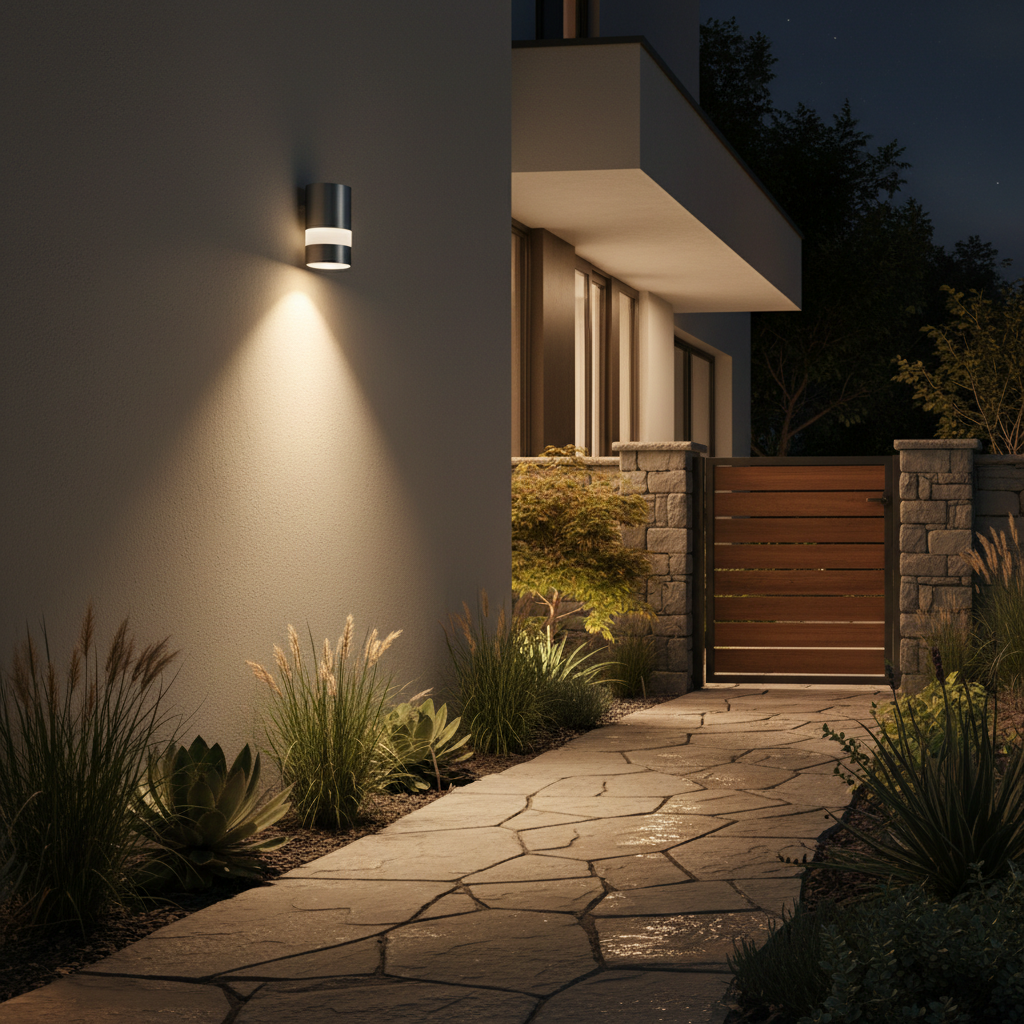
To concretely illustrate the performance of a high-end solar motion sensor light, Lumic's SolarGlow provides a good benchmark. It delivers 1200 lumens, with two 180° sensors each and a detection range of up to 26 feet (8 meters). In detection mode, battery life reaches 20 days without solar recharge, allowing it to get through less sunny periods without interruption.
It is IP65 certified, resistant to rain, snow, and frost, and installs without any cables. It comes with a 5-year warranty. No external wires, no grid dependency. For those who want reliable solar motion sensor lighting without compromising on power, this is a serious option to consider.
If you want to go further and compare with other product types like floodlights, our guide on outdoor solar floodlights will give you the elements to refine your choice based on the area you need to light.
Summary: How to Choose Your Outdoor Motion Sensor Light
To summarize the essential points before you start:
- If you want to avoid major work and are a renter: solar, without hesitation.
- If you already have an electrical circuit in place nearby: wired might be relevant.
- For driveway or distant gate lighting: solar avoids trenching.
- Always check the IP rating (minimum 65), detection angle, and actual range.
- Beware of very low prices: the sensor is often the first component to fail.
- An accessible external cable remains an accessible cable; solar has none.
The ideal outdoor motion sensor light is the one that fits your specific situation. Not the most powerful on paper, not the cheapest to buy, but the one that will work without issues for years to come. Take the time to check the actual specs, not just the advertised price.