What "Autonomous" Really Means for Outdoor Lighting
Autonomous outdoor lighting means lighting that works without you having to manage it. No cables to run, no electrician to call, no electricity bill tied to the installation. But most importantly: no repeated intervention after installation.
This is where many people get it wrong. They buy a battery-powered lamp thinking it's "autonomous." But after three weeks, the batteries are dead. Then it happens again. That's not autonomy; it's a disguised chore.
A truly autonomous outdoor lighting system is one you install once, that turns on by itself when needed, turns off by itself, and requires nothing from you. We'll explore why not all systems are created equal, and which one comes closest to this promise.
The 3 Levels of Autonomy: From Least to Most Effective
Before recommending anything, we need to be honest about what each technology truly entails in daily life. Because product descriptions don't tell you everything.
Battery-Powered Lamps: The False Autonomy
The advantage of batteries is easy installation. No wiring, no drilling. But that's pretty much where the good news ends.
Outdoors, cold weather reduces battery life. A lamp that lasts 4 weeks in summer might only last about 10 days in January. If you have multiple lamps to manage, you'll quickly find yourself monitoring, testing, and replacing batteries. Not to mention the cumulative cost of batteries and the environmental impact, which we tend to underestimate.
This type of lighting is practical for temporary fixes. Not for true long-term autonomy.
USB Rechargeable Lamps: Partial Autonomy
A step up: LED light bars or sconces with rechargeable batteries. You plug in a USB cable occasionally, and it's good for several weeks. Indoors, in a closet or under a kitchen cabinet, it's a great solution. Outdoors, it's more debatable.
Actual battery life depends on usage, temperatures, and chosen brightness level. In motion sensor mode, some models last a month or more. But you still have to remember to recharge. And if you forget during vacation, you'll come back to darkness.
These are useful products, but they don't meet the strict definition of complete autonomy. You remain an active part of the system.
Solar with Motion Sensor: True Autonomy
Here, the principle is fundamentally different. The solar panel recharges the battery during the day. The motion sensor triggers the light at night. And the ambient light sensor prevents the lamp from turning on during the day. Everything is automatic. There's nothing to do after installation.
This is the only system that checks all the boxes: no wires, no batteries to change, no manual recharging, no switches to manage. You install it, make sure the panel is facing the sky, and you're done. For years.
If the idea of never thinking about your outdoor lighting again appeals to you, autonomous solar lighting is the only real answer.
Comparing Options: An Honest Table
| Criterion | Batteries | USB Rechargeable | Solar + Motion Sensor |
|---|---|---|---|
| Cable-free Installation | ✓ | ✓ | ✓ |
| Zero Post-Installation Intervention | ✗ | ✗ | ✓ |
| Automatic On/Off | Partial | Partial | ✓ |
| Solar Energy Recharge | ✗ | ✗ | ✓ |
| Long-Term Cost | High (batteries) | Medium | Low |
| Winter Performance | Degraded | Stable | Depends on panel |
| Rain/Freeze Resistance | Variable | Variable | IP65 if certified |
This table doesn't lie: solar with motion detection is objectively the most autonomous. But that doesn't mean it's perfect in all situations. We'll come back to that below.
Where to Install Autonomous Outdoor Lighting?
Driveway or Gate: Security and Convenience
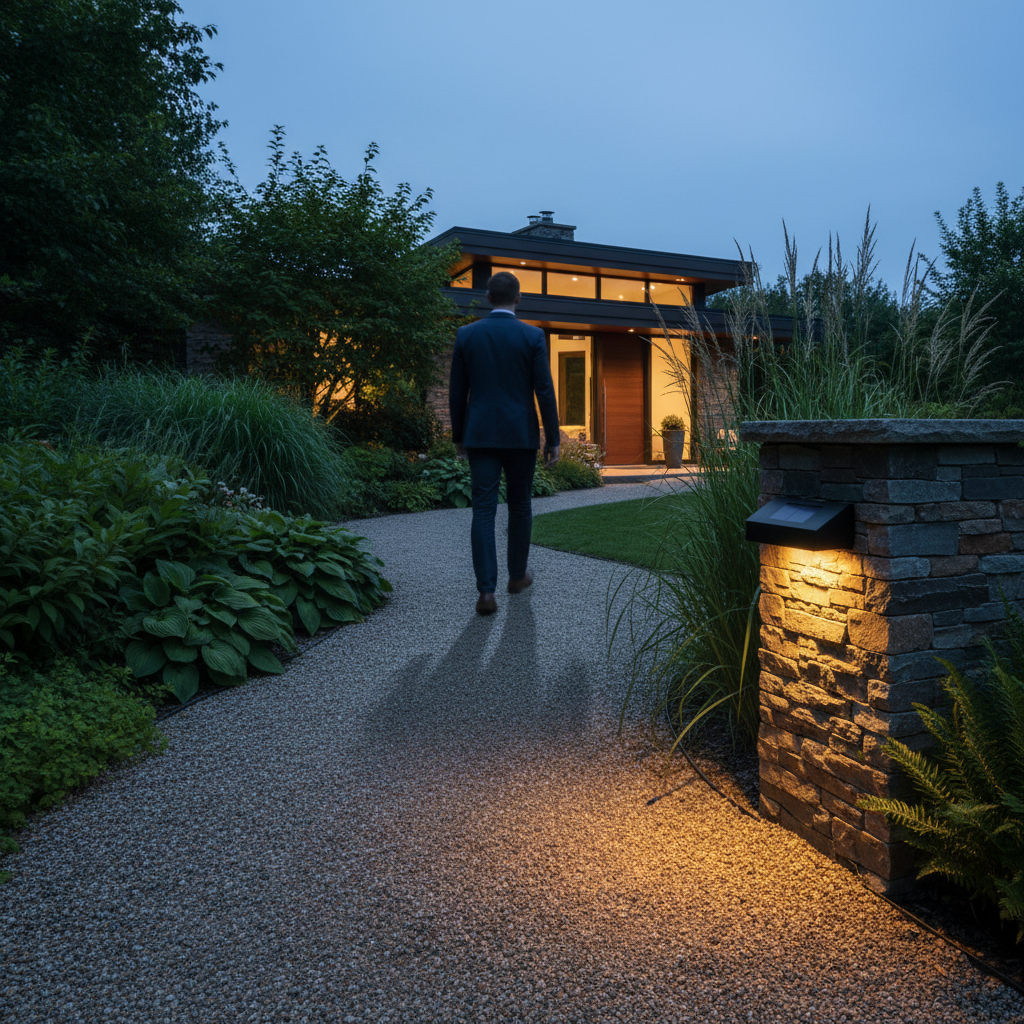
This is the most common use. You want the light to turn on when you arrive, secure access, and not have to touch a switch. A solar lamp with a motion sensor is ideal here: it detects your presence, turns on for 30 seconds to 1 minute, then turns off. Zero unnecessary consumption.
For a driveway, a detection range of about 26 feet (8 meters) is sufficient in most cases. Always check the detection angle: some models have a 180° field, which avoids blind spots.
Patio or Facade: Ambiance and Nighttime Use
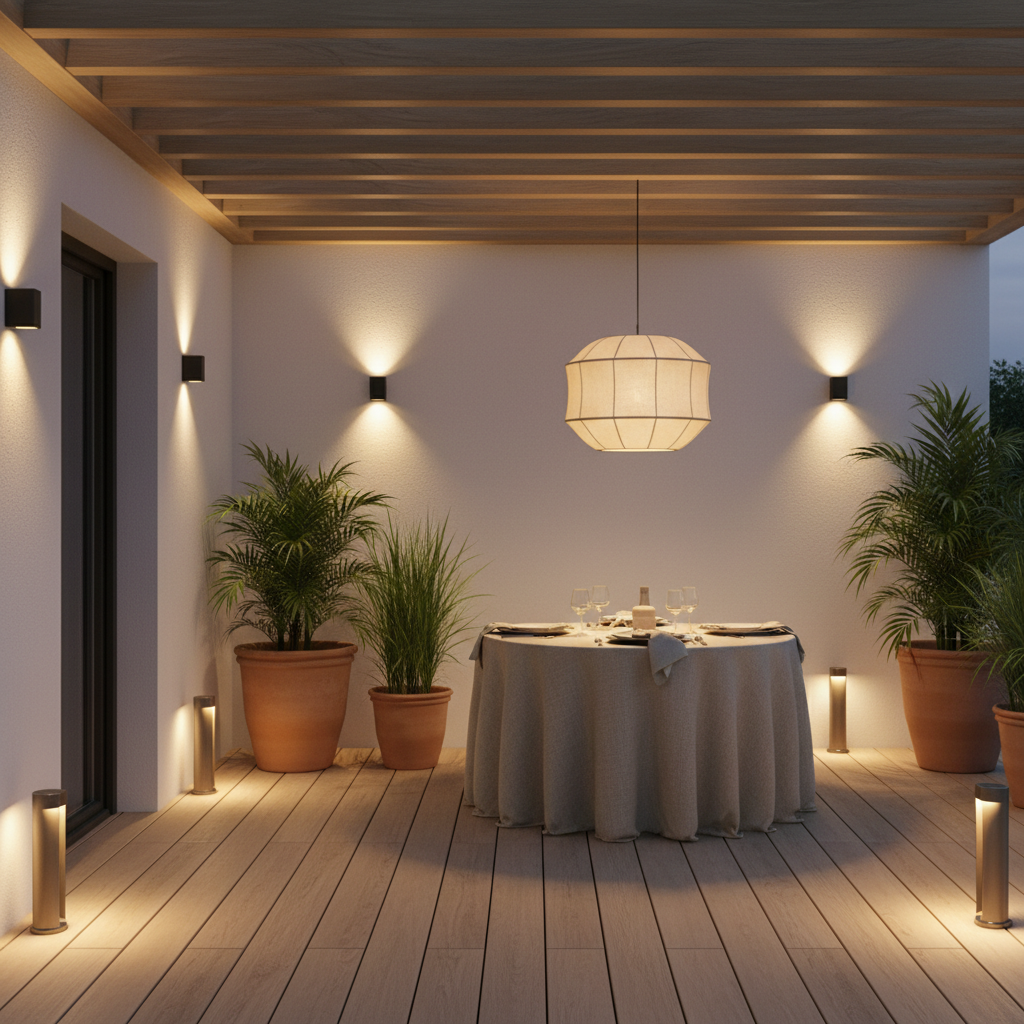
For a patio, the challenge is different. Sometimes you want continuous lighting (outdoor dinner, party), not just a detection flash. Check that the model offers a continuous mode in addition to the detection mode. Some systems allow switching between the two.
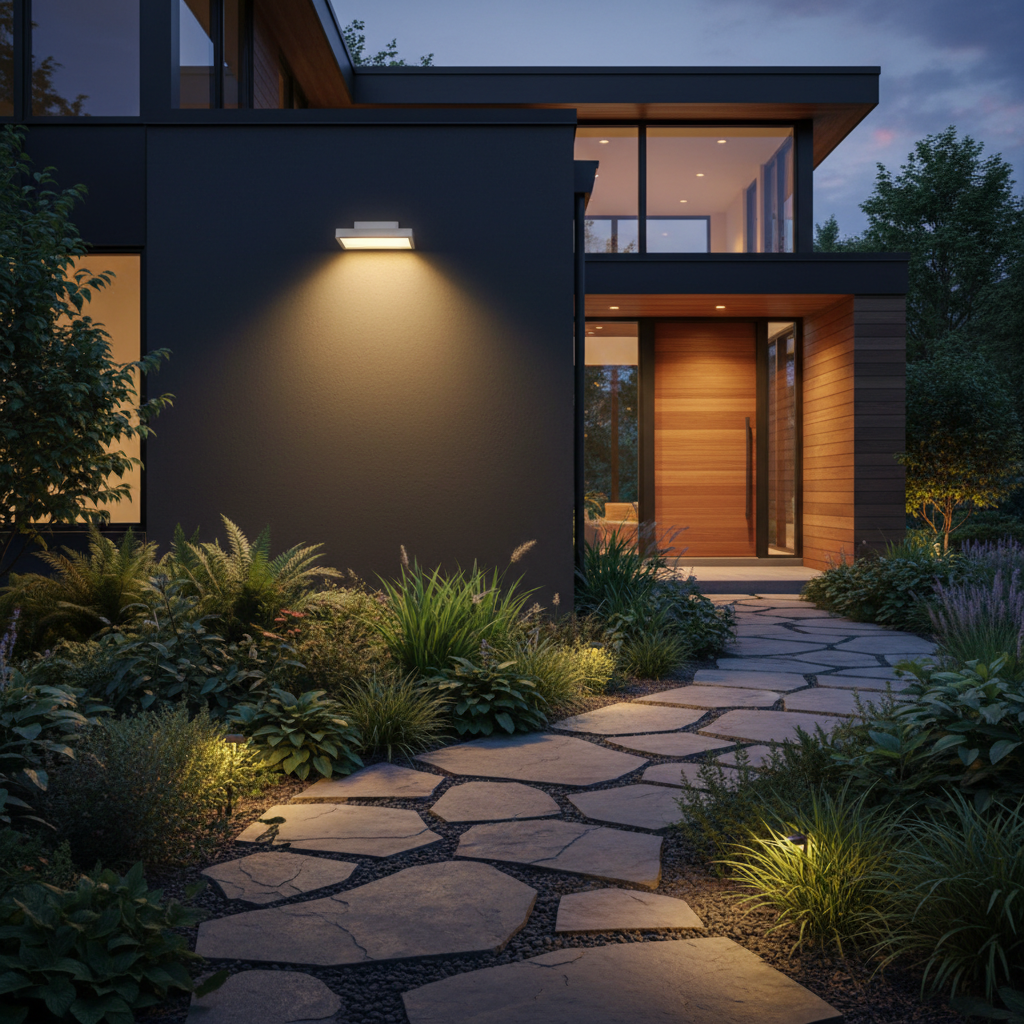
On a facade, solar panel orientation is crucial. A panel that only sees the sun for 2 hours a day won't charge enough for a full night. Orient it as much as possible towards the south, slightly tilted.
For concrete ideas, our article on wireless patio lighting offers good suggestions for different ambiances.
Garden: Each Zone Has Its Constraints
In a garden, needs vary: winding paths, ponds, dense vegetation, gates far from any power source. Autonomous lighting makes perfect sense here, precisely because running a cable for 65 feet (20 meters) is neither simple nor economical.
The main point of attention: shading. A tree that blocks the sun for a large part of the day can seriously compromise recharging. Think about this before installing your lamp. To help you intelligently place each light point, consult our guide on solar garden lighting by zone.
What You Don't Get in a Cheap Solar Lamp
There are dozens of $10 solar lamps on marketplaces. Some people are content with them. Others replace them after a year because they no longer last through the night once autumn arrives.
Here's what really makes the difference:
- Solar panel size: A small miniature panel charges little, especially in winter with a low sun. A more generous panel stores more energy, ensuring real autonomy even on cloudy days.
- Battery capacity: A good capacity battery ensures several days without sun. Low-end models often last less than 24 hours without recharging.
- IP rating: Outdoors, IP65 minimum. This guarantees resistance to water splashes and dust. Essential for rain, frost, snow.
- Sensor quality: A poor motion sensor creates false positives (turns on for no reason) or false negatives (doesn't detect when it should). The advertised range and actual range can differ.
These details aren't visible in a standard product description. Yet, they determine whether your lamp lasts 5 years or 5 months.
Wired Lighting: Autonomous in Another Way, But Not Without Constraints
We sometimes hear that wired lighting is "the most reliable." That's true in a sense: once installed and connected to the grid, it's continuously powered, with no battery to manage. But it's not autonomous in the way we mean here.
Wired lighting requires an electrician, conduit installation, and construction work. In an existing home, it's often a major project. And for a renter, it's simply impossible without the landlord's agreement.
True autonomy also means autonomy from installation constraints. And wired lighting doesn't provide that.
When Solar Reaches Its Limits
Let's be honest. Autonomous solar lighting isn't perfect in every scenario.
Does it really work in winter?
This is the question everyone asks. The honest answer: it depends on the model. A lamp with a generous solar panel and a good capacity battery works very well even in January, even on cloudy days. It charges slower, but it still charges. A low-end lamp with a micro-panel, however, will quickly run out of energy as the days shorten.
In practice, serious models provide several days of reserve autonomy to compensate for sunless days. 20 days of autonomy without any solar recharge is a real safety margin.
What if the panel is in the shade?
If the ideal location for your lamp is entirely in the shade (under an awning, in a north-facing corner), the efficiency of the integrated panel will be greatly reduced. Some systems offer a remote solar panel, meaning it's separate from the lamp body and connected by a cable. You position the lamp where you want, and the panel where the sun hits. This is a real solution for difficult configurations.
Does a solar lamp detect well in strong winds?
Wind can create parasitic movements (leaves, branches) that trigger the sensor. It's better to choose a lamp with sensitivity adjustment. This allows you to adjust the detection threshold to avoid false triggers.
How to Choose Your Autonomous Outdoor Lighting Based on Usage
No need for a list of 50 criteria. Here are the questions that really matter:
- Do you want to light a pathway or create an ambiance? For a pathway, motion detection is sufficient. For a patio where you spend evenings, you need a continuous mode as well.
- Will the panel see the sun? If yes, several hours a day: you're good. If it's in the shade all day, rethink the location or look for a model with a remote panel.
- Are you a renter or homeowner? Both can use solar. But if you're a renter, you'll appreciate no-drill, no-wire installation even more.
- What light intensity? For a path or entrance, 1000 to 1200 lumens provide functional lighting. For a security floodlight, you're looking for maximum output.
For uses requiring power, our comparison on powerful wireless outdoor lighting details options based on the desired intensity level.
Lumic's SolarGlow: A Solution Designed for Total Autonomy
Let's be direct: if you're looking for outdoor lighting that requires no intervention after installation, the SolarGlow is the solution we recommend. Not because it's our product, but because it's precisely designed to meet this expectation.
It delivers 1200 lumens, which is sufficient to effectively light a driveway, gate, or facade. The two 180° motion sensors cover a 26-foot (8-meter) range with no blind spots. It's IP65 certified, meaning it's validated for rain, snow, and frost. And it's designed to last 20 days without any solar recharge in motion detection mode, providing a real buffer for cloudy weeks.
Installation takes minutes, with no wires, no mandatory screws, no electrician. You mount it, orient the panel, and you're done.
It comes with a 5-year warranty and a 90-day satisfaction guarantee. Customer support is based in the US, with a response within 24 hours. Over 2200 reviews on Trustpilot with a 4.5/5 rating: the feedback is there to give you an idea of what users really think.
"Install it once, forget about it for 5 years." That's the idea. And that's what outdoor autonomy should always be.
What to Remember Before Buying
Autonomous outdoor lighting exists at three levels of real independence. Batteries are convenient but restrictive long-term. USB rechargeable is good but requires regular attention. Solar with motion detection is the only system that truly works without you, for the long haul.
Before buying, check three things: battery capacity for sunless days, IP rating for weather resistance, and the actual range of the motion sensor to cover your area. And if you want to go further in choosing a truly hassle-free autonomous outdoor lamp, our dedicated guide will help you compare options precisely.