You've renovated your patio, the furniture is perfect, the plants are beautifully arranged. Then evening falls. The patio disappears into darkness, or worse, you turn on a cold white spotlight that turns your space into a parking lot. The problem isn't lighting. It's bad lighting.
Good solar patio lighting doesn't just illuminate. It gives the space soul. At night, it creates the ambiance you envisioned when you chose your furniture. And during the day, it should be discreet enough not to detract from the scene.
This guide is for those who prioritize aesthetics, then technology. So, let's start there.
Why Lighting Transforms Your Patio
Lighting is often treated as a detail, a technical constraint addressed last. This is a mistake. On a patio, light defines the evening ambiance. It determines if you spend one hour outside or three.
Good Lighting Makes a Space Feel Larger
Poorly placed light—often a cold ceiling spotlight—shrinks the space. It reveals flaws, creates harsh shadows, and makes a place feel like a thoroughfare rather than a living area. Conversely, low, indirect light, at table height or placed on the ground, visually expands the space and makes it feel warmer.
This is why interior designers always multiply light sources at different heights, rather than relying on a single central point.
Invisible by Day, Stunning by Night
Well-chosen patio lighting follows a simple rule: it should blend in during the day. A matte black aluminum fixture disappears into a pergola, on a wall, or within foliage. It doesn't draw attention. Then, at night, it becomes the main attraction.
This is exactly the relationship we seek. The fixture isn't decoration—it's a tool that creates decoration through the light it emits.
The 4 Types of Solar Patio Lights
Depending on your patio, pergola, or outdoor space, the right format varies. Here are the 4 categories to know before choosing.
Pendant Lights for Pergolas or Gazebos
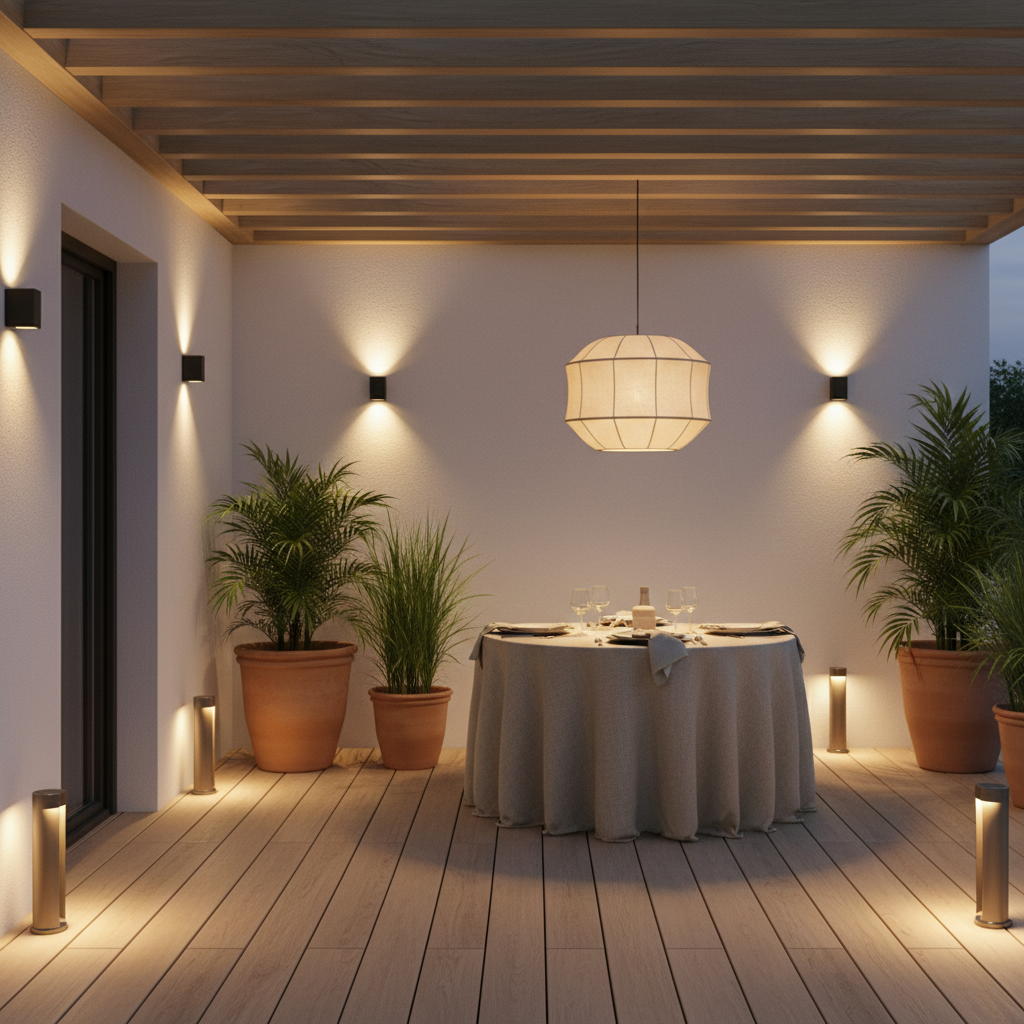
Pendant lights are the most elegant option for covered patios. Hung under a pergola, they descend to a comfortable height, creating intimacy around the table. The downward and sideways diffused light provides that restaurant-like ambiance many seek to recreate at home.
For a pendant-style solar patio light, ensure the solar panel gets enough exposure (some models have integrated top panels, others have a separate panel on a cable for sun orientation). Spherical or cylindrical shapes in frosted glass or washi paper are trendy in 2026. Brushed aluminum is gradually replacing the white plastic of previous generations.
Wall Sconces for Walls and Pillars
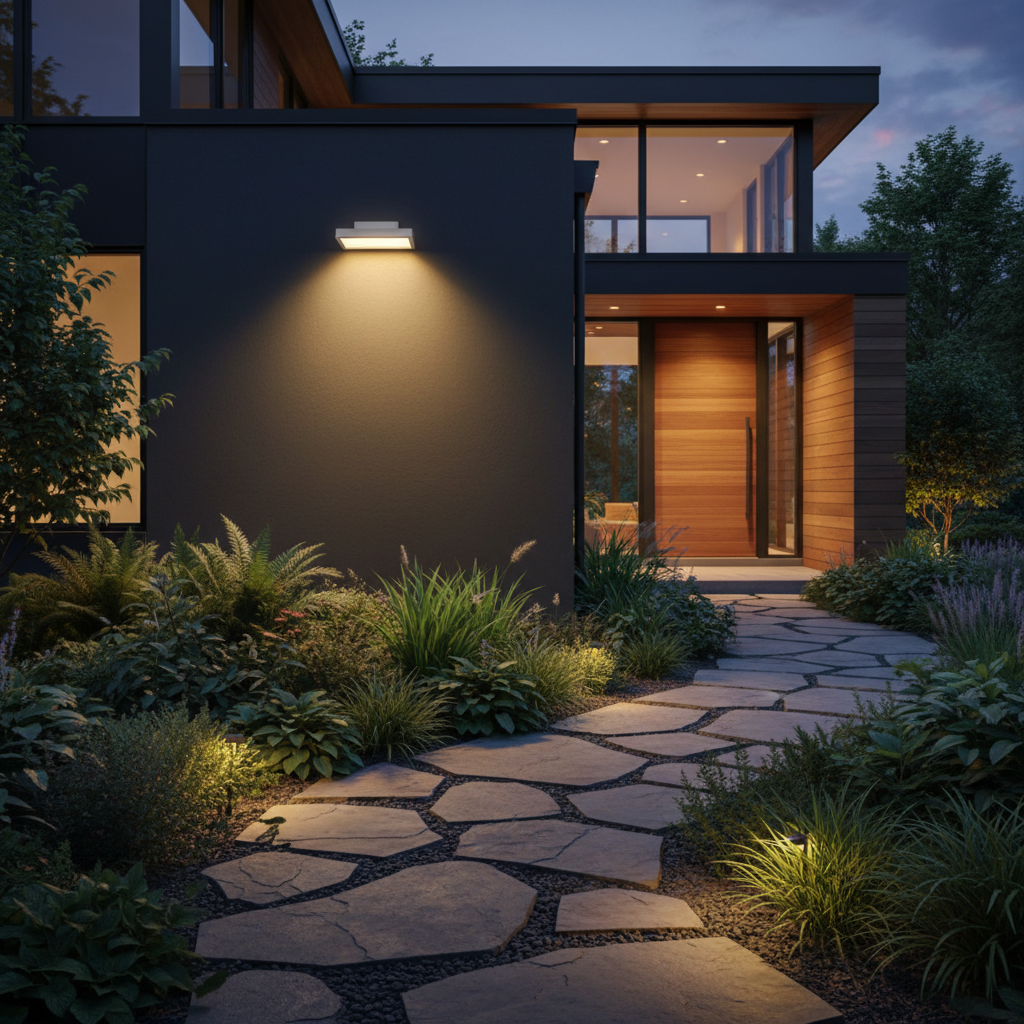
Wall sconces are the most versatile choice. They install on a wall, pillar, or facade, illuminating downwards or sideways, creating visual demarcation. On a patio, two symmetrical sconces on either side of a French door frame the space and give it a true architectural line.
Dominant finishes in 2026: matte black, anthracite, and off-white. Aluminum is the go-to material for durability and a premium look. Avoid plastic models that yellow after one summer.
Table Lamps for Outdoor Dinners
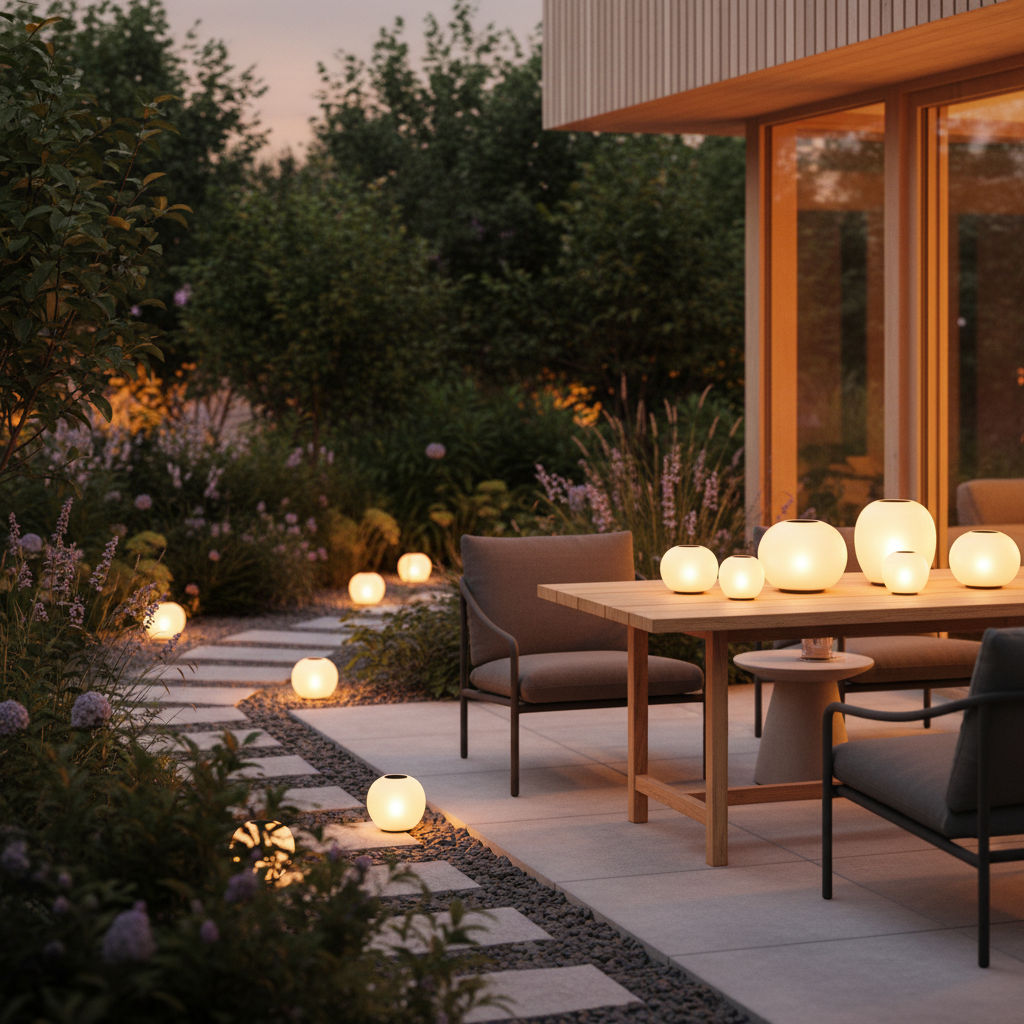
The solar patio table lamp is perhaps the most versatile. Placed at the center of the table, it replaces candles while being more practical—no wax, no wind blowing it out, no fire risk. It creates soft light at face height, exactly what you want for dinner.
Cylindrical shapes in glass or textured concrete are very popular this year. Some models combine a table lamp and a lantern, with 360-degree diffused light. For a wireless patio, this format is ideal: place it anywhere, move it as needed.
Low Bollard Lights for Edges
Low bollard lights placed along the patio edges, stairs, or pathways define the space without overwhelming it with light. They act as visual markers that add depth to the space at night.
For a polished look, aim for consistency: same finishes, same color temperature. Mixing black bollards with white sconces creates a messy result, even if each piece is beautiful individually.
What Design to Choose: 2026 Patio Lighting Trends
Outdoor lighting aesthetics have evolved significantly. Here's what's truly working this year.
Matte Black Aluminum: The Safe Bet
Matte black has become the dominant color for high-end outdoor lighting. It ages well, is inconspicuous during the day, and contrasts elegantly with the light tones of whitewashed walls or natural wood. This finish transcends trends.
A designer solar light in matte black aluminum also offers durability. Aluminum doesn't rust, resists UV rays, and maintains its color season after season. Unlike painted plastic that chips, it looks the same after several winters.
Clean, Geometric Shapes
Overly ornate designs, with complex patterns or embellishments, have given way to pure lines. Cylinder, sphere, cuboid. The influence of Scandinavian design and Japanese minimalism is evident: fewer elements, more impact.
This simplicity has a practical advantage: a geometric fixture suits all patio styles, from contemporary to natural. It doesn't overpower the rest of the decor.
Indirect, Soft Light
Direct light—the spotlight that glares when you look at it—is what you want to avoid on a patio. The 2026 trend is diffused light: frosted glass, fabric or concrete shades, integrated reflectors that project light onto the wall rather than directly into your eyes.
Practically, this means choosing a solar patio lamp with a bulb or LED strip that isn't directly visible. The light source should be hidden; only the effect matters.
Solar vs. Wired: The Argument No One Mentions
Most comparisons between solar and wired lighting focus on light performance. This is reductive. The decisive argument is often elsewhere.
Placement Freedom Changes Everything
A wired fixture dictates its position. The cable goes where it can go, and often, that's not where you wanted the light. You adapt to existing infrastructure rather than choosing the optimal location.
A wireless patio light lets you choose. You can test different positions, see how the light behaves at night, and adjust. And if you re-do your patio in two years, you take your light with you. This flexibility has real value that the purchase price doesn't reflect.
No Installation, No Electrician
Installing a wired outdoor fixture requires conduit, waterproof connectors, and ideally an electrician if the cable needs to go through a wall. That's a day's work, minimum. A solar light attaches with screws or adhesive, and that's it. For many patio projects, it's simply the only realistic solution.
To explore other possible configurations, our article on wireless patio lighting provides concrete ideas based on patio type.
Is Solar Lighting Really Enough for a Patio?
This question comes up often, and it's legitimate. Early generations of solar lights were underpowered. Today, serious models produce enough light for real patio use. The key is to look at two numbers: lumens (light output) and actual battery life in motion sensor or continuous mode.
A fixture with 1200 lumens amply covers an average-sized patio for an evening ambiance. It's not stadium lighting, but that's not what you're looking for on a patio. To delve deeper into this topic, our article on choosing a beautiful and reliable outdoor solar light details the technical criteria that matter.
How to Create a True Ambiance with Solar Lights
Ambiance doesn't come from a single light, no matter its quality. It comes from combining multiple light sources at different heights and intensities.
The Three-Level Rule
For a successful patio at night, aim for three levels of light: high, mid-height, and ground. A pendant or high sconce creates the background light. A table lamp brings warmth at conversational height. Low bollards or string lights on the ground define the edges.
This isn't about budget—you can mix affordable elements with more invested pieces. It's about distribution. Each level plays a distinct role.
Color Temperature: The Detail That Changes Everything
Color temperature is measured in Kelvin (K). For a patio, only one range works: 2700 K to 3000 K. This is warm light, similar to a candle or an old incandescent bulb. It's flattering, relaxing, and creates a sense of intimacy.
Avoid 4000 K (neutral white) and especially 6000 K (cool white) for residential outdoor spaces. These temperatures are suitable for a garage or workshop, not a living area. When choosing your designer solar patio lighting, the warm light option will often be the most used.
Create Zones Rather Than Uniform Lighting
The classic mistake is trying to light the entire patio uniformly. This is a utilitarian reflex. For ambiance, however, you want illuminated zones and shaded areas. The dining area is well-lit, patio corners remain dim, and plants receive backlighting that highlights them.
To explore this further, our guide on creating a true ambiance with solar patio lighting provides configuration examples by patio type.
The SolarGlow: What It Actually Delivers
For those seeking a reliable designer solar light for outdoor use, Lumic's SolarGlow deserves consideration. This isn't a $15 plastic gadget. It's an aluminum fixture with 1200 lumens, two 180-degree motion sensors, and a range of about 26 feet (8 meters).
What truly sets it apart: the battery is four times larger than low-end alternatives, and the solar panel is three times larger. In practice, this changes the experience in winter, when short days limit recharging. Motion sensor mode lasts about 20 days without sun, and continuous mode about 36 hours.
It's UL listed IP65: rain, snow, and frost are not an issue. And if you're not convinced, Lumic offers a 90-day satisfaction guarantee, plus a 5-year warranty. Customer support is based in the US, with responses within 24 hours.
This is the type of fixture that installs in minutes without cables or drilling, and stays in place because it performs. To see how it integrates into a patio, our article solar patio lamp for evening ambiance without cables provides installation examples.
What to Look for Before Buying: Key Criteria
To avoid bad choices, here are the points to check for any solar patio light.
| Criterion | What Matters | What to Avoid |
|---|---|---|
| Material | Aluminum, stainless steel, glass | Untreated UV-sensitive ABS plastic |
| Waterproof Rating | IP44 minimum, IP65 for full exposure | No rating mentioned |
| Color Temperature | 2700 K to 3000 K for ambiance | 6000 K (too cool) |
| Battery Size | Large capacity for winter resilience | Small battery = quick shutdown |
| Warranty | 2 years minimum, ideally 5 years | 6-month warranty or not mentioned |
| Solar Panel Size | Generous surface for winter recharging | Decorative micro-panel |
Common Buying Mistakes
The first mistake is buying based on design alone without checking the technical specifications. A beautiful fixture with a low-capacity battery will be frustrating as days shorten in fall.
The second mistake is forgetting sun exposure. A solar light placed under a covered pergola or in the shade of a wall will never charge properly. For such locations, a model with a separable panel (which can be oriented towards the sun independently of the fixture) is often more suitable.
The third mistake is mixing color temperatures. Warm white on the table, cool white on the wall: the result is disjointed. Choose one temperature and stick with it across the entire patio. To broaden your thinking on possible wireless solutions, our article outdoor wireless lighting covers the available options.
Summary: How to Choose Your Solar Patio Light
To summarize the essential points before taking action:
- Start with design: shape, finish, color. The fixture should blend with your patio by day and create the desired ambiance by night.
- Choose the right type: pendant for pergola, sconce for wall, table lamp for dining, bollard for edges.
- Aim for multiple sources at different heights rather than a single central light.
- Stick to warm white (2700 K to 3000 K) across the entire patio for visual coherence.
- Check the battery and solar panel before buying: these are the true indicators of long-term performance.
- Aluminum is preferable to plastic for durability and a premium look.
- A good solar patio light requires no cables, no electrician, and no subscription. It recharges itself and turns on when you need it.
True luxury on a patio means no longer thinking about lighting. It's just there, it's beautiful, it works. And you spend more time outdoors because the ambiance makes you want to stay.