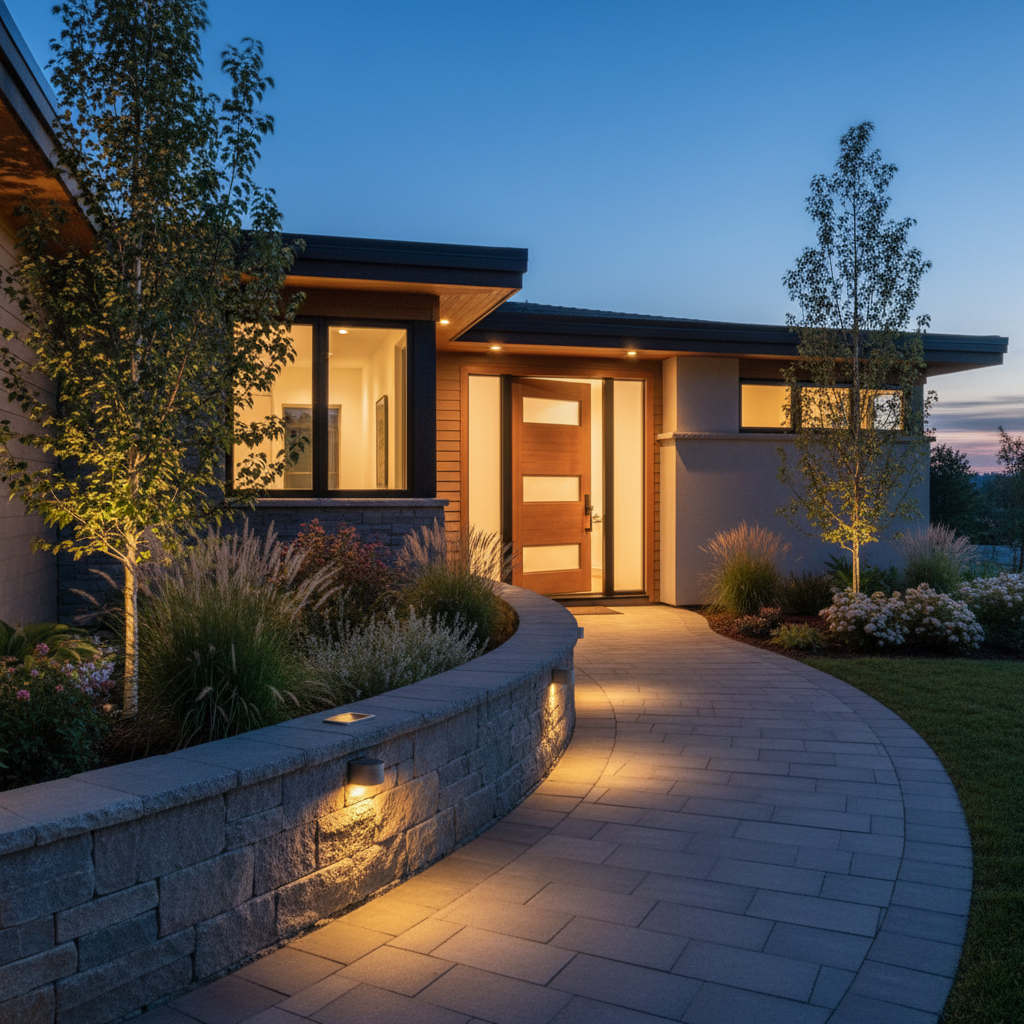
Your patio is finished. Pavers laid, furniture chosen, plants installed. Now you're faced with running an electrical cable to light it? There's another way, and it doesn't require trenching, an electrician, or drilling holes in your wall.
Wireless patio lighting has seriously advanced in recent years. From solar string lights that last all night, to rechargeable lamps you can place anywhere, and motion-sensor wall lights that turn on automatically, the options are concrete and accessible. Here's how to combine them to transform your patio tonight.
Why Wireless is Essential for Your Patio
The question deserves to be asked directly: Can wireless patio lighting truly compete with a wired installation? For the vast majority of residential uses, yes.
Wired lighting has its advantages on paper: continuous power, guaranteed brightness. But in practice, connecting a patio to the electrical grid often means calling an electrician, digging a trench to the breaker box, protecting buried cables, and installing waterproof outlets. This can easily cost $400 to $800 in labor, depending on the configuration, not to mention the cost of restoring the ground afterward.
Wireless changes the equation. No construction, no damage to a newly renovated patio. And for daily use of ambient light or functional lighting on steps, current solutions more than hold their own.
Solar: From Gadget to Real Solution
Just three or four years ago, solar lights had a bad reputation. And for good reason: tiny batteries, ridiculous panels, and autonomy that plummeted as soon as the sky was cloudy for a day. Those days are over. Quality modern models feature significantly larger batteries and solar panels, capable of lasting several days without direct sunlight. Solar is becoming the natural power source for anything installed outdoors.
Rechargeable: Tabletop Flexibility
USB-rechargeable lamps are another useful category. Unlike solar, they don't depend on the weather to recharge. You plug them in at night, then place them the next day. Ideal for outdoor table lamps that you bring inside for winter or move around depending on your patio setup. If you want to explore this category in more detail, check out our selection of rechargeable portable LED lamps for a cable-free patio.
Creating Ambiance: String Lights and Decorative Lighting
Evening ambiance on a patio almost always starts with string lights. Not because it's trendy, but because it truly works: the diffused, suspended light creates a soft luminous envelope that immediately changes the atmosphere of a space.
Solar String Lights: What Makes the Difference
Not all solar string lights are created equal. What distinguishes models that truly last all night from others: the size of the solar panel, the battery capacity, and the bulb's power consumption. Edison bulb string lights (visible filament, warm light) are the most sought-after for their aesthetic. Opt for those with a separate panel that you can orient south, independent of the string lights.
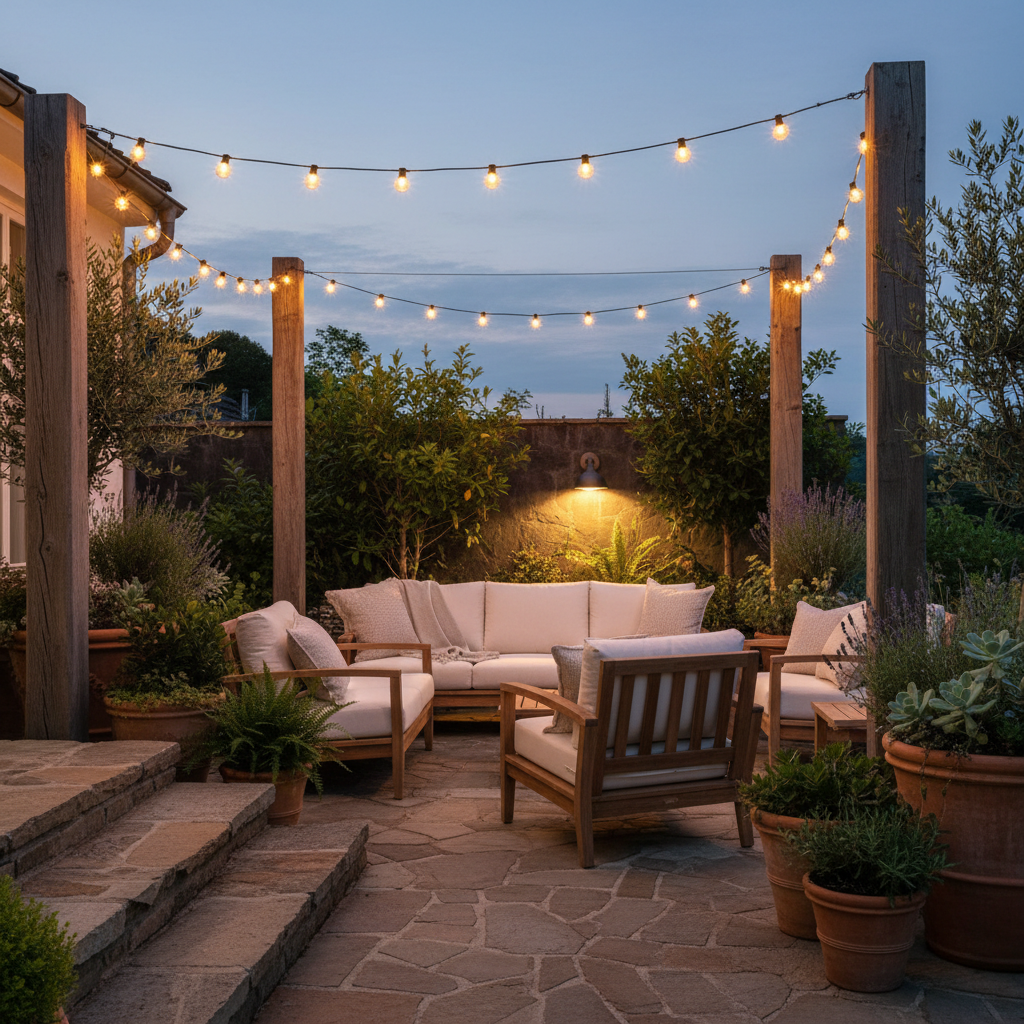
For a standard-sized patio, a 30 to 50-foot (10 to 15-meter) string light set is usually enough to create a cohesive illuminated perimeter. String it between two walls, attach it to wooden posts screwed into weighted planters, or hang it under an awning.
LED Candles and Lanterns: Table Lighting
For the table, rechargeable LED candles and solar lanterns work wonders. The advantage of modern LED candles: realistic flickering that mimics a real flame, comfortable battery life on a single charge, and zero risk. Solar lanterns placed on the ground create low light points that warm the ambiance without glare.
This type of lighting can be moved in thirty seconds to suit your needs: family dinner, happy hour with friends, a quiet evening for two. The flexibility is total, something no wired installation can offer.
Solar Spotlights for Flowerbeds
Spotlights staked into flowerbed borders highlight a plant, a tree, or simply visually define the patio from the garden. This type of low-level lighting is very effective for adding depth to a space at night. The light comes from below, creating a visual contrast that overhead lighting doesn't provide.
Functional Lighting: Safety Without Ruining the Ambiance
A beautifully decorated patio is perfect for a Saturday night. But there are also quick trips outside at night, steps you descend without really thinking, pathways to the garden. This is where motion-sensor functional lighting becomes truly useful, not to replace the ambiance but to intelligently complement it.
Why Steps Deserve Dedicated Lighting
Stair steps and transitions between levels are the most sensitive areas of a patio. A motion-sensor wall light installed on the side wall of a staircase turns on when you pass and turns off automatically. You don't even think about the lighting: it's there when you need it.
The SolarGlow by Lumic is designed exactly for this use. Solar-powered, IP65 certified (rain, snow, frost), 1200 lumens, two 180° motion sensors with a range of about 26 feet (8 meters), and a 20-day battery life without solar recharge in detection mode. It installs without cables, without drilling into the electrical circuit, and performs well in real winter conditions. To understand in detail how this type of equipment works, consult our guide on solar motion sensor lighting.
Solar Wall Lights: Where to Place Them
The rule for placing a solar wall light: the panel must receive sunlight. This seems obvious, but many people miss it. If your wall faces north or is in the shade of an overhang for half the day, the battery will never be fully charged. In this case, opt for a model with a remote solar panel or one that can also be recharged via USB.
Good locations: entrance flanks, walls framing a staircase, patio corners. At a height of about 6.5 to 8 feet (2 to 2.5 meters) for optimal motion sensor coverage.
Ground Stakes and Illuminated Paths
For pathways leading to the patio, solar ground stakes are an alternative to spotlights. They illuminate at ground level, mark the path at night, and integrate discreetly into patio joints or along paver edges. Most charge passively all day and turn on automatically at dusk.
Combining Sources: The Lighting Strategy That Works
The most common mistake when equipping a patio: relying on a single light source, thinking it will be enough for everything. In practice, a well-lit patio combines at least two types of light with two distinct functions.
The Duo That Works in All Situations
The most common combination for well-lit patios:
- Solar String Lights: They run in the background all evening, creating a warm luminous envelope, giving the impression of a distinct space. This is the permanent ambient light.
- Motion-Sensor Wall Light: It activates intermittently in high-traffic areas, on steps, and at entrances. It doesn't glare when you're dining, but it's there when you get up.
These two elements complement each other without competing. One creates the atmosphere, the other ensures safe movement. And both work without touching a single cable.
Adding Layers Based on Your Patio
Depending on the configuration, you can add:
- One or two rechargeable table lamps if you entertain often: closer light, more intimate ambiance, easily movable.
- Flowerbed spotlights if your garden is visible from the patio and you want to give it presence at night.
- Ground stakes if access to your patio is via an unlit path.
The idea is not to accumulate equipment, but to think about each zone: social zone (table, outdoor lounge), traffic zones (steps, access), borders (visual demarcation). Three zones, three levels of light.
Mistakes to Avoid When Installing Wireless Patio Lighting
A few practical points to avoid unpleasant surprises after purchase.
Not Assessing Actual Sunlight
This is the number one mistake with solar. People look at a patio on a sunny summer day and buy without asking questions. But in fall or winter, the sun's angle changes radically. A patio well-exposed in July might only get two hours of direct sun in December. Take time to observe the sunlight on a typical cold-season day before choosing the placement of your panels.
Mixing Incompatible Color Temperatures
A string light at 2700K (very warm white, almost yellow), a wall light at 6000K (cool white, almost blue), and a ground stake at 4000K (neutral white) together: the result is visually inconsistent. For a successful patio ambiance, stick to warm tones, between 2700K and 3000K maximum. This creates that cozy evening effect. Reserve neutral or cool white for strictly utilitarian areas.
Underestimating the Required Battery Capacity
Entry-level solar lights have batteries that don't last a full night once fall arrives. If you're buying wireless patio lighting, battery capacity is a criterion that deserves serious consideration. The larger the battery, the longer the product will last, including during long winter nights or cloudy periods. To learn more about wireless outdoor solutions, our guide on powerful wireless outdoor lighting details useful selection criteria.
What Wireless Truly Changes
The first night with your patio lit, you'll wonder why you didn't do it sooner. Not because it's a technological revelation, but because the space changes its nature. A dark patio is a space you leave as soon as it gets dark. A lit patio is an extension of your living room.
And the fact that you didn't have to touch anything in the wall, didn't have to call an electrician, didn't have to dig up the patio floor: that's real convenience. Especially if you're a renter, or if your patio is new and you have no desire to partially demolish it to run a cable.
If you're still hesitating between different configurations or want to understand how wireless solutions compare to traditional installations, the wireless vs. wired LED strip light comparison provides a clear vision of the trade-offs to make based on your use.
Wireless patio lighting is no longer just an alternative to wired: for most residential patios, it's simply the most suitable solution. Faster to install, more flexible to reconfigure, and often smarter in its behavior thanks to automatic detection.