You look at your garden at night and see nothing. The pathway is dark, flowerbeds disappear into shadows, and the house entrance looks like a poorly lit corridor. The problem isn't the garden itself — it's that we often try to light everything with a single type of lamp. Or worse, with cheap $5 solar stakes that die after two summers.
A well-lit garden is about zones. Each space has a different function and thus a different lighting need. Marking a pathway, enhancing a flowerbed, securing an entrance, creating ambiance on a patio: these four goals require different solutions. This guide gives you the keys to choosing the right solar garden light for each area — no wires, no trenching, and no electrician needed.
Why Zone-by-Zone Solar Garden Lighting Changes Everything
The classic mistake is to try to standardize. We plant five identical stakes along the pathway and stop there. Result: the entrance remains dark, flowerbeds are invisible, and the patio lacks warmth in the evening. Effective solar garden lighting works like an interior designer's plan — each room has its own light adapted to its use.
How to Think About Your Garden in Lighting Zones?
Start by asking yourself three questions: where do I want to guide? where do I want to highlight? and where do I need to secure? These three intentions correspond to three very different types of lighting — and once you've answered, the rest follows naturally.
For guiding (pathways, walkways), you need low, consistent light, placed at ground level. To highlight (flowerbeds, trees, architectural elements), you need directional lighting that plays with shadows and shapes. To secure (entrance, gate, garage), the priority is power and responsiveness — a motion sensor, strong luminous flux, and a generous covered area.
Can You Really Power Everything in a Garden with Solar?
The short answer: yes, in the vast majority of gardens. The nuanced answer: it depends on the sun exposure of each zone. A spot placed under a dense tree on a north-facing exposure will struggle to charge its battery correctly. However, a light in an open area, even on cloudy days, can function reliably if it's equipped with a good capacity battery and a proportionally sized solar panel.
The practical rule: avoid placing solar devices in permanently shaded areas. For the rest — pathways, entrances, patios, exposed flowerbeds — solar is now perfectly viable, even in winter, if the product is well designed. Consult our guide on powerful solar garden lights to better understand how to evaluate the true power of a solar product.
Pathway Zone: Mark Without Glare with Solar Path Lights
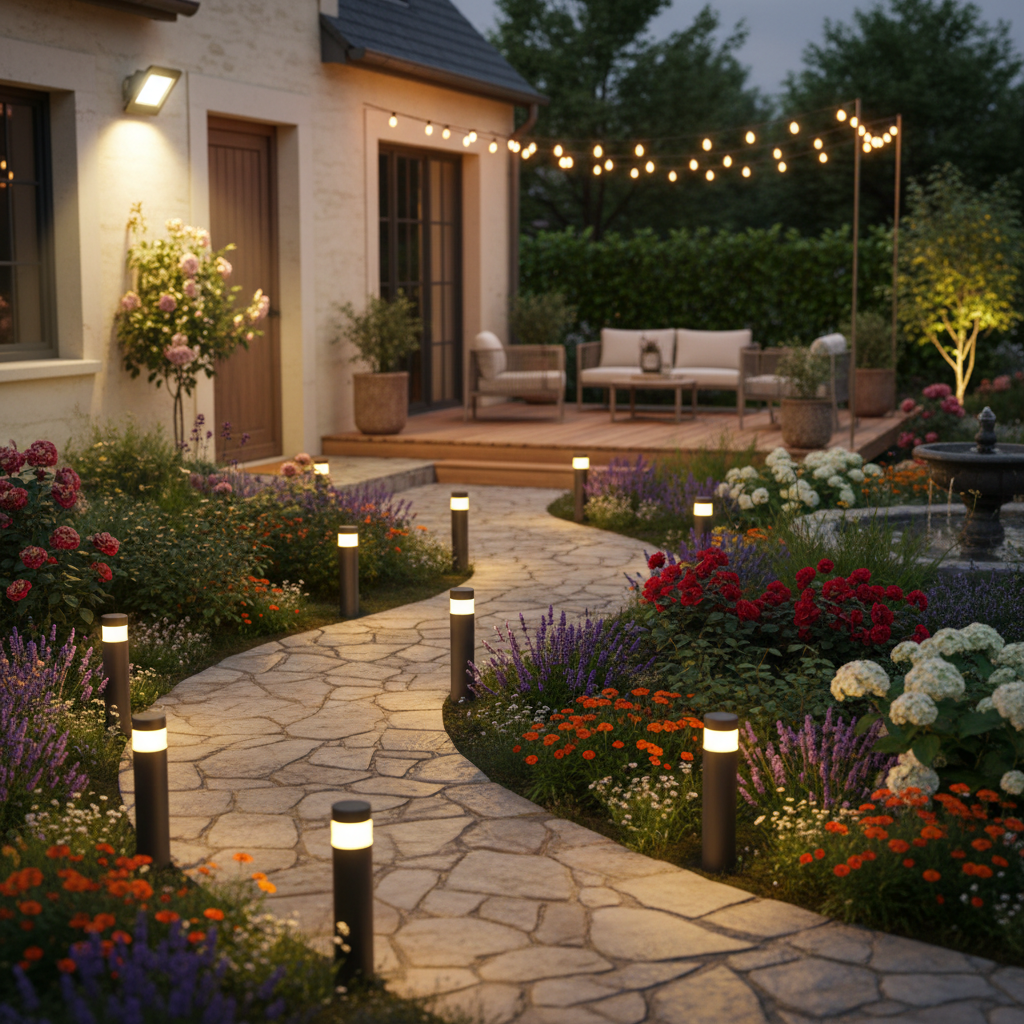
The pathway is the path. Its primary role is to guide your steps, not to flood the garden with white light. Solar path lights are the most suitable format — 16 to 24 inches (40 to 60 cm) high, light directed downwards or sideways, and spaced 6 to 10 feet (2 to 3 meters) apart for visual continuity without redundancy.
What Height Path Light to Choose for a Garden Pathway?
For a standard pedestrian pathway, path lights between 16 and 24 inches (40 and 60 cm) provide the right proportion: high enough to be visible from the patio or window, low enough not to create direct glare. If your pathway leads to a car gate, you can go up to 28-32 inches (70-80 cm) for better visibility from a vehicle.
The trap to avoid: overly bright path lights with too direct an upward beam. They light up the night but create unpleasant light pollution and attract insects. Opt for path lights with opaque diffusers or downward-facing light. Light quality trumps quantity.
How Many Path Lights for a 33-foot (10-meter) Pathway?
With spacing of 6 to 10 feet (2 to 3 meters), you'll need between 4 and 6 path lights to cover 33 feet (10 meters). If the pathway is wide (more than 5 feet / 1.5 m), you can alternate sides to create a more visually interesting depth effect. If it's narrow, place the path lights on one side only, evenly spaced.
Flowerbeds and Vegetation Zone: Solar Spotlights on Stakes
Flowerbeds, shrubs, trimmed hedges, garden sculptures — anything worth highlighting at night — are the domain of solar garden spotlights. These are small, autonomous units, planted directly in the ground, with an adjustable lighting angle.
How to Aim a Solar Spotlight at a Flowerbed?
The classic angle is about 45 degrees from the ground, directed towards the center of the plant or element to be lit. For a dense shrub, place the spotlight 12-20 inches (30-50 cm) from the base and aim it upwards to create a halo effect. For a low hedge, two spotlights at each end are often enough to create a pleasant lateral sweep effect.
Also, consider the light you don't want: a poorly aimed spotlight can directly illuminate a bedroom window or create an unpleasant backlight on the patio. Test the orientation by hand before permanently fixing — most stake spotlights are easily repositioned.
Should You Choose Warm White or Cool White for Lighting Plants?
For vegetation, warm white (around 2700 to 3000K) is almost always the best option. It enhances green and brown tones, creates a soft and natural ambiance, and integrates better into an organic environment. Cool or neutral white can appear harsh on plants and disrupt the garden's evening atmosphere. Reserve cooler temperatures for functional areas like pathways or garages.
Patio Zone: Create Ambiance Without Wires
The patio is an extension of the living room — it's where you entertain, eat, and relax. Lighting plays a fundamental role in the ambiance. Unlike the pathway or entrance, the stakes here are not visibility or security, but visual comfort and atmosphere. To delve deeper into this topic, our article on solar patio lighting for creating a true ambiance details the options in depth.
What Types of Solar Lighting Are Suitable for a Patio?
The patio lends itself well to several formats depending on your setup. Solar string lights are ideal if you have structures (pergola, gazebo, railing) to hang them on: they create a soft, festive light without any visible wiring. Solar lanterns and wall sconces work very well if the patio is against a wall — for facade lighting, solar wall sconces combine aesthetics and efficiency. Low path lights or ground spotlights can define the patio perimeter and create warm light zones in the evening.
Should You Plan for Motion Detection on the Patio?
Not necessarily. On a patio, light is often desired continuously for as long as you are present — motion detection can become irritating if the lamp turns off every thirty seconds because you're not moving enough. If you choose a lamp with detection, make sure it also has a continuous mode that you can manually activate or program.
Pool and Water Features Zone: IP Rating Above All
Around a pool or pond, the basic rule is simple: never install a light that isn't designed for water projection. A minimum IP65 rating guarantees protection against water jets from all directions. For in-water installation, you need IP67 or IP68 — but this type of light often requires an electrician and goes beyond simple solar DIY installation.
What Solar Solution for Lighting Around a Pool?
The area around a pool requires low, consistent, splash-resistant lighting. IP65 rated path lights every 6-10 feet (2-3 meters) around the pool create safe and aesthetic demarcation. Some IP65 certified stake spotlights can also be planted in flowerbeds around the pool to highlight vegetation and reflect light on the water. Avoid string lights in this area — the risk of contact with water is too high if they are not specifically designed for it.
Entrance and Gate Zone: Security First
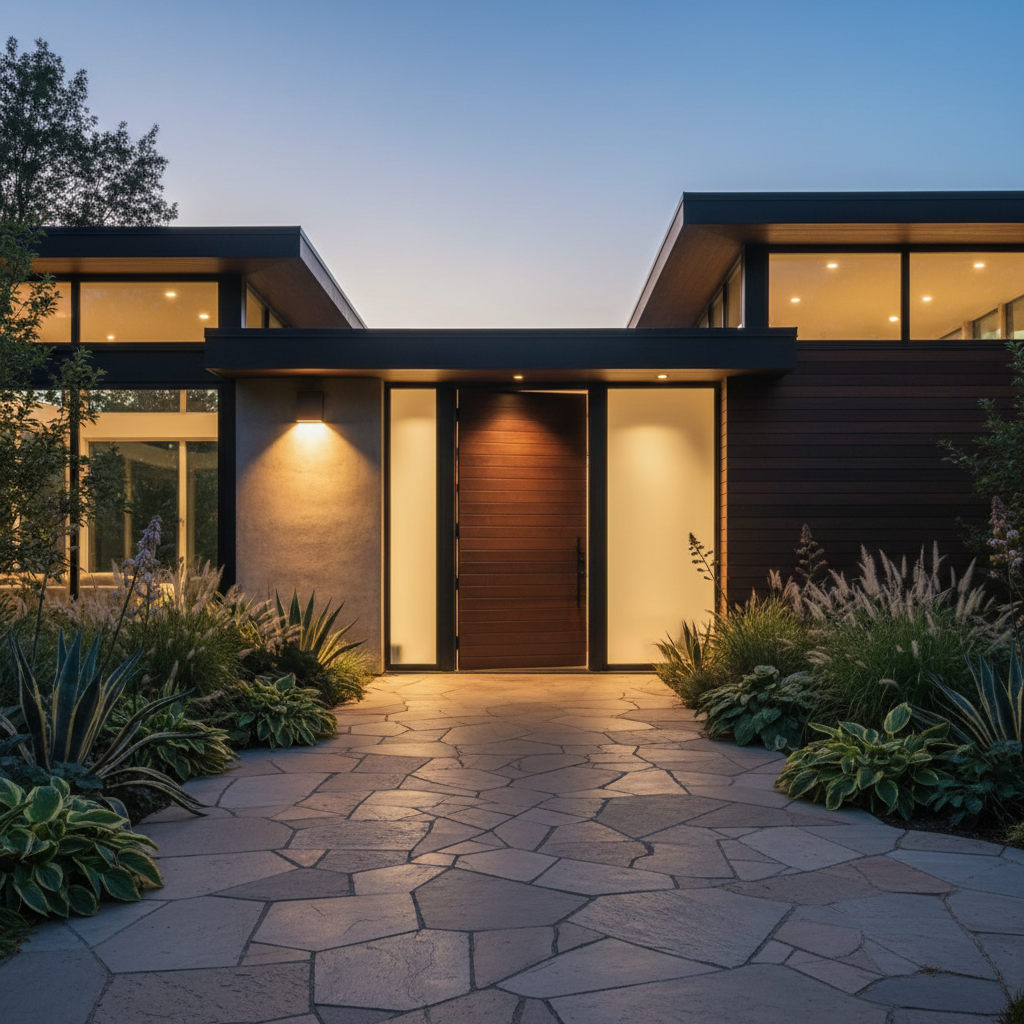
Your home's entrance is the most important area to light — and often the most neglected. It's the first impression your home gives at night, and statistically, it's also the area most exposed to intrusion attempts. Powerful lighting with motion detection at the entrance is the most deterrent signal there is.
The argument I often hear: "I'll have a floodlight wired." The problem is that connecting wired lighting at the entrance often involves trenching the lawn, running cables under the gate, and hiring an electrician. The total cost easily ranges from $500 to $1000 depending on the configuration, not to mention damage to landscaping. Solar, on the other hand, requires no wires or trenching. You install it, it works.
What Luminous Power is Needed to Light a House Entrance?
For an entrance, you need real power — not a small decorative spotlight. We're talking at least 800 to 1200 lumens to properly cover a standard entrance area with effective detection. Sensor range is also crucial: a sensor that only covers 10 feet (3 meters) will be useless if the gate is 20 feet (6 meters) from the house. Aim for a range of at least 20-26 feet (6 to 8 meters).
The SolarGlow by Lumic precisely meets this need: 1200 lumens, two motion sensors covering 180° each with a range of approximately 26 feet (8 meters), IP65 for all weather conditions, and a battery that provides 20 days of autonomy without solar recharge in detection mode. Installation takes minutes with no tools, no wires, no trenching. If you want to compare several models before deciding, take a look at our comparison of the best outdoor solar lights.
Does a Motion-Sensing Solar Light Work Well in Winter?
This is a legitimate question. The answer depends entirely on the battery and solar panel sizing. Low-end models at $15-20 fail after the first few cloudy days in November. Better-designed products, with large capacity batteries and panels sized to compensate for short days, last through winter without issue — even in freezing temperatures. Our guide on motion-sensing solar lighting details the criteria to check before buying.
Summary Table: Which Lamp for Which Zone?
| Zone | Recommended Lamp Type | Useful Brightness | Key Function | Minimum IP Rating |
|---|---|---|---|---|
| Pathway | Solar path light 16-24 inches (40-60 cm) | Low to moderate | Guidance | IP44 |
| Flowerbeds / Vegetation | Directional stake spotlight | Moderate | Highlighting | IP44 |
| Patio | String lights, sconces, path lights | Low to moderate | Ambiance | IP44 |
| Pool Surround | IP65 path lights or spotlights | Low to moderate | Safe demarcation | IP65 required |
| Entrance / Gate | Motion-sensing floodlight | High (800-1200 lm) | Security + deterrence | IP65 recommended |
Mistakes to Avoid When Installing Solar Garden Lighting
Even with the right lights, a few installation or selection errors can spoil the result. Here are the main ones I see regularly.
Placing Solar Panels in the Shade
This is the number one mistake. A solar spotlight planted under a dense tree will never properly charge its battery. Before buying, identify areas in your garden exposed to direct sunlight for at least 4 to 6 hours a day. If an area is in permanent shade, either choose a model with a remote panel (panel separate from the lamp body), or consider another type of lighting for that spot. Also, consult our article on outdoor solar floodlights which often include this separate panel option for difficult areas.
Randomly Choosing Color Temperature
Cool white (6000K and above) in a garden at night gives the impression of construction site or parking lot lighting. Except for a functional area like a garage or workspace, systematically prefer warm white (2700-3000K) or at most neutral white (4000K) for living and passage areas.
Underestimating Lumen Needs for the Entrance
A product that displays 300 or 400 lumens may seem sufficient on the spec sheet, but in practice, for an exposed outdoor house entrance, it's often insufficient. Light dissipates quickly outdoors. For the entrance, do not go below 800 lumens. For large areas or particularly exposed zones, aim for 1000-1200 lumens.
Neglecting Weather Resistance
An IP44 rating is suitable for most gardens if the lights are not directly exposed to water jets. But for installation near a pool, a fountain, or in a region with heavy rainfall, upgrade to IP65. Don't rely solely on the manufacturer's display: verify that the certification is real and documented.
Summary: Key Takeaways
- Think by zones, not globally: pathways, flowerbeds, patio, pool, and entrance have different needs.
- The entrance is priority: it needs the most power (800-1200 lm) and reliable detection. No need for costly wiring if you choose the right solar product.
- Path lights for the pathway: 6-10 ft (2-3 m) spacing, low, non-glaring light.
- Stake spotlights for flowerbeds: warm white, aimed at 45°, repositionable.
- For the patio: prioritize ambiance over raw power, and plan for a continuous mode if you spend long evenings there.
- Minimum IP65 around water: no exceptions.
- Solar exposure: check before buying. No battery compensates for a constantly shaded panel.
A well-lit solar garden is possible without compromise — provided you treat each zone for what it truly is. Start with the entrance if you only choose one zone: it's the one that changes your home's appearance and security the most after dark.