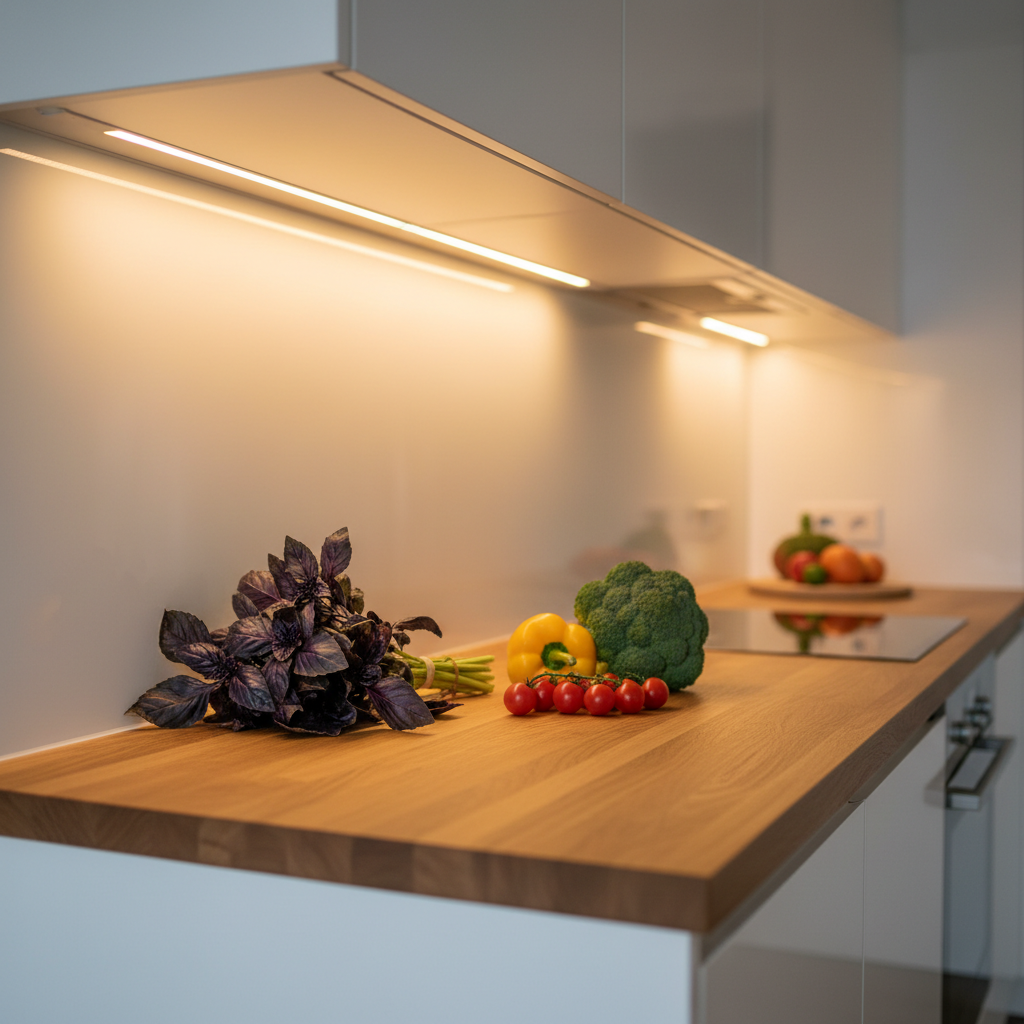
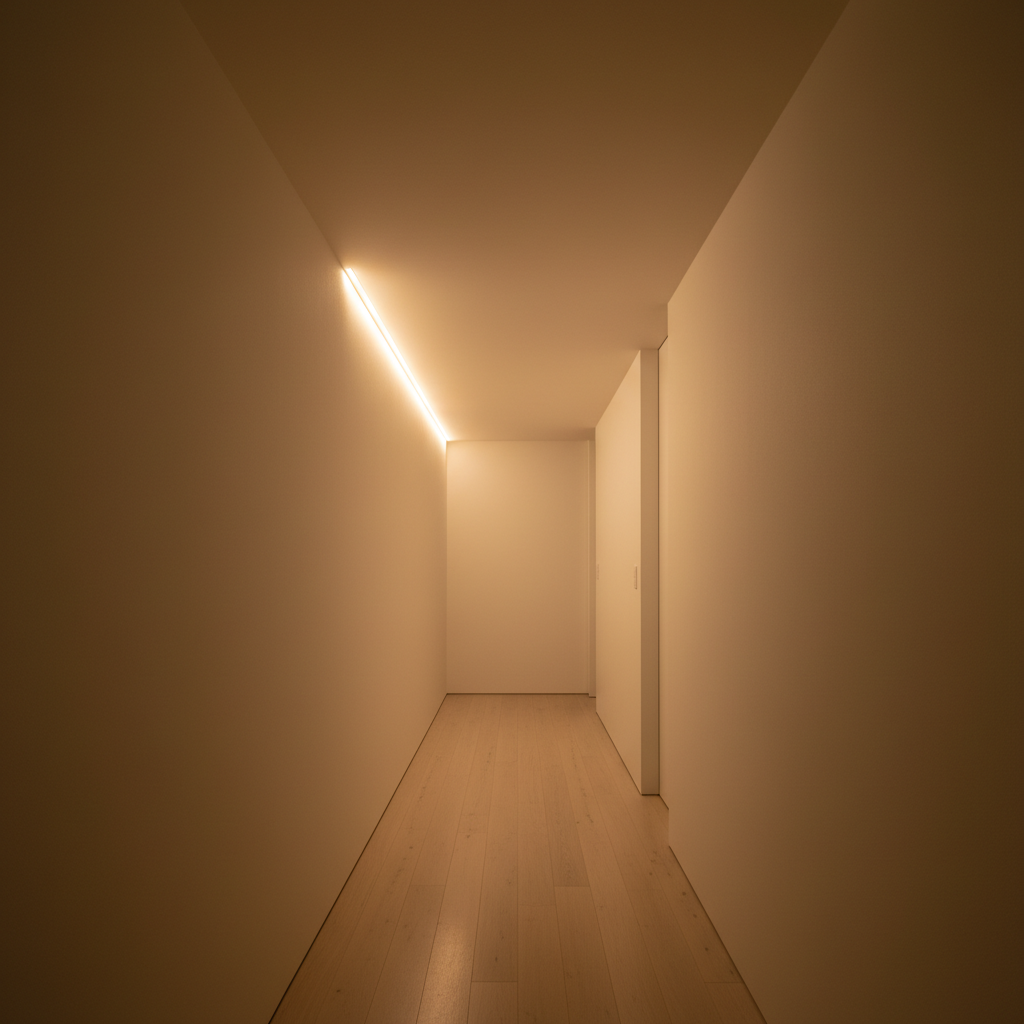
Your hallway is dark, narrow, and windowless. Yet, you walk through it ten times a day. At night, you fumble for the light switch. In the morning, you're hit with harsh light. In between, the overhead light stays on for hours, wasting energy.
This guide helps you understand why most hallways are poorly lit, what simple changes you can make, and when an automatic lighting solution is truly necessary.
Why the Hallway is the Most Neglected Room in Your Home
Bedrooms, living rooms, kitchens — we carefully plan their lighting. Hallways, however, often get stuck with an old, central overhead light installed during construction, and that's it. Yet, it's the room you traverse most frequently.
A Hallway Without Natural Light: The Core Problem
An interior hallway typically lacks windows. It's a structural reality. Even in the middle of the afternoon, it remains dim. The result: artificial lighting is essential at all hours — morning, evening, and night. Not just after dark.
This constant reliance on electric light makes the hallway unique in the home. A kitchen might manage without it during the day if it faces outside. A hallway cannot. This fundamentally changes how you should approach its lighting.
Is a Central Overhead Light Enough?
Before investing in anything, ask a simple question: does your current overhead light actually do the job? Sometimes, the problem isn't the fixture, but the bulb. Replacing a 40W incandescent bulb with an LED of the same base (E26 or GU10) can double the perceived brightness for just a few dollars.
Check this first. If the bulb is already LED and the hallway remains dim, then the issue lies with the number of light sources or their placement — and other solutions are needed.
The Poorly Placed Switch: A Source of Frustration
Another classic hallway problem: the switch is at the entrance but not the exit. You enter the hallway, turn on the light, walk through, arrive in the next room... and have to go back to turn it off. Or you leave it on. Either way, it's a daily annoyance.
Wired solutions (3-way switches, smart switches) exist but require electrical work. This is where automatic lighting with a motion sensor truly makes a difference.
Real Options to Improve Your Hallway Lighting
There's no single answer for a dark hallway. Solutions vary depending on your situation — homeowner or renter, access to electricity, short or long hallway. Here are the main options, honestly evaluated.
Option 1: Change or Add an LED Bulb to the Existing Fixture
This is the logical starting point. If you have a functional overhead light, swap the bulb for an LED with 800 to 1000 lumens and a neutral white color temperature of 4000K. The effect is immediate. Cost: less than $10. No tools, no work.
The limitation: this doesn't solve the problem of a poorly placed switch or dark areas at the end of the hallway. And it won't turn on automatically at night.
Option 2: Install a Wired Wall Sconce with a Motion Sensor
A wall sconce with an integrated motion sensor, plugged into an outlet or hardwired into the wall, is a durable and aesthetic solution. It turns on when you pass by and turns off automatically after a customizable delay.
The catch: if wiring isn't already present, you'll need an electrician. Expect to pay between $150 and $300, depending on the configuration and cable length. For renters, this is often impossible without landlord approval.
Option 3: A Rechargeable LED Light Bar with Motion Sensor
This solution has been a game-changer for many. No wires, no drilling, no electrician. You attach the light bar to the wall (or under a cabinet, or in a corner), and it turns on automatically when you pass.
The principle is simple: the motion sensor detects your presence, the light turns on, and it turns off automatically after a few seconds. For a hallway where you rarely spend more than 30 seconds, this is exactly what you need. To learn more about this type of product, check out our article on the best indoor motion sensor light.
Why a Motion Sensor is Ideal for a Hallway
You never linger in a hallway. You pass through. It's functional by definition. And that's precisely why a motion sensor is the smartest solution for it.
Real Energy Savings in a Hallway
An overhead light left on continuously in a hallway—because you forget to turn it off, because you'll be back, because it's nighttime—wastes energy. With a motion sensor, the light only turns on when someone is present. In a typical hallway where passages last 10 to 30 seconds, the difference in consumption between permanent and automatic lighting is very significant over a year.
Nighttime Comfort: Light Without Glare
At night, when you get up to go to the bathroom or kitchen, the last thing you need is a harsh, cool white light assaulting your eyes. Effective hallway lighting at night should be soft, downward-facing, and warm white.
Color temperature really matters here. At 3000K (warm white), the light remains soft and doesn't disrupt your sleep cycle. At 6000K (cool white), it's much more aggressive. For a hallway used at night, 3000K is essential. To better understand how automatic hallway lighting works, we've created a complete guide.
No-Drill Installation: The Advantage of Magnetic Solutions
Rechargeable LED light bars with magnetic and industrial adhesive mounting install in under a minute, with no drilling, no wiring, and no tools. This is particularly useful in a hallway where drilling into a load-bearing or tiled wall is often complicated.
For renters, it's the only truly non-destructive option. The adhesive surface sticks to plaster, tile, wood, painted concrete—provided the surface is clean and dry at the time of installation.
How to Choose the Right Light for Your Hallway
Now that you know why your hallway is dark and what solutions exist, it's time to choose. Here are the criteria that truly matter.
What Length of Light Bar for a Hallway?
For a standard hallway (31.5 to 47 inches wide), a 9-inch light bar is sufficient for accent lighting or a nighttime nightlight. To truly illuminate a longer or wider hallway, a 16-inch light bar with higher luminous flux (around 320 lumens) will be more effective.
Placement also matters: mounted high on the wall or under a low cabinet, it will illuminate differently. For a hallway, the most effective placement is often around 70 inches high, angled downwards, or by using two light sources alternately on the sides if the hallway is long.
Which White to Choose: 3000K, 4000K, or 6000K for a Hallway?
The answer depends on usage:
- 3000K (warm white): Ideal for a hallway used at night. Soft, non-aggressive light for the eyes. Recommended for entrances and nighttime corridors.
- 4000K (neutral white): A good compromise for a daytime-only hallway where you need clear light without it being cold.
- 6000K (cool white): Best reserved for spaces where you need maximum visibility—not really suitable for a residential hallway.
In most hallways, 3000K is the best choice. You can also opt for a light bar with adjustable brightness if you want to modulate it according to the time of day.
Comparative Table of Hallway Lighting Options
| Solution | Installation | Estimated Cost | Automatic | Ideal For |
|---|---|---|---|---|
| Change LED Bulb | Immediate, no tools | Less than $10 | No | Existing overhead fixture |
| Wired Sconce + Sensor | Electrician required | $150 to $300 (installation) | Yes | Homeowners with electrical access |
| Rechargeable Magnetic LED Light Bar | Less than 1 minute, no drilling | Light bar price only | Yes (motion sensor) | Renters, hallways without nearby outlets |
| Decorative LED Strips | Simple adhesive | $20 to $60 | No (unless smart) | Ambiance, not functional lighting |
What to Absolutely Avoid in a Hallway
Some common mistakes found in poorly lit hallways—it's worth explicitly naming them to avoid repetition.
Don't Multiply Ceiling Lights Without Considering Direction
A single recessed spotlight in the center of a 13-foot long hallway will create dark areas at the ends. Adding more spotlights without considering their orientation won't solve the problem and can even create unpleasant glare.
It's better to think in terms of coverage: two well-placed light sources are better than one powerful, poorly aimed one. If you opt for light bars, positioning them in the middle of the hallway, alternately on each side, often yields better results than a single central light.
Choosing Too Cool Lighting for a Nighttime Passage Area
As mentioned earlier, it bears repeating: a hallway used at night with 6000K lighting becomes a sensory assault. If you get up at 3 AM, you just need enough light to avoid bumping into things, not operating room brightness. 3000K or even a very soft nightlight is more than sufficient.
Ignoring Battery Life if Choosing a Rechargeable Solution
A rechargeable light bar is convenient—provided the battery actually lasts. Low-end models sometimes only last 3 or 4 days with normal use. This isn't enough for an active hallway. Aim for a battery life of at least 3 to 4 weeks in motion detection mode to avoid recharging every week. To delve deeper into this topic, our article on rechargeable LED lighting and its lifespan provides concrete benchmarks.
Installing Automatic Lighting in a Hallway: What to Expect
Practically, what happens when you install an LED light bar with a sensor in a hallway? Here's what you can expect.
The Installation Itself
For a magnetic light bar with industrial adhesive, the process is simple: clean the surface (clean and dry is the number one condition), apply the adhesive backing, wait a few minutes for it to adhere, and then place the light bar on the magnetic mount. It holds. It can be repositioned if you change your mind about the location.
No screws, no anchors, no cables. For a hallway with painted plaster or tiled walls, this truly makes a difference. For a detailed step-by-step guide, check out our article on easily installing automatic lighting in your hallway.
Daily Behavior with a Sensor
In the morning, you walk by, the light turns on. You don't press anything. At night, same thing—at 3000K, it's soft. After you pass, it turns off automatically. Most light bars with sensors have an adjustable shut-off delay (often 10, 30, 60 seconds). For a hallway, 15 to 30 seconds is generally well-calibrated.
The ambient light sensor is also important: when it's daytime and the hallway is sufficiently lit, the light bar won't turn on even if you pass. It only activates when it's truly dark. This detail prevents waste during the day.
Movement 3.0 in Hallways: What it Actually Provides
If you're looking for a wireless rechargeable light bar for your hallway, Lumic's Movement 3.0 is well-suited for this use. It's available in 9 inches (approximately 150 lumens) or 16 inches (approximately 320 lumens), with three color temperatures to choose from—including the 3000K recommended for nighttime hallways. The 3000 mAh battery (3 times larger than low-cost alternatives) lasts approximately 4 to 6 weeks in detection mode, depending on how often you pass, which avoids frequent recharges.
The magnetic attachment allows you to detach the light bar in 2 seconds for USB recharging, then put it back in place. No need to touch it daily. With a 5-year warranty and 90-day satisfaction guarantee, it's a risk-free purchase if you want to try it without a long-term commitment. Average rating 4.5/5 on over 2200 Trustpilot reviews.
Further Reading: Frequently Asked Questions About Hallway Lighting
How many lights are needed in a 13-foot hallway?
For a 13-foot long hallway of standard width (31.5-39 inches), a single central light source might be enough if it's well-aimed and powerful enough. But two light sources—one at the beginning and one in the middle/end of the hallway—provide more uniform lighting and eliminate dark spots. If you use motion sensor light bars, place them so their detection fields slightly overlap.
Does a motion sensor turn on for no reason at night?
This can happen with low-end models: a cat, a door moving, a draft shifting a curtain. Good PIR (passive infrared) sensors are calibrated to detect human body heat, not small movements. If your sensor triggers too often, check that it's not aimed at a heat source (radiator, vent) or an area exposed to drafts. To better understand how a motion sensor works for lighting, we explain everything in detail.
What solution for a nightlight in a hallway?
For nighttime, the need is different: no need to light the entire hallway, just enough to navigate without tripping. A small 3000K light bar with adjustable brightness set to its lowest level works very well as a nightlight. You can also find very affordable LED nightlight plugs, but they require an accessible power outlet in the hallway. For hallways without outlets, a rechargeable light bar remains the simplest solution. Consult our guide on hallway nightlights to compare options.
Summary: Which Solution for Your Hallway?
To choose the right hallway lighting, start by diagnosing your actual problem:
- Hallway lit but insufficient light: Change the bulb to an 800+ lumen LED. Minimal cost, immediate effect.
- Hallway with functional overhead light but poorly placed switch: Add a motion sensor light bar as a supplement. It turns on when you pass, solving the problem without renovations.
- Hallway without a light source or easy electrical access: Rechargeable magnetic LED light bar. Installs in 30 seconds, lasts several weeks, zero cables.
- Renter or limited budget: The no-drill rechargeable light bar is your only true option without renovations. It works, it stays put, and it removes without leaving a trace.
Hallway lighting isn't a luxury—it's about safety and daily comfort. And contrary to popular belief, solving it doesn't necessarily cost a lot or require an electrician. To compare different available models, our guide on choosing an indoor motion sensor light will give you all the necessary benchmarks.