You look at your garden at night and feel something's missing. The space is there, the plants too, but as soon as the sun sets, everything disappears into darkness. It's not about budget or major renovations; it's about method. Good garden lighting is rarely just a single lamp in the middle. It's a composition—like indoors, but outside.
The main takeaway: a well-lit garden always relies on at least 3 types of lighting combined. Ambient, functional, accent. This is called the Rule of 3. When these three levels coexist, the result is radically different from what you see in most North American gardens.
Here's how to plan your garden lighting, zone by zone, effect by effect.
The Rule of 3: Why One Type of Lighting Is Never Enough
Most people install security lighting at the entrance, maybe some candles on the patio, and that's it. The result: the entrance is over-lit, the patio is dim, and the garden ceases to exist after 9 PM.
The Rule of 3 is simple:
- Ambient Lighting: Creates the general atmosphere, adds warmth to the space. String lights, ground lanterns, diffused light above a table.
- Functional Lighting: Guides, secures, allows movement. Pathway bollards, entrance spotlights, path markers.
- Accent Lighting: Highlights a specific element—a tree, a facade, a green wall. This is what differentiates a lit garden from a staged garden.
These three levels are not mutually exclusive. They overlap and complement each other. A tree lit from below, string lights overhead on the patio, and bollards defining the pathway: that's what you see in gardens that truly invite you to spend evenings outdoors.
How to Distribute These 3 Types in Your Space?
Mentally map your garden with 3 zones: circulation areas (pathway, entrance, stairs), living areas (patio, dining area, outdoor lounge), and decorative areas (flowerbeds, trees, walls). Each zone gets a primary lighting type—and sometimes two, if it's central to your use.
Can You Light a Garden Without Electrical Work?
Yes, and it's even the preferred solution for most gardens today. Solar lighting and wireless fixtures have reached a performance level that often makes electrical work unnecessary for common uses. Wireless outdoor lighting solutions allow you to install, move, and adjust your fixtures without wiring constraints.
Grazing Lighting: Creating Depth in a Flat Garden
Grazing lighting is probably the most underestimated technique in garden lighting design. The principle: position a light source very close to the ground, oriented horizontally or slightly upwards, to reveal textures—grass, gravel, pavers, low vegetation.
Immediate result: a garden that looked flat during the day gains real depth of field at night. Cast shadows create relief. A pathway bordered by in-ground spotlights or small grazing projectors becomes a true path of light, not just a strip of gravel.
What Fixtures to Use for Ground Grazing Lighting?
Recessed spotlights are ideal if you're okay with a minor installation. Spike lights are more flexible and can be moved seasonally. Low bollards (under 16 inches / 40 cm) play a similar role by illuminating the ground laterally. The key: maintain angles close to horizontal, not vertical. A light pointing skyward loses all its grazing effect.
Can Solar Spotlights Be Used for Grazing Lighting?
Yes, provided you choose models with good light output. Powerful solar lights can achieve truly effective grazing lighting, even without a nearby electrical outlet. Battery life is sufficient for a full night in continuous low mode or motion sensor mode.
Vertical Lighting: Highlighting a Tree or Facade
This is the most spectacular effect, and also one of the simplest to create. Just place a spotlight on the ground, at the base of a tree or wall, aimed upwards. The tree is suddenly staged: its trunk, branches, canopy. At night, it becomes the garden's main subject.
This technique works particularly well on:
- Trees with interesting silhouettes (olive, birch, bamboo, umbrella pine)
- Stone or brick walls, where upward grazing light reveals textures
- Green walls or trimmed hedges, for a very architectural look
- House facades, to create a soft transition between interior and exterior
The classic mistake: using light that's too cool (bluish white) for this purpose. Opt for a warm white around 3000K to maintain a pleasant atmosphere and avoid a stadium effect.
How to Aim a Spotlight at a Tree?
Place the spotlight 12 to 24 inches (30 to 60 cm) from the base of the trunk, never right against it. Aim it upwards at about a 45° angle. For wider trees, you can use two spotlights positioned slightly offset to envelop the canopy. The goal isn't to light the entire tree but to create a play of light and shadow among the branches.
Suspended Lighting: Festive Ambiance Over the Patio
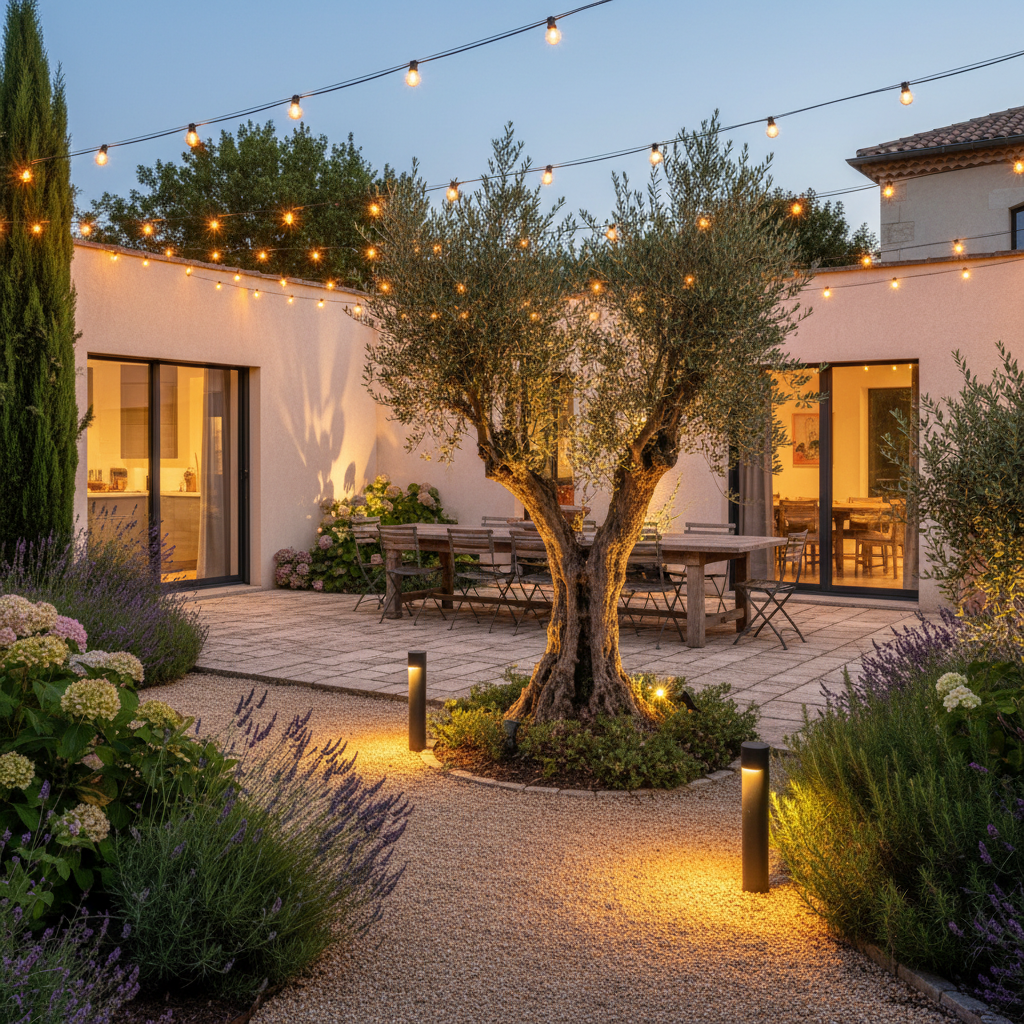
Outdoor string lights are perhaps the best-selling garden lighting product—and for good reason. Strung between two walls, stretched over a patio, or wrapped around a pergola, they instantly create a Mediterranean vacation atmosphere.
But pay attention to a few details that make all the difference between elegant string lights and a Christmas market display:
- Bulb size: Small globe bulbs (like Edison G40 or G30 style) give a warmer look than micro fairy lights.
- Hanging height: Ideally between 7.2 and 9.2 feet (2.20m and 2.80m) above the ground. Below that, you'll bump your head. Above that, the ambient effect disappears.
- Density: Too sparse a string won't light anything. Aim for about 1 bulb per 3 feet (1 meter) for a convincing result.
For patios without attachment points, wireless and solar options bypass the problem. Wireless patio lighting offers true placement freedom, without running a cable from the house.
Solar or Plug-in String Lights for a Patio?
It depends on usage. If the patio is covered or north-facing, solar string lights might lack battery life in winter. For a south or east-facing patio, solar recharging is usually sufficient from April to October. Outside this period, a plug-in solution is more reliable.
Can You Mix String Lights and Lanterns on the Same Patio?
Not only is it possible, but it's even recommended. String lights create general overhead lighting, and lanterns placed on the table or ground add more intimate light points. This is exactly the Rule of 3 applied to a single zone.
Pathway Lighting: Structuring Space and Guiding Steps
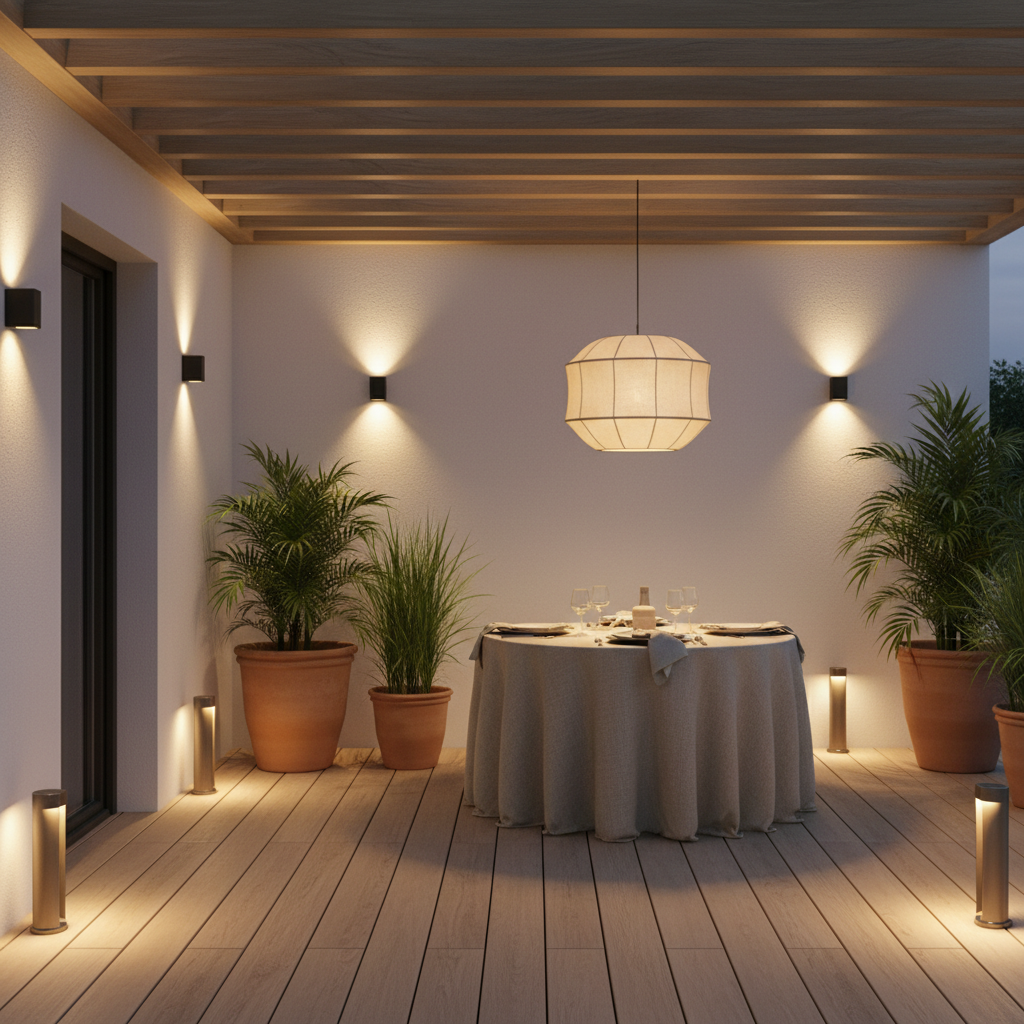
Bollards and pathway lights have a dual function: illuminating circulation areas to prevent falls, and visually structuring the space. When bollards define a path, the garden gains a clear organization, even from a distance.
Pathway lighting is the most functional of the three—but it can also be aesthetic. Designer bollards in brushed aluminum or rusted Corten integrate as architectural elements in the garden.
Some practical rules:
- Space bollards 5 to 6.5 feet (1.5m to 2m) apart maximum for continuous marking.
- Alternate bollards on each side of the path for a more dynamic effect than aligning them side-by-side.
- Do not exceed 20 inches (50 cm) in height to maintain low lighting that guides without dazzling.
If you want to light these garden paths without major work, autonomous solar bollards are now perfectly effective for standard pathway use.
What Height for Pathway Bollards in a Garden?
Between 16 and 24 inches (40 and 60 cm) is the ideal height for pathway marking. Below 16 inches, bollards get lost in vegetation in summer. Above 24 inches, they fall into the lamppost category and create light directed too much towards the face rather than the ground.
Functional Lighting: The Entrance, a Priority Zone
Of the five garden zones, the entrance is one you can't neglect. It's the first thing people see when they arrive—and often the last area to be well-lit. A poorly lit gate, a dark entrance path, invisible steps: it's both uncomfortable and unsafe.
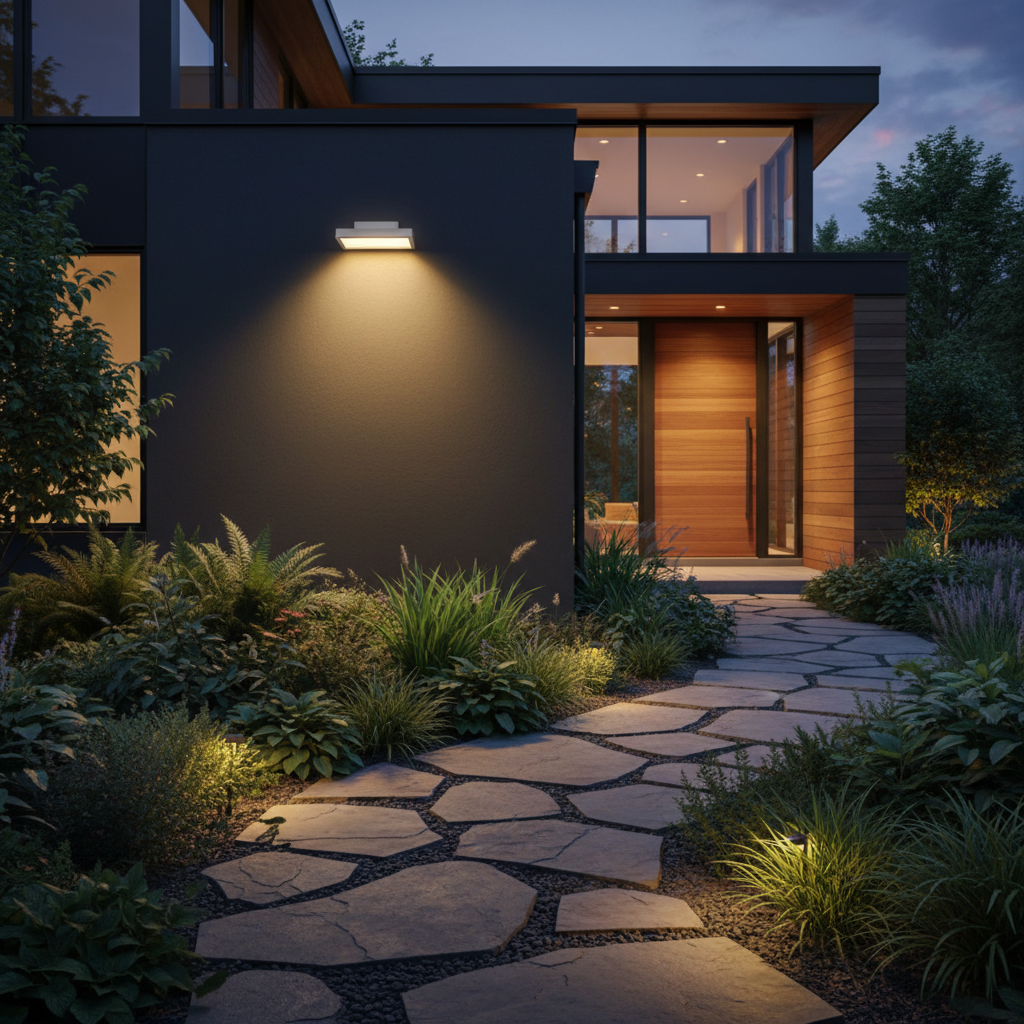
Entrance lighting must fulfill three functions simultaneously: visual guidance, intrusion deterrence, and a warm welcome. The most effective solution for this specific area is a motion-sensor wall light. It stays off when no one is passing, turns on as soon as someone approaches, and turns off automatically. No unnecessary consumption, no manual intervention.
The SolarGlow by Lumic is designed exactly for this: 1200 lumens triggered by two 180° motion sensors, with a range of up to 26 feet (8 meters), IP65 rated (rain and frost resistant), and 100% solar. It installs in minutes without cables. A serious option if you're looking for solar lighting solutions adapted to each garden zone, without relying on an electrical outlet.
How to Choose a Motion Sensor for a House Entrance?
Range and detection angle are the two main criteria. A 180° sensor covers the entire width of a standard entrance. A range of 20 to 26 feet (6 to 8 meters) allows it to turn on well before a person reaches the door. Avoid models with excessively long re-activation times (more than 30 seconds) which create annoying blind spots.
Inspiration: 4 Garden Atmospheres to Find Your Style
Before choosing your fixtures, you need an idea of the final look you're aiming for. Here are four typical atmospheres, each with a different combination of the three lighting levels.
The Mediterranean Atmosphere
String lights suspended over the patio, floor lanterns around the dining area, ground spotlights on olive trees or lavender. All in warm white 3000K. Result: warm, inviting, summery even in fall. This is the easiest atmosphere to create and the most universally appreciated.
The Architectural Atmosphere
Recessed ground spotlights aimed at walls and the facade, very clean designer bollards on the path, no string lights. All in neutral white 4000K. Result: modern, structured, elegant. Perfectly suited for minimalist gardens with sparse vegetation and many materials (concrete, slate, wood).
The Enchanted Forest Atmosphere
Spotlights recessed in moss or the ground around trees, spike lights in flowerbeds, string lights woven into vegetation rather than suspended. In warm white 2700K to 3000K. Result: magical, organic, fairy-tale. Ideal for gardens with rich vegetation and few architectural elements.
The Scandinavian Atmosphere
Simple, clean ground markers on the path, one or two accent lights on natural elements (gravel, birch, grasses), and a single diffuse ambient source near the patio. Very few fixtures, but well-placed. In warm white 3000K or even 2700K. The motto: less, but better.
To refine your choice of fixtures according to these atmospheres, designer solar lights now offer truly refined aesthetic results—no longer just functional.
Mistakes to Avoid for Successful Garden Lighting
Even with good intentions, certain mistakes often recur in poorly lit gardens. Here they are, with their solutions:
- Too much cool white light: Cool white (5000K-6500K) is pleasant in a bathroom, not in a garden. It gives a sterile, almost clinical look. Stay below 4000K for outdoor living spaces.
- Everything at the same height level: If all your fixtures are 6 feet (1.80m) off the ground (standard wall sconce height), you lose all the effect of light layering. Mix heights: at ground level, mid-height, suspended.
- Too many identical light sources: Fifteen identical bollards scattered everywhere create a parking lot effect, not a garden. Vary the types of fixtures.
- Ignoring transition zones: The space between the house and the garden (patio, stairs, doorway) is often under-lit, yet it's a high-traffic area.
- Not testing the night rendering before permanent installation: If your fixtures are portable or solar, spend a night observing the effects before permanently fixing anything.
To learn more about available options for aesthetic and reliable solar fixtures, there's a much richer selection today than five years ago, with truly refined finishes that integrate into a designed garden.
Where to Start Practically?
The most effective method is to work zone by zone, applying the Rule of 3 to each key space. Here's a priority order that works in most configurations:
- The entrance first: security, welcome, first impression. A motion-sensor light is often enough.
- The patio next: this is where you spend the most time in the evening. Start with ambiance (string lights or lanterns) before adding accent.
- The main pathway: pathway lighting guides nighttime movement and visually structures the space.
- Accent elements: last, because they are optional but truly transform the look.
If you're starting from scratch and want to avoid positioning mistakes before investing in fixed fixtures, begin with solar and wireless models. They allow you to experiment with placements freely. Wireless outdoor lighting solutions are now powerful enough to be permanent, not just temporary.
Successful garden lighting isn't about budget. It's about method: combining the right effects, respecting light levels, and treating each zone for what it is. With the Rule of 3 in mind and some good outdoor lighting ideas, your garden can become a true living space even after sunset.