You drive past your house at night and see... nothing. Or almost nothing. A poorly lit facade is a missed opportunity: no welcome, no enhancement, no security. Yet, lighting a facade has never been simpler — provided you know where to start.
This guide presents the 3 concrete approaches to lighting your exterior facade, mistakes to avoid, and how to choose without embarking on projects that cost more than expected.
Why Facade Lighting Really Deserves Your Attention
Facade lighting serves three functions simultaneously, which makes it unique.
Architectural Enhancement: Your Home Deserves to Be Seen
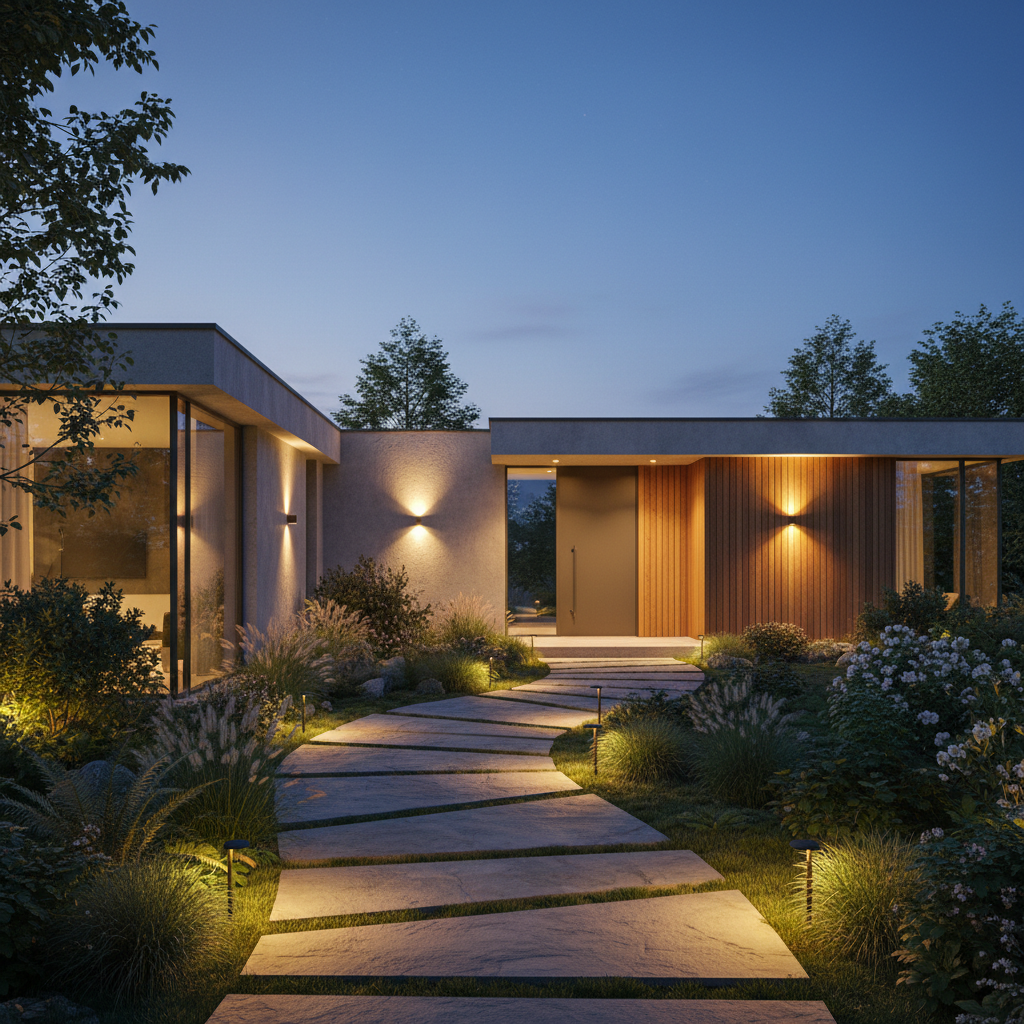
A well-lit facade completely transforms the appearance of a house at night. Volumes, materials, textures — everything takes on another dimension with properly positioned light. This isn't just for luxury villas: even a simple facade can gain character with two or three well-placed light points.
The idea isn't to light brightly, but to light smartly. Grazing light on stucco, a beam directed at a stone facade, a discreet strip light under an awning — each choice creates a different ambiance.
Security and Deterrence: Lighting That Works Without You Thinking About It
A lit facade, especially with a motion sensor, sends a strong signal to ill-intentioned individuals. The main entrance, gate, garage — these areas deserve special attention. And unlike a light that stays on all night (energy-intensive and less effective), motion-activated lighting immediately draws attention.
Welcoming Visitors: First Impressions Start Outdoors
When someone arrives at your home at night, they should easily find their way, feel expected, and be able to read your house number or ring your doorbell without turning on their phone's flashlight. These small details make all the difference in your guests' experience.
The 3 Approaches to Lighting an Exterior Facade
There isn't just one way to light a facade. Depending on the desired effect and your home's architecture, three approaches clearly stand out.
Wall Sconce: The Most Common Option, Often the Most Effective
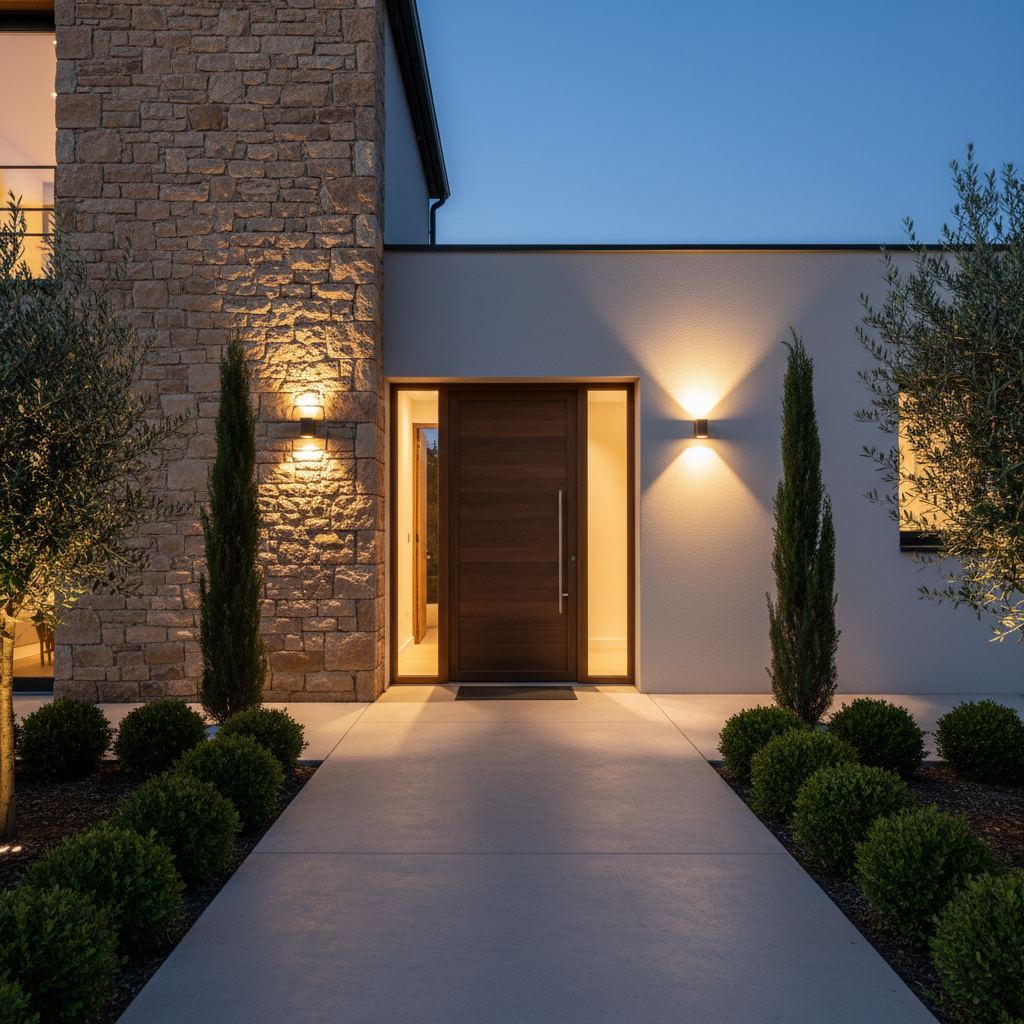
Wall sconces attach directly to the facade wall, usually on either side of the front door or framing windows. It's the most widespread solution, and for good reasons: it illuminates at human height (7 to 8 feet recommended), integrates naturally into the architecture, and is immediately functional for welcoming visitors.
Two screws. That's all a modern solar wall sconce requires. No trenching, no electrician, no extension cord to hide. For facades facing south or east, the integrated solar panel charges during the day and provides autonomous light as soon as night falls.
To choose your sconce wisely, consult our guide on how to choose and install an outdoor solar wall sconce — the criteria differ from classic wired sconces.
Ground-Mounted Spotlight: The Ultimate Architectural Effect
You've probably seen hotel or restaurant facades lit from the bottom up, with beams rising along the wall and revealing textures. This is exactly what a ground-mounted spotlight, facing the facade, achieves.
The effect is spectacular on stone or brick facades, or those with architectural relief elements (columns, eaves, window frames). Grazing light creates shadows and contrasts that add volume and character to materials that appear flat during the day.
For this approach, power matters more than for a sconce. A solar outdoor spotlight with sufficient light output can cover several feet of facade from a single ground point — without trenching or burying cables.
Indirect LED Strip Light: For a Soft, Contemporary Ambiance
LED strip lights are less common on facades but are gaining traction in contemporary architecture. The idea: a discreet LED strip tucked under an awning, along a cornice, or outlining an entrance, projecting indirect light onto the facade without being visible itself.
The effect is sophisticated: the light seems to emanate from the building itself rather than an identifiable source. This approach requires a bit more thought in implementation (the strip must be protected from weather with a suitable profile), but the result is unique.
This option remains mostly wired in practice, as long-distance LED strips require a stable power supply. This is where investing in an electrical installation can be justified — if you're considering a larger project.
Wired or Solar for a Facade: What No One Really Tells You
This is often the first question. And the answer is simpler than it seems when you look at the facts.
The True Cost of Wired Facade Lighting
Wired facade lighting isn't just about buying a sconce and plugging it in. You need to plan for:
- Cutting a channel in the wall to run the cable (often up to 1.2-1.6 inches deep)
- Patching and repainting the facade along the entire length of the cable run
- An electrician's intervention for code compliance
- An electrical panel with appropriate protection
The total can easily reach $500 to $1,000 per light point, depending on your home's configuration and the length of cabling required. And if you change your mind in two years about the location or model, you start over.
Why Facades Are Ideal for Solar
It's a paradox few people realize: facade walls are among the best sun-exposed surfaces. Facing south or southeast, they capture direct light for a large part of the day — exactly what a solar panel needs to recharge efficiently.
Unlike a location under trees or in a shaded corner, a clear facade is generally the best place to install a solar light. This explains why solar results on facades are often better than elsewhere in the garden.
To explore all available options, this comparison of wireless outdoor lighting solutions will help you refine your choice based on your setup.
The Winter Question: Does Solar Hold Up?
Honestly, not all solar lights perform equally in winter. Low-end models with small panels and low-capacity batteries can disappoint between November and February, when days are short and skies are often cloudy.
What makes the difference: the size of the solar panel and the battery capacity. The larger they are, the more energy the light accumulates on sunny days to last through sunless days. This is where model selection becomes truly important — and where buying at the lowest price can cost you dearly in disappointment.
How High to Place Facade Lighting?
Mounting height is a technical detail many overlook, yet it completely changes the result.
For a Wall Sconce
The ideal height for a facade sconce is between 7 and 8 feet from the ground. At this height, the light naturally falls onto the pathway, it's out of direct reach for visitors (no glare when looking towards the door), and it illuminates a sufficiently wide area in front of the entrance.
Too low (less than 5 feet), it causes glare and poorly lights the ground. Too high (more than 10 feet), it loses effectiveness in the welcoming area and looks like construction lighting.
For a Ground-Mounted Spotlight
The spotlight is ideally placed 20-30 inches from the base of the facade, slightly angled upwards. The distance from the wall depends on the desired tilt angle and the height of the facade to be lit. A spotlight too close will create a concentrated funnel effect on the bottom of the wall; too far, it will lose intensity on the upper part.
The basic principle: to light a 13-foot high facade, the spotlight is generally positioned 30-40 inches from the wall. Then adjust the angle according to the visual result.
How to Choose the Right Color Temperature for a Facade
The color temperature of your light completely changes the ambiance of your facade. It's not just a matter of personal taste: certain temperatures work better with certain materials.
Warm White (2700-3000K): Warmth and Character
Warm white is the safe bet for a residential facade. It creates a welcoming look, highlights warm tones (bricks, ocher stucco, wood), and integrates harmoniously into a residential neighborhood. It's the luminous equivalent of a candle or a fireplace — reassuring and hospitable.
Recommended for: stone houses, brick facades, entrances with vegetation, village or country ambiances.
Neutral White (4000K): Modernity and Readability
Neutral white renders colors and architectural details better. It's more suitable for contemporary facades, gray materials (concrete, zinc, smooth stucco), and situations where readability takes precedence over ambiance — house number, mailbox, intercom.
It can appear a bit cold on warm materials. When in doubt, warm white remains more universal for a residential facade.
Cool White (6000K): Avoid on a Private Facade
Cool white (bluish light) is typically used for public or industrial lighting. On a house facade, it creates a cold and unwelcoming ambiance. Avoid it unless you have a very specific architectural project that justifies it.
What Lumic's SolarGlow Brings to a Facade
For facade lighting with no wiring, Lumic's SolarGlow precisely addresses this use case. With 1,200 lumens, it illuminates a significant area in front of an entrance or along a facade — enough for architectural enhancement and deterrence.
The integrated solar panel is sky-facing, optimizing capture on an exposed facade wall. Motion detection (two 180° sensors, range of approximately 26 feet) saves battery life and creates a visible light signal when someone approaches. IP65 resistance ensures weatherproofing — rain, snow, frost — without additional protection.
Installation is as simple as two screws in the wall. No trenching, no cables, no electrician. And if you change the facade or move, you take it with you — 5-year warranty, 90-day money-back guarantee.
If you're still hesitating between several models or approaches, this guide on how to choose an outdoor solar wall light details the criteria to check before buying.
Mistakes to Avoid When Lighting a Facade
Some mistakes are common, and they make all the difference between a satisfactory result and an installation you regret six months later.
Choosing Too Low (or Too High) Power
An entrance sconce with too few lumens barely lights your doorstep. One that's too powerful blinds your neighbors and creates a parking lot ambiance. For a standard entrance, aim for 500 to 1,000 lumens on a wall sconce. For a spotlight effect on a large facade area, go for 1,000 lumens and above.
Neglecting the Luminaire's Daytime Aesthetics
The light is also visible during the day. An unsightly luminaire or one that clashes with the facade will be there for years. Take the time to check the visual rendering of the product on the wall, not just its light efficiency at night.
Putting All the Light in One Place
Two sconces on either side of the front door are good. But if the driveway, gate, or garage remain in darkness, the overall effect is ruined. Facade lighting should be thought of holistically, covering pathways and architectural elements you want to highlight.
Buying a Cheap Solar Light to Save Money
This is the most common mistake. Models sold for a few dollars at big box stores or general marketplaces often promise performance they don't deliver — especially in winter or cloudy weather. Disappointment is almost guaranteed after a few weeks. A model with a larger solar panel and higher capacity battery costs more upfront but delivers on its promises long-term. To better understand the real technical differences, consult our article on what they don't tell you about powerful autonomous outdoor lighting.
Ignoring the Motion Sensor
A facade continuously lit all night wastes energy (even with solar, the battery drains faster) and creates a less striking visual effect than a light that turns on with motion. The motion sensor is not a gadget: it's what makes facade lighting truly smart. Comparing wired and solar options for outdoor lighting with a motion sensor will help you decide what best suits your situation.
Recap: Where to Start Practically?
Want to light your facade without getting lost in options? Here's how:
- Identify priority areas: main entrance, gate, garage, side access
- Define the desired effect: warm welcome (warm white sconce), architectural enhancement (ground spotlight), contemporary ambiance (indirect strip light)
- Evaluate the solar exposure of your facade walls — if your main facade is well-exposed, solar is most likely the best option
- Choose the right power: 500-1000 lumens for an entrance, over 1000 lumens for a large area
- Opt for a model with a motion sensor: preserved battery life, increased efficiency
Exterior facade lighting doesn't have to be complicated or expensive. With the right choices from the start, you get an aesthetic, functional, and autonomous result — without touching a single electrical wire.