You look at your facade in the evening and think something's missing. Not just light: an object that looks good, integrates cleanly into the architecture, and doesn't resemble those cheap white plastic boxes you see on Amazon for $18.99. You're looking for a designer solar wall light — not a gadget, but a real fixture.
Good news: the offerings have truly evolved in recent years. Bad news: you need to know how to distinguish between a wall light that looks good in a photo and one that still looks good 18 months later. That's exactly what we'll explore here.
Why Solar Wall Lights Have Become a Design Statement
Five years ago, an outdoor solar wall light was noticeable from a distance — and not in a good way. An opaque yellowish diffuser, an exposed solar panel, hastily molded plastic. The unconscious message it sent: functional but not aesthetic.
Things have changed, largely because demand has changed. Homeowners renovating their exteriors now have expectations closer to those they have for their interiors: refined finishes, clean lines, and coherence with the overall facade.
What Makes a Solar Wall Light Truly "Designer"?
It's an honest question, because the word "design" is overused in product descriptions. Concretely, a designer solar wall light is recognizable by a few tangible characteristics:
- Visible Material: Brushed aluminum, zinc, cast iron — not polypropylene that fades in the sun.
- Discreet Solar Panel: Integrated into the fixture's body or intentionally positioned, not obviously placed as an afterthought.
- Geometry: Straight lines, sharp angles, simple volumes. Minimalism isn't a fleeting trend in exterior architecture — it's what ages best.
- Finish: Matte black, anthracite gray, satin white. Opaque, non-reflective finishes visually absorb daylight and blend into the facade.
Matte Black: Why This Finish Dominates 2026 Trends
Matte black has become the go-to finish for designer outdoor solar wall lights, and not by chance. It offers perfect visual neutrality: visible on a light facade, understated on a dark one. It doesn't reflect light during the day, so it doesn't create unwanted visual hot spots. Most importantly, it resists the "aged" look better than white or light gray plastics that yellow over time.
Homes with wood siding, polished concrete facades, lime renders: all these contemporary architectural styles perfectly accommodate a matte black aluminum solar wall light. It integrates without imposing itself.
Styles Defining Modern Solar Wall Lights in 2026
The market for modern outdoor solar wall lights is structured around a few major aesthetic trends. Here's how to interpret them to make the right choice.
The Clean Scandinavian Style
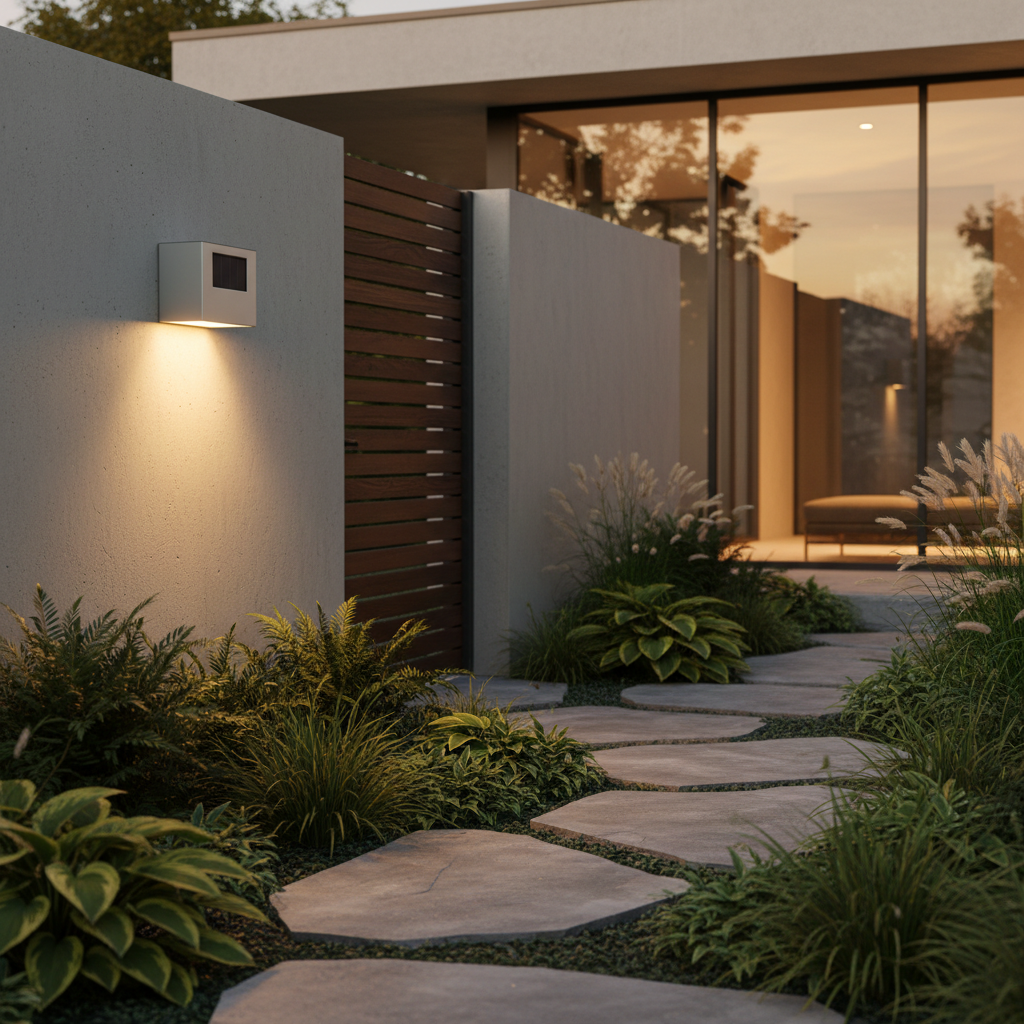
Compact body, downward-facing light (downlight), no superfluous decorative elements. The fixture almost disappears from the facade during the day — it only reveals its existence at night, casting a warm glow on a wall or pathway. This style is perfect for timber-frame houses, Nordic architecture, and white or light-colored facades.
The Contemporary Industrial Style
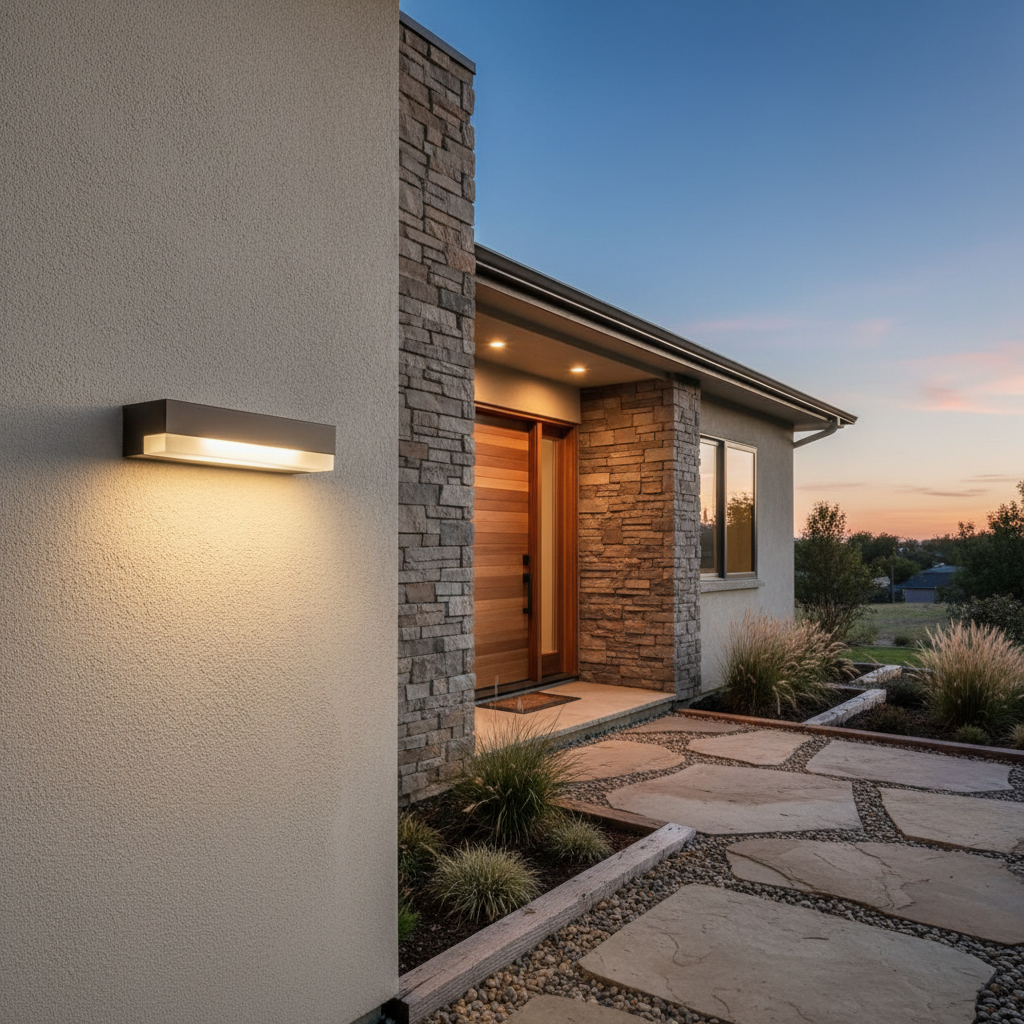
Assertive geometric shapes, visible edges, and exposed material. Aluminum isn't hidden: it's part of the visual language. It often comes in anthracite gray or textured black finishes. These fixtures integrate well on brick facades, metal fences, or steel gates.
The High-End Minimalist Style
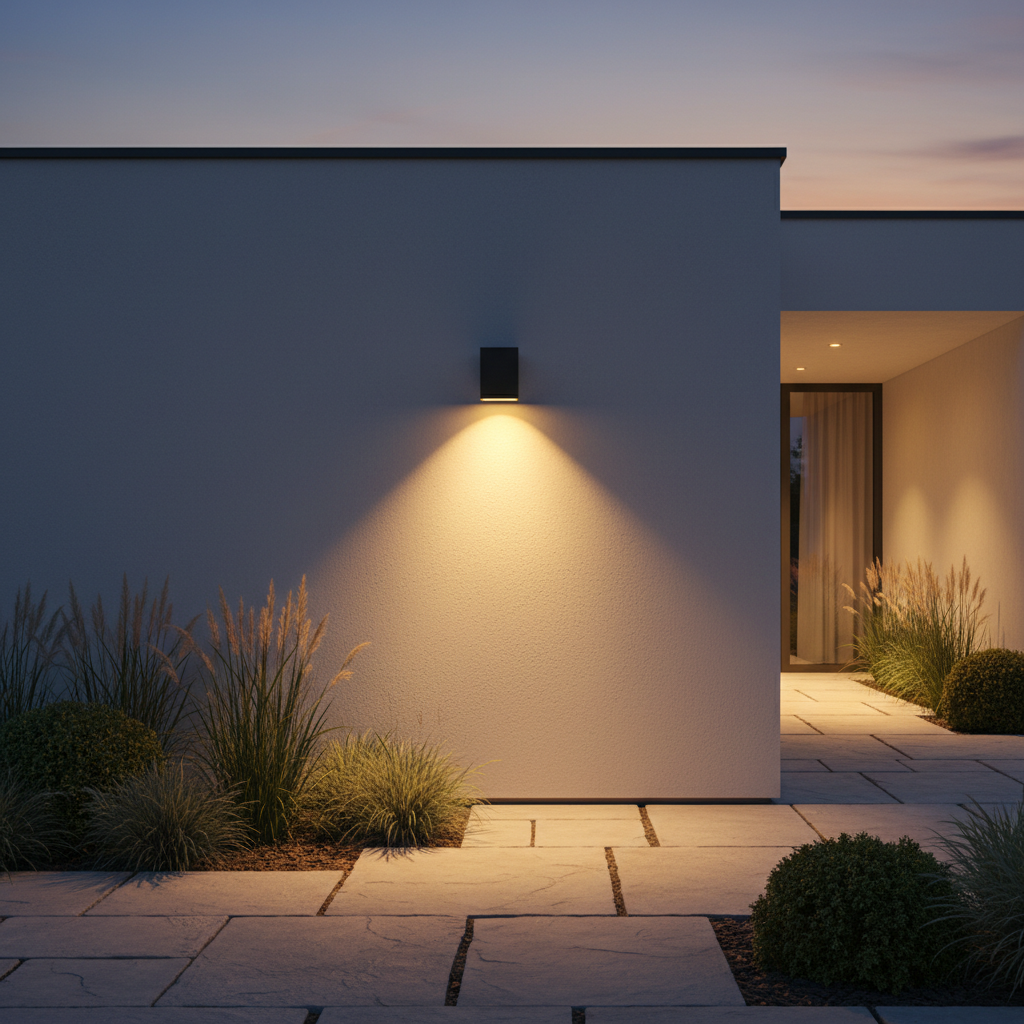
This is probably where the standards are most demanding. A high-end minimalist solar wall light almost resembles a wall sculpture: its presence is intentional, not just tolerated. Finishes are impeccable, angles are perfect, and the emitted light is carefully directed to create a precise effect — not just to illuminate.
To delve deeper into this topic, our article on choosing a beautiful and reliable outdoor solar light details how to reconcile aesthetics and long-term performance.
The Real Problem with Cheap Designer Solar Wall Lights
You may have experienced it, or know someone who has: a beautiful solar wall light bought for $20-$35, convincing photos, seemingly positive reviews. And three months later, the plastic starts to change color. Six months later, the LED loses its brightness. A year later, the whole thing has that grayish tint of outdoor objects that didn't live up to their promises.
Why Plastic Yellows — And How to Avoid It
Standard quality plastic — especially polystyrene and certain untreated ABS — reacts to UV rays. The process is called photodegradation: molecular bonds break under the effect of sunlight, and the color changes. This isn't a manufacturing defect immediately visible. It's a problem that appears precisely when the return period has expired.
Aluminum, on the other hand, does not yellow. It oxidizes very slightly on the surface, creating a thin protective layer — not a degrading one. An aluminum solar wall light maintains its finish over time. That's why high-end exterior architecture almost exclusively uses noble materials for its lighting fixtures.
Fading LED: A Component Quality Issue
Not all LEDs are created equal. In entry-level fixtures, LEDs are often chosen to reduce manufacturing costs, not for their durability. In practice, this results in a visible loss of light output after a few months of use. The light remains, but it's less crisp, less pleasant.
A manufacturer offering a long-term warranty — 5 years, for example — is a clear signal that the components have been chosen to last. You don't guarantee something for 5 years if you know it will fail in 18 months.
How to Integrate a Designer Solar Wall Light into Your Exterior Architecture
Choosing the right fixture is good. Placing it correctly is better. A poorly positioned designer wall light loses 80% of its visual impact.
How High Should a Solar Wall Light Be Placed?
The standard height is between 6.5 and 7.2 feet (2 and 2.2 meters) from the ground for a pathway or entrance. High enough for the beam to cover a useful area without glare, low enough for the decorative effect to be visible from the street. For a gate, you can go down to 5.9 feet (1.8 meters) if the fixture is oriented upwards (wash effect on the pillar) or downwards (ground lighting).
One or Two Light Points: What Composition Logic?
On a simple facade with a single entrance, a single wall light is usually sufficient — provided it has character. On a longer facade or with multiple levels, repetition works well: two or three identical fixtures create a coherent visual rhythm.
Be careful with systematic symmetry: it can work on classical architecture, but it can stiffen contemporary facades. Sometimes, a single, well-chosen and well-placed fixture creates more impact than a regular row.
What Type of Light Orientation for What Use?
The beam orientation completely changes the ambiance:
- Downward (downlight): Soft ambiance, functional light for a pathway or step. More discreet.
- Upward (uplight): Architectural accent effect, grazing light on a wall or pillar. More spectacular.
- Omnidirectional: Wider illuminated area, less directional effect, good for a patio or courtyard.
If you're still unsure about the best positioning or model, the article on choosing and installing an outdoor solar wall light provides very concrete benchmarks.
Motion Detection and Design: Are They Compatible?
It's a legitimate question. We often associate motion sensors with those utilitarian, somewhat crude floodlights seen on warehouses or parking lots. But technology has evolved, and sensors integrated into modern designer wall lights have become almost invisible.
A Discreet Sensor Changes Everything in Visual Integration
Recent designer solar wall lights integrate the sensor directly into the body, with no visible protrusion. The result: during the day, you don't guess that the object reacts to movement. At night, it's a real convenience — the pathway lights up when you arrive, the patio activates when you step out, the gate welcomes you before you even reach for your key.
This automatic behavior, in addition to being practical, preserves battery life. The fixture only consumes power when necessary, extending autonomy between solar recharge cycles.
Continuous Mode or Detection Mode: When to Use Which?
Most designer solar wall lights with detection offer both modes. Detection mode is the good default option for a pathway or gate: energy-efficient, practical. Continuous mode is better for a patio where you want a constant ambient light during dinner or an evening outdoors.
To delve deeper into this topic, our guide on outdoor motion detection technology explains the differences between PIR, microwave sensors, and the range criteria to consider.
SolarGlow: When Design Doesn't Compromise Performance
If you're looking for a high-end solar wall light that ticks the aesthetic boxes without sacrificing performance, Lumic's SolarGlow deserves your attention — and here's why we can say that without exaggeration.
The casing is aluminum. Not plastic tinted gray to look like aluminum: actual aluminum. This concretely changes the durability of the finishes and resistance to UV, rain, and frost (IP65). The shape is understated, without superfluous ornamentation. During the day, it blends into a modern facade without drawing attention. At night, the 1200 lumens create a real lighting zone, not an anemic halo.
Two 180° sensors cover a range of about 26 feet (8 meters) — sufficient for most pathways and entrances. And the battery lasts about 20 days without solar recharge in detection mode. In winter, when sunlight is scarcer, this makes the difference between a fixture that dies after 3 days of bad weather and one that continues to function.
The 5-year warranty and 90-day satisfaction guarantee are part of the equation. Not just as a sales pitch: if a manufacturer is willing to guarantee a product for 5 years, it means they are confident in the real durability of what they sell.
To position this type of wall light among other available outdoor solar lighting formats, the article on different types of outdoor solar lighting provides a useful overview.
Mistakes to Avoid When Choosing a Designer Solar Wall Light
We often see these in customer reviews, renovation forums, or Amazon comments. Here are the most common pitfalls:
- Choosing based on aesthetics without checking the material: A beautiful photo doesn't tell you if it's plastic or aluminum. Look for explicit mention of the material in the product description.
- Neglecting solar panel orientation: Does the spot where you want to place the fixture really receive direct sunlight for a good part of the day? A north-facing or heavily shaded wall will never charge properly.
- Underestimating necessary lumens: For a pathway, less than 400-500 lumens will be insufficient. For decorative ambiance alone, 150-200 lumens might suffice.
- Ignoring the IP rating: IP44 resists water splashes, IP65 resists direct water jets. For a facade exposed to weather, IP65 minimum.
- Buying solely based on price: The real cost of a fixture is the purchase price divided by the years of effective use. A $20 fixture that lasts 2 years costs $10/year. A $60 fixture guaranteed for 5 years costs $12/year — but with better performance throughout those years.
If you're new to this choice and want a structured method, the guide on choosing a solar wall light covers all these criteria in detail.
What Exterior Design Says About Your Home — And How to Choose Well
Exterior lighting is the first thing people see when they arrive at your home in the evening. Before the door, before the facade: the light. A well-chosen designer solar wall light says something about the care you put into your space. It's not superfluous — it's the same logic that makes you choose a beautiful fixture in your living room rather than a bare bulb.
The difference is that outdoors, conditions are more demanding. Sun, rain, temperature variations, UV: all these test the material over time. And that's precisely why the choice of material — aluminum versus plastic — isn't just an aesthetic question. It's a durability decision.
In 2026, trends converge towards modern solar wall lights that embrace their architectural presence: matte black, clean shapes, refined finishes. Fixtures that exist during the day as decorative objects, not just at night as light sources.
If you want your exterior to match your interior, it starts with lighting.