You've searched for designer solar lights and found rows of gray plastic, motion sensors that look like surveillance cameras, and casings yellowed before the first season even ended. This is the historical problem with solar lighting: the promise of energy freedom, but an aesthetic result that makes you want to hide everything behind a potted plant.
Those days are over. Designer solar lights truly exist in 2026, and they deserve a prime spot on your facade, driveway, or patio — not just because they work, but because they enhance your outdoor space.
Here's how to spot the real deal, understand what makes the difference, and choose a solar fixture you'll still be proud of in five years. For a deeper dive into your selection, also check out our guide to choosing outdoor designer solar lights, which details essential criteria.
Why Solar Design Had a Bad Reputation
Let's be honest: the bad reputation was earned. For a long time, solar lights were designed with one goal in mind — cheap production. The result? Translucent ABS plastic casings, awkwardly angled solar panels, motion sensors sticking out like warts, and visible degradation by the end of summer.
Cheap Plastic That Ages Poorly
The first sign of a bad solar fixture is the material. Low-grade plastic yellows under UV rays, cracks with frost, and eventually looks abandoned even when still functional. It absorbs heat differently in various areas, creating invisible but real mechanical stress. In two or three winters, the item no longer resembles what you bought.
The problem isn't just aesthetic. A warping casing lets in moisture, and moisture kills electronics. It's not bad luck; it's a material flaw.
A Visible Solar Panel That Ruins Everything
Another classic pitfall: the prominent solar panel, sometimes mounted on an adjustable articulated arm, sometimes visibly integrated on top of the device. On some entry-level models, it takes up more visual space than the light fixture itself. Hard to talk about design under these conditions.
Serious brands understand that the panel must either blend into the product's silhouette or be efficient enough to remain discreet while ensuring a full recharge even on cloudy days.
2026 Design Trends for Solar Lighting
Outdoor aesthetics follow the same trends as interiors, with a slight delay. What's emerging today for designer solar lights is the result of an evolution that began in high-end architecture and garden furniture.
Matte Black Aluminum: The Absolute Standard
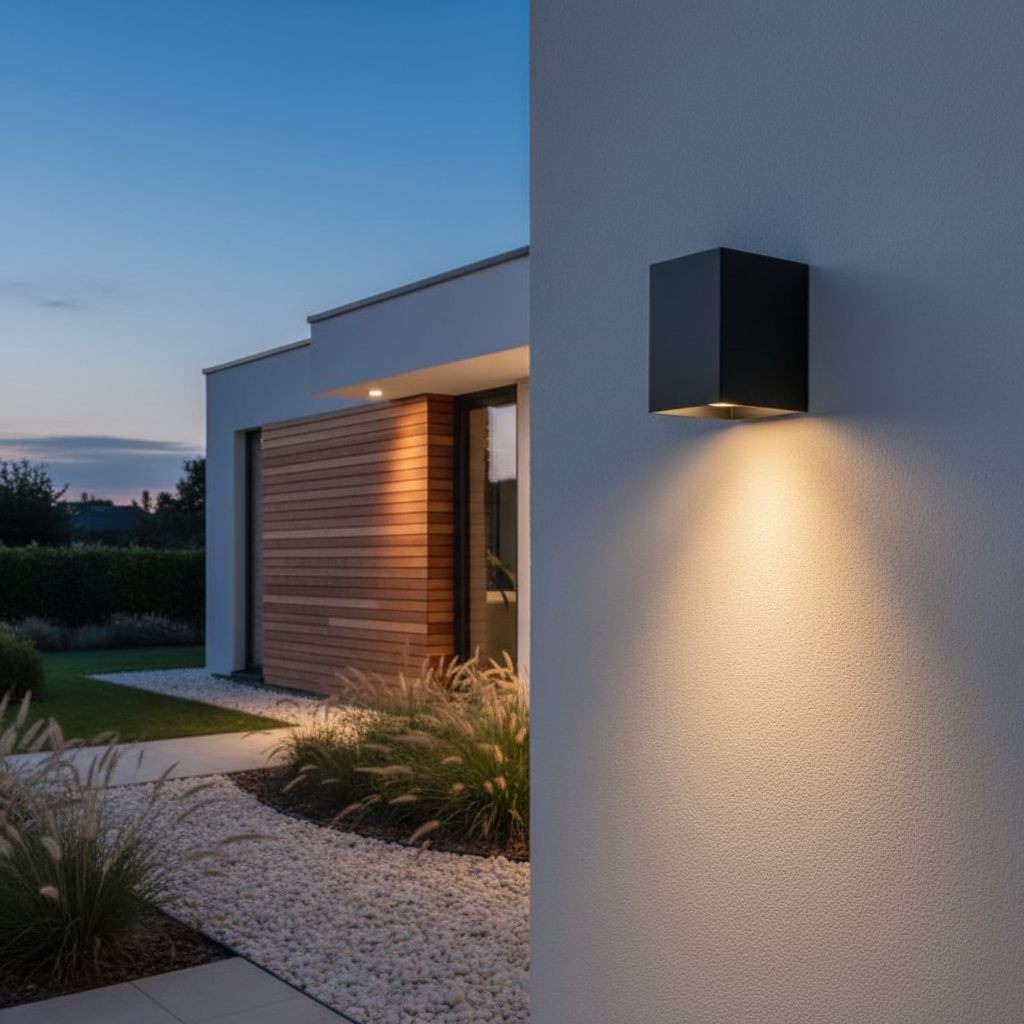
Aluminum is the material that changed everything for solar design. Lightweight, corrosion-resistant, and precisely machinable, it allows for sleek forms impossible to achieve with plastic. And in a matte black finish, it becomes truly timeless.
Matte black aluminum offers several practical advantages beyond aesthetics: it absorbs less heat than glossy black, it hides dust and rainwater marks, and it ages well — without yellowing or cracking. It also integrates best with a wide range of facades, from white stucco to dark wood siding.
In 2026, this is clearly the dominant finish among manufacturers targeting the design market. Brushed stainless steel remains an elegant alternative, but it requires more maintenance and can appear cold depending on the context.
Geometric Shapes and Architectural Minimalism
The shape trend is clear geometry. No convoluted curves, no ornaments. Thin rectangles, cylinders, volumes that could belong to a Scandinavian or Japanese design object.
This architectural minimalism follows a simple logic: a light too cluttered with visual details draws attention to itself. A minimalist light, however, draws attention to what it illuminates. The wall, the plant, the pathway, the entrance. The fixture becomes a discreet tool rather than a decorative accessory seeking to stand out.
This philosophy is similar to high-end contemporary furniture — and it's precisely what quality modern solar lights are beginning to integrate into their DNA. Find detailed variations of these trends in our article on designer solar wall light trends.
Discreet Solar Panel Integration
The hallmark of high-end solar lights in 2026 is also how the solar panel is integrated. The best models house it in the upper part of the device without it looking like an add-on. Some even embed it under a protective glass that makes it appear as a structural rather than functional element.
The result: you first notice the fixture's silhouette, not its inner workings. This is exactly what you expect from a well-designed object.
Where to Install Designer Solar Lights for Maximum Impact
Design isn't appreciated in a vacuum — it's appreciated in context. The same light placed in the right spot can transform a mundane facade. Placed incorrectly, it becomes just another gadget. Here are the locations that truly enhance a designer solar fixture.
Entrance and Front Door
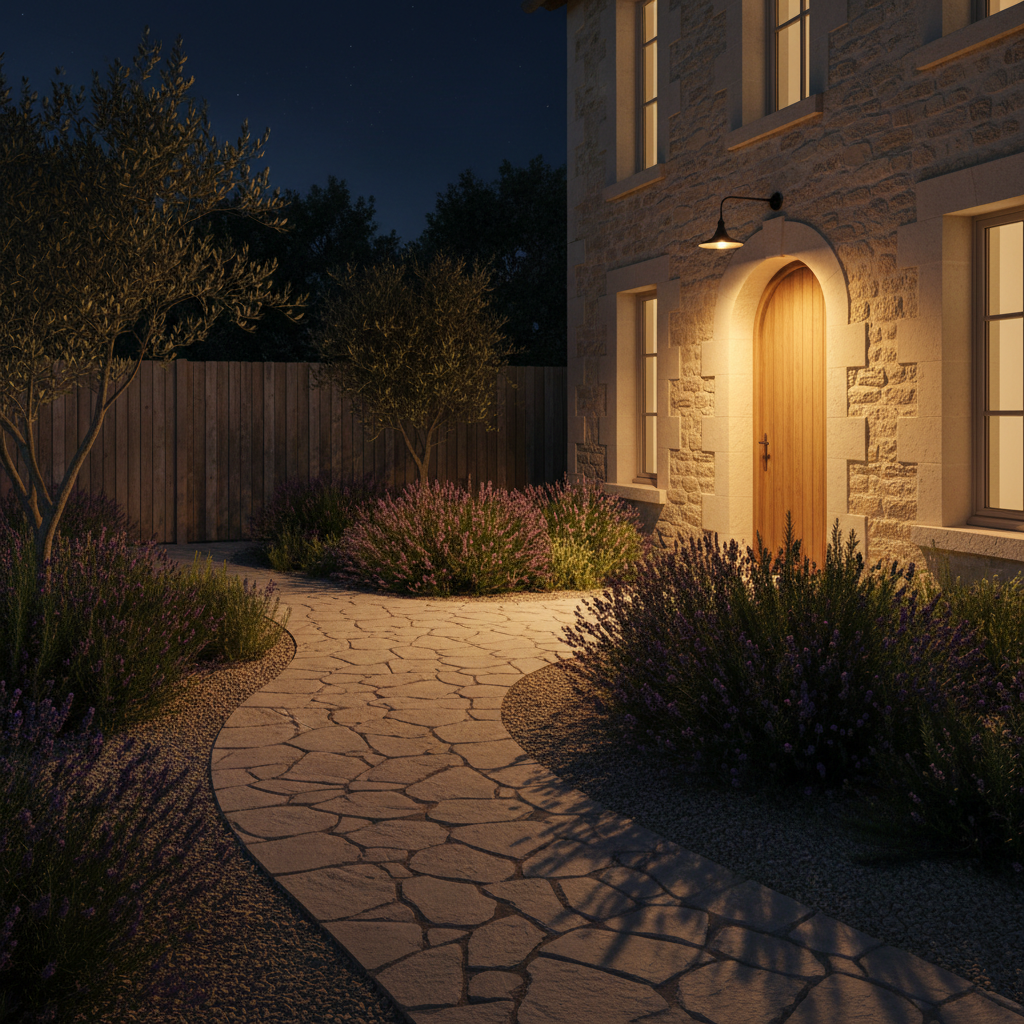
This is the most visible, and often most neglected, spot. A quality solar light placed on either side of a front door — or even a single, well-chosen one — instantly changes how the house is perceived from the street. It's the first and last visual contact point.
For this use, we generally look for light between 3000K and 4000K: warm enough to create a welcoming atmosphere, neutral enough to be functional. The designer outdoor solar wall light is the ideal format for this application — mounted as a sconce on the wall or pillar, it frames the space without cluttering it.
Driveway and Garden Edges
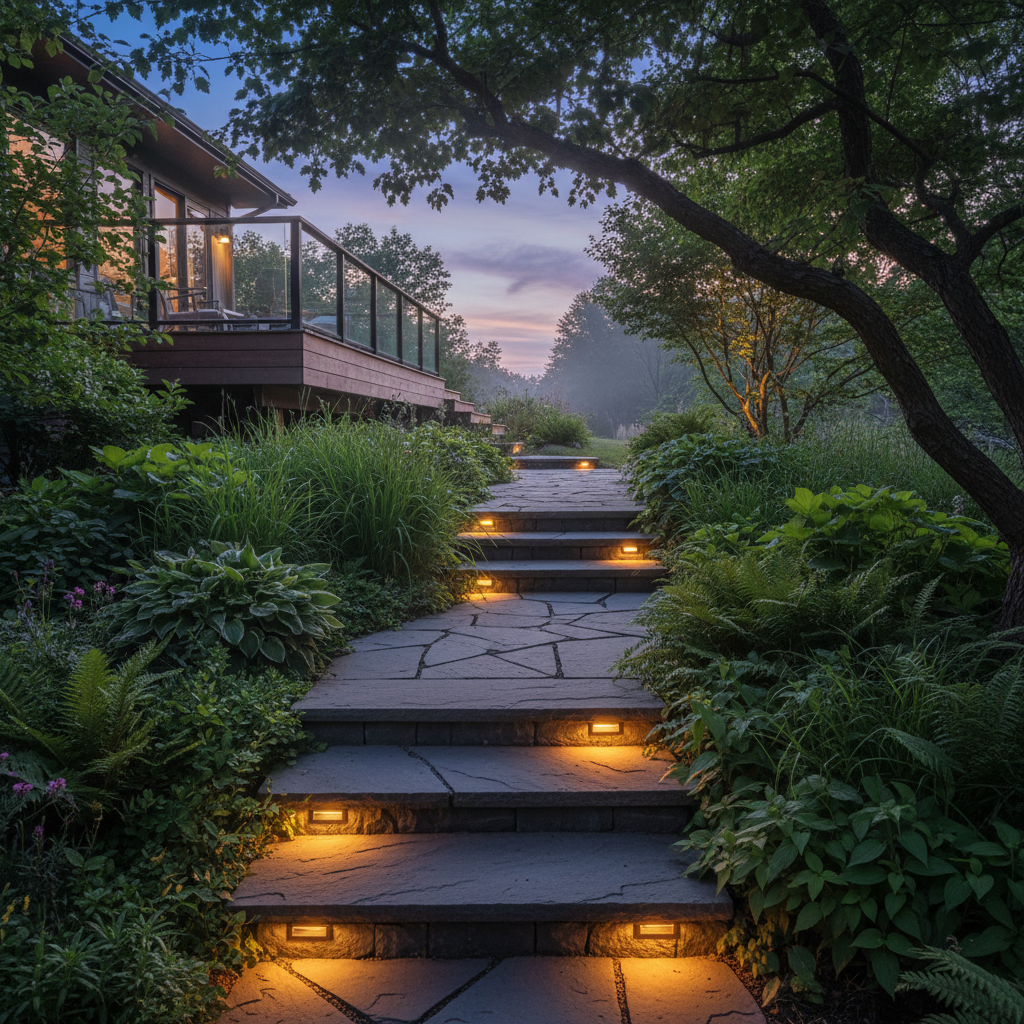
A lit driveway at night is both practical and spectacular. Slim solar lights aligned along the edges create a perspective effect that enhances the garden even in darkness. It's a simple staging with a strong visual impact.
Here, the design criterion is even more important than elsewhere, because the lights are seen up close and in natural light. The quality of the material and the sleekness of the forms make all the difference between a polished result and a functional plastic alignment.
Patio and Outdoor Living Spaces
On a patio, a designer solar light advantageously replaces a classic wired sconce. No cables to run, no electrical work, no holes in the wall. You install it, orient it, and enjoy. To explore all types of outdoor solar lighting suitable for living spaces, a complete guide will help you make the right choice for your setup.
The desired ambiance on a patio is generally softer than at the entrance. A warm white at 3000K, moderate light intensity, a beam that enhances materials — wood, stone, plants. The light should not be harsh; it should envelop.
What "Design" Means in Practice: Criteria to Check
The word design is overused. Here's what it concretely means when talking about an aluminum solar light or a high-end solar fixture.
Finish Quality
Touch the product. Are the edges sharp or slightly rounded by the mold? Is the paint uniform or does it show drips? Are the joints between parts clean? A well-made object is immediately felt in the hand, even before it's turned on.
On a quality aluminum solar light, the finish is applied after machining or extrusion — not on a plastic mold. The result is more precise, more uniform, more durable. And it shows.
Visual Consistency Between Day and Night
A good designer solar light works twice: off during the day, and on at night. These two states must be considered together. A light that looks good by day but emits a greenish, uneven light at night is not truly a design object.
The quality of the emitted light — its color, uniformity, softness — is an integral part of the design. This is often where the differences between ranges are most noticeable.
Durability as an Aesthetic Criterion
A beautiful light that starts to age after a year is money poorly spent. Durability isn't just a technical criterion — it's an aesthetic one. An object that retains its appearance over time, resisting rain, frost, and UV without degrading, is fundamentally a better design object.
A minimum IP65 rating is the threshold not to go below for outdoor use in the US/Canada. It guarantees protection against water jets and dust. Below that, you take a real risk on durability.
The True Luxury of a Designer Solar Light: Zero Maintenance
There's something profoundly elegant about an object that works without you having to think about it. No cables to lay, no associated electricity bill, no batteries to change, no electrician to call when it breaks down. You install it once, and it does its job.
That's the real argument for high-end wireless outdoor lighting solutions. Not just freedom of placement, but mental freedom. A light that demands nothing.
This logic also changes the cost perception. A quality designer solar light costs significantly less than an equivalent wired fixture once you factor in the cost of electrical installation — trenching, cabling, panel, electrician. And over five years, the difference is even more pronounced.
SolarGlow: When Solar Embraces Sleek Aluminum
The SolarGlow by Lumic was designed with this philosophy. Aluminum, a minimalist finish, a silhouette that doesn't try too hard. The goal was simple: to create a solar light you want to display prominently, not one you try to hide.
Technically, it delivers on its promises even in winter — that's often when cheap solar lights show their limitations. Its solar panel and battery are sized for US/Canadian conditions, not an idealized Mediterranean use. With IP65 protection, two 180° motion sensors, and a detection range of about 26 feet (8 meters), it covers common uses without compromising visual discretion.
4.5/5 on Trustpilot with over 2200 reviews, 5-year warranty, 90-day satisfaction guarantee. No empty promises on durability. For those looking to combine aesthetics and long-term reliability, our guide designer and reliable outdoor solar light explores this equation in depth.
How to Choose Your Designer Solar Light: The 4 Real Questions
Before buying, ask yourself these four questions. They are more useful than any product sheet.
Will I still like this light in five years?
A trendy design for one season can become a dated accessory the next. Timeless forms — straight lines, neutral finishes, natural materials — withstand time better than products that try to be too creative. Matte aluminum in dark tones is a safe bet in this regard.
Does the emitted light match the desired ambiance?
Warm white (3000K) for a welcoming and soft atmosphere — ideal for an entrance or patio. Neutral white (4000K) for more functional light on a driveway or garage. The choice of color temperature has as strong a visual impact as the device's design itself.
Is the installation irreversible?
A good designer solar light should be as cleanly removable as it is installed. If the mounting leaves significant marks or requires drilling into the facade, you're committing for the long haul. Always check mounting options before buying.
Will the manufacturer still be around in two years?
A warranty is only as good as the brand that honors it. Prioritize brands with clearly identified customer support, recent customer reviews, and a long-term commitment. This applies to any purchase, but even more so for an item fixed to your facade.
What a Designer Solar Light Truly Changes in Your Home
Outdoor lighting is one of the most impactful elements of a home's appearance at night — and one of the most underestimated. A well-lit facade with cohesive fixtures gives an impression of care, taste, and intention. A poorly lit facade with disparate devices has the opposite effect, even if the house itself is beautiful.
Investing in a quality outdoor designer solar light is therefore also investing in your home's image. It's a detail visible every evening, by you and your neighbors. And unlike an interior renovation, it doesn't involve weeks of work — just a good choice, an hour of your time, and an immediate result.
The prejudice "solar = ugly plastic" is a thing of the past. What exists today in terms of modern solar lights truly deserves a closer look.