Which Type of Solar Garden Spotlight Should You Choose for Your Project?
Choosing a solar garden spotlight isn't a random decision you make in a garden center aisle. The right model depends primarily on where you want to illuminate: a lawn, a composite wood deck, or your home's entrance. These three scenarios have very different requirements, and each spotlight format—spike, in-ground, or wall-mounted—serves a specific purpose.
In this article, we'll review all three types. For each, we'll clearly tell you where it works best, what to look for before buying, and common mistakes people make in poorly designed gardens. No unnecessary jargon, no artificially inflated product lists. Just what you need to make the right choice.
Spike Spotlights: Ideal for Flowerbeds and Lawns
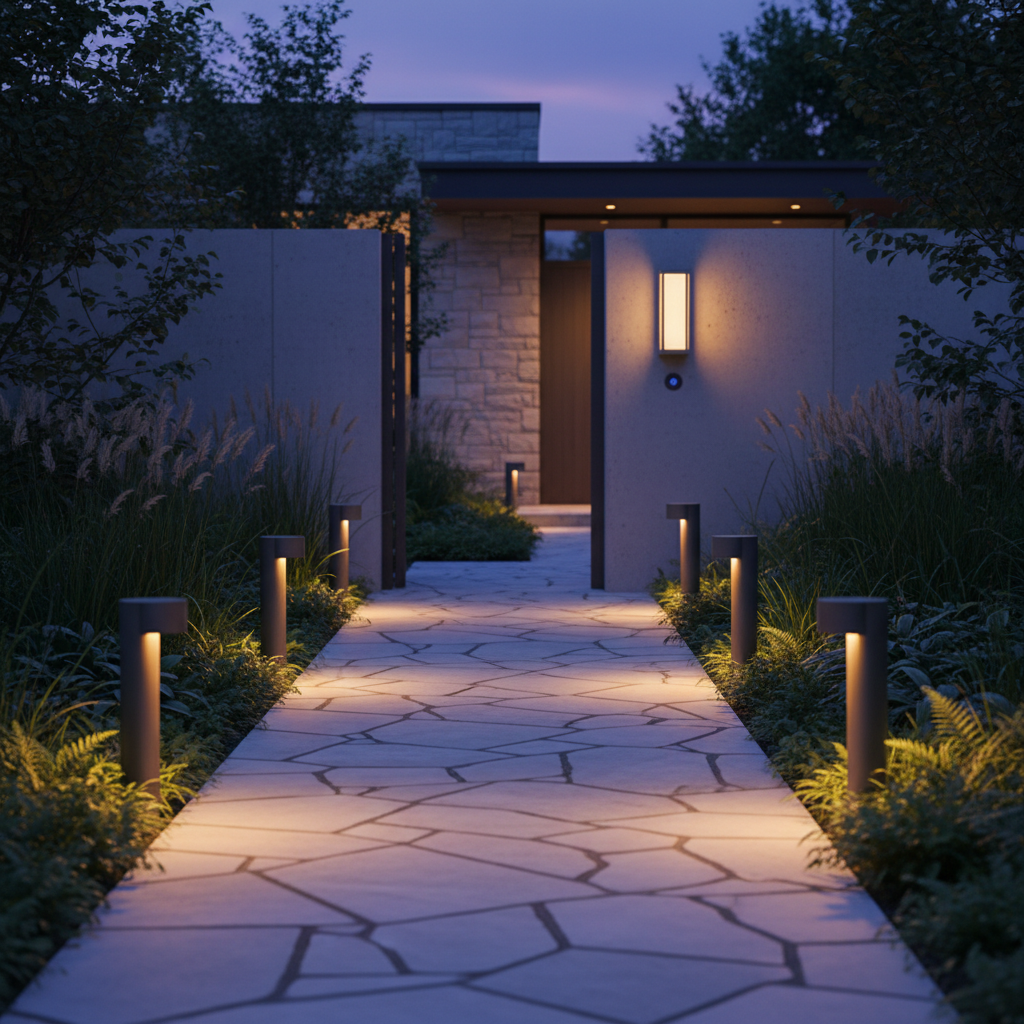
The spike spotlight (or stake light) is the most common solution for garden lighting. You simply push it into the ground, no mounting, no tools required. This is its main advantage: it takes two minutes, and you can move it from season to season as your desires or plantings evolve.
Where Do Spike Spotlights Really Shine?
Spike spotlights are perfect for flowerbeds, around shrubs, along hedges, or to mark a dirt or gravel path. They create a low-level, ambient light close to the ground, highlighting plant volumes. For effective and decorative garden path lighting, it's often the first choice.
However, avoid placing them in high-traffic areas: a lawnmower or a soccer ball can easily dislodge them. They are also not well-suited for regularly mowed lawns, where they interfere with mowing.
What to Look for Before Buying a Solar Spike Spotlight
Three criteria really matter:
- Ingress Protection (IP) Rating: It must be at least IP65. Below that, rain and soil moisture will quickly damage the electronic components. A garden spike spotlight without a minimum IP65 rating won't survive the winter.
- Light Output: Entry-level spike spotlights often produce between 10 and 30 lumens. This is enough to create ambiance but not to see where you're stepping. If you want true functional pathway lighting, look for models exceeding 50 lumens.
- Size of the Integrated Solar Panel: On solar spike lights, the panel is small by definition. During several consecutive cloudy days, the battery life drops quickly. If you live in a less sunny region or want it to work in winter, this point is crucial. Our article on solar lights that work in winter explains exactly what to look for.
Spike Spotlight with or Without Motion Sensor?
Most spike spotlights don't have motion sensors: they turn on at dusk and off at dawn. This is intentional, as their role is decorative and continuous. A motion sensor on a spike in the middle of a flowerbed doesn't make much sense: moving branches would constantly trigger false positives. For motion detection functionality, wall-mounted spotlights are much more relevant—we'll get back to that.
In-Ground Solar Spotlights: For a Clean, Designer Deck
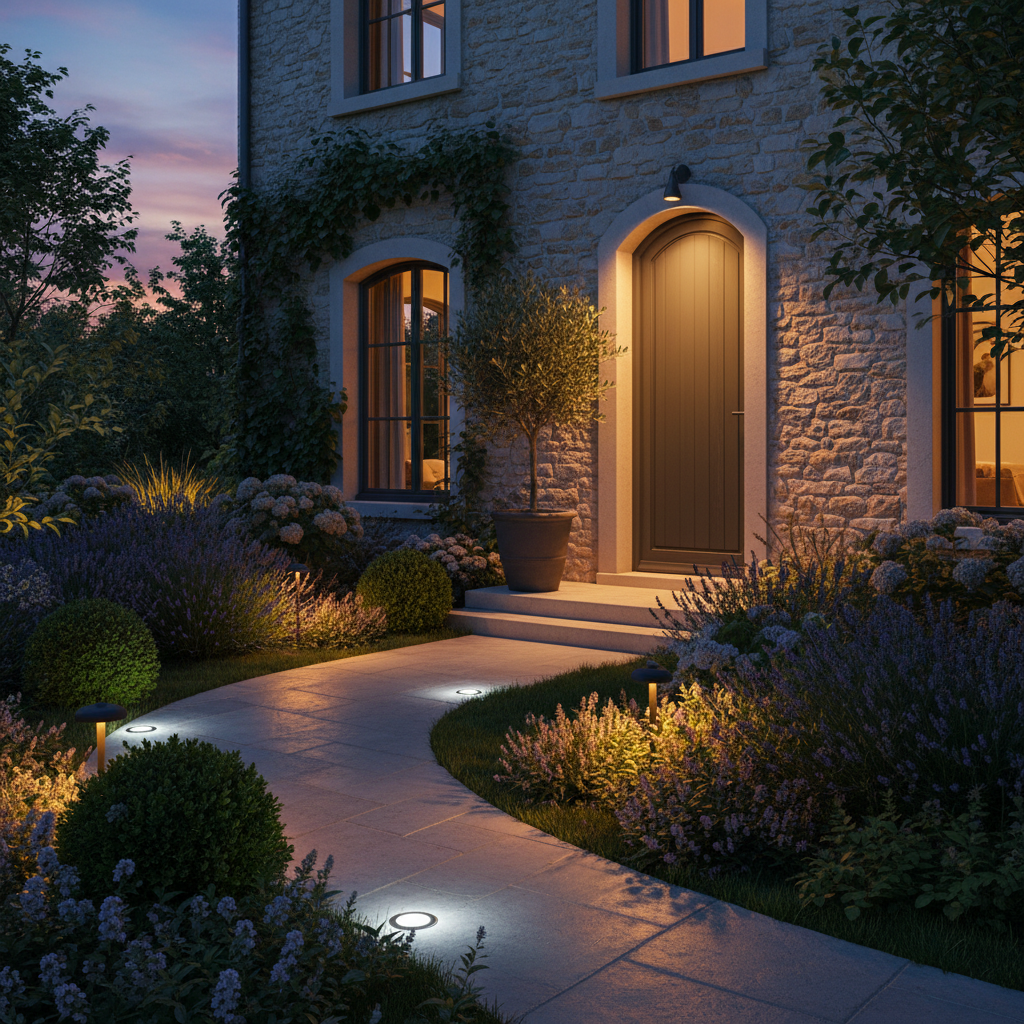
In-ground spotlights are installed flush with the ground, integrated into a slab, a wooden deck, outdoor stairs, or a low wall. The result is clean, discreet, and professional. No protruding stakes, no tripping hazard.
When to Choose an In-Ground Spotlight?
If you have a composite wood deck, a paved pathway, or access stairs, the in-ground spotlight is aesthetically unbeatable. It creates a low-level light that structures the space and guides movement at night. It's also a good option for bordering a pool, provided the IP rating is appropriate (IP68 for possible immersion).
The major drawback: installation requires planning. You need to drill or route your deck material, define the placement before installation, and ensure the spotlight will be well-oriented towards the sun for recharging. With a solar version, this is where it gets tricky: the solar panel often needs to be remote to capture enough light, which complicates installation.
Power and IP: The Minimums Not to Neglect
For a spotlight recessed into stairs or a pathway, we recommend a minimum of 50 to 80 lumens per spotlight. Below that, the effect is purely decorative—and that might be enough if that's what you're looking for. For true visibility of steps at night, opt for more powerful models, even if it means installing fewer.
The minimum IP for an outdoor in-ground light is IP67 (resistant to temporary immersion). For pool edges, IP68 is essential.
Can You Install an In-Ground Spotlight Yourself Without a Professional?
On paper, yes. In practice, it depends on the surface. On a wooden deck, a hole saw is sufficient. On concrete or stone, you'll need a hammer drill and potentially a tile setter. The solar version simplifies the electrical power question—no cables to run, no electrician—but the mechanical installation remains demanding. It's often the most challenging format to install among the three.
Wall-Mounted Solar Spotlights: The Solution for Entrances and High-Traffic Areas
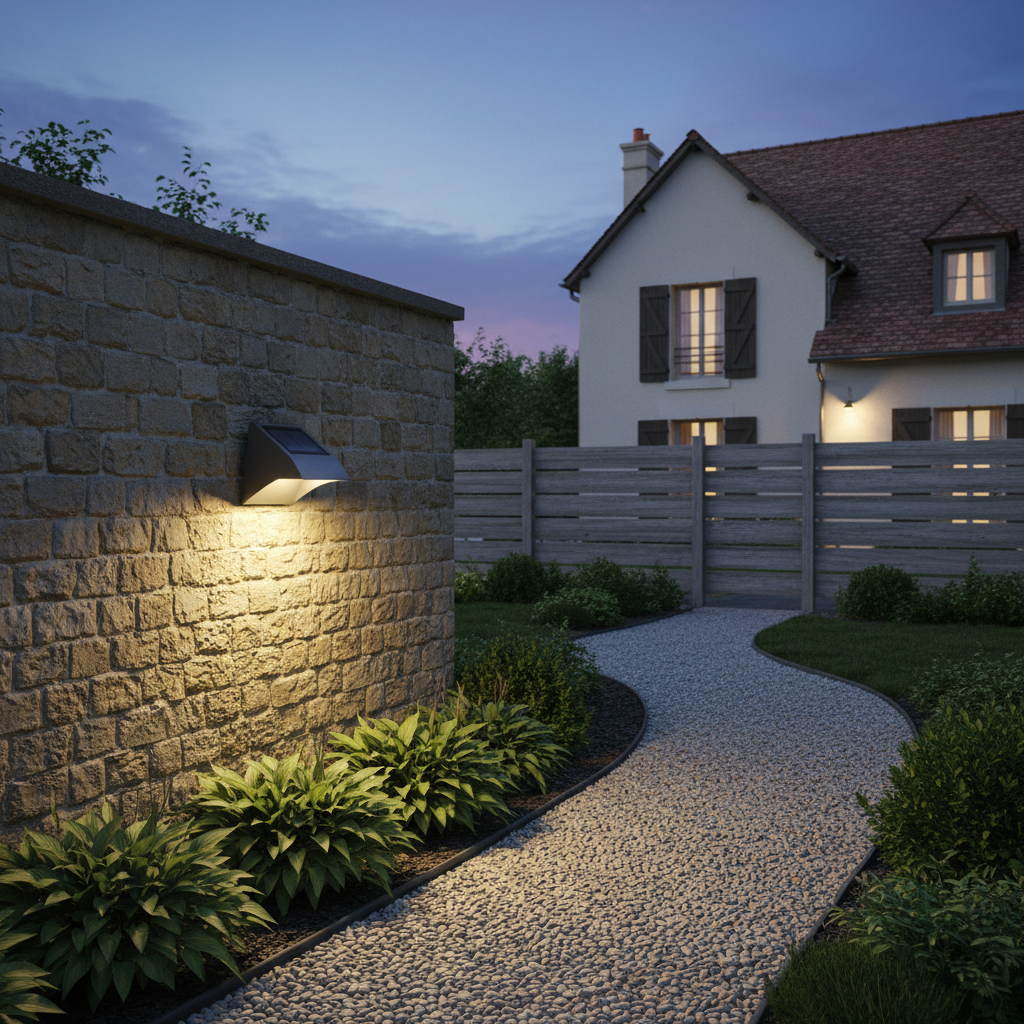
Wall-mounted spotlights attach to a facade, pillar, fence, or gate wall. This is the most versatile format for security and functional garden lighting. And with a solar motion-sensing model, it becomes almost autonomous: you install it once, and it takes care of the rest.
Why is Wall-Mounted More Logical Than Spike for an Entrance?
For a home entrance, an outdoor hallway, or a regular passage area, a wall-mounted spotlight with a motion sensor makes sense in a way a spike light doesn't. It turns on when someone arrives, illuminates exactly the area you need (the path, stairs, gate), then turns off by itself. A spike light, on the other hand, stays on all night and shines downwards—which is good for ambiance, but not for seeing a visitor arrive or deterring an intruder.
The other advantage of wall-mounted: no need to stake or embed. Zero excavation, zero cutting into your deck. You aim for the right spot on the wall, mount it, and you're done. For renters or those who want to avoid any construction, it's by far the simplest solution to implement.
Power, Range, and IP: What You Need for an Effective Wall-Mounted Spotlight
A quality solar wall-mounted spotlight should offer at least 200 to 400 lumens to be truly useful at night. Below that, you'll have psychologically reassuring light but insufficient to comfortably illuminate an entrance area. Also, check our comparison of outdoor solar floodlights if you need higher power for a large area.
The motion sensor itself should have sufficient range: 6 to 8 meters (about 20 to 26 feet) is a good standard for a pathway or home entrance. The detection angle also matters: a 180° sensor covers much better than a 90° sensor centered on a single axis.
For IP, a minimum of IP65 is essential for a wall light exposed to rain. If you are in a region with frequent frost, check that the manufacturer specifies resistance to negative temperatures.
Lumic's SolarGlow: When a Wall-Mounted Spotlight is the Right Answer
For entrance areas, facades, and garages, Lumic's SolarGlow is an option to seriously consider. It delivers 1200 lumens—significantly above the average for solar wall-mounted spotlights—with two 180° motion sensors and a range of about 8 meters (26 feet). With an IP65 rating, it withstands rain and cold.
What truly sets it apart from most alternatives: its solar panel is three times larger and its battery four times more powerful than common low-end models. In practice, this makes all the difference in winter or during a week of bad weather. The advertised battery life reaches 20 days without solar recharge in motion detection mode.
No cables, no outlets, no electrician needed. You mount it on your wall, orient the panel, and it works by itself. It comes with a 5-year warranty and a 90-day satisfaction guarantee. If you want to delve deeper before buying, our guide on outdoor wall-mounted solar lights covers all selection criteria in detail.
An important nuance: the SolarGlow is designed for high-traffic areas and security, not for the decorative ambiance of a flowerbed. If you want to highlight your plants or create an atmosphere in your garden, a spike spotlight is more suitable for that use.
Comparison Table: The Three Types of Solar Garden Spotlights
| Criterion | Spike Spotlight | In-Ground Spotlight | Wall-Mounted Spotlight |
|---|---|---|---|
| Primary Use | Flowerbeds, pathways, lawn | Deck, stairs, paved pathway | Entrance, facade, gate, garage |
| Ease of Installation | Very easy (stake into ground) | Demanding (drilling, embedding) | Simple (screws on wall) |
| Recommended IP | IP65 minimum | IP67 (IP68 if pool edge) | IP65 minimum |
| Movable? | Yes, no tools needed | No (permanent fixture) | Limited (requires re-mounting) |
| Motion Detection | Rarely (frequent false positives) | Sometimes (specific models) | Yes, its strength |
| Aesthetic Result | Decorative, warm | Sleek, integrated, discreet | Functional, secure |
| Ideal for Renters? | Yes | No (requires work) | Yes (simple screwing) |
How to Combine Multiple Types of Spotlights in One Garden?
In most gardens, a single type of spotlight isn't enough. The most effective approach—and the most common among those who have thoughtfully designed their outdoor lighting—is to combine two formats depending on the zones.
A Layered Lighting Approach
Think of your garden in layers:
- The Decorative Layer: Spike spotlights in flowerbeds, around shrubs, along borders. Warm ambiance, low light, warm color temperature (2700 to 3000 K).
- The Functional Layer: In-ground or wall-mounted spotlights for circulation areas—pathways, decks, stairs. More direct light, sometimes cooler (4000 K) if you want to clearly see where you're walking.
- The Security Layer: One or two motion-sensing wall-mounted spotlights for the entrance, gate, or garage. They turn on briefly, brightly, when someone arrives. They consume no power the rest of the time.
This layered approach prevents the garden from being too dark (only one light source) or aggressively lit (a blinding floodlight pointed at the door). And with solar models, each zone operates independently—no need to wire everything together.
What Order to Buy If Starting from Scratch?
If you're starting with an unlit garden, begin with a motion-sensing wall light for the entrance. It's the most useful for daily life, the easiest to install, and it works from the first night. Then, add spike lights in flowerbeds for ambiance. In-ground lights come last, when you have a deck project or more structured landscaping planned.
To go further on choosing a powerful solar garden light suited to your needs, our guide compares essential criteria based on usage.
Common Mistakes to Avoid with Solar Garden Spotlights
We often see this in customer feedback: several mistakes consistently reappear. By knowing them in advance, you can avoid a bad experience.
Underestimating the Importance of Sun Exposure
A solar spotlight needs sun to work—this seems obvious, but people often forget to consider it during installation. Planting a spike light in a flowerbed shaded by a large tree all day guarantees poor battery life by September. Before installing anything, observe when the sun hits the area where you want to place the spotlight. The panel needs to capture at least 4 to 6 hours of direct sunlight per day to last all night.
Buying Low-End to Save Money
Solar spotlights for $5 for a pack of 8 exist. In practice, most don't survive their second winter. The battery degrades quickly, the IP rating doesn't live up to claims, and brightness drops after a few months. Ultimately, you buy again, throw away, and spend more than you would with a single good model from the start. If your budget is tight, one well-placed quality spotlight is better than six spike lights that won't work by the following spring.
Neglecting Color Temperature
Color temperature completely changes your garden's ambiance. A cool white (6000 K) in a flowerbed creates a clinical, almost industrial look. For a garden, the vast majority of users prefer warm white (2700 to 3000 K) or at most neutral white (4000 K) for circulation areas. This detail makes all the difference to the overall evening atmosphere.
Forgetting Solar Panel Maintenance
Solar panels on garden spotlights get dirty over time: dust, fallen leaves, hard water stains. A dirty panel loses some of its charging efficiency. A quick clean with clear water two or three times a year is enough to maintain performance. It's not a zero-maintenance product, just a minimal-maintenance one.
Solar Garden Spotlights and Winter: What They Don't Always Tell You
This is the real question few websites frankly ask: do solar garden spotlights really work in winter in the US/Canada?
The honest answer: it depends on the model and your region. A low-end solar spike light with a small panel and low-capacity battery will struggle by November in northern areas. Short, cloudy days don't sufficiently recharge the battery to last all night.
Spotlights and solar lights with a larger panel and a more powerful battery perform significantly better. Motion-sensing solar lighting is also a good strategy for winter: since the spotlight only turns on occasionally, the battery lasts much longer between insufficient sunny days. Our guide on solar lights that work in winter goes into detail on this topic if you want precise answers for your situation.
Key Takeaways for Choosing Your Solar Garden Spotlight
The right solar garden spotlight is one that matches your actual intended use.
- Do you want to create ambiance in your flowerbeds or mark a pathway? A spike spotlight is for you. Simple, movable, decorative. Get at least IP65 and ensure the panel receives enough sun.
- Are you renovating your deck or installing outdoor stairs? An in-ground spotlight provides a clean, integrated result. Plan the installation before finishing the work, and get at least IP67.
- Do you want to secure your entrance, gate, or garage without cables or an electrician? A motion-sensing wall-mounted spotlight is the most effective and easiest solution to install. It turns on when it matters, not the rest of the time.
And if you want to combine all three, start with the wall-mounted light; it will be useful from the first night. Spike lights for ambiance come next, when you have time to refine your garden lighting.