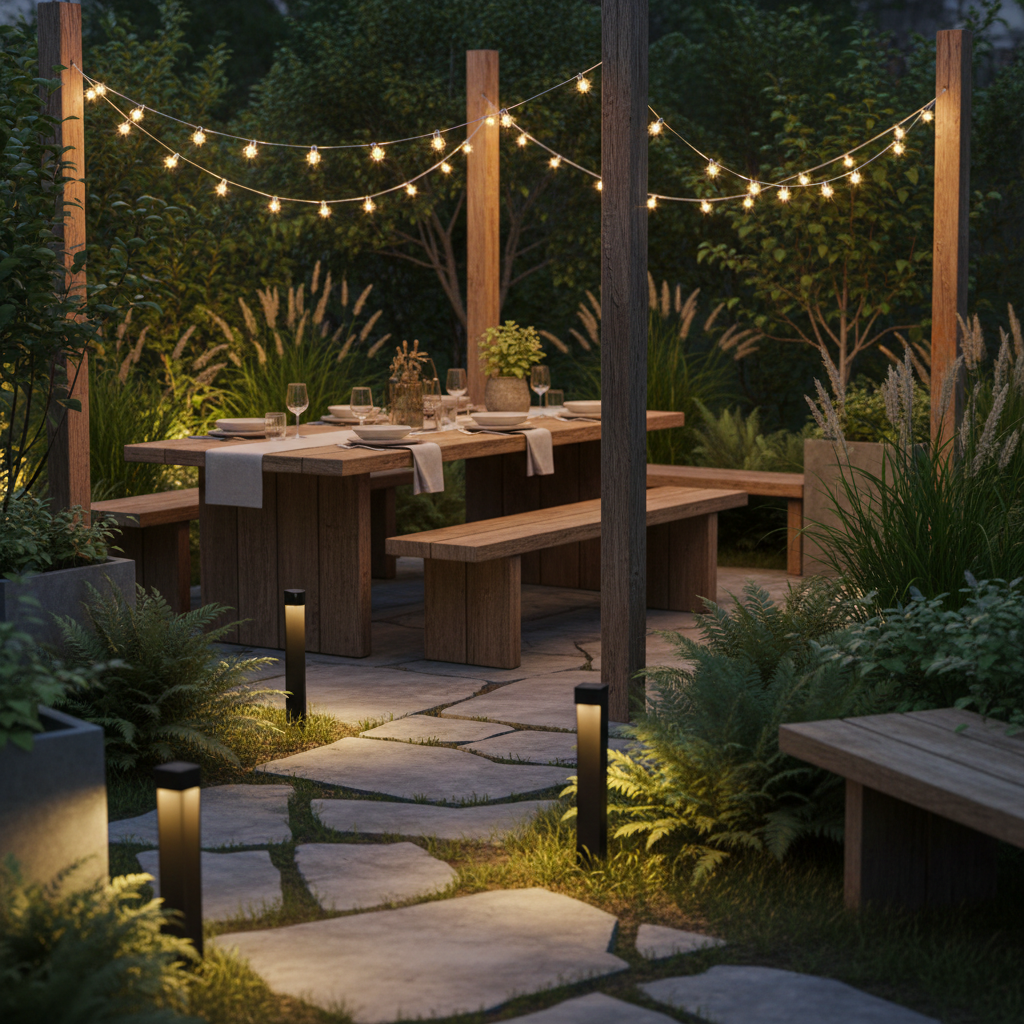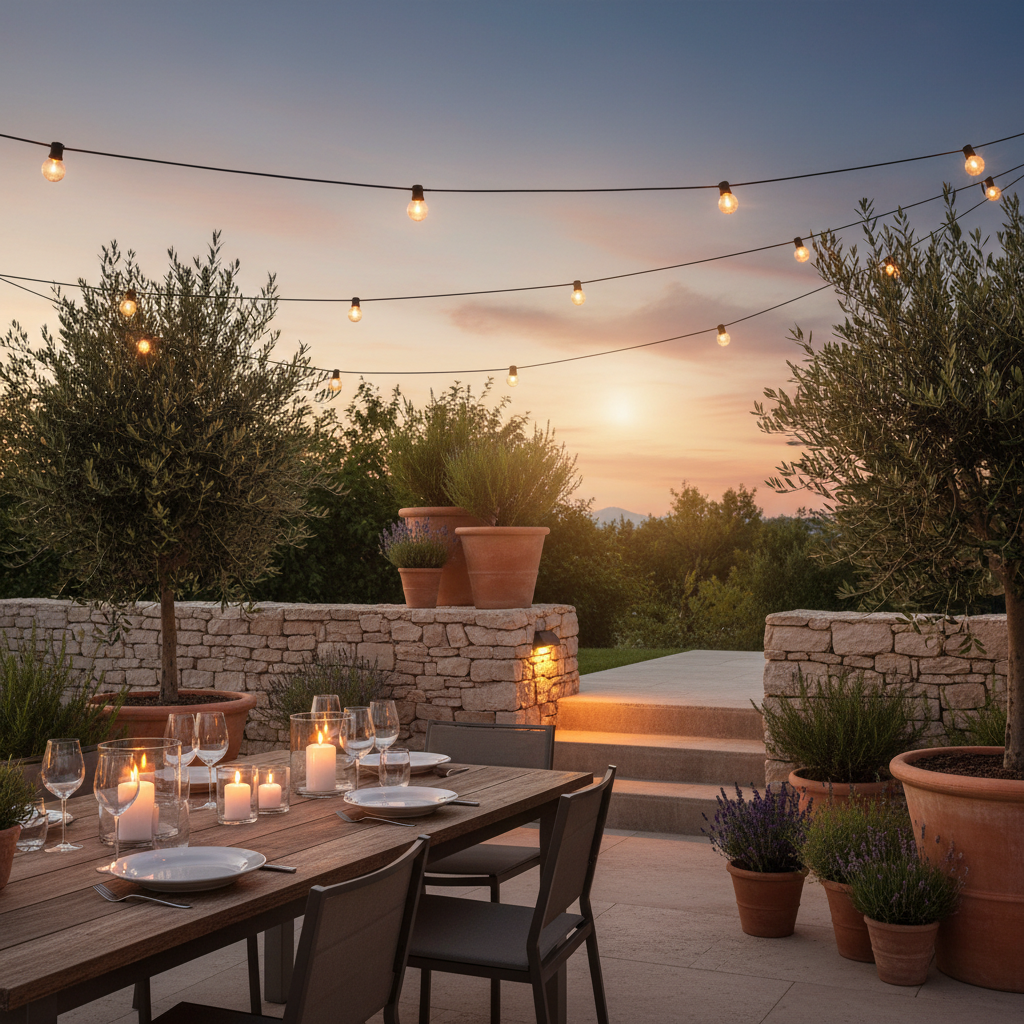
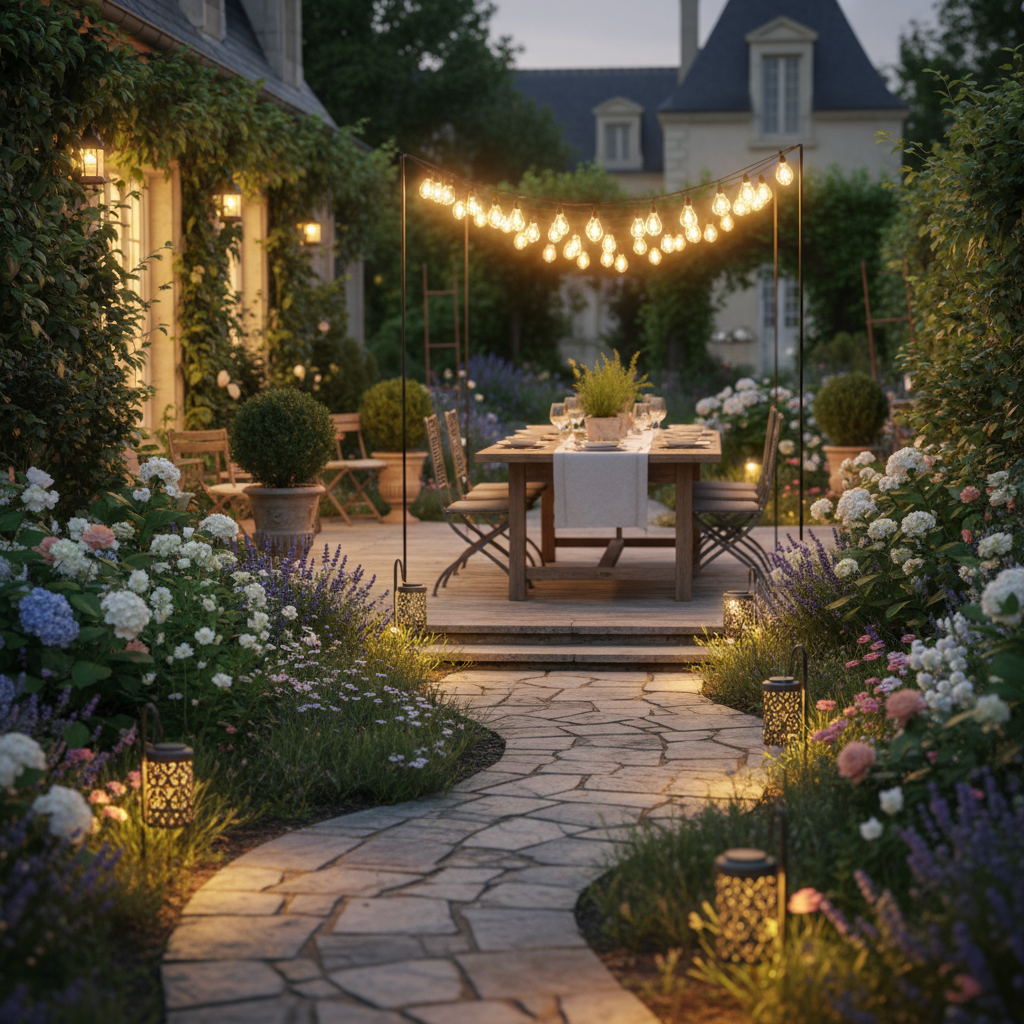
You have a garden, a patio, or even just a small pathway, and when night falls, everything disappears into darkness. No cables to run, no electrician to call — solar garden decor addresses this exact need: creating an illuminated ambiance outdoors, without any construction work.
But there's a world of difference between $4 string lights that die in August and real solutions that last season after season. This article gives you concrete ideas, zone by zone, to make your outdoor space as beautiful at night as it is during the day.
Why Outdoor Solar Decor Changes Everything in Your Garden
Solar lighting isn't what it was five years ago. We've moved from small, white plastic mushrooms that blinked like Christmas lights to objects with real style — brushed aluminum, frosted glass, concrete, synthetic rattan. Outdoor solar decor has become professional.
What changes everything is autonomy. A good solar panel coupled with a decent battery, and you no longer manually turn anything on. Light appears when you need it, turns off when it's not. And during the day, the object itself contributes to the garden's decor.
The Real Trap: Cheap Solar Decor
Let's be frank: solar decorations sold for $5 on online marketplaces have a lifespan of one summer, sometimes less. Thin plastic doesn't resist UV rays — it yellows, cracks, and breaks. Rain, frost, direct sunlight: all these destroy a low-end casing in six months.
The result? You buy new ones every spring. And in the end, you've spent more than if you had bought a solid model from the start. Durable solar garden decor is designed with components — battery, panel, casing — built for long-term outdoor use. When comparing options, look for designer solar lights that combine aesthetics with real durability.
What UV Rays Do to Materials in 6 Months
Untreated polystyrene and ABS absorb UV rays and become brittle. Untreated metal rusts. Only anodized aluminum, stainless steel, glass, and UV-treated plastics truly resist. This isn't a minor detail: it's what separates a useful purchase from a waiting piece of trash.
Entry Zone: Welcome with Style
The entrance to your garden or home is the first impression. And often, it's the most neglected area in terms of lighting. Here are some ideas for solar garden items to transform it:
- Low light bollards on each side of the gate or steps: they mark the path without dazzling, and their geometric silhouettes are attractive even during the day.
- Solar lanterns placed on a low wall or hung from a post: the effect is immediate, warm, almost rustic depending on the chosen style.
- Recessed spotlights in steps: discreet by day, effective at night. Some models attach without any screws, just with high-strength adhesive.
But be careful: at the entrance, decor creates ambiance, but the entrance also has a safety function. Your guests need to see where they're walking. A 20-lumen lantern won't be enough. We'll come back to this in the dedicated section.
What Light Intensity for a Solar-Powered Home Entrance?
For an entrance, you want real visibility, not just a decorative touch. Purely ornamental bollards produce between 5 and 30 lumens — it's pretty, not functional. To illuminate an entrance path where people walk, aim for at least 200 to 400 lumens on the ground. That's why it's often better to combine a low decorative bollard with a more powerful light source placed higher up.
Pathway Zone: Guide Without Deception
A well-marked garden path is one of the easiest things to achieve with solar garden decoration. And the visual effect is immediate: small lights guiding step by step towards the door transform a mundane space into something refined.
Solar bollards for pathways come in dozens of styles: cylindrical, cubic, lantern-shaped, with glass diffusers or frosted polycarbonate. Here are some practical tips:
- Space bollards every 5 to 6.5 feet (1.5 to 2 meters) for smooth guidance without visual clutter.
- Alternate sides (left, right, left...) rather than placing them all on one side — the eye guides better.
- Choose models that emit light downwards or sideways, not towards the sky — you want to illuminate the ground, not the stars.
Can You Mix Different Bollard Styles?
Yes, as long as you maintain a common thread: the same light color (warm white is preferable for a welcoming ambiance), or the same dominant material. Mixing matte black metal with wood can work. Mixing shiny white plastic with brushed zinc creates visual dissonance. The simple rule: consistency in material or light color.
Flowerbed Zone: Highlight Your Plants
This is perhaps the least utilized zone, yet one of the most visually impactful. Lighting a flowerbed at night reveals a sculpture you hadn't seen during the day. Grazing light on grasses, a soft spot under an evergreen shrub, string lights wrapped around a tree trunk: solar garden accessories create very different effects depending on their placement.
- Stake solar spotlights: you plant them directly into the ground at the base of a plant or shrub. The light rises from bottom to top, creating a very successful dramatic effect on textured foliage.
- Solar string lights: wrapped around a trunk or a fence railing, they create a magical effect that you're sure to enjoy. Choose transparent or copper wire for a more elegant look than green garden wire.
- Decorative lanterns placed on a rock or stump: a solar garden accessory that integrates as a natural element.
What Color Temperature for Night Garden Lighting?
For a garden, warm white (around 2700 to 3000K) is almost always the right choice. It mimics candlelight or firelight, harmonizes with nature, and creates a soft, warm atmosphere. Cool or bluish white is reserved for very targeted spotlight effects — not for decorative ambiance. On green plants, warm white brings out deep greens where cool white distorts them.
Patio Zone: Dinner Ambiance Outdoors
The patio is the quintessential outdoor living space. Here, you don't just want light — you want an ambiance. Some must-haves for outdoor solar decoration on the patio:
- Solar string lights above the table: suspended between two walls, between two posts, or under a pergola, they immediately create a Parisian bistro effect. Choose string lights with sufficiently large bulbs (Edison style) for a premium look.
- Lanterns placed on the table or on the ground: a good quality solar lantern can replace candles with a very similar effect. The advantage: no risk of fire, no dripping wax.
- Ground solar spotlights that project towards the wall or facade: an architectural enhancement effect with zero cables.
To go further on patio lighting, we've written a dedicated article on solar patio lighting to create a real ambiance — with concrete layout ideas based on your patio's configuration.
How to Prevent Solar String Lights from Tangling or Falling?
The classic problem with outdoor string lights. Some good habits: use outdoor adhesive hooks (they hold up better than you think if you choose models designed for outdoor use). Allow a little slack in the string lights so they aren't taut and prone to breaking at the first gust of wind. And store them coiled in a dedicated bag each winter — this prevents impossible knots the following spring.
Pool Zone: Reflections and Safety
The pool, in the evening, is a special space. Light reflections on the water create visual effects unmatched elsewhere in the garden. Here are some ideas for solar garden items to enhance this space:
- Solar bollards around the pool: they mark the perimeter, prevent people from walking into the void unseen, and their reflection on the water is beautiful.
- Floating solar lanterns: some models are waterproof and float on the surface. The effect is spectacular for a summer evening.
- Solar spotlights directed towards the water: light hitting the surface creates constantly evolving shimmering effects. It's subtle and very effective.
Around a pool, safety is as important as aesthetics. A poorly lit slippery surface is a real danger. For walkways, you need functional lighting that goes beyond decorative. This is where the complementarity between decor and detection comes in.
Decor and Safety: The Two Are Not Mutually Exclusive
This is the real topic rarely discussed in inspirational articles. Outdoor solar decor creates ambiance — no one denies that. But when your guests arrive at 9 PM in summer or 6 PM in November, they need to see where they're walking. A decorative lantern producing 15 lumens isn't enough to secure a pathway.
The smartest solution: combine both. Bollards or string lights for atmosphere, and a powerful motion sensor for the access path and walkways. The sensor turns on when someone approaches, brightly illuminates the path, then turns off. The decor stays on permanently for ambiance.
A powerful solar garden light is the logical complement to your decor: it handles utility while your string lights handle beauty.
Lumic's SolarGlow fits this logic. It's a 1200-lumen solar spotlight with motion detection and a dual 180° sensor. You place it at the entrance or above a walkway — it turns on when someone approaches, brightly illuminates for about 26 feet (8 meters), and turns off by itself. Zero cables, IP65 (rain, snow, frost), and up to 20 days of autonomy in detection mode. It ensures no one trips while your lanterns do their decorative work.
Can a Solar Spotlight with Motion Sensor Also Be Decorative?
Not really — and that's precisely why you don't choose one or the other, but both together. A powerful motion sensor is designed for visibility and safety: strong light, targeted activation. A solar bollard or string light is designed for atmosphere: soft, permanent light. They play different roles and complement each other perfectly. The result: a garden that is beautiful AND safe when your guests arrive.
How to Choose Your Solar Garden Decor Without Making a Mistake
Here are some concrete criteria, without unnecessary jargon:
- Material takes precedence over style: aluminum, glass, stainless steel, UV-treated plastic. Avoid polystyrene and untreated plastic.
- Solar panel size matters: a tiny 0.3 square inch (2 cm²) panel won't charge enough to last all night in summer, let alone in fall. Visually compare panels — a large, visible panel is a good sign.
- Battery determines autonomy: quality models indicate capacity in mAh. To last several nights without sun (overcast weather), you need sufficient reserve. To learn more, our article on effective solar lights in winter explains exactly what to look for.
- IP protection: IP44 minimum for standard outdoor use, IP65 if you want zero worries in rain or frost.
- Installation: the best models require no cables, drilling, or screws. High-strength adhesive or a simple stake in the ground is sufficient.
For an overview, the complete guide to outdoor solar lighting details each product type and how to combine them according to your project.
How Many Light Points for a Medium-Sized Garden?
It's hard to give a universal number, but here's a working basis: count one light point per functional zone (entrance, pathway, patio, flowerbeds) and increase density where you spend the most time. For a 33-foot (10-meter) pathway, 6 to 8 bollards (one every 4 to 5 feet) are enough. For a 215 sq ft (20m²) patio, 2 to 3 lanterns and a string light already create a real ambiance. A few well-placed beautiful elements are always better than an accumulation of low-end decor that creates visual clutter.
Summary: The Right Solar Decor by Zone
| Zone | Suitable Solar Decor | Desired Effect | Safety Complement |
|---|---|---|---|
| Entrance | Lanterns, low bollards, step spotlights | Welcome, visual marker | Powerful motion sensor |
| Pathway | Alternating marker bollards | Guidance, pathfinding | High-mounted spotlight if pathway is long |
| Flowerbeds | Stake spotlights, string lights | Highlight plants | Optional |
| Patio | String lights, table lanterns | Dinner ambiance, conviviality | Wall spotlight if patio is isolated |
| Pool | Perimeter bollards, floating lanterns | Reflections, nocturnal atmosphere | Mandatory motion sensor |
Successful solar garden decoration is when you've thought before buying: which zone, what effect, what level of light is truly necessary. The beautiful illuminated gardens we see in photos are not accidental — they are thoughtful combinations of soft decor and functional lighting. And solar makes all of this accessible without any cables to run, which truly changes the game for anyone wanting to improve their outdoor space without major work. To refine your project zone by zone, consult our article on solar garden lighting by zone — it perfectly complements these inspirational ideas with concrete technical benchmarks.