You want to light up your yard, driveway, or entrance without running a single cable — and you're looking at outdoor solar LED spotlights. Good idea in principle. But when you start searching, you realize that "outdoor solar LED spotlight" actually covers very different products: garden stakes, in-ground lights, and wall-mounted motion sensor lights. They have different uses, different performance levels, and different installation constraints.
This guide will clarify things. We'll look at the three main formats, what they do well, what they do less well, and in what situations each truly makes sense.
The 3 Formats of Outdoor Solar LED Spotlights
Before comparing advertised watts or lumens on the product sheet, you first need to know what type of spotlight we're talking about. Because a stake light and a wall light play in completely different leagues.
The Solar Stake Light: For Highlighting Your Garden
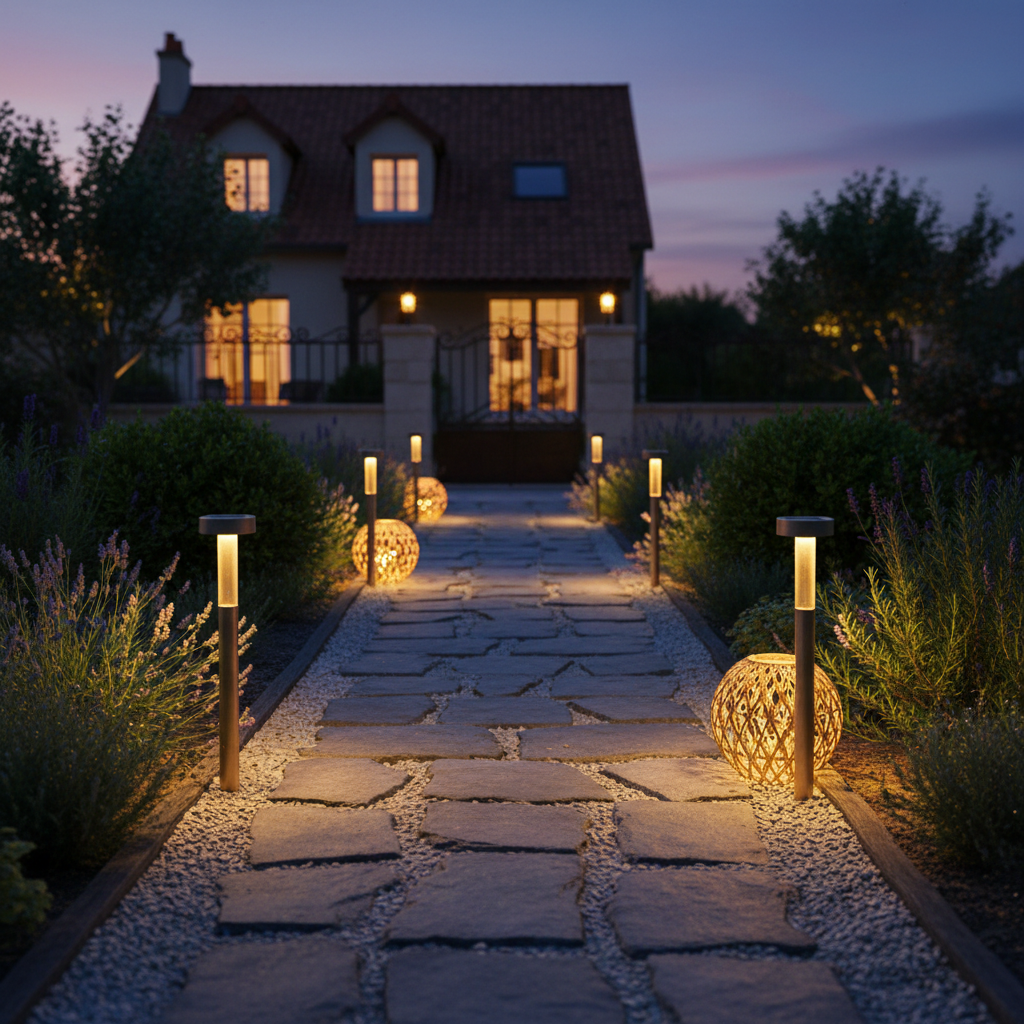
The stake light is a classic for solar garden lighting. You plant it in the ground, it captures sunlight all day, and in the evening it illuminates a plant, a tree, or a flower bed. This is decorative and ambient lighting, not security lighting.
The big advantage: zero installation. You plant it, position it, and you're done. No wall mounting, no cable routing. Ideal for renters or anyone who wants quick results without much effort.
Its limitations are real, and it's better to know them before buying:
- Power remains modest. A stake light effectively illuminates within a 3 to 6-foot (1 to 2-meter) radius. To light an entire driveway, you'll need several.
- The beam angle is often wide. It's not designed to project light over a distance, but to create a diffused ambiance around the installation point.
- Stability depends on the soil. In loose soil or after heavy rain, some stakes may tilt. Not a dramatic problem, but something to anticipate.
- Water resistance varies. Always check the IP rating: a minimum of IP65 is necessary for year-round outdoor use, including frost.
For purely decorative solar garden lighting, the stake is often the simplest format to implement. But if you're looking for power or security, you need to look elsewhere.
The Solar In-Ground Light: For Driveways and Patios
The in-ground light is the most discreet format. You integrate it into the ground of a patio, a paved driveway, or a pathway. The result: ground-level lighting that guides passage at night, with no visible equipment during the day.
It's aesthetically very clean. And in terms of installation, the solar version avoids the major work typically involved with a wired in-ground light (no trenching, no buried cables).
But this format has specific constraints:
- The IP rating must be high. An in-ground light is in constant contact with moisture, mud, and sometimes supports foot or vehicle traffic. You need at least IP67, or even IP68 for high-traffic areas.
- Sun exposure is often limited. If the solar panel is integrated into the housing recessed in the ground, it captures less light than a tilted panel in full sun. Some models have a separate panel to be placed on the surface — this is better, but more cumbersome.
- Brightness remains low. This format is designed for marking, not for powerful illumination. Don't expect to light a 30-foot (10-meter) driveway with a single in-ground light.
The solar in-ground light is a good solution when aesthetics matter more than lighting performance — on a high-quality patio or a well-designed pathway, it adds a real touch of class.
The Wall-Mounted Solar Spotlight: The Most Versatile Format
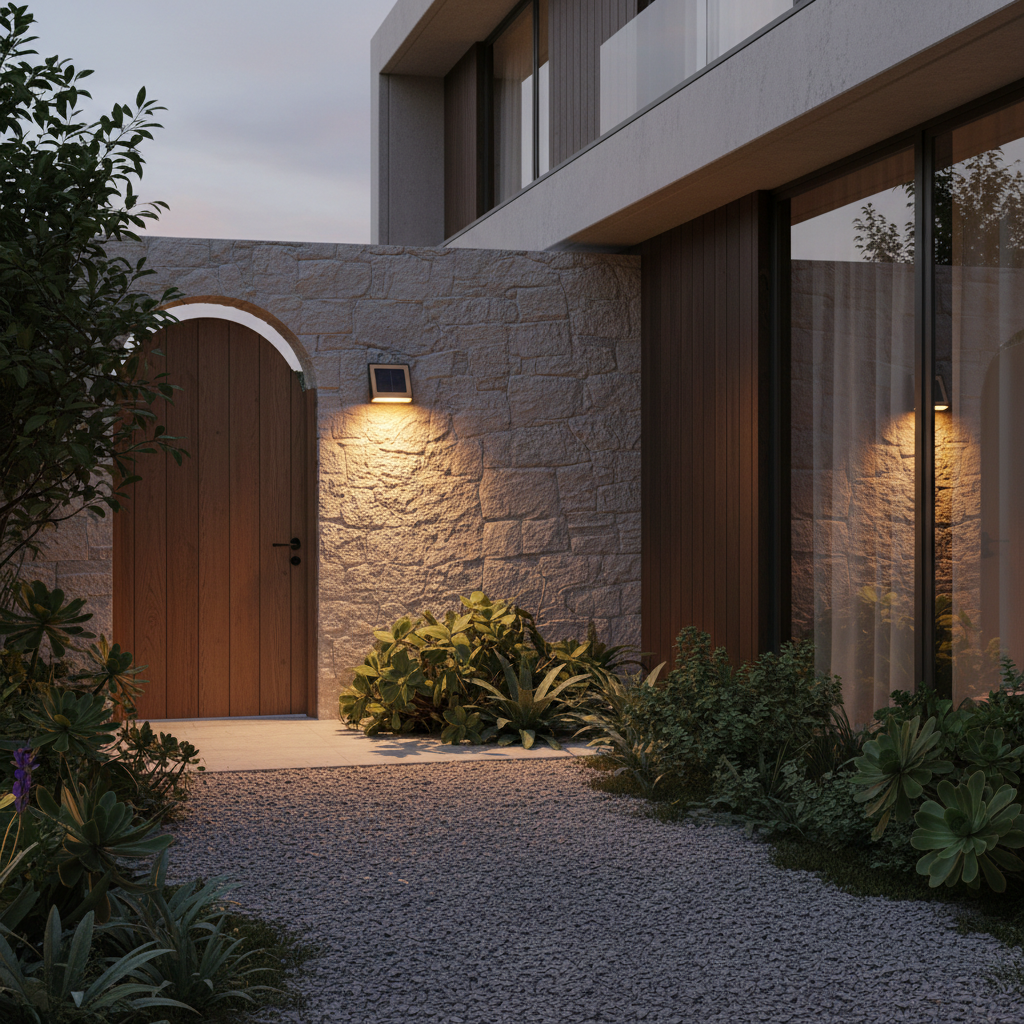
The wall-mounted solar spotlight is fixed to a facade, a fence wall, a gate, or the corner of a garage. This format best combines light output, durability, and practicality.
Why is it more powerful? Because the solar panel can be oriented independently of where the light is projected. You can fix the device to a north-facing wall but orient the panel south. This is an advantage that stake lights and in-ground lights don't have.
Additionally, the mounting height — generally between 6.5 and 10 feet (2 and 3 meters) — improves both the coverage angle and security (less accessible, less risk of displacement or damage).
To learn more about this type of equipment, our article on powerful solar floodlights details what truly distinguishes a good model from a bad one.
What Power and Beam Angle for Each Use
Lumens and beam angle are not numbers to ignore — these are the two parameters that determine whether a spotlight will truly fulfill its function or disappoint you in use.
How Many Lumens for an Effective Outdoor Solar Spotlight?
The answer directly depends on what you want to illuminate.
For decorative use (highlighting a plant, marking a path), 50 to 200 lumens are more than enough. Stake lights typically fall into this category.
For functional use (lighting a driveway to walk at night, seeing who arrives at the entrance), you need at least 500 to 1000 lumens. Below that, you'll see it light up — but you won't really see much.
For perimeter security (deterrence, area surveillance), 1000 lumens and more are recommended. This is the level of powerful wall-mounted spotlights with motion sensors.
A common pitfall: low-cost manufacturers advertise peak lumens (lumens at the second the spotlight turns on in full flash mode). In real, continuous or detection mode use, effective lumens are often 40% to 60% lower. Prefer brands that provide lumens in stabilized mode.
Which Beam Angle to Choose Depending on the Location?
The beam angle determines whether the light is concentrated (directional spotlight) or diffused (wide illumination).
- Narrow angle (15° to 30°): perfect for highlighting a tree, a facade, an architectural element. The light is precise and powerful over a small area.
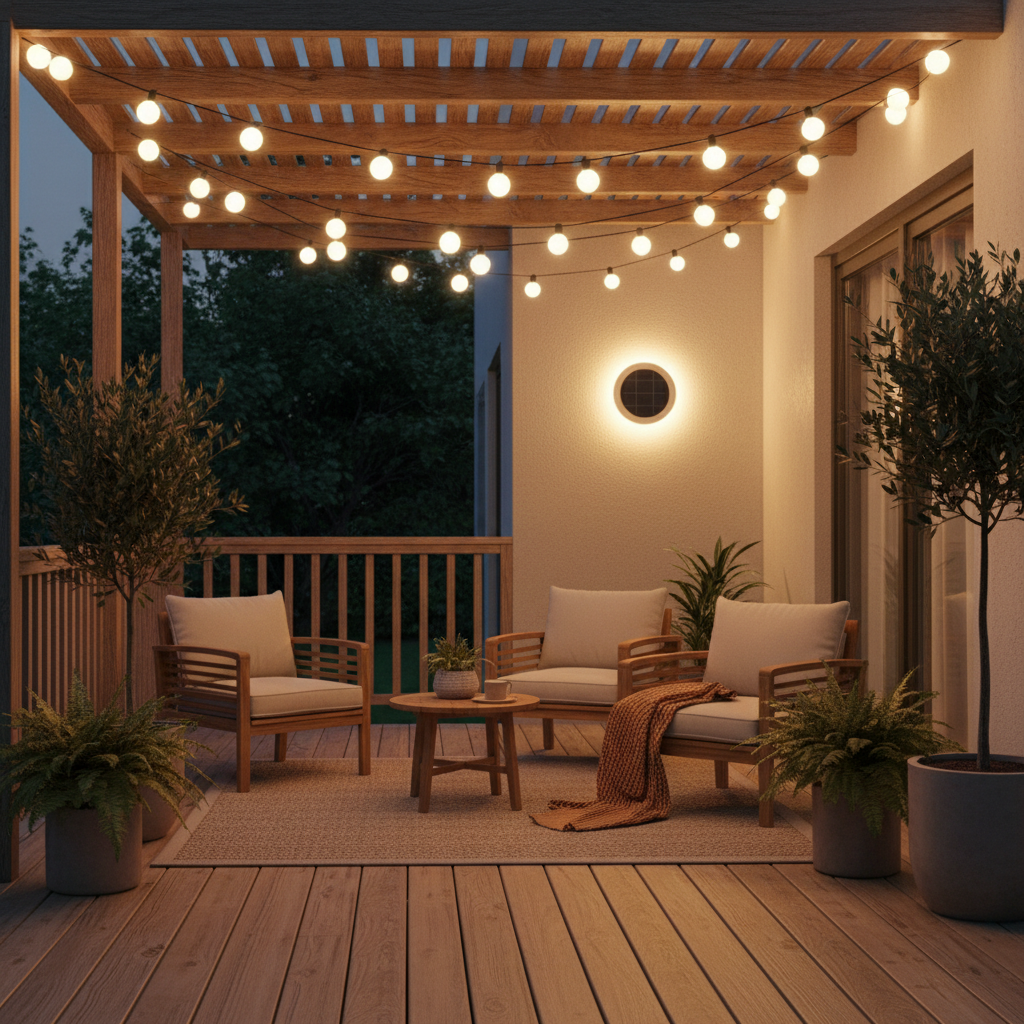
- Medium angle (60° to 90°): suitable for lighting a gate, an entrance, an outdoor living space.
- Wide angle (120° and more): ideal for security and surveillance. It covers a large area, but with less intensity at the center.
A wall-mounted motion sensor spotlight with a 120° or wider angle is the most consistent setup for an entrance or driveway. It sees wide, turns on early, and deters.
The IP Rating: What You Really Need to Know
The IP (Ingress Protection) rating is the most underestimated data when buying an outdoor solar spotlight. And this is often where disappointments occur.
What's the Difference Between IP44, IP65, and IP67?
The IP code consists of two digits:
- The first indicates protection against solid objects (dust, insects)
- The second indicates protection against water
For outdoor use in the US/Canada, here's what that means:
| IP Rating | Water Resistance | Recommended Use |
|---|---|---|
| IP44 | Splashing water (side rain) | Sheltered, covered patio |
| IP65 | Directional water jets | Facade, exposed garden, driveway |
| IP67 | Short immersion (3.3 ft / 1 m for 30 min) | Ground, in-ground, flood-prone areas |
| IP68 | Prolonged immersion | In-ground under fountain, pool |
For a stake or wall-mounted spotlight installed in a garden exposed to weather, IP65 is the non-negotiable minimum. For an in-ground light, aim for IP67.
A spotlight sold as "outdoor" without an explicit IP rating is a red flag.
Does an IP65 Spotlight Resist Freezing Temperatures?
Not automatically. The IP rating says nothing about resistance to sub-freezing temperatures. For areas where it freezes regularly (northern US, Canada, mountains), check that the product is tested between -4°F and -13°F (-20°C and -25°C) minimum. Good product sheets explicitly mention this.
Outdoor Solar LED Spotlight with Motion Sensor: Who Is It For, What Is It For
A motion sensor transforms a decorative spotlight into a security and convenience tool. This feature truly changes daily use.
Why a Motion Sensor is More Useful Than Continuous Lighting at an Entrance
Without a sensor, you have two options: either you leave the light on all night (the solar battery rarely lasts 8 hours continuously in winter), or you manage it manually. Both are inconvenient.
With a solar motion sensor spotlight, the light turns on when someone arrives, stays on for the necessary time, and turns off by itself. Result: the battery lasts much longer, and you have light precisely when you need it.
For an entrance, gate, or garage, this is objectively more logical than continuous lighting. A decorative spotlight looks nice, but it won't alert you that a delivery person is there, nor will it deter intruders.
How to Evaluate the Quality of a Motion Sensor on a Solar Spotlight?
Not all sensors are created equal. Things to look for:
- Range: Below 16 feet (5 meters) is insufficient to properly cover an entrance.
- Detection angle: 120° is an acceptable standard, 180° is better for facades.
- Adjustable sensitivity: Useful for avoiding false triggers (animals, cars passing in the distance).
- Adjustable shut-off delay: Between 10 seconds and 3 minutes depending on use.
To delve deeper into this topic, our guide on how to choose a solar lamp with a motion sensor details each criterion with practical advice.
Powerful Solar Spotlight: What "Powerful" Really Means
We often see the mention "powerful solar spotlight" without product sheets providing objective comparison elements. Here's how to read between the lines.
The Battery Is Often the Real Bottleneck
A spotlight with an advertised 1500 lumens but a 1000 mAh battery won't last the night in winter. Battery capacity dictates real autonomy — and that's what makes the difference between a spotlight that works all night and one that dies at 2 AM.
In practice, a minimum 2000 mAh battery is recommended for serious use in detection mode. For continuous all-night use, you need more, and a capable solar panel.
The Solar Panel: Surface Area and Orientation Make the Real Difference
A small, poorly oriented panel won't sufficiently recharge a large battery. And in winter in the US/Canada, short days and low sun compromise the recharging of cheap models.
Serious solar spotlights offer either a larger panel or a remote panel to allow optimal orientation independently of the light fixture's position. This is a technical detail that has a real impact during the months of November to January.
Lumic's indoor Movement 3.0 LED light bar uses a 3000 mAh battery — for comparison with what you find in entry-level models. For outdoor use, the same principle applies: battery size isn't a marketing argument; it determines whether the product works in December.
Lumic's SolarGlow: Honesty About What It Is (and What It Isn't)
The Lumic SolarGlow is a wall-mounted solar spotlight with a motion sensor. It's important to understand what that means — and what it doesn't.
What It's Truly Designed For
The SolarGlow is designed for entrances, facades, gates, and driveways. It delivers 1200 lumens with two 180° sensors and a range of approximately 26 feet (8 meters). The IP65 rating ensures year-round outdoor use, including frost. Its autonomy in detection mode reaches 20 days without solar recharge, and it lasts about 36 hours continuously.
For an outdoor wall-mounted solar lamp dedicated to a home's entrance or perimeter, it's a consistent solution: 1200 lumens at 5.9 feet (1.8 meters) high with a reliable sensor illuminates and deters.
What It Is Not
Let's be direct: the SolarGlow is not a stake light for highlighting a flower bed, and it's not an in-ground light for marking a patio. If you're looking for those uses, you need to look at other products adapted to those specific formats. Recommending it for all "outdoor spotlight" uses would not be honest.
It's made to illuminate a specific area when someone arrives, not to create a decorative ambient light in a garden. This isn't a product limitation — it just meets a different need.
If you want truly autonomous outdoor lighting without cable or connection constraints, the SolarGlow deserves to be on your list for the entrance. For the rest of the garden, stake lights and in-ground lights remain the right formats. The 5-year warranty and 90-day satisfaction guarantee allow you to test it risk-free.
How to Choose Your Outdoor Solar LED Spotlight Based on Your Situation
To summarize in an actionable way, here's how to guide your choice based on your specific situation:
You Want to Highlight a Plant or Tree
Suitable format: stake light or adjustable ground spotlight. Look for a narrow beam angle (15° to 30°), 100 to 300 lumens are sufficient, and a minimum IP65. Aesthetics take precedence over power.
You Want to Mark a Driveway or Patio
Suitable format: in-ground light or regularly spaced stake lights. IP67 is recommended if the ground can be wet or walked on. Opt for several low-power light points rather than a single powerful spotlight.
You Want to Light and Secure an Entrance or Gate
Suitable format: wall-mounted motion sensor spotlight. Minimum 500 lumens, ideally 1000 and more, minimum 120° detection angle, IP65, sufficient battery to last in winter. This is where the power/autonomy ratio matters most, and where the motion sensor makes perfect sense.
To further explore the selection criteria for a reliable outdoor sensor, our guide on choosing an outdoor motion sensor goes deeper into available settings and technologies.
The Most Common Mistakes to Avoid
After helping many customers choose their outdoor lighting, here are the most common mistakes.
- Buying the cheapest spotlight without checking the IP rating. An IP44 spotlight directly exposed to rain will have a very short lifespan. IP65 minimum is not an option.
- Overestimating advertised autonomy in winter. Autonomy durations are measured under ideal sun conditions. In December in the northern US/Canada, divide by at least half.
- Confusing peak lumens with real lumens. Some product sheets advertise maximum lumens obtained in flash mode. For daily use in normal or detection mode, the effective number is lower.
- Neglecting solar panel orientation. A wall-mounted spotlight on a north-facing facade with an integrated, non-adjustable panel will be chronically undercharged. Prefer models with a remote or adjustable panel.
- Choosing a format that doesn't match the use. A stake light to secure an entrance makes no sense. A wall-mounted motion sensor for decorating a flower bed doesn't either. The format must match the real need.