A Light Isn't an Alarm — But Light is Still the First Defense
Before we go further, let's set the record straight. When you're looking for an outdoor motion sensor alarm, you want to protect your home. That's a clear intention, and it deserves an honest answer: a motion-sensing light isn't an alarm. It doesn't notify anyone, it doesn't send alerts, and it doesn't record anything.
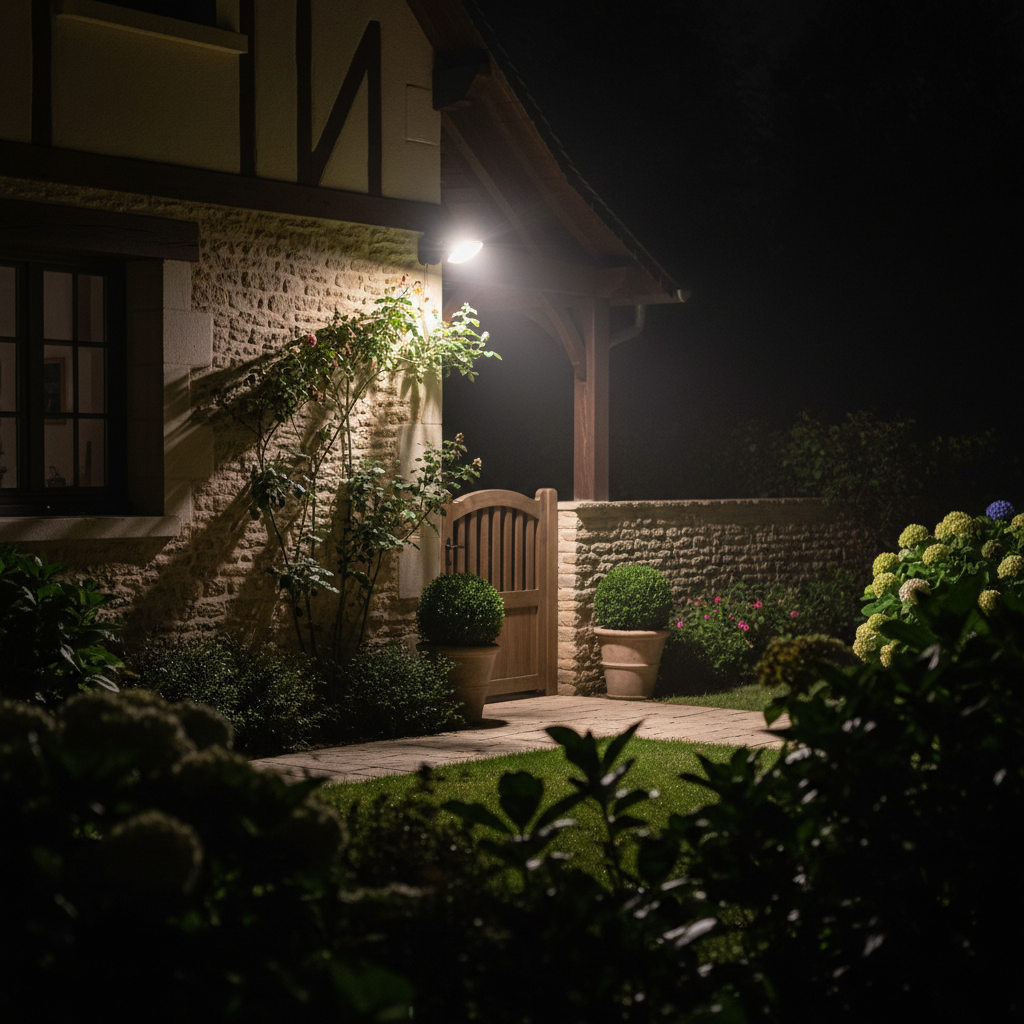
But here's what burglary prevention studies consistently show: sudden light remains one of the primary deterrents. An intruder exposed by a 1200-lumen spotlight in the middle of the night is an intruder who thinks twice. Light surprises. It exposes. It signals that the house isn't asleep.
What you'll find in this article: how a real outdoor alarm works, why motion-sensing lighting is its best complement, and how to combine both for truly effective outdoor security.
How an Outdoor Alarm with Motion Sensor Works
A traditional outdoor alarm relies on one or more motion sensors — typically PIR (passive infrared) sensors — positioned on the facade, at a house corner, or above a gate. When someone enters the detection zone, the system triggers a siren, a smartphone alert, sometimes even a phone call to a monitoring service.
What Types of Outdoor Sensors Are There?
For outdoor use, sensors must be robust: resistant to rain, frost, and false positives caused by animals or vegetation. The main types are:
- Standard PIR sensors: Sensitive to moving body heat. These are the cheapest but also the most prone to false alarms if poorly adjusted.
- Dual-technology sensors (PIR + microwave): They combine two detection types, drastically reducing false alarms. Recommended for outdoor use.
- Infrared barriers: Two terminals create a beam between them. Ideal for securing a gate or a defined perimeter.
- Volumetric microwave sensors: Very powerful, suitable for large areas, but more expensive.
What Range and Coverage Area Can You Expect from an Outdoor Sensor?
The range varies greatly depending on the model: from 26 to 65 feet (8 to 20 meters) in width, with detection angles from 90° to 180°. To effectively cover the entrance of a single-family home, one or two well-placed sensors are usually sufficient. The installation angle — slightly elevated, pointed towards the area to be monitored — is as important as the technical range.
Should You Choose a Wired or Wireless Outdoor Alarm?
Wired alarms offer maximum stability but require installation work. Wireless systems (433 MHz, Z-Wave, or proprietary protocols) are more flexible to install and easy to upgrade, but you need to check the radio range based on your wall thickness and environment. For a house with a yard, a wireless system certified Grade 2 (EN 50131 standard) is often the best option.
Recommended Outdoor Alarm Systems in 2025
Some references are widely accepted by demanding installers and homeowners. Without claiming to be an exhaustive comparison, here are the serious players to consider:
| Brand / System | Type | Strengths | Weaknesses |
|---|---|---|---|
| Somfy Protect | Wireless, self-monitored | Clear app, powerful siren, reliable | Subscription for monitoring |
| Ajax Systems | Wireless, Grade 2 | Very robust, excellent range, anti-sabotage | Higher price, technical configuration |
| Risco Group | Wired or hybrid | Professional, certified | Professional installation recommended |
| Dahua / Hikvision | Camera + detection | Integrated video, many models | Sometimes complex interface |
Before choosing, check if the system is compatible with an existing indoor hub or if you're starting from scratch. A modular system (like Ajax) is easier to upgrade.
Positioning Your Outdoor Sensors: Common Mistakes to Avoid
Even the best sensor is useless if poorly placed. Some practical rules:
- Avoid aiming directly at the street: Every passerby would trigger an alert. Point sensors towards actual access areas (gate, garage, side windows).
- Beware of vegetation: A bush moving in the wind can flood your system with alerts. Ensure nothing obstructs the detection path.
- Install at height: Between 6.5 and 8 feet (2 and 2.5 meters) from the ground. Too low = pets triggering it. Too high = ground blind spot.
- Consider shaded areas: A camera or sensor can't see in the dark. This is where motion-sensing lighting comes in.
To learn more about this topic, our article on choosing your outdoor motion sensor details the technical criteria to check before buying.
Why Motion-Sensing Lighting is the First Line of Deterrence
Here's something experienced alarm installers know well: an alarm acts after an attempt. Light acts before. It exposes the intruder even before they try anything.
An individual approaching a property in the dark who suddenly finds themselves exposed by a powerful spotlight has two immediate problems: they are visible from the street, and they don't know if anyone saw them. It's precisely this uncertainty that discourages. Surveys of arrested burglars consistently confirm that outdoor lighting is one of the primary factors that made them change targets.
How Much Light Power is Truly Deterrent at Night?
At night, 1000 lumens in the face is blinding. It's like a construction spotlight aimed at you. A decent solar light rarely exceeds 400 to 600 lumens. The difference is visible and felt. For lighting to be deterrent, it must surprise, expose, and maintain the light until the intruder leaves.
Can a Solar Light Really Work as a Deterrent Tool?
Yes, provided you don't choose the cheapest $15 model. Low-end lights have two major flaws: insufficient light output and a battery that gives up after a few cloudy days. Models designed to last have solar panels and batteries sized to hold up even in winter, during overcast weather.
If you're wondering about the differences between available solutions, our guide to motion-sensing solar lighting compares options based on usage.
How to Effectively Combine an Alarm and Motion-Sensing Lighting
The principle is simple: the alarm monitors, the light deters. The two complement each other without replacing one another. Here's how to integrate them:
Which Locations Should Be Covered First with Light?
The areas that benefit most from motion-sensing lighting are:
- The driveway and gate: first point of contact
- The garage and side door: often less monitored areas
- The rear perimeter: often more isolated from the street and thus more vulnerable
- House corners: blind spots from windows
Lighting at these four points creates a coherent illuminated perimeter. The light's motion sensor can even signal an intrusion before the alarm's sensor is triggered — simply because it's positioned further out on the property.
Can a Light's Sensors and an Alarm's Sensors Complement Each Other?
Yes, and it's even an advantage. A motion-sensing light's sensors cover an immediate outdoor area. An alarm's sensors monitor strategic entry points. By overlapping the two coverages, you reduce blind spots. The light handles visual deterrence, the alarm handles active response.
To understand exactly how this complementarity works, the article understanding motion sensor and lighting operation explains the technical mechanisms in detail.
The SolarGlow as an Alarm Complement: What It Actually Provides
The SolarGlow by Lumic is not an alarm. It's important to state that clearly. It's an outdoor solar light with motion detection, designed to be your property's first visual barrier.
What differentiates it from standard solar lights:
- 1200 lumens: This is blinding at night, significantly above what most cheap alternatives offer.
- 2 x 180° sensors with a range of about 26 feet (8 meters) each: wide coverage, few blind spots.
- IP65 rated: Rain, snow, frost — it holds up all year without intervention.
- Up to 20 days of autonomy without solar recharge in detection mode.
- Zero cables to run: Installation in minutes, no electrician, no complex drilling.
In practice, you place it at your driveway entrance, above the gate, or on the garage wall. It handles visual deterrence while your dedicated alarm handles active monitoring. Together, they cover what neither could do alone.
If you want to compare options before deciding, our guide to choosing a motion-sensing solar light details the criteria to check.
The SolarGlow is covered by a 5-year warranty and a 90-day money-back guarantee. Lumic customer support responds in less than 24 hours. This is consistently highlighted in reviews on Trustpilot (4.5/5 from over 2200 reviews).
Outdoor Security: The Layered Approach to Protecting Your Home
Security professionals talk about defense in layers, or defense in depth. The idea: each layer slows down or discourages the intruder, and if one is breached, the next takes over.
For a single-family home, here's how to build these layers from the outside in:
- Layer 1 — Perimeter: Fence, gate, hedge. Initial physical obstacle.
- Layer 2 — Visual Deterrence: Motion-sensing lighting. This is where the SolarGlow or any equivalent spotlight comes in. The intruder is exposed before even approaching.
- Layer 3 — Active Detection: Motion sensors connected to an alarm. If the intruder continues despite the light, the alarm triggers.
- Layer 4 — Notification: Outdoor siren + smartphone alert + optional professional monitoring.
- Layer 5 — Protected Access: Reinforced locks, door blockers, laminated glass.
Don't neglect any layer. An alarm without lighting makes approach easy. Lighting without an alarm lets a determined person act. Both together create coherent defense.
To delve deeper into cable-free lighting, the article on powerful wireless outdoor lighting solutions provides a complete overview of available options.
What You Need to Remember Before Choosing
The outdoor motion sensor alarm remains the central element of your active security. To choose the right system, here are the points to check:
- Control panel certification (Grade 2 minimum for residential use)
- Sensor compatibility with the outdoor environment (IP65 minimum, resistance to false alarms)
- Notification type: local siren, smartphone alert, professional monitoring
- Ease of installation and system scalability
- Overall budget: sensors, control panel, installation, potential subscription
And once your alarm is in place, don't leave the dark corners of your property unlit. Light does the deterrence work before your alarm even has to react. That's the principle of layered defense — and it's what makes the difference between a secure home and one that looks like an easy target.