You've renovated your patio, laid beautiful tiles, and carefully chosen your furniture. But when evening comes, a single yellow spotlight illuminates everything like a parking lot. Patio lighting is often the last box we check, yet it completely transforms the ambiance once the sun sets.
Here's what we're seeing more and more on modern patios in 2026: lights you don't see, but feel. A curated atmosphere, not harsh functional lighting. Hidden sources, soft shadows, materials that play with light. This inspiration guide will show you exactly how to achieve it, style by style.
Indirect Lighting: The Strongest Trend Right Now
Indirect lighting means never exposing the light source directly. You illuminate a surface, a wall, the ground, and that reflection creates the ambiance. This principle is widely used in luxury hotels and designer restaurants, and it's now making its way into residential patios.
LED Strip Lights Under Coping or Benches
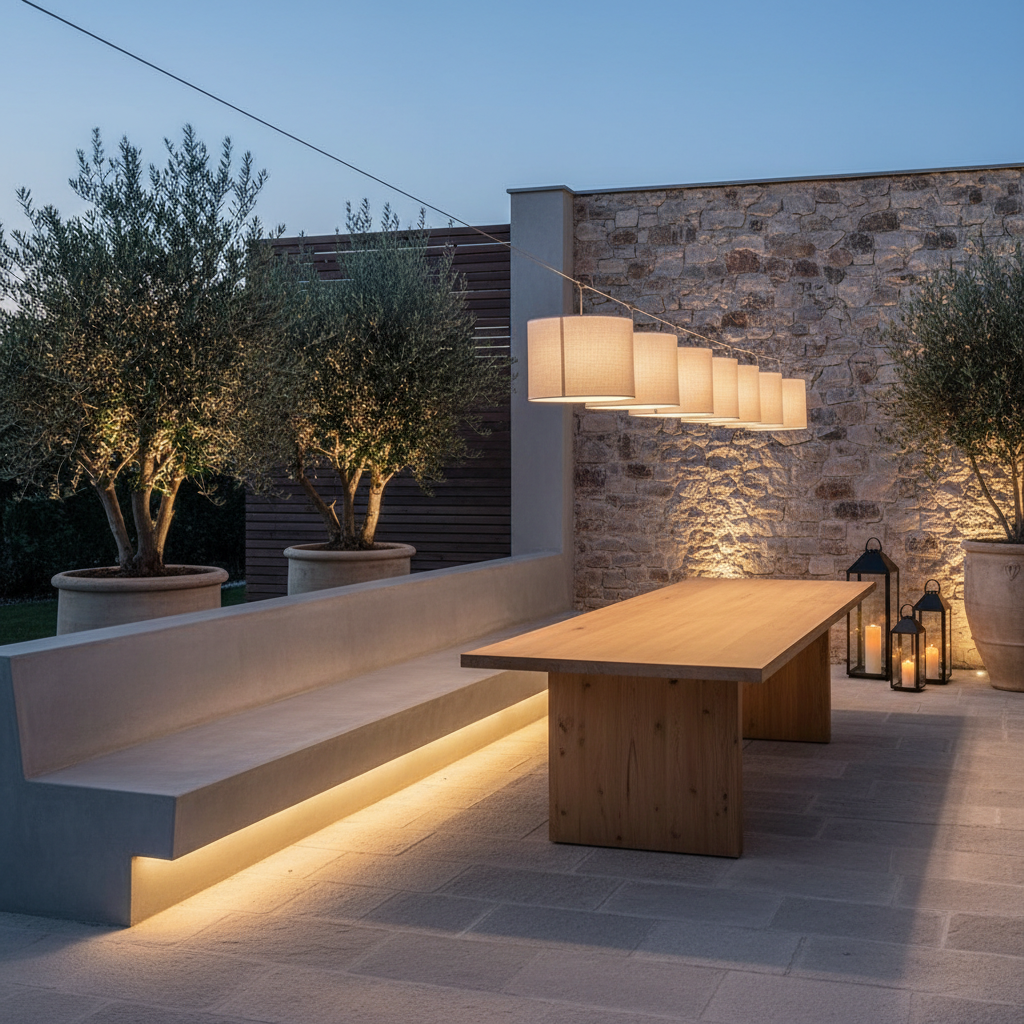
The idea: slide an LED strip light under the edge of pool coping, under a polished concrete bench, or under the edge of a raised patio. The light flows towards the ground without ever revealing the source. The nighttime effect is spectacular, especially with a warm white hue around 3000K, which gives an amber, inviting glow.
This technique works particularly well on patios with strong horizontal architectural elements: thick coping, a low wall, or stairs with risers. The aluminum channel housing the strip is both invisible and discreet, protecting the LEDs from moisture.
Lighting in Tile Grout or Between Deck Boards
Less common but increasingly present in high-end patio projects: LED profiles integrated directly into widened grout lines between composite wood or tile boards. The patio itself becomes luminous. This type of installation requires planning during the design phase, but the result is truly striking.
If you're not in a construction phase, you can achieve a similar look with recessed ground lights that direct light upwards along a wall or hedge.
Dominant Styles in 2026 Patio Lighting Design
Three aesthetics clearly stand out this year. They are not mutually exclusive, and many successful patios intelligently blend two of these styles.
Japanese Minimalism: Fewer Sources, More Impact
On a minimalist patio, lighting follows the same rule as everything else: every element must have a purpose. Avoid tangled string lights, colorful lanterns, or an abundance of spotlights. Choose two or three light sources maximum, carefully placed, and let darkness be part of the composition.
The look: a concrete or ceramic floor lantern with a visible, low-wattage Edison bulb. A recessed ground light highlighting bamboo or an olive tree. A hidden LED strip light under an awning roof. Nothing more. Materials are neutral, shapes are clean, and shadows are embraced as a decorative element in their own right.
Outdoor Industrial: Matte Black Metal and Directional Light
The industrial style on a patio combines raw metal, concrete, and warm light. Matte black metal fixtures are the signature of this trend: cage wall sconces, adjustable track spotlights, tripod floor lamps. The light is more direct, more assertive, but always in a warm tone to counterbalance the coolness of the materials.
This style works particularly well on urban patios with rooftop views, or on extensions of contemporary homes with exposed metal beams. The effect is highly refined but gives an impression of natural industrialism, without affected sophistication.
Contemporary Mediterranean: Embraced Warmth
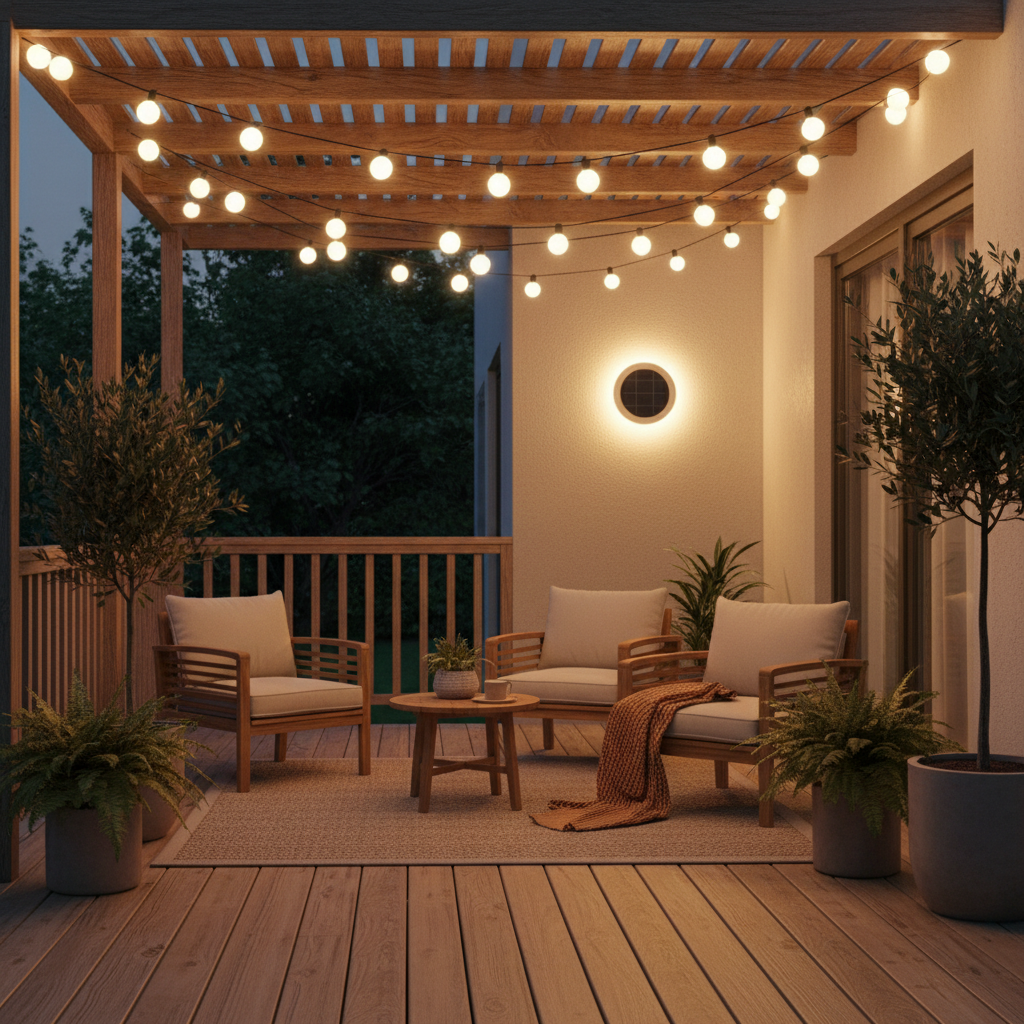
On modernized Mediterranean patios, references to seaside heritage are blended with contemporary finishes. String lights are making a comeback, but in a refined version: clear bulbs with visible filaments on black or off-white textile cords, strung in straight lines rather than swags. The result evokes a seaside restaurant patio, without the folkloric overload.
The warmth of the light is paramount in this style: stick to 2700K to 3000K maximum. Pottery, potted palm trees, and stone walls are highlighted by discreet ground spotlights. Wireless patio lighting is particularly suitable here, as it allows you to adjust the ambiance for different evenings without cable constraints.
Fading Light: Invisible Functional Lighting
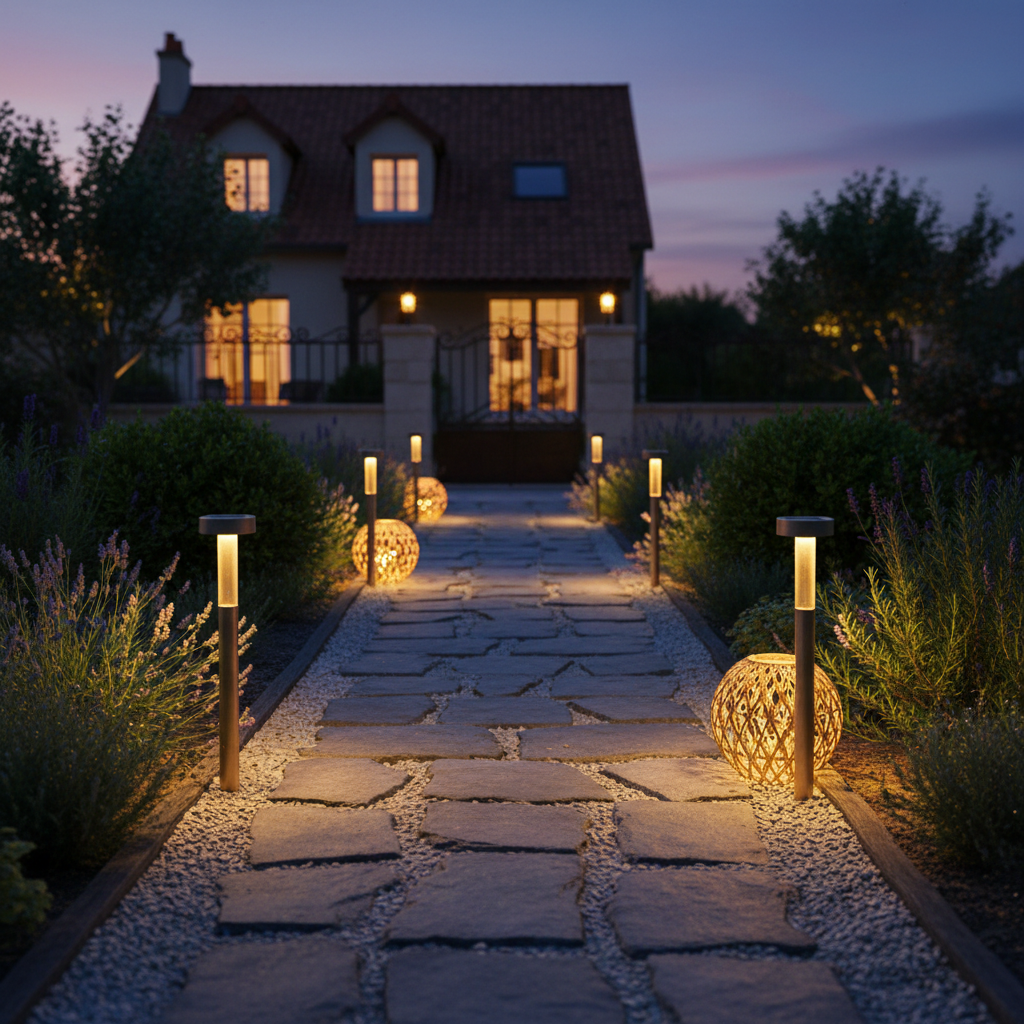
There's a category of lighting you don't see in magazines but is essential on a real patio: safety and circulation lighting. Steps, stairs, garden access, path to the gate. These areas must be lit at night, but without disrupting the carefully crafted ambiance.
Lighting Steps Without Overwhelming Them
The golden rule: light that illuminates the ground, not your eyes. Recessed lights in stair risers (downward-facing) provide exactly that. But for quick, no-fuss installation, motion sensor lights are the most logical solution: they only turn on when you pass, remain off otherwise, and their design can be as discreet as a fixed fixture.
Solar patio lighting perfectly meets this need: no cables to run along steps, no electrical work, and autonomous recharging during the day. Lumic's SolarGlow fits this scheme with its matte black aluminum casing and 180-degree sensor: it turns on when you pass, turns off automatically, and its design blends into the environment. This is exactly the principle of invisible functional lighting.
The Motion Sensor as a Design Tool
Think of the motion sensor differently: it's not a stark security device, it's a tool that makes your lighting smart. Your patio is dark and calming when you're not there, and it gently illuminates when you arrive. It's an experience, not just a function.
On a modern patio, this logic applies to several points: access from the living room, the path to the garden, side stairs. Each zone lights up on demand, then turns off automatically. The overall effect remains coherent and understated.
Materials for a Trendy Luminous Patio
Patio lighting should not be considered independently of the surrounding materials. Some surfaces amplify light, others absorb it. Understanding this interaction helps in choosing light sources.
Polished Concrete and Stone: Best Allies for Grazing Light
Polished concrete and natural stone (travertine, limestone, slate) have a texture that reacts spectacularly to grazing light. A low light source placed a few inches from a stone wall highlights every irregularity, every vein, every rough spot. This is the principle of wall-washing, and it's free if you already have this type of surface.
To leverage this, place a ground light 8-12 inches (20-30 cm) from the wall, pointed upwards. Or embed an LED strip light in a profile at the base of the wall. The wall itself becomes a source of reflected light.
Wood and Metal: Two Opposite Reactions to Light Warmth
Composite or natural wood absorbs warm light and gives it a golden depth. This is why wooden patios under a 2700K string light consistently have that cozy look that works so well. Conversely, metal (stainless steel, lacquered steel, aluminum) reflects light, giving it a more contemporary character.
On a patio that mixes both (e.g., a composite deck with a stainless steel railing), play with the direction of light: illuminate the wood with diffuse warmth, and let the stainless steel catch natural reflections.
String Lights and Lanterns: How to Use Them Without Kitsch
String lights are often misused: too many, poorly strung, with mismatched bulbs. Used correctly, they are one of the most effective elements for creating a modern patio atmosphere.
The Straight Line Rule
Forget swaged string lights. Modern string lights are stretched in a straight line, from one point to another, horizontally. Between two posts, between the facade and a pillar, above a dining table. The ideal height is around 7.2-8.2 feet (2.20-2.50m), creating a luminous canopy without obstructing circulation.
A single string, regularly spaced bulbs (10-16 inches / 25-40cm apart), 2700K color temperature with a visible filament. That's it. The result is clean, romantically understated, and compatible with virtually all patio styles.
Floor Lanterns: Decorative Objects That Truly Illuminate
Floor lanterns are among the rare objects that are both decorative by day and functional by night. In matte black metal with clear glass, textured ceramic, or outdoor-treated natural rattan: their form matters as much as the light they emit.
Place them on the ground, never elevated. One in a patio corner, another at the base of a large pot, a third along a low wall. They create warm light points at ground level, which is much more flattering than overhead light.
To delve deeper into this topic, our article on solar lamps for patios details how to create an evening ambiance without any cables.
Patio Lighting and Plants: Staging Living Elements
An olive tree, bamboo, or climbing rose on a pergola: plants on a patio become magnificent at night if you light them correctly. This is one of the simplest techniques to visually transform an outdoor space.
Up-lighting
Place a ground spotlight pointed upwards, at the base of the plant. The light passes through the leaves, creating shadows on the wall or ground behind. This is pure staging. Works particularly well on shrubs with textured leaves (agave, yucca, dwarf palm) and trees with expressive branches.
The ideal color temperature for plants is neutral white (4000K), which respects natural green tones, rather than warm white, which can make them appear yellowish. This is one of the rare situations where neutral white is preferable to warm white on a patio.
Shadows as a Compositional Element
Shadow projections on a white wall are free and spectacular. If your patio has a light-colored wall behind a tree or shrub, you already have all the elements to create a dynamic lighting installation. The wind moving the branches creates shifting, living shadow plays. This is an effect no designer fixture can replicate at this price.
Designer solar lamps are particularly suited for this use: autonomous, repositionable at will, they allow you to experiment with lighting angles without committing to a permanent position.
Mistakes to Avoid on a Modern Patio
As much as trends, pitfalls to avoid are part of a good inspiration brief. Here are the most common mistakes on contemporary patios.
Too Many Different Color Temperatures
Mixing 2700K, 4000K, and 6500K on the same patio is the quickest way to an inconsistent result. Choose a primary temperature (2700K or 3000K for a warm ambiance, 4000K for a more contemporary look) and stick to it for all fixtures. Temperature variations create a sense of visual disorder even when each fixture's design is impeccable.
Lighting Only From Above
A single ceiling light or spotlight above the dining table is not enough to create an ambiance. Light coming only from above is the flattest and least flattering light there is. Multiply levels: ground (path lights, lanterns), mid-height (wall sconces), high (string lights, awning ceiling lighting). Layered lighting makes all the difference.
Neglecting the Indoor-Outdoor Transition Zone
The transition between the living room and the patio is a critical area. If the patio is too dark compared to the interior, the contrast is unpleasant and gives a sense of danger. If it's too brightly lit, it loses its nocturnal character. The ideal: a slight gradation, with well-lit passage areas (door threshold, access stairs), and the patio space with softer ambient light.
For fully autonomous and repositionable solutions, consult our article on autonomous outdoor lamps, which summarizes the available options without cable constraints.
Where to Start to Transform Your Patio
Changing patio lighting doesn't mean starting from scratch. You can begin with a single element and observe the effect before going further.
Priority number one: light your steps and main access with a discreet motion sensor. It's not visually spectacular, but it's the foundation of safety and comfort on which everything else rests. Next comes staging: string lights, lanterns, or indirect lighting depending on your patio's style. Finally, the finishing touches: up-lighting plants, LED strip lights under coping, designer fixtures that double as decorative objects during the day.
You don't need to do everything at once. A good, well-strung string light and two floor lanterns are enough to transform a plain patio into a truly inviting space. That's the essence of modern patio lighting: in subtlety, not in quantity.
And if you're still looking for more ideas, our guide on powerful solar outdoor lighting explains how to combine discretion with true lighting performance.