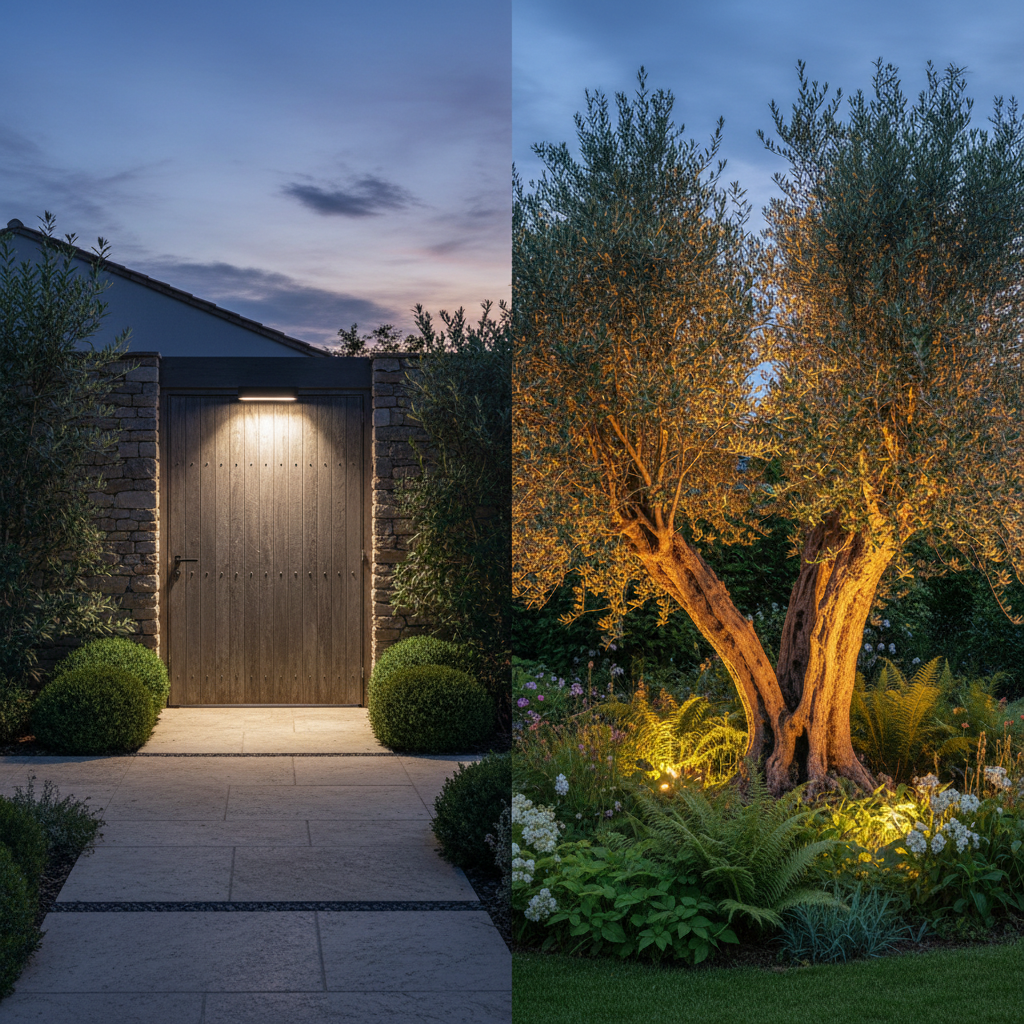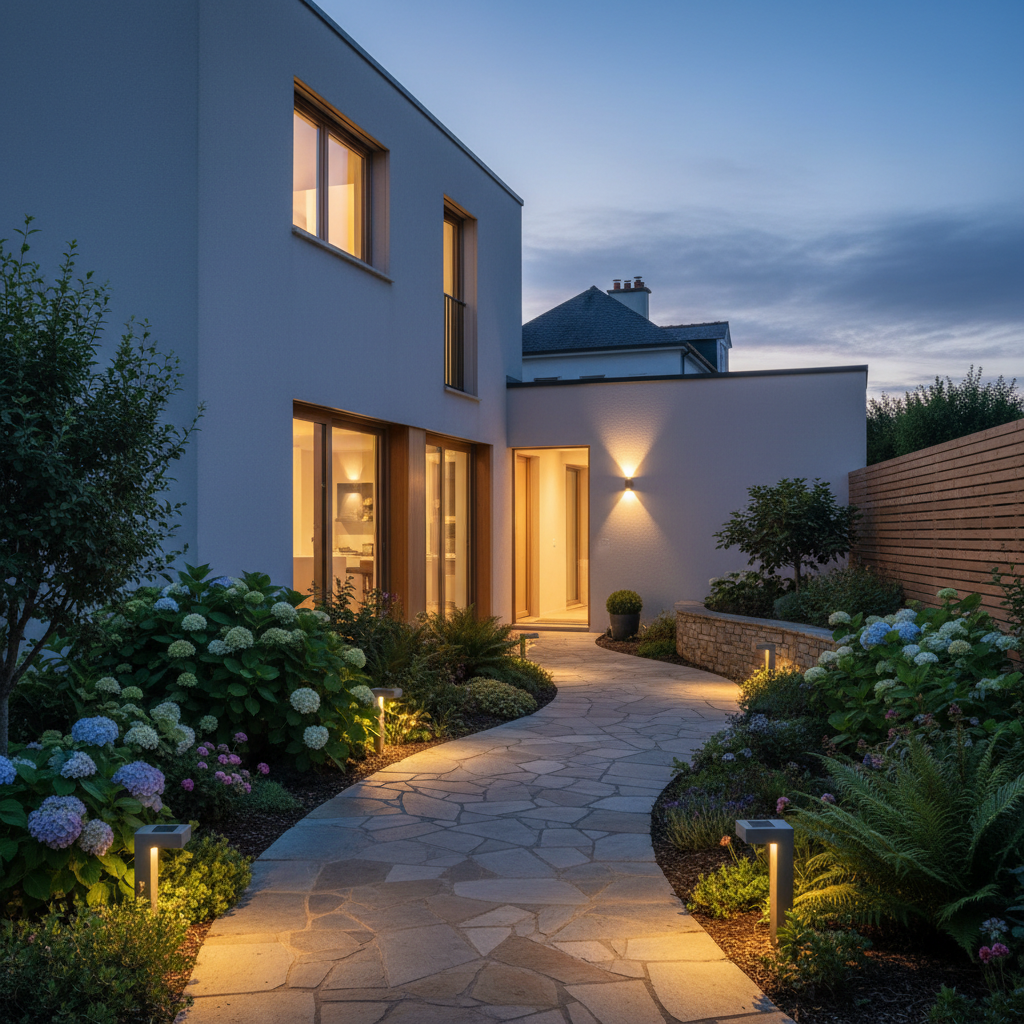
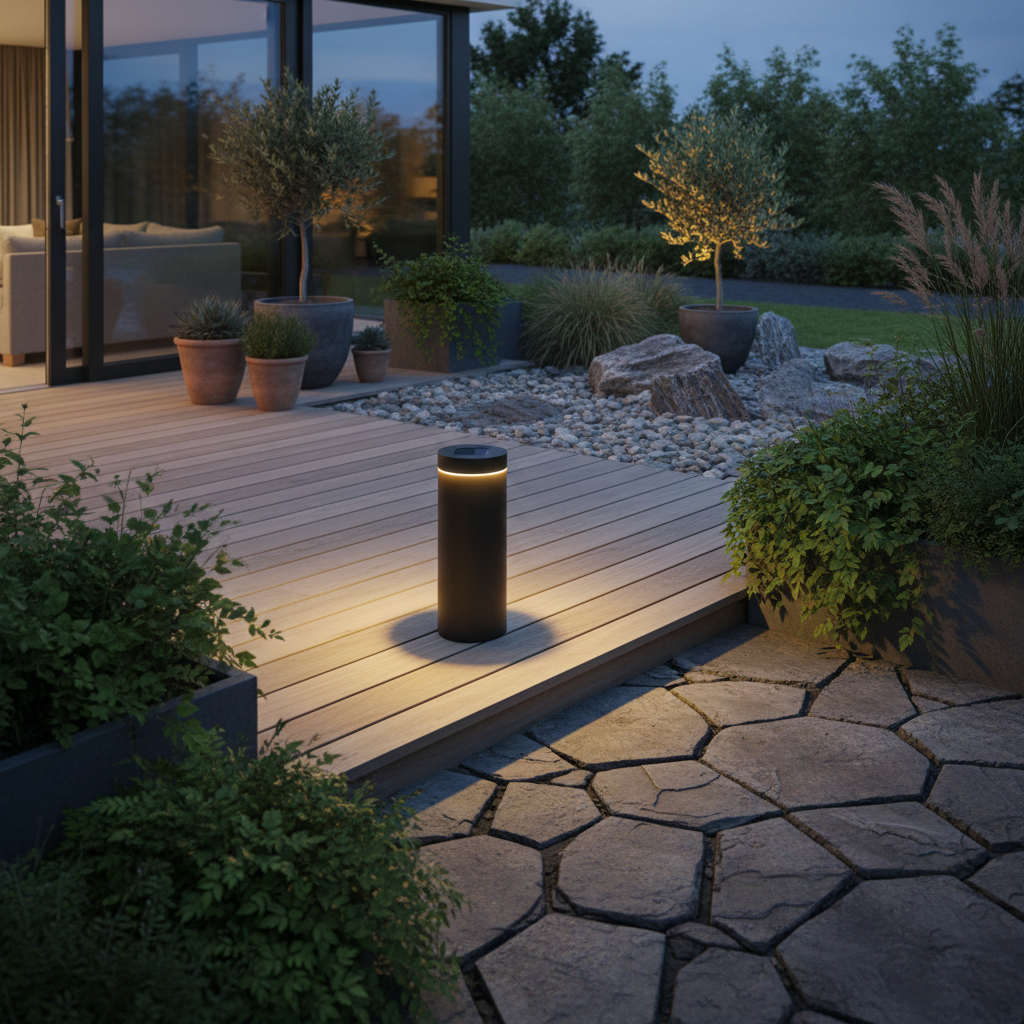
You scroll through dozens of garden photos on Pinterest, you find that perfect patio with soft light outlining plants, and you wonder: how do they do that? The answer is rarely basic supermarket solar string lights. It's a designer solar garden light, chosen for its look as much as for its night performance.
But here's the trap many people fall into: buying a solar fixture for its appearance in May, only to find it barely lights up by October. A beautiful design that fails by January is simply wasted money. This guide is here to prevent that from happening to you.
Why Outdoor Solar Design Finally Got Serious
For a long time, solar garden lights had a well-deserved reputation as gadgets: frosted white plastic globes that flickered for two hours before dying. Design? Zero. Durability? Even less.
What we've seen in recent years is a real shift. Manufacturers targeting discerning customers understand that a garden is a living space in its own right. People invest time, money, and intention into it. They carefully choose patio furniture, paying attention to materials, colors, and vegetation. It would be absurd for lighting to remain an afterthought.
Today, the most serious designer solar lights incorporate premium materials (aluminum, brushed steel, brass), finishes designed to age gracefully, and storage technology that allows them to last several weeks without sunlight. Beauty and efficiency are no longer incompatible.
What Distinguishes a True Designer Solar Light from an Ordinary Product?
The difference is immediately visible in the materials. A generic product uses ABS plastic, often white or clear, which yellows and cracks within a few seasons. A true designer solar light, however, relies on aluminum, brushed metal, or UV-resistant composites. The silhouette is clean, angles are deliberate, and finishes are refined.
But design goes beyond the casing. It's also about how light is diffused: too direct, it glares and ruins the ambiance. Well-designed, it creates halos, reflections on pavers, and depth in the garden. This is where the quality of designer garden lighting truly shines.
What Budget Should You Expect Compared to a Wired Fixture Installed by an Electrician?
This is a fair question, and the answer is often surprising. Installing a wired outdoor fixture involves trenching in the garden, connecting to the electrical panel, and hiring a professional. In practice, this type of installation often costs several hundred dollars, or even more depending on distance and complexity. A quality designer solar light, installed in minutes without tools or cables, typically costs 3 to 5 times less for a comparable, sometimes superior, visual result.
Top 4 Designer Solar Garden Light Styles Dominating in 2026
The market has evolved around a few major aesthetic directions. Each corresponds to a type of garden, a house style, and a desired atmosphere. Here's how to identify and choose them.
Minimalism: Matte Black, Clean Lines, Nothing Superfluous
This is undoubtedly the strongest trend right now in designer garden lighting. Matte black is everywhere: on gates, steel windows, garden furniture. Solar lights follow this trend with bold geometric shapes, without ornamentation. A cylinder, a cuboid, a slender rod topped with a discreet diffuser.
This style is perfect for contemporary homes, gardens with sparse but intentional vegetation, and patios made of polished concrete or dark composite wood. The effect is sharp, elegant, and ages well because it doesn't follow a fleeting trend.
What to check with this type of product: the quality of the black coating. Some dull finishes turn grayish-brown after two summers. Good products use epoxy paint or baked powder that resists UV without fading.
Natural Style: Wood and Metal, a Durable Alliance
Teak, treated oak, or eucalyptus wood combined with raw or galvanized metal elements: this style embodies both aesthetic and sustainable principles. It suits Scandinavian gardens, spaces with wooden pergolas, and patios that blend plant and mineral elements.
The decorative solar light that fits here is usually a low bollard, a tabletop lantern, or a wall sconce with a wooden frame. The resulting lighting is soft, warm, almost domestic. It feels as comfortable as a living room.
Beware of products that use untreated or poor-quality wood: within two seasons of rain and frost, wood-metal joints become weak points. Opt for FSC-certified wood and assemblies with stainless steel fasteners.
Industrial: Brushed Steel, Cast Iron, Raw Light
This style draws from workshops and urban architecture. Brushed steel, zinc, gray cast iron: materials that embrace their robustness. Shapes evoke old factory lamps or theater spotlights. The result is architectural, assertive, and works remarkably well in gardens with dense vegetation, stone walls, or patios with raw metal furniture.
What's interesting about this style is its ability to remain beautiful even during the day, even when off. A well-designed industrial light fixture is a decorative piece in itself. Some manufacturers play on contrasts: a dark steel exterior and a golden interior that warms the emitted light.
Vintage: Aged Brass, Blown Glass, Amber Light
For gardens that want to tell a story, aged brass and amber glass create a bistro or long-inhabited country house atmosphere. This style works with climbing roses, stone houses, and patios with terracotta tiles or fine gravel.
Designer solar lights in this vein are often hanging lanterns, floor globes, or old-fashioned sconces. The warm light they emit is unparalleled for creating ambiance during outdoor dinners. The only drawback: some brass finishes are superficial and flake quickly. The best ones are achieved through deep surface treatment, not just a golden varnish.
How to Organize Your Garden with Multiple Designer Light Sources
A well-lit garden is a garden with multiple light levels. Not a single floodlight that washes everything out, but a composition: high lighting for security, low lighting for pathways, and ambient lighting for relaxation areas.
Which Areas Are Priority for Installing a Designer Solar Light?
Start with the entrance and main pathway: it's the first thing you see when you arrive, and the first impression you make. A well-chosen modern solar garden light here immediately structures the space. Next, the patio or dining area: this is where the ambiance is created. Finally, the garden's focal points: a remarkable tree, a stone wall, an architectural plant illuminated from below.
To delve deeper into this zone-by-zone consideration, our article on designer garden lighting adapted to each zone provides concrete benchmarks based on surface area and use.
How to Mix Styles Without It Getting Chaotic?
The key is to choose a common thread: a material (all matte metal, or all natural wood), a light temperature (all warm white, never mixing with cool white), or a color palette (black and wood, or white and brass). You can have different shapes and heights, but if these three elements are consistent, the overall look holds together.
What designers systematically avoid: mixing different lighting tones in the same space. Cool white next to warm white creates an immediate dissonance, even if the fixtures are individually beautiful.
Solar Wall Sconces: When the Wall Becomes a Design Element
Solar wall sconces deserve special attention. They integrate with the facade, fence wall, or pergola, creating a lateral light that sculpts volumes very differently from a bollard or stake light.
A well-positioned designer solar wall sconce on a natural stone wall creates shadows that highlight the material's texture. On a smooth rendered facade, it draws a clean silhouette. The effect is completely different depending on the surface, and that's what makes this element so versatile.
Can a Solar Wall Sconce Really Replace a Wired Sconce in Terms of Design?
Yes, provided you choose the right product. Entry-level solar sconces often have a very visible and inelegant integrated solar panel. Designer models solve this problem in two ways: either by harmoniously integrating the panel into the fixture's shape, or by using a small, detachable panel placed elsewhere, out of sight. For spaces where aesthetics are paramount, this detail changes everything.
Pathways and Borders: Designer Solar Bollards as Visual Guides
Marking a pathway with lights is one of the most elegant effects you can create in a garden at night. Designer solar bollards don't just indicate where to walk: they create perspective, depth, an invitation to move through the space.
The secret to successful pathway lighting is consistent spacing and uniform products. Identical bollards every 30 to 47 inches (80 to 120 cm), with a soft light grazing the ground, are subtle and striking. As soon as you mix models or space them irregularly, the effect is lost.
What Height Solar Bollard for a Garden Pathway?
For pathway lighting, bollards between 12 and 24 inches (30 and 60 cm) provide the best visual results. Too tall, they look like miniature streetlights and lose their character. Too short, the grazing light disappears into the vegetation. The ideal height allows you to see both the fixture itself and its reflection on the ground.
Patio and Dining Area: The Ambiance That Changes Everything
It's on the patio that the decorative solar light fully expresses its potential. The challenge here isn't security or orientation, it's ambiance: a light that makes you want to stay, chat, and finish that glass of wine even as the evening cools.
For designer solar patio lighting, multiple sources at different heights are infinitely better than a single powerful fixture. A wall sconce on the facade, two bollards on the periphery, and perhaps a few lanterns placed on the table or low wall: light is everywhere without coming from anywhere in particular. That's ambiance.
Can You Leave Your Solar Patio Lights On All Night?
In motion sensor mode, yes, without hesitation: the light only turns on when someone passes by and turns off automatically. In continuous mode, autonomy depends on the product and its battery. Serious models offer several hours of continuous lighting. For a dinner party on the patio, most good solar lights last well, especially if the battery was charged on a sunny day.
The Real Challenge: Beautiful AND Reliable, Not One or the Other
Let's get back to basics. A designer solar light that dies in November because its battery is too small or its panel poorly captures winter light is a failed light. Even if it's beautiful.
Products that do both well are those that haven't sacrificed technology for design. A larger solar panel, a higher capacity battery, a seriously tested waterproof casing: all this can coexist with an elegant silhouette and refined finishes. Lumic's SolarGlow is an example of this approach: sleek aluminum, but a battery and panel sized to last up to 20 days without solar recharge. The kind of product that remains beautiful and useful in winter, not just in July.
To help you weigh aesthetics against performance across your selection, our article on designer outdoor solar lighting provides the right criteria to avoid mistakes.
How to Assess the Reliability of a Designer Solar Light Before Buying It?
Some concrete indicators: the IP rating (at least IP65 for outdoor use in all conditions), battery capacity (in mAh, not just "large capacity"), the advertised number of hours or days of autonomy in standby mode, and the warranty period. A manufacturer offering a 5-year warranty on a solar light knows they are selling a durable product. One offering a one-year warranty, less so.
Customer reviews are also revealing: not overall ratings, but comments dated October, November, December. If people say their light still works well in winter, that's a strong signal. If all positive reviews are from June-July, be wary.
Concrete Inspirations for Designing Your Garden
Finally, here are some successful compositions that can serve as a starting point:
- The Minimalist Zen Garden: Two matte black cylindrical bollards on each side of the entrance, a discreet sconce on the facade, nothing more. Simple and very effective at night.
- The Mediterranean Patio: Vintage brass lanterns placed on low walls, ambient lighting on the stone facade. The warm light and reflections on the stone create something unforgettable.
- The Scandinavian Natural Garden: Wood and brushed metal bollards along the path, a simple sconce at the entrance. The light is diffused, welcoming, almost forest-like.
- The Urban Industrial Space: Gray cast iron spotlight on a concrete block wall, raw steel bollards to mark the concrete patio. It embraces the raw aesthetic and is frankly beautiful.
In all cases, the common thread: each light fixture was chosen for its style, but never at the expense of performance. Because a garden is used all year round, not just in summer. And a designer solar garden light that delivers on its promises in winter as well as summer is one you'll still be happy with five years from now.