Which solar spotlight should you choose based on its installation location?
Choosing a solar spotlight isn't a random decision. Whether you want to illuminate a flower bed, mark a patio pathway, or secure your entrance at night, the ideal format varies significantly. Picking the wrong type often leads to a device placed incorrectly, insufficient light, or an unsuitable IP rating that fails after the first winter.
There are three main types of outdoor solar spotlights: spike lights for gardens and flower beds, in-ground lights for patios and pathways, and wall-mounted lights for facades and entrances. Each addresses a specific need. This guide helps you choose the right one, with the correct criteria, to ensure you're satisfied with your purchase.
For more on general outdoor lighting, you can also check our guide on different types of solar garden lighting for each area to illuminate.
Spike Solar Spotlights: For Flower Beds and Lawns
Spike solar spotlights are the most common type in gardens. They stake directly into the ground, require no cables, and capture sunlight via a small integrated panel or one positioned at the top of the spike. They are the logical choice for lighting a plant bed, lining a lawn path, or highlighting a tree or decorative corner.
What are spike spotlights used for?
Spike spotlights are well-suited for areas where you want a soft ambient light in the evening, providing visual demarcation rather than powerful functional lighting. Most models are adjustable, allowing you to direct light towards specific plants or flower beds. In practice, they are used to:
- Mark a pathway by placing spikes on either side.
- Create a dramatic effect on shrubs or rose bushes.
- Illuminate lawn edges without cables or trenching.
What light output for a spike spotlight?
The power of a solar spike spotlight varies greatly by model. Entry-level versions often produce less than 50 lumens, which is enough for marking but not for clearly seeing where you're walking. For a more functional pathway light, aim for models above 80-100 lumens. For purely decorative purposes, less is fine.
What IP rating for a spike solar spotlight?
A spike spotlight is exposed to rain, irrigation, and sometimes wet grass. The minimum IP rating to look for is IP44 for standard use, but IP65 is preferable if you live in an area with harsh winters or heavy rainfall. Also, check the robustness of the spike itself: some low-end models crack quickly with frost.
In-Ground Solar Spotlights: For Patios and Hard Pathways
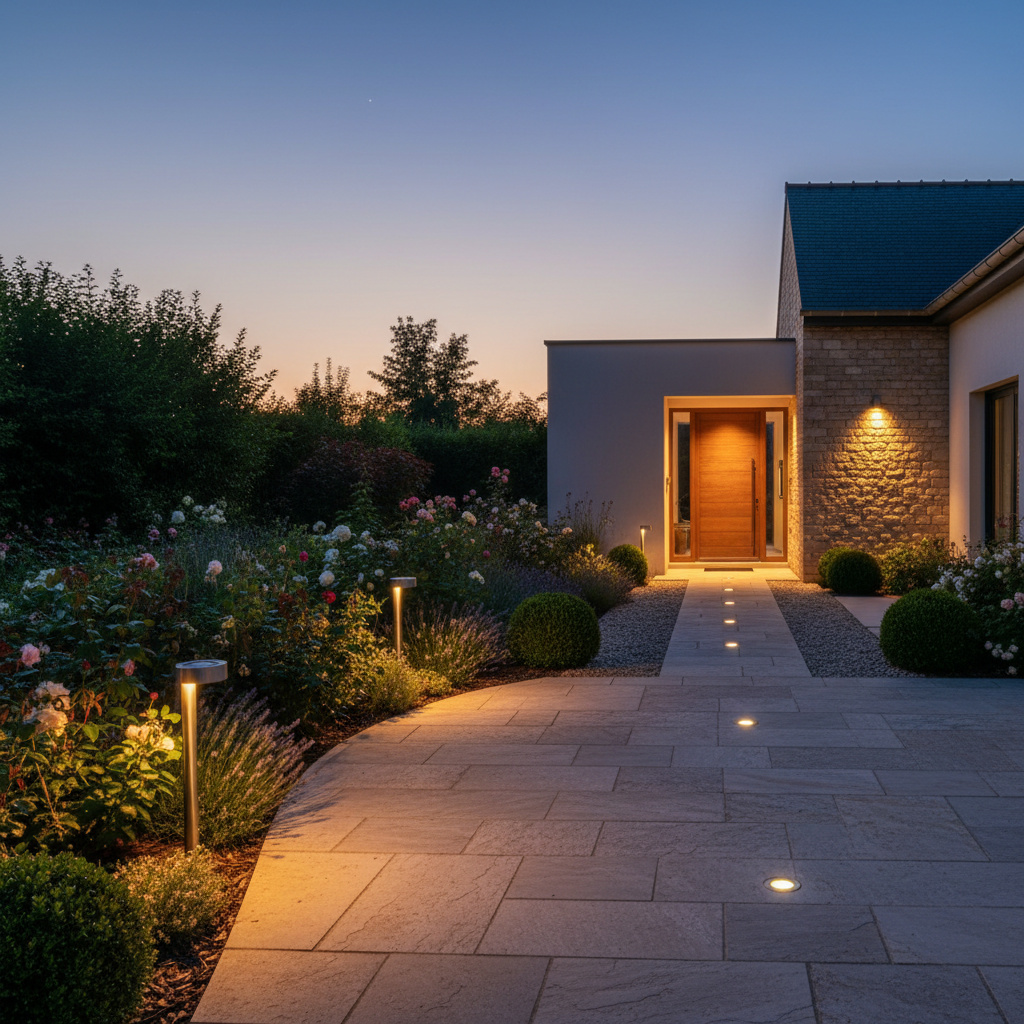
In-ground solar spotlights are recessed into the ground or patio decking. They are discreet, almost invisible during the day, and create an elegant accent lighting effect at night. This is the ideal option for composite wood patios, concrete slabs, stair treads, or paved pathways.
If you prefer discreet integration, in-ground solar spotlights offer an elegant solution to mark a pathway or light a patio without cluttering the space.
Is it difficult to install an in-ground solar spotlight?
Installation depends on the surface. For a wooden deck, a simple hole saw and a few screws are enough. For concrete or tile, you either need to plan for recessing during construction or use models designed for hard surfaces. The advantage of solar versions: no cables to run, no trenches to dig. The solar panel is often integrated into the surface around the spotlight or connected by a thin cable.
What IP rating is essential for an in-ground light?
This is the most critical criterion for this category. A spotlight recessed into the ground can be submerged during heavy rains or water accumulation. An IP67 minimum is imperative, ideally IP68. Avoid models with only IP44 or IP55 for ground installation: their lifespan will be very short. IP67 guarantees resistance to temporary immersion, which is a reality on a patio during rainy weather.
What light intensity to illuminate a patio?
For accent lighting only (steps, borders, outlines), 30 to 80 lumens per spotlight are sufficient if you install several. For slightly more functional patio lighting, aim for over 100-150 lumens per point. In practice, solar in-ground spotlights remain in a decorative range: to truly light a dining area, you'll need to supplement with a more powerful wall-mounted spotlight.
To create a complete ambiance in your outdoor space, you can combine in-ground lights and string lights — our article on creating ambiance on your patio with solar lighting provides many practical ideas.
Wall-Mounted Solar Spotlights: The Most Powerful and Useful Format
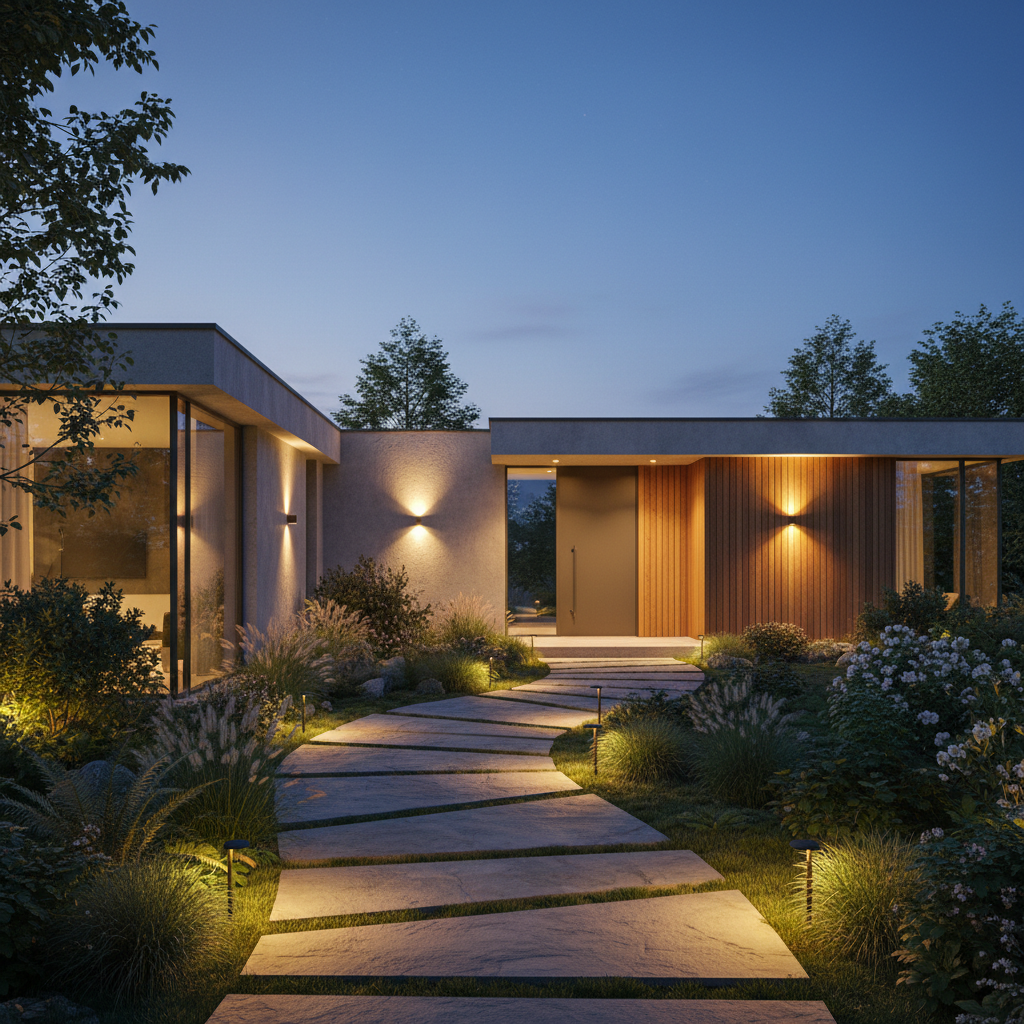
Wall-mounted solar spotlights attach to a facade, fence wall, post, or door frame. This category offers the most light output among solar spotlights and is also the most versatile for security. Unlike spike or in-ground lights, they capture more sunlight from their elevated position and can cover a much wider area.
To understand all the criteria to evaluate before buying, our article on wall-mounted solar spotlights details each point in depth.
Why is a wall-mounted spotlight with a motion sensor the best choice for an entrance?
For an entrance, gate, or garage, a decorative spotlight that stays on all night has little value. What you need is a light that automatically turns on when someone approaches. The integrated motion sensor (PIR) completely changes its use: you no longer think about turning it on, the light is there when you need it, and the battery lasts much longer because it doesn't drain by lighting an empty space.
A good wall-mounted solar spotlight with a sensor should cover a wide angle — at least 120°, ideally 180° — and have sufficient range to detect a person several feet before they reach the door.
What light output for an outdoor wall-mounted spotlight?
This is clearly the brightest category. While a spike light is around 50-100 lumens and an in-ground light between 30 and 150 lumens, a serious wall-mounted spotlight often exceeds 500 lumens, with high-performance models reaching 800 to 1200 lumens. The difference is very noticeable: at 1200 lumens, we're talking about a light that truly illuminates an 8 to 10-yard pathway, not just signals a presence.
Lumic's SolarGlow: A Wall-Mounted Solar Spotlight for Entrances and Pathways
If you're looking for a reliable wall-mounted solar spotlight for your entrance, garage, or patio, Lumic's SolarGlow is a great reference point. It produces 1200 lumens, making it one of the most powerful consumer solar spotlights on the market. It features two 180° PIR sensors with a range of approximately 26 feet — enough to cover an entrance or pathway without blind spots.
What sets it apart from often disappointing low-end solar lights in winter: its solar panel and battery are sized to perform in real-world conditions. It is IP65 certified, meaning it's resistant to rain and water splashes, compatible with normal winters. And it simply mounts to a wall — no staking or recessing needed, no excavation, installation in minutes.
For those who have had bad experiences with solar lights bought from marketplaces that didn't last through winter, this is a notable difference. Lumic offers a 5-year warranty on this product and US-based customer support with responses within 24 hours.
What IP rating for an outdoor wall-mounted spotlight?
For a wall-mounted spotlight, IP65 is the minimum acceptable. It protects against water jets and splashes, covering rain and normal outdoor conditions. If you install the spotlight in a very exposed location (north-facing, coastal area, rooftop), an IP66 or IP67 is preferable for optimal lifespan.
Comparison Table: The 3 Types of Solar Spotlights
| Criterion | Spike Spotlight | In-Ground Spotlight | Wall-Mounted Spotlight |
|---|---|---|---|
| Main Use | Flower beds, lawns, decorative accent lighting | Pathways, patios, steps | Facades, entrances, garages, security |
| Light Output | 50 to 150 lumens | 30 to 150 lumens | 200 to 1200 lumens |
| Recommended Minimum IP | IP44 (IP65 recommended) | IP67 mandatory | IP65 minimum |
| Installation | Very simple (stake into ground) | Drilling required | Wall mounting (screws) |
| Motion Sensor | Rarely | Rarely | Often available |
| Solar Capture | Variable (depending on orientation) | Limited (on the ground) | Better (at height) |
| Ideal for | Decorative ambiance | Discreet integration | Security and functionality |
How to Combine Multiple Solar Spotlights in One Garden?
Most gardens benefit from a combination of several types of solar spotlights rather than just one model. The approach that works best in practice:
- Spike lights for flower beds and lawn paths: decorative ambiance and marking.
- In-ground lights on the patio or stair treads: clean and discreet integration.
- Wall-mounted with motion sensor at the entrance, gate, and garage: daily security and convenience.
This zone-based strategy ensures each light serves its proper role. A spike light at the entrance won't provide much security, and an ultra-powerful wall-mounted light in a flower bed will be oversized and spoil the ambiance.
If you want to compare specific models before deciding, our comparison of the best outdoor solar lights reviews available options on the market.
Common Mistakes to Avoid When Buying a Solar Spotlight
Choosing a spotlight with too low an IP for its use
This is the most common mistake. A spotlight with IP44 placed on the ground under an exposed patio won't last. Take the time to check the IP rating based on the actual location. If the product doesn't clearly display its IP or if it's below IP65 for intensive wall/outdoor use, move on.
Underestimating the importance of the solar panel in winter
Many solar spotlights boast impressive battery life... calculated in summer with optimal sunlight. In December in the US/Canada, days are short and often cloudy. A spotlight that lasts one night in July might not recharge at all in January if it's not sized for it. Check that the manufacturer mentions performance under real conditions, and choose products with a sufficiently sized panel.
Neglecting solar panel orientation
A solar spotlight placed in the shade of a tree or facing north will recharge very little, even in summer. Before permanently fixing your spotlight, observe the sun exposure of the area at different times of the day. For wall-mounted spotlights, a south-facing facade is ideal. For spike lights, choose a clear area and orient the panel towards the south or southwest.
Confusing the three formats
A spike spotlight is not designed for a facade, and a wall-mounted spotlight is not meant to be staked into the ground. Each format has its mechanical, waterproofing, and capture constraints. Respecting the manufacturer's intended use ensures product durability.
If you're still hesitating between a solar and a wired version for your entrance, the article on outdoor motion sensor lights, wired or solar objectively compares both approaches.
Key Takeaways for Choosing Your Solar Spotlight
The right solar spotlight primarily depends on where you want to install it and what you expect from it. For a flower bed or lawn path, a spike spotlight with an IP65 rating and decent power will do the job. For a patio or steps, the in-ground option is the most elegant, provided you aim for a minimum IP67. And for the entrance, garage, or facade, the wall-mounted spotlight with a motion sensor is clearly the most useful for daily life: more power, better solar capture, and automatic activation that truly changes habits.
If lighting power is an essential criterion for you, don't hesitate to consult our guide on choosing a powerful solar garden spotlight tailored to your actual needs. And for a complete overview, our complete guide to outdoor solar lighting covers all available options by fixture type.