You've spent time setting up your deck. The furniture is perfect, the plants are thriving, then evening falls and... nothing. A utility bulb screwed in somewhere under the awning, or worse, an orange extension cord snaking through your living room. Solar deck lighting completely changes that equation, and not just because it's convenient.
This guide covers the four types of solar lighting that truly work for a deck, how to combine them, and why solar is now the smartest solution, even if you're not particularly eco-conscious.
Why Solar Over Wired for Your Deck?
The real reason is the cost and complexity of wired setups. Running electrical current to an existing deck means digging a trench in the yard, calling an electrician, maybe even breaking up tiles or concrete you just laid. In practice, a wired deck lighting installation costs between $400 and $800, depending on the configuration, not to mention potential damage to your finished deck.
Solar, on the other hand, installs in minutes with a drill and two screws, or even just strong adhesive. Zero trenches, zero visible cables, zero electricians. And the battery life of current models is far superior to the flickering little lights of a decade ago.
Does Solar Lighting Really Work Year-Round?
Yes, provided you choose a model with a battery sized to compensate for sunless days. Low-end solar lights (often sold in bulk on marketplaces) have small batteries that die after two cloudy days. Models with large battery capacities can last several weeks in motion sensor mode, even in winter. If you live in a less sunny region, check out our article on high-performance solar lights for winter before choosing.
Can Solar Completely Replace Wired Lighting?
For a residential deck with normal use (evening meals, happy hour with friends, nighttime passage), yes. For a professional space open every evening until midnight with continuous, intense lighting, it's more limited. But in 90% of domestic situations, solar easily covers the need.
Top 4 Types of Solar Deck Lighting
There's more than one way to light a deck with solar. Each type plays a different role, and combining them creates a truly beautiful and functional result.
Solar String Lights: Ambiance First
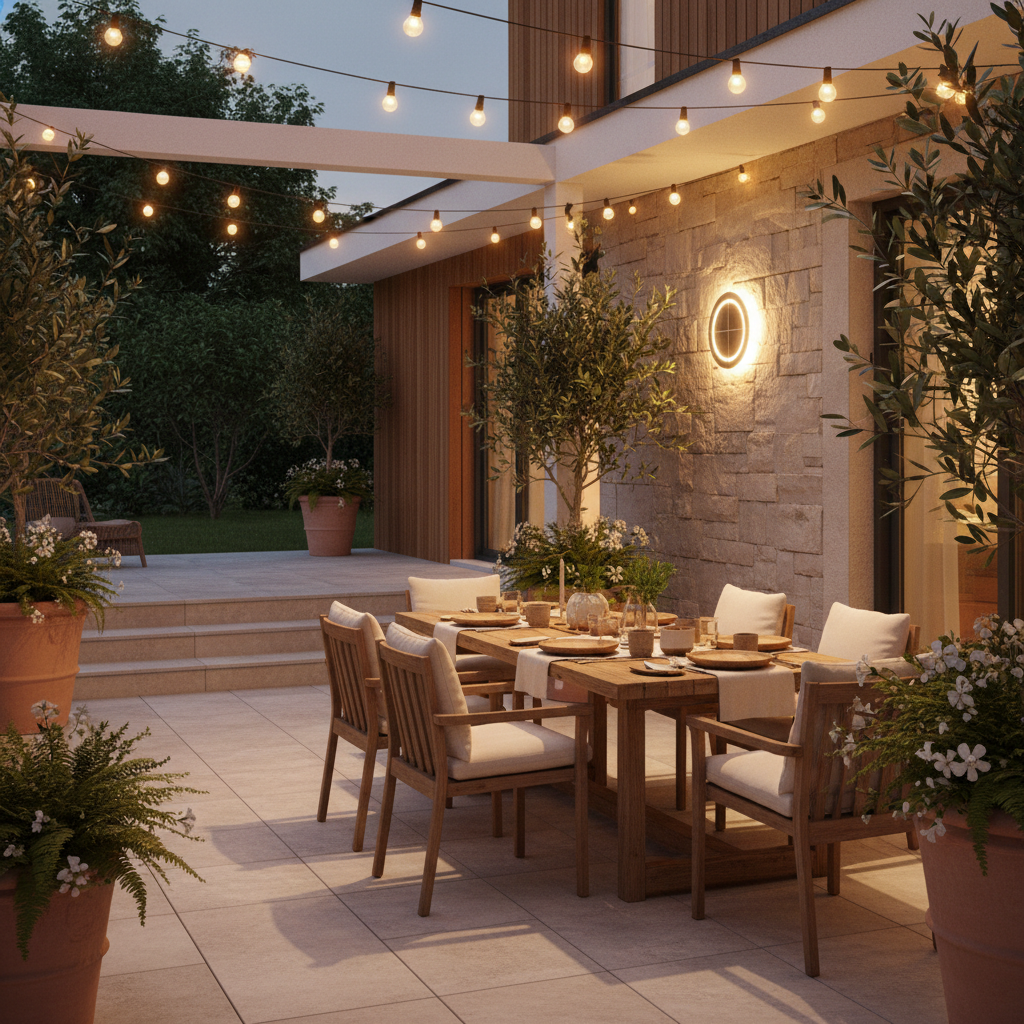
This type of lighting visually transforms a deck the most. Solar string lights strung between two posts or under a pergola immediately create that summer evening atmosphere, even on an ordinary Tuesday night.
What works well:
- Stringing lights in a zigzag pattern above the dining table rather than a straight line (creates a warmer effect)
- Choosing bulbs with replaceable E27 bases instead of inaccessible soldered LEDs
- Opting for warm light (around 2700-3000K) for a golden ambiance, not stark white
- Checking the advertised battery life: good solar string lights last 6 to 8 hours per charge
Solar string lights are ideal for creating ambiance, but they don't provide enough light to see what's on your plate or to safely navigate steps. They work best as a complement to other sources.
Solar Wall Sconces: Security and Style
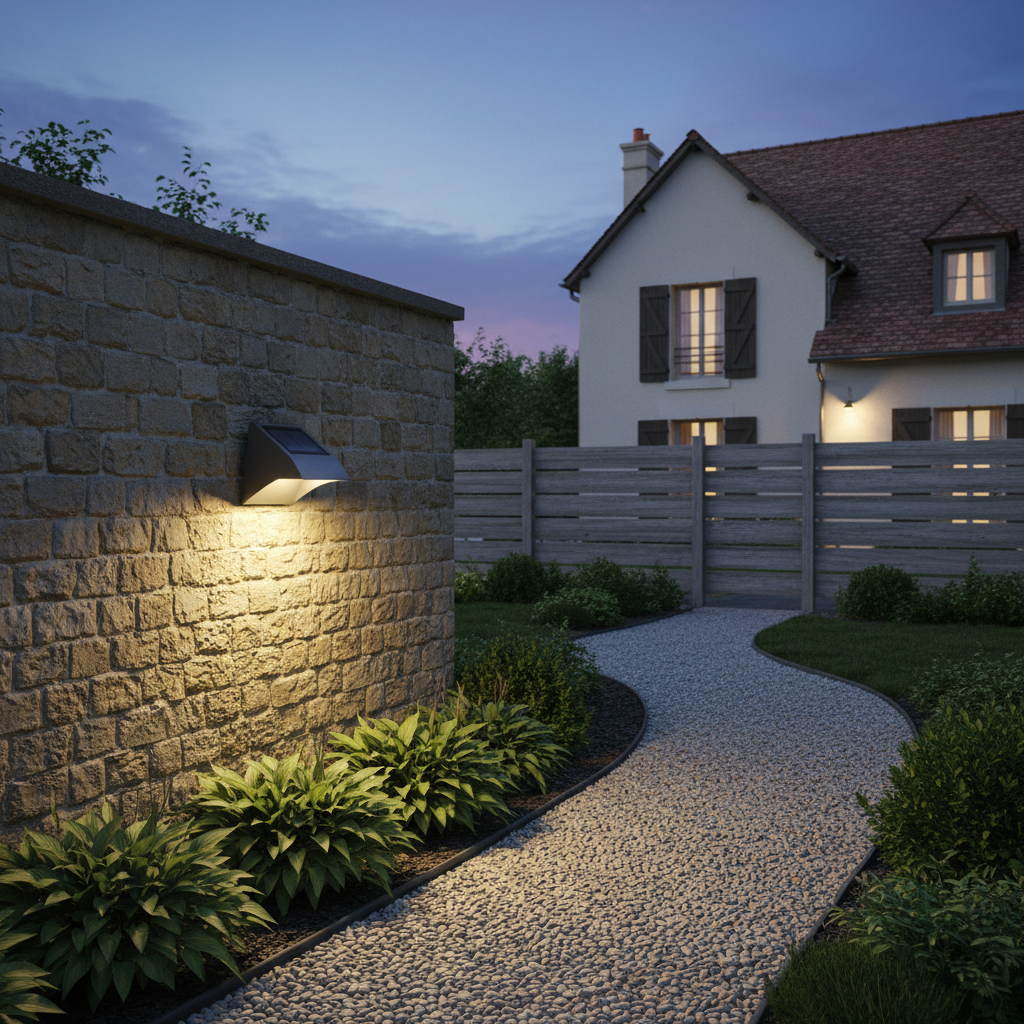
An outdoor solar wall light mounted near a door or above steps does two things at once: it provides functional light and enhances the wall's aesthetic. This is the most versatile lighting for a deck.
The best solar wall sconces have an integrated motion sensor. This is important for two reasons:
- The battery lasts much longer (the light only turns on when needed)
- It provides real security: the light turns on when someone approaches
For nighttime pathways on a deck, steps, garden access, or gate entrances, a motion-sensing sconce is much more effective than a continuous light that drains the battery in a few hours. Our guide on motion-sensing solar lighting explains in detail how to choose the right range and sensitivity.
Solar Pathway Lights and Stakes: Mark Paths Without Wiring
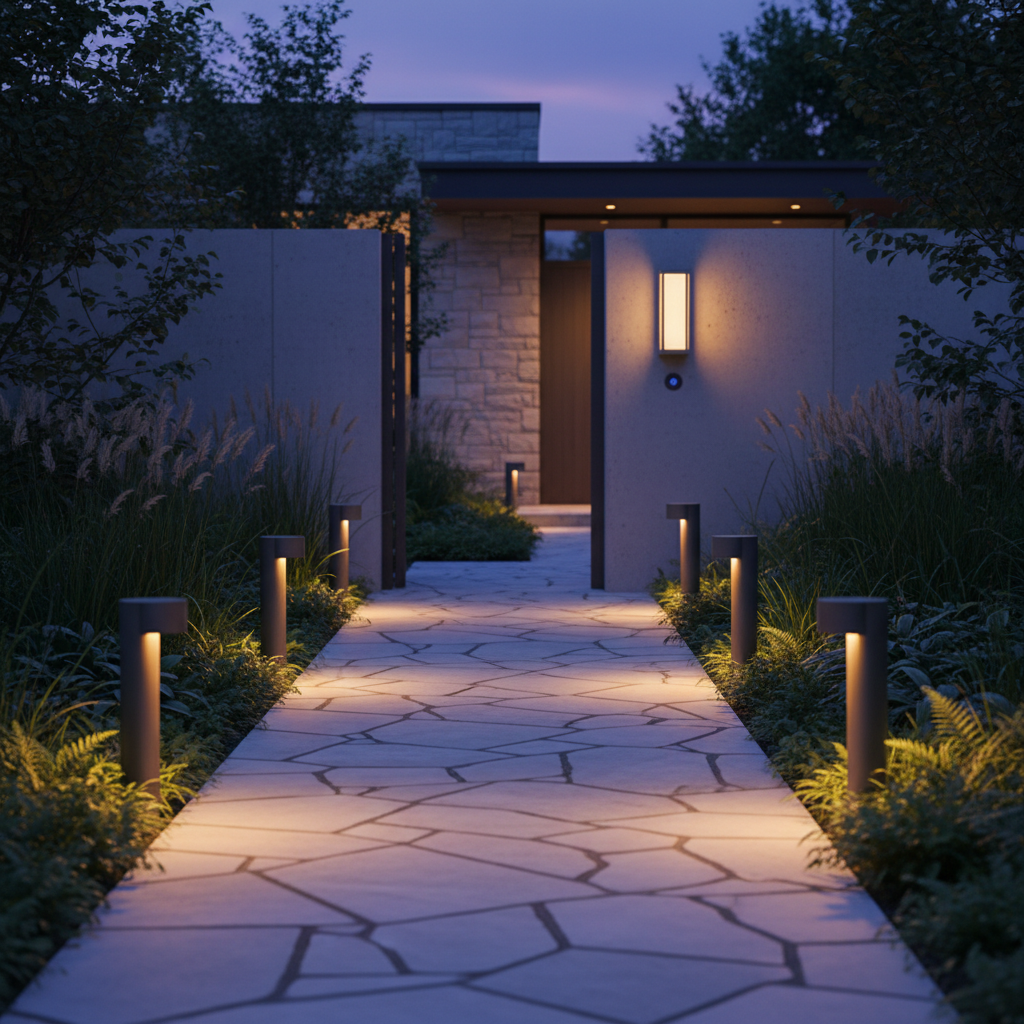
Solar pathway lights can be staked into the ground or placed on deck edges to mark a path, delineate an area, or highlight the space's structure. They emit a soft light, often downward or sideways, creating a very aesthetic grazing light in the evening.
This type of lighting is particularly effective:
- Along a walkway leading to the deck
- To define the edge of a raised deck
- At the base of plants or shrubs to create accent lighting effects
Solar pathway lights generally don't need a switch; they turn on automatically at dusk via a light sensor. Installation literally takes two minutes.
Solar Spotlights and Floodlights: For Precise Illumination
If you want to illuminate a specific area of your deck with intense light (a dining area, stairs, a BBQ zone), a solar spotlight or powerful outdoor solar floodlight is what you need. These are the brightest models in the solar range, often adjustable to direct the beam exactly where you need it.
Quality spotlights now offer sufficient lumens to comfortably illuminate a dining area. With a well-adjusted motion sensor, they can also serve an effective security role.
How to Combine 2 or 3 Types for a Professional Look
Most decks seen in interior design magazines or on Instagram decor accounts aren't lit by a single source. There are always multiple layers of light that complement each other. You can easily replicate this with solar.
Ambiance + Security Combination (Most Popular)
Solar string lights above the dining area (ambiance, warm diffuse light) + motion-sensing wall sconce near the door and steps (automatic security). This is the minimal combination that truly makes a difference. It covers the essentials without visual clutter.
Complete Combination for Large Decks
For a larger deck or if you want a very polished result:
- String lights above or around the main area: general ambiance
- Wall sconce with motion sensor near access points and steps: security and functional lighting
- Pathway lights or stakes along the deck perimeter or in the back of the garden: visual depth and demarcation
These three elements together create what interior designers call "lighting layers": a high level (string lights), a mid-level (sconces), a low level (pathway lights). The result is incomparably more beautiful than a single overhead light source.
What's the Best Layout for a Small Deck?
For a small deck (100-160 sq ft), a solar string light strung diagonally and a motion-sensing wall sconce are sufficient. Avoid multiplying light sources in a small space; it can look cluttered, and the solar panel's power consumption would be difficult to compensate for. Two well-placed sources are better than five mediocre ones.
Choosing Your Solar Light: The Criteria That Really Matter
Not all solar lights are created equal. The difference between a $15 model and a quality model often lies in the battery, the quality of the solar panel, and weather resistance.
| Criterion | Low-End Models | Quality Models |
|---|---|---|
| Battery Life Without Sun | 2 to 3 days | 2 to 4 weeks (motion mode) |
| Weather Resistance | Often unspecified or IP44 | IP65 minimum (rain, frost, snow) |
| Brightness | Often overestimated, practically dim | Honestly advertised, verifiable |
| Battery Lifespan | 1 to 2 seasons | Several years |
| Sensors | Often basic or absent | Motion + ambient light |
| Warranty | 6 to 12 months | 5 years and up |
IP65 Rating: What It Actually Means
IP65 means the light is protected against water jets from all directions and against dust. In practice, this means it resists normal rain, splashes, and standard winter conditions. For a deck in the US/Canada, this is the minimum to demand. IP44 models only protect against directional splashes and are not suitable for prolonged outdoor exposure.
How to Evaluate a Solar Light's True Battery Life?
Manufacturers generally advertise battery life in continuous mode and motion-sensing mode. Motion-sensing mode is much more realistic for daily use: the light turns on for a few seconds with each passage, so the battery lasts for weeks. Continuous mode is when you keep the light on all night, which drains the battery much faster. A good model in motion-sensing mode lasts 3 to 4 weeks without sun under normal use conditions.
Motion-Sensing Solar Wall Sconce: The Smart Choice for Steps
If you can only choose one type of solar lighting for your deck, it's probably the motion-sensing wall sconce. It combines utility and aesthetics, and it addresses the most practical need: seeing where you're going at night without leaving a light on all night.
Lumic's SolarGlow is designed exactly for this use case. Two 180° motion sensors with a range of about 26 feet (8 meters), 1200 lumens, IP65 for all-season use, and a battery sized to last up to 20 days without solar recharge in motion-sensing mode. Cable-free installation, two screws, and it's in place.
For high-traffic areas on your deck, steps, garden access, or next to the door, this type of solution truly changes habits. The light turns on when you pass, illuminates the area precisely, and turns off automatically. No need to think about it. To delve deeper into choosing a model, our guide on powerful wireless outdoor lighting reviews the criteria to consider based on usage.
Installing Your Solar Deck Lighting: Mistakes to Avoid
Most disappointments with solar come from poor installation, not a bad product. Here are some concrete points:
Solar Panel Placement
This is the most common mistake. People install the light where it looks good, without checking if the panel gets enough sun. A panel in the shade for 4 hours a day recharges half as much as a panel in full sun. Ideally, the exposure should be south or southwest, with no shadows from buildings, trees, or awnings between 10 AM and 3 PM. If your wall faces north, a solar light with a remote panel (connected by cable) allows you to place the light where you want and the panel where the sun hits.
Sconce Mounting Height
A motion-sensing wall sconce mounted too high loses effectiveness: the light beam doesn't reach the ground as well, and the sensor detects movement from a less effective angle. The recommended height for an outdoor sconce with a sensor is generally between 8 and 10 feet (2.4 to 3 meters). Below that, the detection angle is poor. Above 11.5 feet (3.5 meters), the beam no longer properly covers the immediate area.
Not Reading the Operating Modes
Most quality solar lights have multiple modes: motion detection only, constant dim light + motion detection, strong light on demand, etc. Many users keep the default mode without realizing that another mode might better suit their needs. Take two minutes to read the instructions; it truly makes a difference.
Solar Deck Lighting Over Time: Maintenance and Optimization
Once installed, solar lighting requires little maintenance. Here are some useful habits:
- Clean the solar panel once a month with a damp cloth: dust and pollen reduce charging efficiency. In fall, dead leaves can accumulate on horizontal panels.
- Check orientation at the end of summer: with the sun's path shifting in fall, a panel well-exposed in July might be partially shaded in October.
- Bring string lights indoors for severe cold if they are not rated for very low temperatures. IP65 sconces can remain outdoors year-round.
If you're interested in the technical aspects of battery life, our article on solar light batteries explains why storage capacity is the number one factor in real-world performance.
What Good Lighting Truly Changes on a Deck
We often talk about lighting as a functional detail. In reality, it's one of the elements that has the most impact on the perceived ambiance of an outdoor space. A well-lit deck becomes a place where you want to linger after dinner, host a spontaneous happy hour, or read in the evening.
Solar deck lighting makes this accessible without the constraints of wired systems: no trenching, no electrician, no visible cables. And since the lights turn on automatically, you don't even have to think about it. You come home in the evening, and the deck is lit. You walk near the steps, and you see where you're going.
If you want to explore all the possibilities of wireless deck lighting beyond solar, we've gathered ideas for every type of ambiance and configuration. And for decks with greater lighting needs, solar floodlight solutions can complement the ambiance sources described here.
The combination that works for the vast majority of decks: solar string lights for ambiance, a motion-sensing wall sconce for high-traffic areas. Two elements, two purchases, a transformed deck.