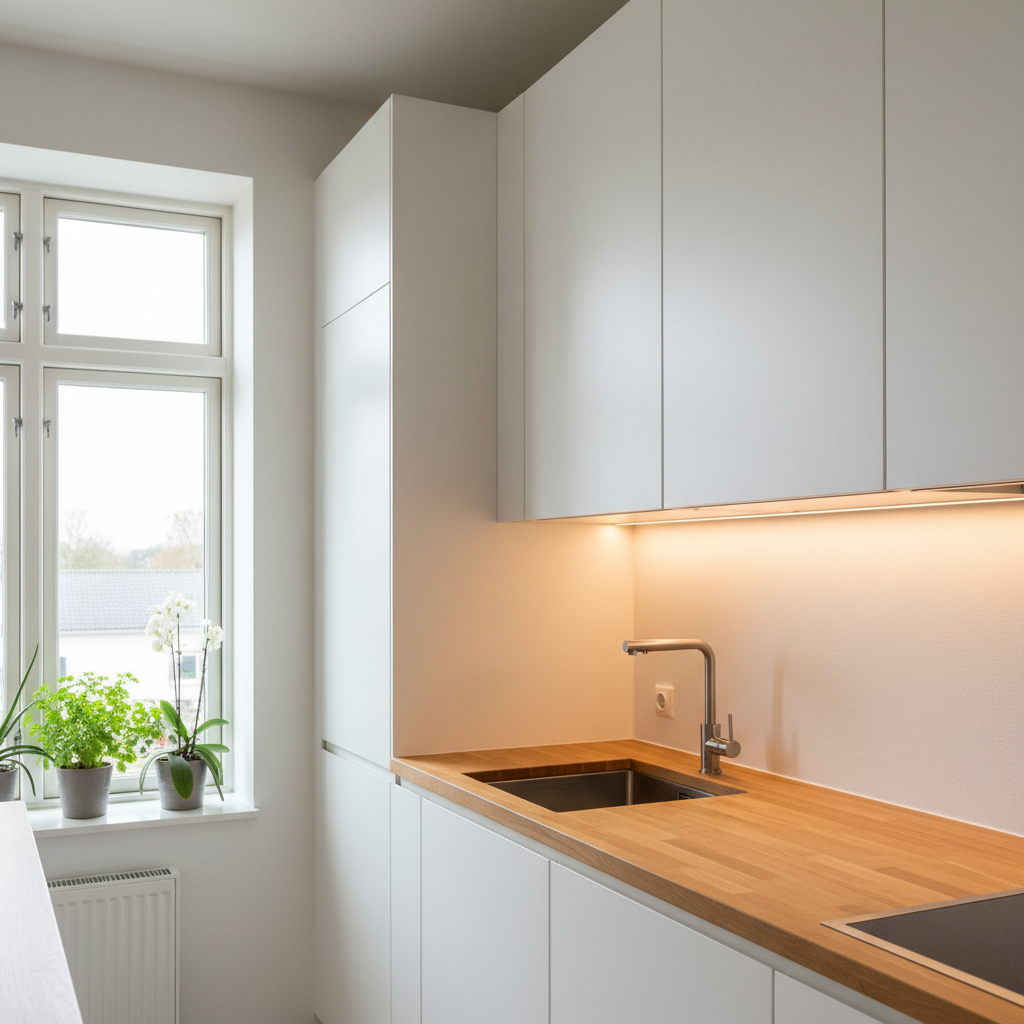
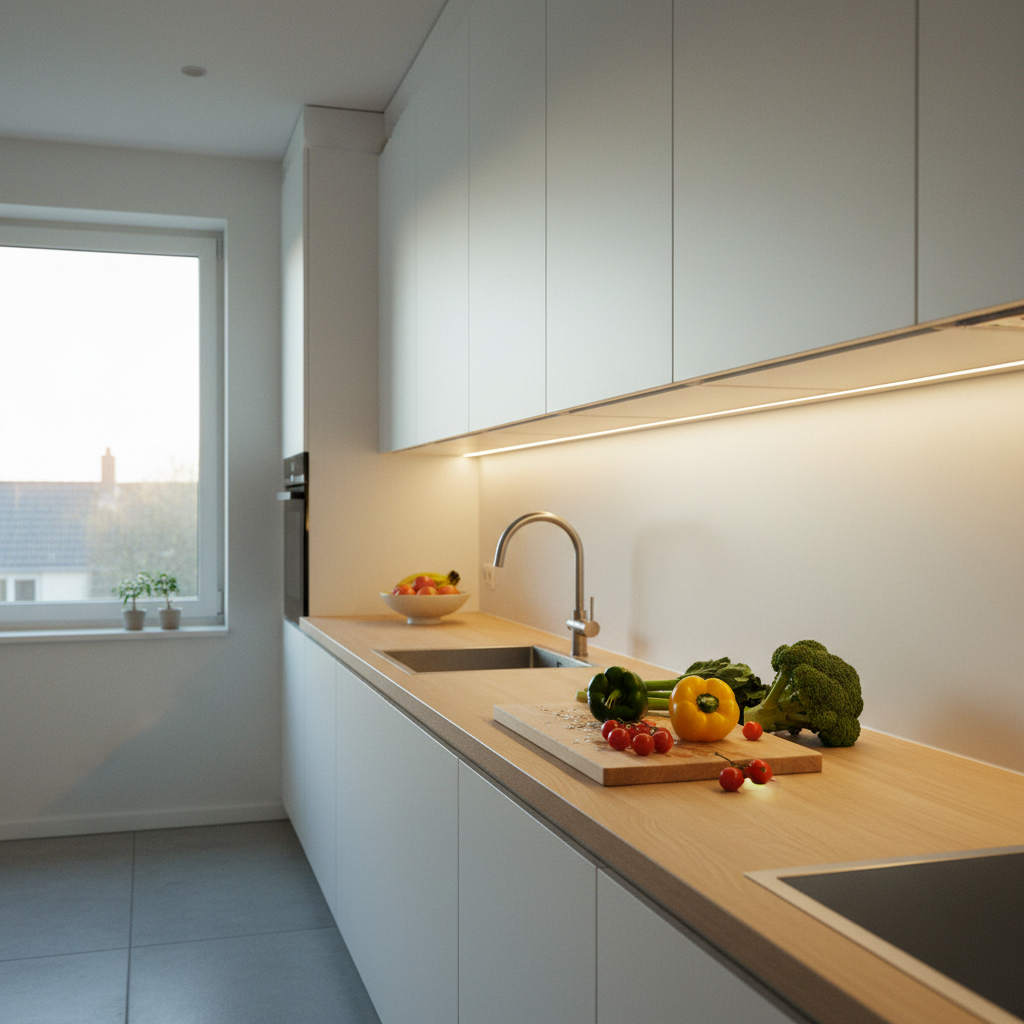
You visited IKEA, saw the OMLOPP and MITTLED LED light bars, liked the price, and the design. But once you got home, a question popped into your head: how exactly do you connect these?
This is often where kitchen lighting projects stop. Or where they end up costing much more than expected.
This article won't tell you IKEA products are bad — that would be false. It will give you the information product descriptions don't specify, so you can make an informed choice based on your actual situation. If you want to go further, check out our complete guide to kitchen lighting solutions.
OMLOPP, MITTLED: What IKEA Really Offers
IKEA offers two main ranges for under cabinet lighting in the kitchen. They work well, have a clean design, and their catalog price is attractive. But they don't work the same way.
OMLOPP: The Classic Wired Under Cabinet LED Light Bar
The OMLOPP is a wired LED light bar designed for installation under kitchen wall cabinets. It plugs into a power outlet and requires an accessible socket, usually hidden inside the cabinet or behind the kitchen.
What this practically means:
- If you already have an outlet installed in the wall cabinet, it's easy to set up.
- If you don't, you'll need one installed — which means hiring an electrician. Depending on your area and kitchen configuration, expect to pay between $150 and $300 for this type of service.
- The cable remains visible if you haven't planned for a cable pass-through in your cabinets.
The OMLOPP comes in several lengths, providing decent light output for a kitchen. The main advantage: once installed, you don't worry about batteries. The main drawback: you can't move it without uninstalling it.
MITTLED: More Modular, Same Constraint
The MITTLED range is newer. It offers flexible LED strip lights and various formats to adapt to different configurations. The visual result is clean, and the connection system between modules is designed to limit cable clutter.
But again: the power supply is wired. The MITTLED needs a transformer plugged into a wall outlet. Without an accessible outlet, it's the same problem as the OMLOPP.
For kitchens initially equipped with under-cabinet outlets, both ranges work perfectly. For other situations, you need to consider the true cost.
The True Cost of IKEA Under Cabinet Lighting
The OMLOPP light bar costs between $15 and $30 in stores, depending on length. The MITTLED is in a similar price range. These are fair prices for decent quality equipment.
But the product price is not the installation price.
If You Have an Outlet: The Calculation is Simple
IKEA light bar + a few minutes to mount the brackets = functional lighting. In this case, IKEA is a perfectly valid option. The quality-to-price ratio is good, and the result is clean.
If You Don't Have an Under Cabinet Outlet
This is the situation for many kitchens, especially those installed over ten years ago or in older apartments. In this case, the budget changes dramatically:
- OMLOPP light bar: $15 to $30
- Electrician intervention to create an outlet: $150 to $300 (indicative range, varies depending on access difficulty)
- Time and organization: scheduling an appointment, half a day at your home, etc.
Total real cost: between $165 and $330 for under cabinet lighting. This completely changes the initial equation.
If You're a Renter: An Added Layer of Complexity
As a renter, creating an electrical outlet in a kitchen generally requires landlord approval. Structural modifications are often out of the question. The OMLOPP, however well-designed, becomes a complicated option to implement without risking your security deposit or having to restore everything upon moving out.
To learn more about solutions adapted to this situation, our article on wireless lighting for your countertop details no-drill, no-wire alternatives.
Comparison Table: IKEA vs. Wireless Light Bar
| Criterion | IKEA OMLOPP | IKEA MITTLED | Wireless Light Bar (e.g., Lumic Movement 3.0) |
|---|---|---|---|
| Product Price | $15 to $30 | $15 to $35 | See trylumic.com |
| Wiring Required | Yes (wall outlet) | Yes (transformer) | No (USB rechargeable) |
| Installation without Electrician | Only if outlet exists | Only if outlet exists | Yes, always |
| Drilling Required | Depends on model | Depends on model | No (magnetic + adhesive) |
| Available Color Temperatures | 1 (warm or neutral white depending on version) | 1 to 2 depending on version | 3 (3000K, 4000K, 6000K) |
| Adjustable Brightness | No | Depends on version | Yes |
| Motion Sensor | No | No | Yes |
| Easily Repositionable | No | No | Yes (magnetic attachment) |
| Renter-Friendly | Difficult | Difficult | Yes |
| Warranty | Standard IKEA warranty | Standard IKEA warranty | 5 years + 90-day money-back |
For a broader comparison of wireless light bars on the market, check out our complete comparison of wireless LED light bars.
When IKEA is the Right Choice
Let's be honest: IKEA has real advantages. If you're renovating a complete kitchen with an electrician already on site, adding a few under-cabinet outlets is inexpensive. In this context, OMLOPP or MITTLED are perfectly valid and economical options.
Profiles for Whom IKEA Works Well
- You're doing a full kitchen renovation with an electrician already involved. You can take advantage of this to have outlets installed under the wall cabinets.
- You have a recent kitchen (less than 8-10 years old) equipped with standard under-cabinet outlets. This is sometimes included in new IKEA kitchens installed by professionals.
- You are a homeowner and want permanent, self-sufficient lighting (no battery to recharge).
- You have a very tight budget and an electrical setup that's already ready. In this case, $20 for a decent light bar is hard to beat on product price alone.
What the OMLOPP Does Well
Once installed with its outlet, the OMLOPP provides consistent, continuous lighting on the countertop. No battery to monitor, no interruptions. For someone who cooks a lot and for long periods, this is a tangible advantage. The design is discreet, and the light output is suitable for a family kitchen.
When IKEA Poses a Problem
There are situations where wired IKEA light bars create more complications than they solve. Not because they are bad — but because they are not designed for these scenarios.
You're a Renter
This is probably the most common situation in many US/Canadian cities. As a renter, you generally cannot modify the electrical installation without landlord approval. And even with that approval, you'll have to restore everything when you move out. Result: the investment isn't truly yours.
Your Kitchen Doesn't Have Under Cabinet Outlets
The vast majority of apartments built before 2010, kitchens installed without integrated lighting, repurposed or moved cabinets... In all these cases, installing OMLOPP requires electrical work. And as we've seen, that completely changes the cost calculation.
You Want to Change the Configuration Later
If you plan to rearrange your kitchen in a few years — change a cabinet, move an island, modify the layout — a fixed wired light bar will constrain your choices. An OMLOPP screwed into your current cabinet cannot be moved without leaving marks.
You Want Different Light Temperatures for Different Times
The standard OMLOPP offers only one color temperature. If you want warm white for dinner and neutral white for cooking, you don't have that choice with IKEA. This is a minor detail for some, a real limitation for others.
If you find yourself in one of these situations, our comparison of wireless vs. wired LED light bars will give you all the information to decide.
The Wireless Alternative: What It Really Changes
A wireless LED light bar — like Lumic's Movement 3.0 — addresses a different need than IKEA. It's not meant to replace permanent wired lighting in a well-equipped new kitchen. It's for all situations where wired solutions aren't feasible.
Installation in Under a Minute, Really
The mounting uses industrial adhesive backing and a magnetic system. Clean the surface, stick the bracket, clip on the light bar. That's it. No screws, no cables, no outlets. And if you want to move it tomorrow — for example, to another cabinet or a hallway — you just unclip it and reposition it.
For someone renting an apartment or wanting to test a location before committing, this offers true freedom.
The Motion Sensor: Useful or Gimmick?
In practice, the motion sensor combined with an ambient light sensor is more useful than it seems. The light bar only turns on when you pass by — and only when it's dark. You never have to remember to turn it off, and the battery lasts much longer than with continuous use. For a hallway at night or a closet you quickly open, it's exactly what you need.
For those who prefer continuous lighting: there's also a fixed mode, without motion detection.
Three Color Temperatures and Adjustable Brightness
This is one of the points where the comparison with IKEA is most striking. Where the OMLOPP offers a single option, the Movement 3.0 allows you to choose between warm white (3000K), neutral white (4000K), and cool white (6000K), with adjustable brightness. In the kitchen, this really changes the ambiance depending on the time of day and use.
The Battery: The Only Real Constraint
This is the only true constraint of a wireless light bar: the battery. The Movement 3.0 features a 3000 mAh battery, which is significantly higher capacity than most alternatives on the market. In motion detection mode, battery life reaches approximately four weeks for the 9-inch (23 cm) model and five to six weeks for the 16-inch (40 cm) model. In continuous mode, expect five hours for the 9-inch (23 cm) and eight hours for the 16-inch (40 cm).
Recharging is done via USB, like a phone. Plan it into your routine — not every night, but don't forget it for two months either.
Lumic offers a 5-year warranty on the product, and a 90-day money-back guarantee. Customer support is based in the US/Canada with a 24-hour response time according to customer reviews. The brand has a 4.5/5 rating on over 2,200 Trustpilot reviews.
To discover why more and more users are switching to this type of solution, the article on the benefits of wireless LED light bars goes into detail.
How to Choose Based on Your Real Situation
There's no single "best" universal kitchen lighting. There's what fits your home, your electrical setup, and your lifestyle. Here's a simple guide:
You're Completely Renovating Your Kitchen with a Pro
Take the opportunity to have outlets installed under your wall cabinets. In this case, IKEA OMLOPP or MITTLED are valid and economical options. Wired lighting has the advantage of being forgotten once installed.
You're a Renter or Want to Avoid Any Work
A wireless light bar is clearly more suitable. You install it without drilling, leave no trace when you move out, and can reuse it in another home. The total cost is known upfront — no electrician intervention needed.
You Want to Test Before Committing
Start with wireless. You'll see where you really need light, at what angle, at what height. Then, if you want to switch to wired, you'll have the information to have an outlet installed exactly in the right place.
You Want More Control Over the Lighting Ambiance
If color temperature and brightness matter to you, IKEA is limited on this point. The ability to switch from warm white in the evening to cool white for cooking during the day, with adjustable intensity, is a daily comfort that few anticipate — and then greatly appreciate.
To refine your choice based on technical criteria, our guide choosing the best LED light bar for your kitchen compares all important parameters.
Key Takeaways from This Comparison
IKEA kitchen lighting — OMLOPP or MITTLED — is a good product under the right conditions. If your kitchen already has an accessible outlet under the wall cabinets, and you're a homeowner, it can work very well.
But the price displayed in stores is not the real price if you don't have that outlet. And for renters, this option is often out of reach without a complicated process.
A wireless LED light bar doesn't aim to replace the OMLOPP in its natural use. It addresses a different need: installing functional, beautiful, adjustable lighting without relying on an existing electrical point — and without risking anything in a home you don't own.
Both types of products have their place. The question is, what kind of kitchen do you actually live in?