You want a powerful solar spotlight. Maybe you've already bought a cheap model, stuck it in your yard, and it barely shines brighter than a candle on a cloudy day. Now you're wondering what truly differentiates a disappointing spotlight from a solar light that actually works.
Good news: powerful solar spotlights exist. Bad news: "powerful" means very different things depending on the type you choose. And the type, precisely, is where most people go wrong.
This guide will clarify everything, no false promises.
What "Powerful" Really Means for Solar Lights
For solar lighting, the lumens advertised on the package rarely match reality. But before we talk numbers, let's establish a simple baseline: what do you expect from your spotlight?
Here's an honest breakdown to calibrate your expectations:
- 200 lumens or less: ambiance, path marker, decoration. Not functional for illuminating an area.
- 400-600 lumens: functional lighting for a patio, walkway. Enough to navigate, not for working outdoors.
- 1000 lumens and up: security, deterrence, actual illumination of an entryway or garage. This is where it becomes truly useful at night.
The takeaway: if you're looking for a powerful solar spotlight for real nighttime use, aim for at least 800 lumens. Below that, you'll be disappointed in half of the weather conditions.
Why are advertised lumens often overestimated?
Manufacturers often measure lumens under ideal conditions: new panel, full battery, maximum sunlight. In the reality of a cloudy October day, the battery might only charge to 60-70%. The actual light output is proportionally reduced.
That's why two criteria are more reliable than advertised lumens: battery capacity (in mAh) and solar panel surface area. A spotlight claiming 1000 lumens but with only a 1000 mAh battery and a tiny panel won't last all night, even in summer.
Key rule: look at the battery's mAh and the panel size, not just the advertised lumens.
What runtime to expect from a solar spotlight?
In motion sensor mode, a properly sized solar spotlight can last several weeks without direct solar recharge. In continuous mode, it's a different story: the best models last between 8 and 20 hours, depending on battery capacity. In continuous mode with a low battery, you risk being in the dark by 2 AM. Motion detection mode is clearly the best choice to maximize runtime.
The Problem with Stake Lights: Let's Be Honest
The stake light is often what people imagine when looking for a garden solar spotlight. Planted in the lawn, discreet, easy to install. The problem: it's structurally the least suitable for power.
Why? Because the panel surface is limited by the stake's size. A small panel means a small battery, and thus low maximum light output. In practice, most solar stake lights on the market range from 50 to 200 lumens. This is sufficient for marking a path or decorating a flowerbed. It's not security lighting.
If you're looking for a powerful outdoor solar spotlight in a stake format at 800 lumens or more, the reality is simple: they barely exist. The rare models that claim high numbers rarely deliver in real-world conditions.
What are stake lights good for then?
They are perfect for:
- Marking a garden path (visual guidance, not illumination)
- Highlighting plants or flowerbeds (decorative ambiance)
- Signaling a step or change in elevation
But if your goal is to light your entrance, gate, garage, or deter intruders, forget the stake format. It's not the right tool.
To learn more about the differences between formats, our article on garden solar spotlights: stake, recessed, or wall-mounted objectively details the use cases for each.
Wall-Mounted Format: The Only One That Truly Delivers Power
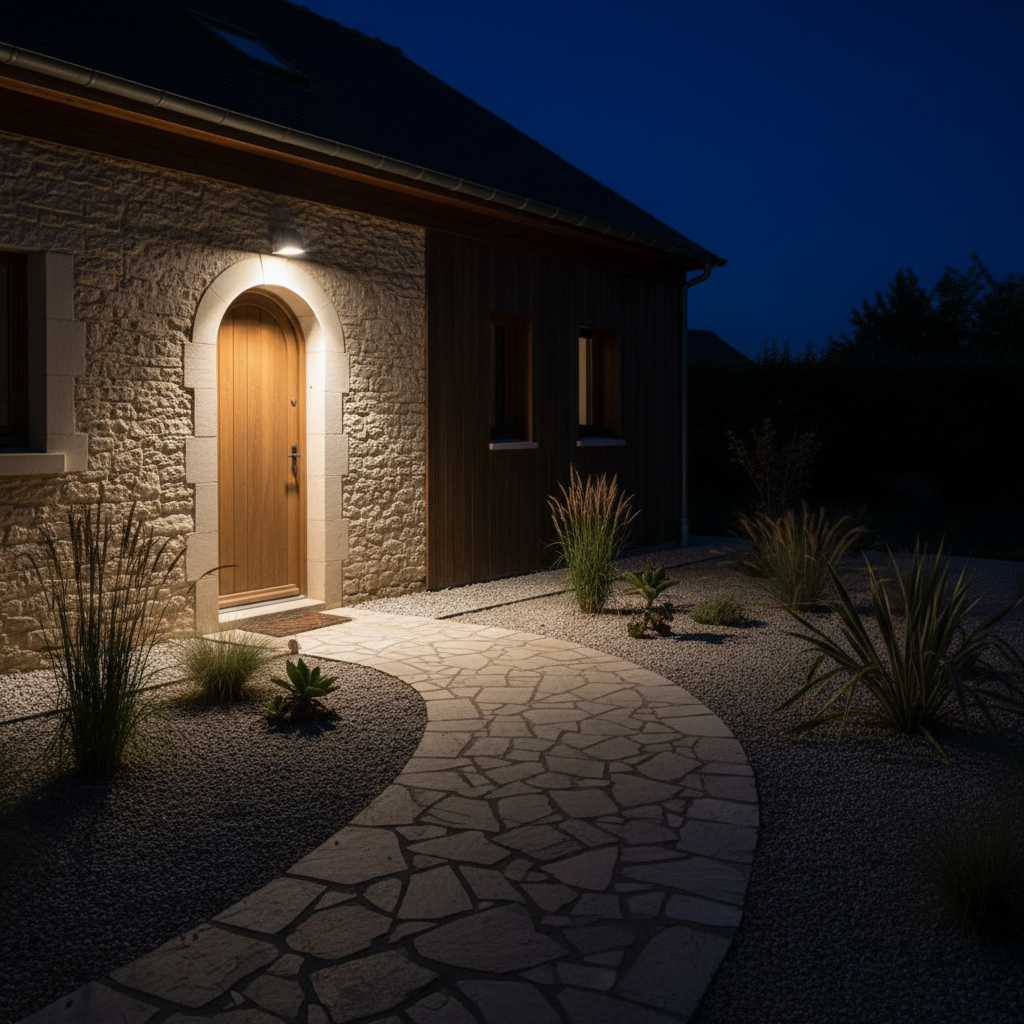
If you want a powerful LED solar spotlight, the wall-mounted format is almost essential. The reason is physical: fixed to a wall or facade, the fixture can accommodate a significantly larger solar panel and a more generous battery. The result: more stored energy, more lumens delivered, and real runtime.
The wall-mounted format also offers another often underestimated advantage: the lighting angle. Positioned high on a facade, it covers a much wider area than a ground-level spotlight. For securing an entrance, patio, or gate, this is crucial.
How to choose a good powerful wall-mounted solar spotlight?
Here are the criteria to check in this order:
- Battery capacity (mAh): The higher, the longer the runtime, especially in winter. This is the #1 criterion, often missing from low-end product descriptions.
- Solar panel surface area: A large integrated or remote panel = more recharge on cloudy days.
- Actual lumen output: Aim for at least 800 lumens for functional use, 1000+ for security.
- Presence of a motion sensor: Essential for saving battery and maximizing runtime.
- IP rating: IP65 minimum to withstand rain and frost.
To understand how a solar motion sensor works and how to choose the right sensitivity, we've written a dedicated guide.
What installation height for a wall-mounted solar spotlight?
Between 8.2 and 11.5 feet (2.5 and 3.5 meters) is the ideal range. Too low (under 6.5 feet / 2 meters) and you risk directly dazzling people passing by. Too high (over 13 feet / 4 meters) and the detection angle becomes less effective depending on the model. Panel orientation towards the south or southwest remains crucial to maximize recharge.
For more on selection criteria, this guide on outdoor wall-mounted solar lights: how to choose covers all the points to check before buying.
Comparing Powerful Solar Lighting Types: Summary Table
| Format | Typical Lumens | Recommended Use | Actual Power | Installation |
|---|---|---|---|---|
| Stake Light | 50-200 lm | Decoration, Path Marking | Low | Very Simple |
| Recessed Spot | 100-300 lm | Ground Marking, Steps | Low to Medium | Medium |
| Wall Sconce / Spotlight | 600-1500 lm | Security, Entryway, Garage | High | Simple (screws or adhesive) |
| Solar Floodlight | 1000-3000 lm | Large Area, Enhanced Security | Very High | Requires a mount |
For those hesitating between wall-mounted and floodlight formats, our guide on outdoor solar floodlights: how to choose in 2026 details the differences and specific use cases for each format.
Common Mistakes When Looking for a 1000 Lumen Solar Spotlight
We see them regularly in customer reviews and forums. Here are the pitfalls to avoid if you don't want to be disappointed.
Relying solely on advertised lumens
A spotlight advertised at 1000 lumens with an 800 mAh battery will never last all night, even in summer. The 1000 lumens are measured with a full battery, often in maximum mode. After a few hours, the power automatically decreases to preserve the battery. Result: you think you bought a 1000-lumen spotlight, but in reality, your entryway is lit at 300-400 lumens after midnight.
Ignoring panel orientation
A wall-mounted spotlight facing due north will capture almost no solar energy. If your facade faces north, either opt for a model with a remote panel (on a cable) or accept very reduced runtime in winter. This detail, rarely mentioned on packaging, explains many disappointments.
Choosing a spotlight without motion detection
A powerful solar light in continuous mode all night means a dead battery before dawn in winter. The motion sensor is not a gadget: it's what allows you to concentrate power when you need it while preserving runtime. A good powerful solar spotlight without a sensor is a contradiction in terms, unless you have an oversized panel and battery.
Forgetting the IP rating
An outdoor solar spotlight must withstand rain, frost, and snow. IP65 is the minimum acceptable. Below that, you risk failure with the first autumn rains. Always check this rating, even on well-known brands.
To avoid these mistakes, the article on powerful outdoor solar lighting: what they don't tell you provides a complete and frank overview of what manufacturers often omit.
What 1200 Lumens Really Means in Real-World Use
1200 lumens is roughly equivalent to a classic 75-100W incandescent bulb. In practice, it comfortably covers a house entrance area, a gate, a 16-26 foot (5-8 meter) long pathway, or a garage facade.
It's not stadium lighting. But it's enough to identify someone at 26-33 feet (8-10 meters), to move safely in an outdoor space, and to deter intrusion. This is the threshold above which we truly speak of functional powerful solar lighting, not just decorative.
Lumic's SolarGlow delivers exactly 1200 lumens, with two 180° motion sensors and a range of about 26 feet (8 meters). It's not a stake light. It's a wall sconce designed for people who have been disappointed by low-end models and want lighting that truly works, night after night, even in winter. Its battery and panel are significantly larger than what is usually found in this price range. 5-year warranty, 90-day satisfaction guarantee.
If you want to delve deeper into the selection criteria for a powerful solar floodlight and understand what truly differentiates models, this guide goes further into the technical aspects.
Summary: How to Choose Your Powerful Solar Spotlight
We've covered a lot of ground. Here's the essential takeaway before making a purchase:
- "Powerful" starts at 800-1000 lumens minimum for security or functional use.
- Stake lights cannot be powerful by design. They are the wrong tool if you want power.
- The wall-mounted format is the best compromise of power / runtime / installation for home use.
- Look at the battery (mAh) and panel size, not just advertised lumens.
- IP65 minimum, no exceptions.
- The motion sensor is essential to maximize runtime without sacrificing power.
A disappointing powerful solar spotlight is almost always a problem of choosing the wrong format or an undersized battery compared to the promises. By knowing how to read a product's true specifications, you avoid 90% of bad surprises.