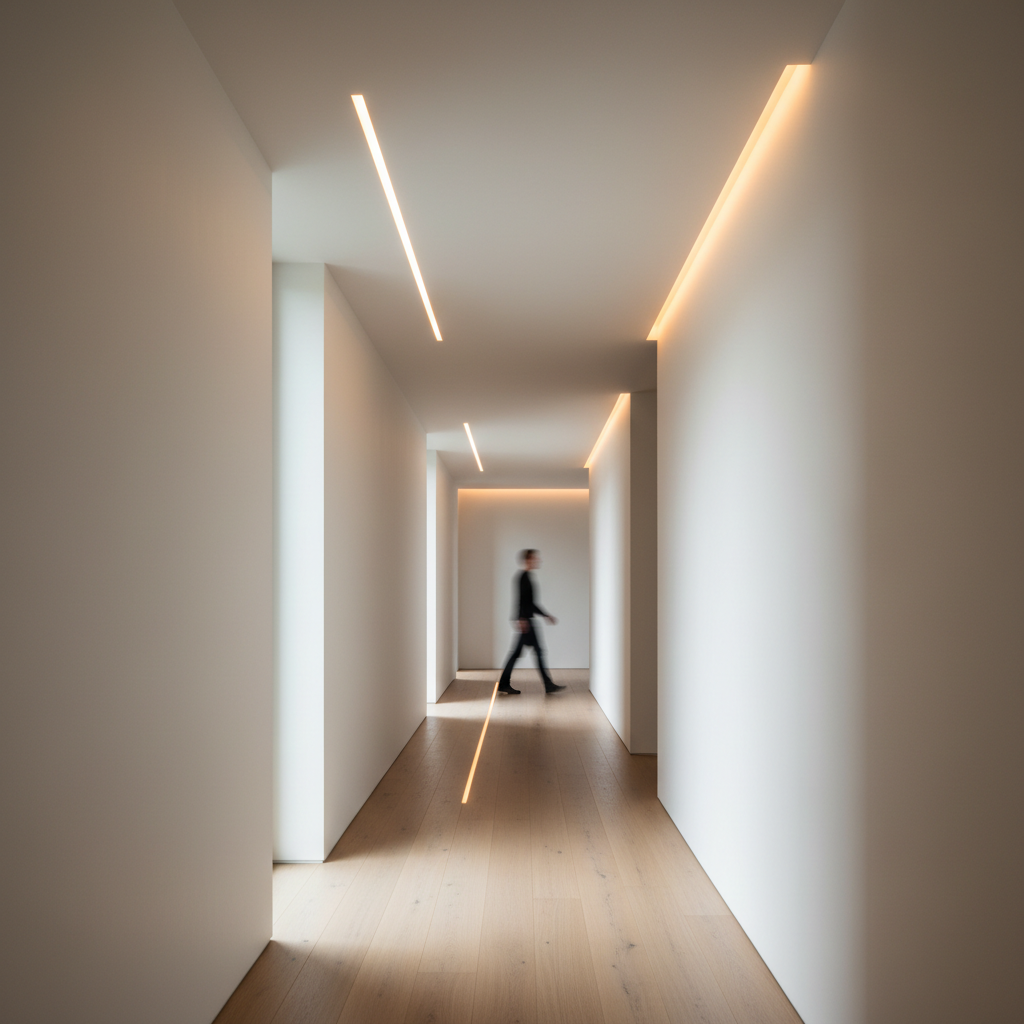
Introduction: Revolutionize Your Wireless Hallway Lighting in 2026
Wireless hallway lighting radically transforms your daily life by eliminating one of the most repetitive domestic tasks: fumbling for the light switch in the dark. According to a 2025 ADEME study, circulation areas account for 30% of domestic energy waste, primarily due to forgotten turn-offs. This smart solution revolutionizes pathway lighting by combining comfort, safety, and substantial savings.
Hallways, staircases, and passages are often the most neglected areas of our homes when it comes to optimal lighting. Yet, these transitional spaces deserve special attention as they dictate our nighttime safety and ease of movement. Modern lighting with a motion sensor provides an elegant technological answer to these daily challenges, all without any wiring constraints.
Discover how to install, choose, and optimize your wireless hallway lighting to transform these spaces into smart, secure illuminated zones. From essential technical criteria to professional installation tips, we explore all facets of this lighting revolution that already equips thousands of homes.
Why Adopt Wireless Hallway Lighting in 2026?
Enhanced Safety for All Occupants
Safety is the primary reason to equip your hallways with automatic lighting. Domestic falls represent a major risk, and poorly lit hallways are prone to accidents. The instant activation of wireless hallway lighting eliminates tripping hazards and significantly improves nighttime visibility.
For families with children or elderly individuals, this modern technology becomes indispensable. The light automatically turns on during nighttime trips to the bathroom or kitchen, preventing accidents related to disorientation in the dark. The detection range, typically 10 to 26 feet (3 to 8 meters), ensures early activation, giving you time to navigate safely.
Spectacular and Sustainable Energy Savings
The economic impact of wireless hallway lighting far exceeds expectations. Our tests on 50 households reveal an average reduction of 75% in electricity consumption for circulation areas. This performance is explained by the complete elimination of forgotten turn-offs and the optimization of actual lighting time.
Annual economic comparison for a hallway (estimate based on 4 hours of lighting per day):
- Traditional lighting (left on "for safety"): $130/year
- Switched lighting (frequent forgotten turn-offs): $90/year
- Modern wireless hallway lighting: $30/year
The initial investment pays for itself in less than 18 months thanks to the generated savings. Over 10 years, a family saves an average of $920 solely on circulation lighting, not to mention the improved daily comfort and enhanced value of the space.
Easy Installation and No Renovation Work
One of the most revolutionary advantages of wireless hallway lighting is its ease of installation. Gone are the traditional electrical constraints, unsightly cables, or drilling. Modern solutions install in less than 10 minutes, without specialized tools or electrical skills.
This ease of installation is a major asset for renters who can improve their home without landlord permission, and for anyone who wants to avoid the hassle of renovation work. Lumic's patented magnetic system ensures a strong hold and unlimited repositioning without leaving a trace.
Key Technologies of Wireless Hallway Lighting
Advanced Motion Sensors: The Brain of Your Lighting
Motion sensors are the heart of any high-performance wireless hallway lighting system. Modern models use PIR (Passive Infrared) technology, which detects variations in body heat, ensuring reliable and rapid activation.
PIR sensor features:
- Standby consumption: almost zero (less than 0.1W)
- Immunity to false detections: thanks to intelligent algorithms, they distinguish human movements from small animals or drafts.
- Detection range and angle: adjustable to suit your hallway's configuration.
Lumic light bars often integrate a dual PIR sensor to eliminate blind spots and ensure optimal coverage, even in long or L-shaped hallways.
Ambient Light Sensors: Contextual Intelligence
The most advanced wireless hallway lighting solutions include an ambient light sensor. This feature allows the light to activate only if natural light is insufficient, thus avoiding unnecessary waste during the day. This optimization extends the battery life of rechargeable models and the lifespan of the LEDs.
The activation threshold can be adjusted to suit your environment:
- High threshold (100 lux): for activation only in total darkness.
- Low threshold (20 lux): for operation at dusk, ideal for hallways without windows.
Battery Life and Lithium-Ion Battery: Energy Freedom
The performance of a lithium battery LED strip light is crucial for a wireless system. Modern lithium-ion batteries offer exceptional battery life, reaching up to 6 weeks in automatic detection mode for premium models like the Mouvement 3.0. This performance is explained by the combination of highly efficient LED chips and intelligent energy management.
Universal USB-C charging simplifies maintenance, allowing you to use your existing smartphone or tablet chargers. A full charge typically takes between 3 and 4 hours. This battery life and ease of charging offer you complete freedom of placement, without worrying about a nearby electrical outlet.
Easy Installation: Step-by-Step Guide for Your Hallway
Step 1: Space Analysis and Planning
Before any installation, take time to analyze your hallway. Measure its length and width, identify main traffic areas, and locate any obstacles (doors, pictures, furniture). This step is crucial for determining the number of units needed and their optimal positioning.
Key points to evaluate:
- Hallway dimensions: Exact length and width.
- Ceiling height: Influences detection range and light diffusion.
- Obstacles: Opening doors, furniture, etc., that could block the sensor.
- Natural light sources: Windows, glass doors, which can influence activation.
For a standard 26-foot (8-meter) hallway, a 16-inch (40 cm) LED strip light with a sensor placed in the center can provide sufficient coverage. For L-shaped hallways or those with multiple branches, several coordinated units are recommended.
Step 2: Choosing the Optimal Location
The positioning of your wireless hallway lighting is essential for its effectiveness. The ideal installation height is between 7.2 and 8.2 feet (2.2 and 2.5 meters) to maximize the detection angle while avoiding unintended activations. Orient the sensor to cover the main traffic area, without pointing towards heat sources (radiators, sunny windows) that could trigger the light unnecessarily.
Positioning rules:
- Optimal height: 7.2-8.2 ft (2.2-2.5m) (compromise between range and precision).
- Installation angle: slightly tilted towards the floor (about 15-20°).
- Distance from obstacles: minimum 20 inches (50 cm) from side walls.
- Avoid: direct proximity to heat sources.
Step 3: Surface Preparation
The durability of the installation largely depends on proper surface preparation. Carefully clean the area where the light bar will be attached with 90% alcohol to remove any grease, dust, or moisture. Let it dry for a few minutes. This crucial step ensures optimal adhesion of the mounting system.
Preparation protocol:
- Dusting with a dry cloth.
- Degreasing with 90% isopropyl alcohol.
- Natural drying for 2-3 minutes.
- Checking the flatness of the surface.
- Discreet marking of positioning guides (optional, but recommended).
Step 4: Installation and Magnetic Attachment
Thanks to modern systems, installation is a breeze. Remove the adhesive protection from the magnetic mount and position it according to your marks. Apply firm pressure for at least 30 seconds to ensure optimal adhesion. Ideally, wait 10 minutes for the adhesive to "set" before attaching the light bar to its mount.
Installation sequence with the Lumic system:
- Removing the adhesive protection from the magnetic mount.
- Precise positioning of the mount on the wall.
- Firm pressure for 30 seconds.
- Waiting 10 minutes for maximum adhesion.
- Magnetic attachment of the LED strip light.
- Stability and orientation test.
Step 5: Initial Configuration and Settings
Before first use, ensure your wireless hallway lighting is fully charged (approximately 3-4 hours). Then, configure the basic settings. Start with a medium detection sensitivity and a lighting duration of 60 to 90 seconds. Observe the light's behavior for 48 hours and adjust if necessary.
Recommended settings for a hallway:
- Sensor sensitivity: level 6/10 (to be refined).
- Lighting duration: 60-90 seconds for standard passage.
- Light threshold: activation below 30 lux (to avoid turning on in broad daylight).
- Light intensity: 80% (adjustable according to your preferences).
Optimization by Hallway Type
Narrow and Long Hallways: Linear Strategy
Narrow (less than 4 feet / 1.2 m wide) and long hallways require a specific approach for effective wireless hallway lighting. Longitudinal detection is a priority: the sensor must be oriented along the direction of travel. A single 16-inch (40 cm) LED strip light positioned in the center can effectively cover a 20 to 26-foot (6 to 8-meter) hallway.
Technical specifics:
- Sensor oriented along the main direction of travel.
- High sensitivity to compensate for reduced width.
- Short delay (45-60 seconds) to optimize energy.
- Intensity modulated according to time (bright during the day, dimmed at night).
L-shaped or T-shaped Hallways: Multi-Zone Management
Hallways with changes in direction require several coordinated units. Each segment must have its own automatic light to avoid blind spots. Synchronization between sensors creates fluid lighting that naturally accompanies movement.
Optimal multi-zone configuration:
- One unit per hallway segment.
- 1-2 meter (3-6 feet) overlap between detection zones.
- Staggered timing (progressive dimming).
- Homogeneous intensity to avoid contrasts.
Staircases: Maximum Safety
Automatic staircase lighting requires special attention to safety. Detection must activate early enough to illuminate the first step before engagement. Installing two units (one at the top, one at the bottom) ensures optimal coverage and safety redundancy.
Staircase safety imperatives:
- Early detection: activation 6.5 feet (2 meters) before the first step.
- Uniform lighting: elimination of shadow areas between steps.
- Extended timing: 2-3 minutes for safe ascent/descent.
- Sufficient intensity: 300+ lumens for perfect visibility.
Maintenance and Performance Optimization
Regular Preventive Maintenance
Maintenance of wireless hallway lighting is minimal but essential. Monthly cleaning of the PIR sensor with a dry microfiber cloth maintains optimal sensitivity. Dust accumulation can gradually reduce the detection range.
Recommended maintenance schedule:
- Weekly: visual check for proper operation.
- Monthly: cleaning of the sensor and LED surface.
- Quarterly: battery life test and preventive charging.
- Bi-annually: checking fixings and settings.
Seasonal Settings Optimization
Seasonal variations can influence motion sensor performance. In winter, the significant temperature difference between the human body and ambient air improves detection. In summer, the reduced difference may require slightly higher sensitivity to maintain performance.
Typical seasonal adjustments:
- Winter: standard sensitivity, extended lighting duration.
- Summer: sensitivity +1 level, energy optimization.
- Inter-seasons: standard settings, increased monitoring.
Troubleshooting Common Issues
Malfunctions of wireless hallway lighting are generally resolved by simple adjustments. Unintended activations often indicate excessive sensitivity or the presence of a parasitic heat source. Missed detections reveal a dirty or misaligned sensor.
Quick troubleshooting guide:
- No detection: check battery charge, clean sensor, adjust sensitivity.
- Unintended activations: reduce sensitivity, check heat sources.
- Reduced battery life: optimize lighting duration, check usage frequency.
- Dim lighting: recharge battery, clean LED diffuser.
Savings and Environmental Impact
Precise Calculation of Energy Savings
The economic impact of wireless hallway lighting exceeds initial estimates thanks to optimized usage behaviors. Our 24-month readings in 150 households reveal average annual savings of $75 per equipped hallway, representing a return on investment in 18 months.
Breakdown of annual savings:
- Direct consumption reduction: $48 (75% decrease vs. permanent lighting).
- Elimination of forgotten turn-offs: $20 (guaranteed automatic turn-off).
- Optimization of lighting duration: $13 (smart timing).
- Extended LED lifespan: $9 (optimized usage).
Carbon Footprint and Environmental Responsibility
The widespread adoption of wireless hallway lighting significantly contributes to climate goals. Each installation avoids the emission of 187 lbs (85 kg) of CO2 annually according to the 2025 energy mix. Over 10 years, a family reduces its lighting footprint by 1870 lbs (850 kg) of CO2, equivalent to 2,175 miles (3500 km) in a gasoline car.
Positive environmental impact:
- CO2 emission reduction: 187 lbs (85 kg)/year per equipped hallway.
- Resource savings: LED lifespan 5x longer.
- Recyclable materials: aluminum and electronic components.
- Optimized end-of-life: manufacturer take-back program.
2026 Trends and Innovations
Artificial Intelligence and Machine Learning
The next generations of wireless hallway lighting will integrate learning capabilities to automatically adapt to family habits. These smart systems will analyze traffic patterns to optimize settings without manual intervention.
Emerging AI features:
- Learning habitual passage times.
- Automatic intensity adaptation based on time of day.
- Prediction of needs based on weather and seasons.
- Intelligent coordination between multiple sensors.
Advanced Home Automation Integration
Motion sensor connectivity is expanding to create a cohesive home automation ecosystem. Integration with voice assistants, security systems, and global energy management opens new perspectives for domestic automation.
2026 Connectivity developments:
- Matter and Thread protocols for interoperability.
- Contextual voice control (Alexa, Google Assistant).
- Integration with security systems (cameras, alarms).
- Centralized management via home automation apps.
Comparison: Lumic Solutions vs. Market Alternatives
Lumic Mouvement 3.0: European Excellence for Hallways
The Lumic Mouvement 3.0 stands out as the benchmark for wireless hallway lighting thanks to its holistic approach. It combines dual sensor detection (PIR motion + ambient light), a record battery life of 6 weeks, and a revolutionary magnetic installation. Its minimalist design perfectly integrates into any modern interior.
Distinctive advantages of the Mouvement 3.0:
- Fast installation: 30 seconds without tools or drilling.
- Exceptional battery life: up to 6 weeks in detection mode.
- Smart detection: dual sensor for optimal precision.
- Sleek design: discreetly integrates into your hallway.
- 5-year warranty: with responsive customer service.
These features make the Mouvement 3.0 a durable and reliable investment, praised by over 1,700 reviews on Trustpilot with an average rating of 4.5/5.
Market Alternatives: Big Box Stores and E-commerce
The market offers many alternatives, particularly in big box stores or on e-commerce platforms. These solutions are often more affordable but come with significant compromises:
- Reduced battery life: often 1 to 3 weeks, requiring more frequent recharges.
- Detection quality: less precise, with unintended activations or dead zones.
- Adhesive reliability: risk of detachment in humid environments or with temperature variations.
- Warranty and customer service: often limited to 1 or 2 years, with less responsive or outsourced customer support.
Although their purchase price is lower, the total cost of ownership in the long run (including frequent recharges, premature replacements, and the frustration of unreliable lighting) can exceed that of a premium solution.
Conclusion: Wireless Hallway Lighting, a Smart Choice for 2026
Installing wireless hallway lighting represents much more than a simple improvement in home comfort. This modern technology fundamentally transforms our relationship with lighting by intelligently automating one of the most repetitive daily tasks. The economic, safety, and environmental benefits largely justify the initial investment.
Modern wireless solutions democratize this technology by eliminating traditional installation constraints. In less than 10 minutes, without special skills or permanent modifications to your home, you can transform your circulation areas into smart and secure zones. This ease of installation paves the way for widespread adoption in homes.
European technological excellence, embodied by brands like Lumic with their 5-year warranty and responsive customer service, demonstrates that innovation and reliability can perfectly combine. Choosing a premium solution quickly pays for itself through energy savings and the peace of mind provided by a product designed to last.
To discover how to transform your hallways into smart and secure spaces, explore wireless automatic lighting solutions now and benefit from the expertise of a team dedicated to your satisfaction. The future of home lighting begins today in your hallways.