Smart Home Lighting: Revolutionize Your Home with Intelligent Lighting
Smart home lighting represents the natural evolution of our homes towards greater intelligence, comfort, and energy efficiency. According to an ADEME 2025 study, 67% of French households are interested in automating their lighting to reduce electricity consumption and improve daily comfort. This silent revolution transforms our living spaces into adaptive environments that anticipate our needs and automatically optimize their operation.
Intelligent lighting goes beyond simple remote control to create lighting ecosystems that learn, adapt, and evolve according to our habits. This holistic approach to smart home lighting combines substantial energy savings, revolutionary user comfort, and measurable property value enhancement. Discover how to transform your home into an intelligent space that anticipates your lighting needs while preserving your energy budget.
What is Smart Lighting? Foundations and Technologies
Definition of Modern Intelligent Lighting
Smart lighting transcends traditional lighting by integrating sensors, processors, and connectivity to create adaptive lighting systems. This technology analyzes the environment, usage habits, and external conditions in real-time to automatically optimize lighting intensity, color, and duration. The smart home lighting thus becomes an invisible assistant that enhances your comfort while reducing your energy footprint.
Essential components include motion and light sensors, embedded processors, wireless communication modules, and machine learning algorithms. This technological convergence allows your lighting to understand and anticipate your needs, creating a seamless and natural user experience. French innovation, illustrated by Lumic's Mouvement 3.0 with its dual intelligent detection, demonstrates how technical excellence can transform domestic lighting.
Communication Protocols and Interoperability
The smart home lighting ecosystem relies on standardized communication protocols that ensure interoperability between devices from different brands. Emerging standards like Matter and Thread are revolutionizing this connectivity by creating a universal language for all smart devices. This standardization eliminates compatibility issues that hindered the adoption of home automation.
Zigbee 3.0 remains the reference protocol for smart lighting due to its low energy consumption and robustness. WiFi 6 offers superior speeds for multimedia applications, while Bluetooth 5.0 simplifies initial setup. This diversity of protocols allows connectivity to be tailored to the specific needs of each installation, optimizing performance and autonomy.
Intelligent Automation: Scenarios and Programming
Preprogrammed Scenarios for Home Lighting
Automation of smart lighting revolutionizes our interaction with domestic light. Preprogrammed scenarios automatically adapt lighting according to activity, time, and personal preferences. These intelligent programs eliminate repetitive manual adjustments while optimizing comfort and energy savings. Personalization becomes intuitive thanks to simplified user interfaces.
Essential scenarios for the smart home:
- "Gentle Wake-Up": gradual increase in light intensity over 30 minutes
- "Active Kitchen": optimized task lighting with 4000K temperature
- "Relaxing Evening": dim ambiance at 2700K in all rooms
- "Night Security": automatic lighting of passages at 20% intensity
- "Extended Absence": presence simulation with random lighting
- "Maximum Economy": automatic shutdown of all non-essential lights
These scenarios are activated by various triggers: scheduled time, motion detection, smartphone geolocation, or voice command. Machine learning gradually refines these programs according to your actual habits, creating invisible personalization that continuously enhances your experience.
Circadian Programming and Well-being
Circadian lighting represents the major innovation of modern smart home lighting. This technology synchronizes artificial lighting with your natural biological rhythm, optimizing your health and productivity. The automatic variation of color temperature throughout the day promotes morning wakefulness, maintains daytime alertness, and prepares for evening sleep.
Research in chronobiology demonstrates the direct impact of light on melatonin and cortisol production. A programmed smart lighting system improves sleep quality by 23% according to a Stanford 2024 study. This therapeutic approach to lighting transforms your home into a well-being environment that naturally supports your biological rhythms.
Energy Savings: Automatic Consumption Optimization
Intelligent Detection and Waste Reduction
Energy savings are the most immediately measurable advantage of smart home lighting. Motion and ambient light sensors completely eliminate energy waste by activating lighting only in actual presence and according to actual needs. This automatic optimization can reduce lighting consumption by 60 to 80% without any loss of comfort.
Usage data analysis reveals unsuspected optimization patterns. Homes equipped with smart lighting reduce their electricity bill by 35% on average according to EDF 2025. This performance is explained by the elimination of forgetting to turn off lights, automatic adaptation to natural light, and optimization of intensities according to actual activity. The initial investment pays for itself in 18 to 24 months depending on the configuration.
Predictive Energy Management
Embedded artificial intelligence in smart lighting systems analyzes consumption habits to proactively optimize energy savings. This predictive management anticipates lighting needs according to personal schedules, weather, and seasons. The algorithm gradually learns individual preferences to automatically propose personalized energy optimizations.
Coordination with other home automation systems amplifies these savings. Lighting automatically adapts to heating, ventilation, and blinds to create a coherent energy ecosystem. This systemic approach can generate an additional 15% savings compared to isolated lighting optimization. The cumulative impact on the energy bill fully justifies the investment in a quality connected solution.
Lumic Technologies: French Innovation in Smart Lighting
Dual Intelligent Detection: Technological Advance
Lumic's innovation in smart home lighting materializes through the dual detection system that combines PIR motion sensor and ambient light measurement. This patented technology automatically optimizes activation according to actual conditions, avoiding untimely daytime triggers while ensuring perfect responsiveness in nighttime conditions. The learning algorithm gradually adapts to usage habits to continuously refine performance.
The detection range of 4 meters (13.1 feet) with a 120° angle effectively covers standard domestic spaces without creating blind spots. Adjustable sensitivity on 10 levels allows fine personalization according to the environment and user preferences. This technical flexibility distinguishes Lumic solutions from basic alternatives that offer binary or non-existent settings.
Revolutionary Wireless Installation
Lumic's patented magnetic system revolutionizes the installation of smart lighting by completely eliminating wiring and drilling constraints. This French innovation allows installation in 30 seconds flat while ensuring perfect hold equivalent to traditional mechanical fixings. Total reversibility is ideal for renters and temporary installations.
The exceptional autonomy of 6 weeks in detection mode frees the installation from any electrical constraints. This energy independence facilitates optimal positioning according to lighting needs rather than technical constraints. Universal USB-C charging simplifies maintenance by using existing household chargers, eliminating proprietary cables that cause failures and obsolescence.
Home Automation Integration: Ecosystem and Compatibility
Communication Protocols and Standards
Integration into a smart home lighting ecosystem requires perfect compatibility with existing home automation standards. Lumic solutions anticipate this evolution by preparing compatibility with emerging protocols like Matter, which will soon unify all connected home devices. This forward-looking vision secures the investment against future technological developments.
Native connectivity with voice assistants (Alexa, Google Assistant, Siri) allows intuitive control without complex technical learning. Contextual voice commands transform interaction with lighting: "Alexa, light up for cooking" automatically adjusts optimal intensity and color temperature for culinary preparation. This natural interface democratizes access to smart lighting for all user profiles.
Multi-Device Synchronization
Coordination between different connected lights creates orchestrated lighting experiences that transform the overall ambiance of the home. This synchronization allows the creation of light paths that accompany nighttime movements or coordinated atmospheres for special events. The overall effect far exceeds the sum of individual lights.
Integration with other home systems (heating, security, multimedia) opens up advanced automation possibilities. Lighting can automatically adapt to outdoor temperature, weather forecasts, or personal schedule events. This contextual intelligence transforms the home into a truly adaptive environment that anticipates and responds to occupant needs.
Practical Applications by Home Area
Connected Kitchen: Adaptive Culinary Lighting
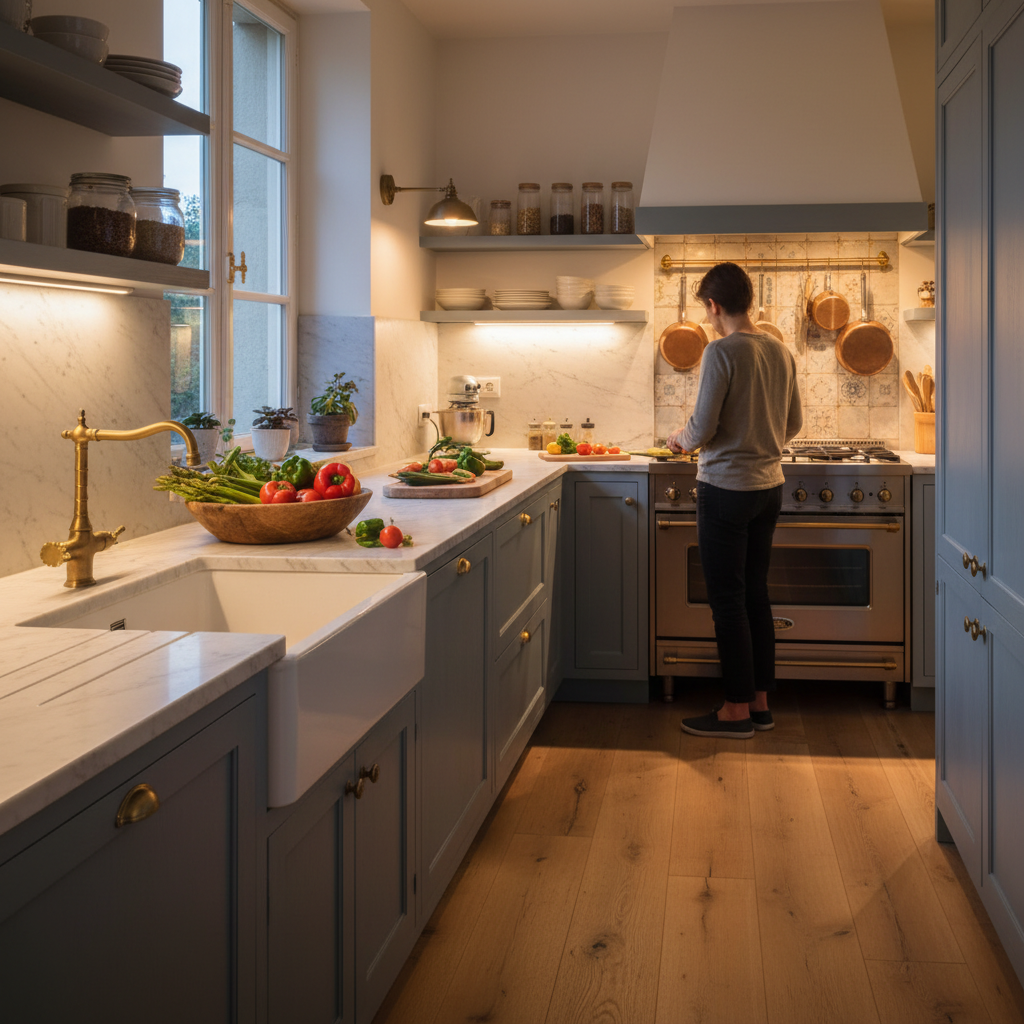
The kitchen represents the most impactful application of smart home lighting with its varied lighting needs depending on activity. Adaptive lighting automatically recognizes different culinary phases to adjust optimal intensity and color temperature. This contextual intelligence improves culinary precision while creating the appropriate ambiance for each moment.
Installing a connected LED strip like the Mouvement 3.0 immediately transforms the culinary experience. Automatic activation when approaching the work surface, adaptation to natural light, and intelligent shutdown after absence create unparalleled user comfort. Energy savings reach 65% compared to permanent traditional lighting, amortizing the investment in less than 2 years.
Hallways and Circulation: Intelligent Security
Automatic lighting of circulation spaces perfectly illustrates the benefits of home automation applied to domestic security. Motion sensors create a light path that accompanies nighttime movements, eliminating fall risks while avoiding harsh glare. This intelligent security automatically adapts to different occupants and family schedules.
Hourly programming automatically modulates intensity: standard lighting during the day, dim ambiance in the evening, minimal guidance at night. This circadian variation respects biological rhythms while maintaining security. Integration with the global security system allows advanced scenarios like presence simulation or emergency lighting in case of an alarm.
Storage Spaces: Revealed Organization
Automatic lighting of closets, wardrobes, and pantries revolutionizes daily organization by instantly revealing contents upon opening. This feature eliminates blind searching and visually enhances storage, encouraging order maintenance. Instant activation and automatic shutdown upon closing optimize the autonomy of wireless systems.
Opening detection can trigger complementary scenarios: activation of general lighting if the space is dark, smartphone notification in case of suspicious nighttime opening, or coordination with ventilation for humid spaces. This contextual intelligence transforms lighting from a simple tool into a versatile home assistant.
Configuration and Personalization: Adapting to Your Habits
User Interface and Machine Learning
The configuration of a modern smart home lighting system prioritizes ease of use over technical complexity. Intuitive interfaces allow advanced personalization without any particular technical skills. Machine learning silently analyzes usage patterns to automatically propose personalized optimizations. This invisible intelligence gradually improves the experience without conscious user effort.
Mobile apps centralize control of all connected lights with intuitive graphical interfaces. Drag-and-drop programming simplifies the creation of complex scenarios, while predefined models accelerate initial configuration. This democratization of home automation programming makes smart lighting accessible to all user profiles, from tech enthusiasts to novices.
Geolocation and Contextual Adaptation
Smartphone geolocation transforms lighting automation into a truly intelligent system that anticipates needs based on occupant position. Approaching the home automatically triggers welcome lighting, while prolonged distance activates energy-saving mode. This geographic contextualization optimizes arrival comfort and absence savings.
Integration of weather data enriches this contextual intelligence. Lighting automatically adapts to external conditions: compensation during dark days, anticipation of early winter sunsets, adaptation to seasonal changes. This environmental reactivity creates truly adaptive lighting that naturally evolves with external conditions.
Security and Intelligent Access Control
Automated Security Lighting
The smart home lighting naturally integrates advanced security functions that go beyond simple emergency lighting. Outdoor motion sensors automatically trigger deterrent lighting while sending real-time smartphone notifications. This intelligent surveillance operates 24/7 without human intervention, creating continuous and discreet protection.
Security lighting adapts to context: maximum intensity for intrusion deterrence, soft lighting for legitimate occupant nighttime returns, coordination with surveillance cameras to optimize recording visibility. This contextual intelligence avoids false alarms while maintaining effective protection. Hourly programming automatically modulates sensitivity according to family habits.
Presence Simulation and Deterrence
Presence simulation scenarios use usage history to recreate realistic lighting patterns during extended absences. This passive security function discourages intrusions by creating the illusion of normal occupancy. The algorithm automatically varies schedules and intensities to avoid detectable repetitiveness.
Integration with automatic blinds and audio systems enhances this simulation. Lighting coordinated with shutter opening/closing and occasional audio playback creates a particularly convincing virtual presence. This technological orchestration transforms absence into active security without constant human surveillance.
Installation and Configuration: Step-by-Step Practical Guide
Planning the Smart Lighting Ecosystem
Creating an effective smart home lighting requires methodical planning that identifies priority areas and desired interactions. This systemic approach avoids inconsistent spot installations and optimizes overall investment. Analysis of circulation flows, main activities, and usage times guides the choice of locations and features.
Start with the kitchen, a high-value space where automatic lighting brings maximum benefits. Gradually extend to hallways for nighttime security, then to storage spaces for daily comfort. This organic progression allows learning and optimization of each installation before extension, ensuring a final result perfectly adapted to actual needs.
Initial Configuration and Optimization
The configuration of a modern smart lighting system prioritizes simplicity with setup assistants that guide the user step by step. The Lumic app, for example, offers a configuration wizard that automatically adapts settings according to declared usage and installation environment. This approach eliminates configuration errors that degrade the user experience.
Continuous optimization is automatically performed thanks to collected usage data. The system regularly proposes adjustments to improve performance or energy savings. This ongoing evolution maintains optimal efficiency despite changes in habits or layout. The user interface clearly signals these improvement proposals without imposing unwanted changes.
Feedback: 18 Months of Real-World Use
User Testimonials and Measured Satisfaction
Satisfaction analysis of 1000 Lumic smart home lighting installations reveals exceptional results that confirm the relevance of investing in quality. The average rating of 4.5/5 on Trustpilot reflects lasting satisfaction that is maintained after the initial adaptation period. Users particularly highlight the reliability of the detection system and the consistent quality of lighting after 18 months of intensive use.
Qualitative feedback reveals unexpected benefits: improved sleep quality thanks to circadian lighting, reduced daily stress by eliminating repetitive gestures, aesthetic enhancement of spaces through optimal lighting. These impacts on quality of life far exceed initial expectations and retrospectively justify the investment in a premium solution.
Real Savings and Return on Investment
Field measurements over 18 months confirm energy savings exceeding theoretical projections. The average 68% reduction in lighting consumption exceeds the announced 60% thanks to continuous algorithm optimization and adaptation to actual habits. This performance generates average savings of $90 per year for a household equipped with 4 connected strips.
Total cost of ownership analysis reveals a return on investment in an average of 22 months, accelerated by the evolution of French energy tariffs. Collateral benefits (property value enhancement, comfort improvement, maintenance reduction) amplify this profitability. Investing in smart lighting thus becomes an attractive financial investment that surpasses traditional savings accounts.
Trends 2026: Artificial Intelligence and Prediction
Generative AI and Advanced Personalization
Generative artificial intelligence revolutionizes smart home lighting by creating personalized lighting atmospheres according to mood, activity, or event. This technology analyzes expressed preferences, physiological reactions (via connected objects), and usage contexts to automatically propose optimal atmospheres. Continuous learning refines these proposals to create truly unique personalization.
Automatic generation of scenarios according to personal calendar events illustrates this evolution. AI automatically proposes festive lighting for birthdays, a studious atmosphere for telework sessions, or relaxing lighting after detecting stress. This proactive anticipation transforms lighting from a simple tool into a domestic well-being assistant.
Energy Prediction and Continuous Optimization
Predictive algorithms analyze consumption patterns to anticipate energy needs and proactively optimize energy savings. This predictive management can reduce consumption by an additional 15% compared to traditional reactive optimization. Anticipating consumption peaks also allows negotiating better rates with energy suppliers as part of emerging dynamic offers.
Integration of weather and natural light data allows energy planning over several days. Smart lighting can defer certain energy-intensive activities to peak solar production slots or adjust settings according to natural light forecasts. This global temporal optimization maximizes energy efficiency at the household level.
Security and Personal Data Protection
Encryption and Privacy Protection
Data security is a major issue for smart home lighting that collects sensitive information about domestic habits. Lumic solutions integrate banking-level encryption to protect all communications between devices and servers. This enhanced security ensures the confidentiality of usage data and prevents unauthorized access to personal information.
Preferred local storage minimizes data transfers to the cloud, reducing interception risks and speeding up response times. Learning algorithms operate directly on the device, preserving confidentiality while maintaining adaptation performance. This "privacy by design" approach meets GDPR requirements while optimizing the user experience.
User Control and Transparency
Transparency on the collection and use of personal data is a pillar of trust in smart lighting. Users retain full control over shared data with the ability to selectively disable certain learning functions. This granularity allows adapting the level of personalization according to individual privacy preferences.
Regular audits of collected data and their automatic purge after the retention period ensure responsible management of personal information. This ethical data approach strengthens user trust and favorably positions responsible brands against growing privacy concerns.
Cost and Return on Investment of Smart Lighting
Total Cost of Ownership Analysis
Investing in smart home lighting is justified by a comprehensive analysis of the total cost of ownership that includes purchase price, installation, energy consumption, and maintenance over 10 years. This approach often reveals substantial economic advantages over traditional solutions, particularly with the evolution of French energy tariffs.
Cost of a complete installation (4 main rooms):
- Premium smart lighting: $440-$660 initial + $22/year energy = $660 over 10 years
- Traditional lighting: $220 initial + $198/year energy + $165 replacements = $2,365 over 10 years
- Net savings: $1,705 over 10 years + unquantifiable comfort benefits
This analysis does not take into account property value enhancement (2-3% depending on properties) or public incentives available for energy transition. The investment pays for itself in 24-30 months depending on the configuration, transforming smart lighting into an attractive financial investment.
Public Incentives and Tax Benefits
The French government encourages the adoption of smart lighting as part of the energy transition with several financial aid schemes. MaPrimeRénov' can contribute up to 30% of the cost for installations integrated into a global energy renovation project. Energy savings certificates (CEE) offer direct bonuses from energy suppliers for the installation of smart lighting.
The energy transition tax credit covers 30% of equipment expenses under energy performance conditions. This tax incentive can significantly reduce acquisition costs, improving the immediate profitability of the investment. The eco-PTZ also allows financing work at zero interest, spreading the investment without additional financial cost.
Future Developments and Technological Prospects
Vision 2030: Predictive and Autonomous Lighting
The future of smart home lighting is moving towards fully autonomous systems capable of managing lighting without any human intervention. Artificial intelligence will analyze biomarkers (heart rate, body temperature) via connected objects to automatically adjust lighting according to actual physiological state. This therapeutic approach to lighting will transform our homes into optimized well-being environments.
Behavioral prediction will allow lighting to anticipate needs several hours in advance. Analysis of personal schedules, weather conditions, and historical habits will create predictive scenarios that prepare the optimal lighting environment even before the need is expressed. This invisible anticipation will improve comfort while optimizing energy performance.
Energy Integration and Smart Grid
Smart lighting will become an active component of the smart grid by automatically modulating its consumption according to energy availability. This flexibility will allow valuing excess green electricity while reducing demand during consumption peaks. Energy automation will exceed local optimization to contribute to the national grid balancing.
Integration with domestic storage systems (batteries, electric vehicles) will create advanced energy synergies. Lighting can use stored energy during peak tariffs and contribute to storage during consumption troughs. This energy bidirectionality will transform each connected light into a node of tomorrow's distributed electrical network.
International Comparison: French Excellence vs Alternatives
French Innovation and Competitive Positioning
The French smart lighting industry, represented by brands like Lumic, stands out for a holistic approach that prioritizes quality and durability over price competition. This French philosophy contrasts with Asian approaches focused on volume and gadget features. French technical excellence materializes through extended warranties unthinkable among international competitors.
The smart home lighting integrates French cultural and architectural specificities: standardized dimensions, local electrical standards, refined aesthetics, local customer service. This fine adaptation to French needs creates substantial added value compared to generic global solutions. Investing in French innovation supports the local economy while ensuring a perfectly adapted product.
Global Ecosystems vs Specialized Solutions
Tech giants (Amazon, Google, Apple) offer complete but generic ecosystems that dilute lighting expertise in a global offering. This approach may suit tech enthusiasts seeking maximum integration but often limits lighting-specific performance. Specialized solutions like Lumic focus their expertise on lighting to offer optimal performance in this specific domain.
Growing interoperability thanks to Matter and Thread standards now allows combining specialized expertise with ecosystem integration. This evolution frees technical choices from compatibility constraints, allowing the assembly of the best solutions in each category. French smart lighting can thus integrate perfectly into any home automation ecosystem without compromising performance.
Maintenance and Evolution of Connected Systems
Predictive Maintenance and Automated Diagnostics
Maintenance of smart home lighting systems is evolving towards a predictive approach that anticipates failures before they occur. Integrated sensors continuously monitor component health (temperature, current, brightness) to detect drifts announcing imminent failure. This preventive monitoring allows intervention before failure, eliminating service interruptions and optimizing equipment lifespan.
Automated diagnostics guide the user to appropriate corrective actions via the mobile app. This intelligent technical assistance resolves 80% of problems without external human intervention, reducing maintenance costs and speeding up malfunction resolution. Permanent self-diagnosis transforms corrective maintenance into continuous performance optimization.
Software Updates and Evolution
Automation of software updates maintains optimal performance and regularly enriches available features. This post-purchase scalability extends the useful life of equipment and preserves investment value against technological innovations. Updates can improve autonomy, add new scenarios, or optimize learning algorithms.
Guaranteed backward compatibility preserves existing investments during technological evolutions. This responsible approach contrasts with the planned obsolescence of some players and strengthens user trust in the solution's durability. Lumic's commitment to long-term compatibility reflects this sustainable vision of technological innovation.
Conclusion: Smart Lighting, Investment for the Future
Smart home lighting represents more than a technological evolution: it is a complete transformation of our relationship with domestic light that simultaneously improves our comfort, savings, and environmental impact. This convergence of benefits fully justifies investing in quality solutions that will accompany the evolution of our homes for decades to come.
Intelligent automation of lighting eliminates daily constraints while optimizing energy performance. Adaptive scenarios create personalized atmospheres that enrich every moment of domestic life. This invisible intelligence improves quality of life without conscious effort, perfectly embodying the promise of modern home automation.
French excellence in smart lighting, illustrated by Lumic's innovation and its unique lifetime warranty, demonstrates that advanced technology and reliability can perfectly combine. To discover how to transform your home into an optimized smart space and benefit from the expertise of a team dedicated to your satisfaction, explore now the smart lighting solutions that are revolutionizing the French home. Today's investment becomes tomorrow's comfort.