The Problem Nobody Talks About with Solar Projectors
You're looking for a powerful solar LED projector and you find listings on Amazon advertising 3000, 5000, or even 8000 lumens for less than $15. Spoiler: these numbers are meaningless. Or rather, they tell you everything about how this market operates.
The reality is, a low-end solar projector advertised at 3000 lumens often produces 10 to 20 times less after just a few minutes of operation. The solar panel is undersized, the battery barely lasts a few cycles, and brightness quickly drops under real load. This isn't an opinion; it's the physical mechanics of these devices.
This article won't give you a "top 10 best projectors" ranking. It will give you the tools to distinguish a truly powerful solar projector from a well-packaged marketing gimmick.
Why Advertised Lumens Are Often Pure Marketing
Cheap solar projector manufacturers use a simple trick: they measure lumens under ideal conditions, often right at startup, with a fully charged battery and perfect ambient temperature. This number doesn't reflect what you'll experience in your backyard.
How Lumens Are Actually Measured (and Why It Changes Everything)
A lumen is a unit of luminous flux. But how it's measured makes all the difference. Serious solar projectors publish their lumens at stabilized operation, meaning after 30 minutes of use, when thermal conditions are stable and the battery is discharging normally. Marketing models publish the peak at startup.
Concrete result: a model advertised at "3000 lumens" can drop to 300-500 lumens in prolonged real-world use. That's 6 to 10 times less than what's written on the box.
The Simple Test to Spot Fake Numbers
Here's a practical rule: if a solar projector costs less than $20 and claims more than 2000 lumens, it's marketing. Physics doesn't lie: producing 2000 stable lumens requires a quality solar panel, battery, and LEDs that cost money. You can't sell that for $12.
Another red flag: a complete lack of data on the battery (mAh capacity), solar panel surface area, or continuous runtime. Serious manufacturers communicate these points because they have numbers to back up.
What Truly Makes an Outdoor Solar LED Projector Powerful
A powerful outdoor solar LED projector isn't just a brighter LED. It's a balance between three components. If one is undersized, the whole system fails.
The Solar Panel: The Source of Everything
The solar panel recharges the battery. A panel that's too small won't recharge properly even in full sun. In winter, with fewer hours of direct sunlight, an undersized panel will never compensate for nighttime consumption.
Serious solar projectors use oversized panels relative to LED consumption. This ensures a full recharge even with partial sunlight. On low-end models, this ratio is sacrificed to cut costs.
The Battery: Real Runtime
Minimum capacity to aim for daily use: 2000 mAh. Below that, you won't have enough reserve for cloudy nights or gray days. Models under $15 often come with 600 to 1200 mAh batteries, barely enough for a normal night, and nothing for a night after an overcast day.
A properly sized battery gives you several days of runtime without direct sun. This is the true reliability criterion for a powerful solar projector used in all seasons.
The LEDs: Real Lumens vs. Peak Lumens
The LED chip itself determines luminous flux, but also its stability over time. A quality LED produces stable flux throughout its operation. A low-end LED quickly overheats and sees its performance drop, sometimes by 70% in minutes.
That's why the lumen figure measured after 30 minutes of operation is the only relevant one. To find this number, you need to look for the complete technical specifications or user reviews that have measured with a lux meter.
Professional vs. Consumer Solar Projectors: What's the Real Difference?
The distinction between "professional" and "consumer" is often blurry in the solar lighting market. But certain characteristics truly make the cut.
Weather Resistance: IP65 Minimum
An outdoor projector will face rain, snow, and frost. The IP (Ingress Protection) rating indicates the level of protection. For permanent outdoor use, IP65 is the serious minimum: total protection against dust and water jets. Below that, you risk a shorter lifespan. To learn how to choose a professional solar projector that will last, these certification criteria are essential.
Motion Detection: Not a Gadget, Real Savings
On a powerful solar projector, the motion sensor isn't a bonus: it's what preserves the battery. A projector that turns on 10 times a night for 30 seconds consumes 10 times less than a continuously lit projector. Result: you can have higher luminous flux when it truly matters.
Detection range and angle vary greatly by model. A well-chosen solar projector with motion sensor should cover at least a 180° detection field, with a useful range of about 26 feet (8 meters).
Long-Term Durability
A professional solar projector also has components designed to last. LEDs have a very long theoretical lifespan, but only if they are not subjected to repeated thermal peaks. A properly sized aluminum casing dissipates heat. A cheap plastic casing retains heat and accelerates aging.
The manufacturer's warranty is the simplest indicator. A five-year warranty means the manufacturer is confident in their components. One year means they hope you won't have a problem within the year.
1200 Real Lumens vs. 3000 Marketing Lumens: Which Truly Illuminates?
This is the central question. And the answer is less intuitive than it seems.
What 1200 Real Lumens Actually Represent
1200 stable lumens, measured under real conditions, is enough luminous flux to illuminate a driveway, a gate entrance, or a medium-sized patio. For comparison: a classic 75W incandescent bulb produced about 1000 to 1100 lumens. So, 1200 real lumens provide solid, usable lighting.
3000 marketing lumens that drop to 400 lumens after heating means a barely lit gray area. And that's where many people are disappointed with their purchases.
Why Honest Numbers Are a Sign of Quality
There's something paradoxical about this market. Brands that advertise the most impressive numbers are often those with the least confidence in their products. Brands that display more modest but real numbers, and offer a long-term warranty, send the opposite signal.
Lumic's SolarGlow advertises 1200 lumens. Less than the "3000 lumens" of many competitors. But these 1200 lumens are real, stable, with 2 motion sensors covering 180°, a range of 26 feet (8 meters), an IP65 certification, and a battery sized for 20 days without solar recharge in detection mode. When a brand dares to announce moderate numbers with a 5-year warranty and a 90-day money-back guarantee, it means they have nothing to hide about their real performance.
To go further on this topic, our article on what truly makes a powerful solar light different details these honest comparison criteria.
Criteria to Compare Before Buying a Powerful Solar Projector
Here's a reference table to objectively evaluate any outdoor solar LED projector before buying it.
| Criterion | Avoid | Acceptable | Truly Powerful |
|---|---|---|---|
| Advertised Lumens | Unspecified peak number | Stabilized measurement provided | Certified real lumens |
| Battery | Less than 1000 mAh | 1500 to 2000 mAh | 2000 mAh and above |
| IP Rating | IP44 or unspecified | IP54 | IP65 minimum |
| Detection | Absent or angle < 90° | 120° / 16 ft (5m) range | 180° / 26 ft (8m) or more |
| Warranty | 0 to 6 months | 1 to 2 years | 5 years |
| Runtime without sun | 1 to 2 nights | 5 to 10 days | 15 days and more |
Where to Install a Solar Projector to Maximize Its Real Power
A 1000 lumen solar projector or more installed in the wrong place will perform worse than a less powerful, well-oriented model. Installation matters as much as specs.
Solar Panel Orientation
In the US/Canada, the solar panel should ideally face south, with a tilt between 30 and 45 degrees to maximize capture. A panel oriented east or west easily loses 30 to 40% of its efficiency. A panel shaded part of the day means a battery that never fully recharges.
On some models, the solar panel and projector are separate (connected by a cable), allowing for independent optimization of orientation and lighting angle. This is a real advantage for complex setups.
Installation Height and Lighting Angle
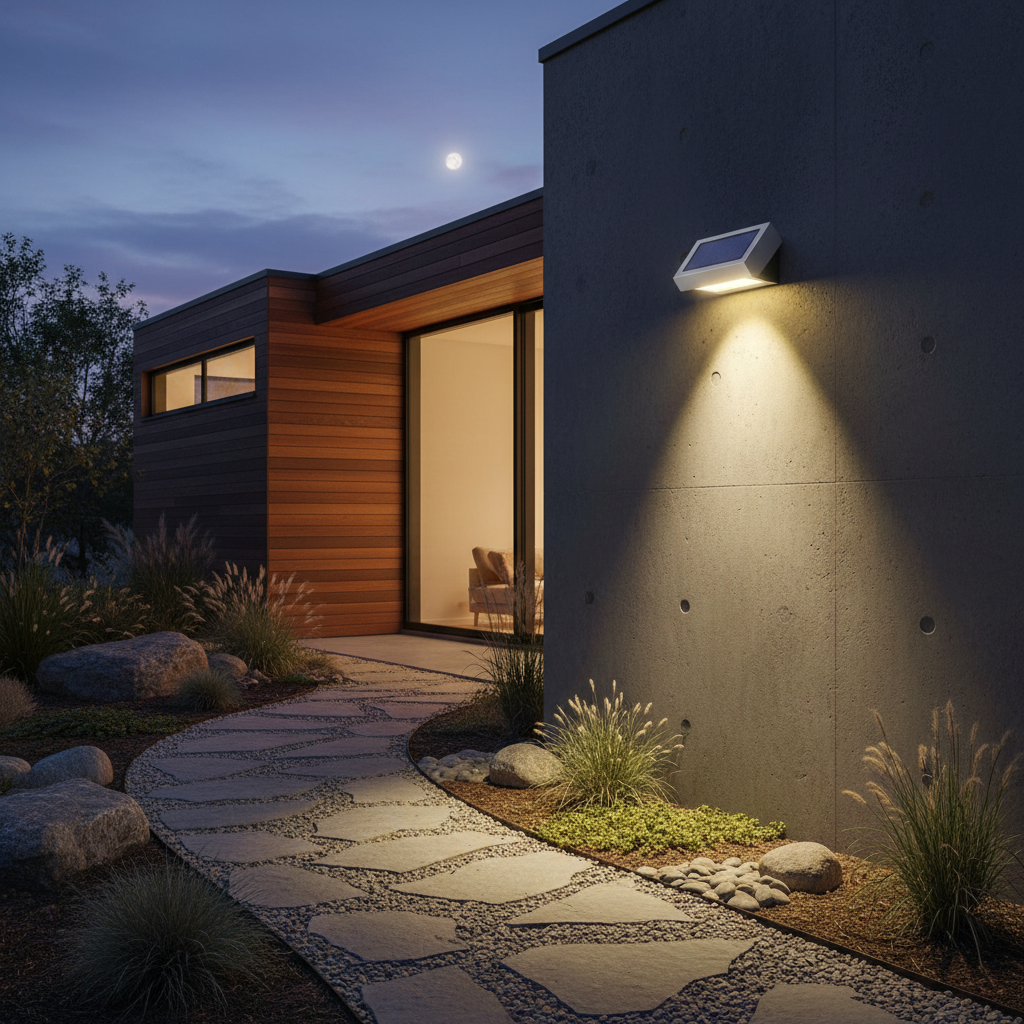
For a driveway or entrance, an installation height between 8 and 13 feet (2.5 and 4 meters) allows for both a good detection angle and effective light diffusion. Too low, the beam is too focused. Too high, the power is lost in diffusion.
To learn more about the best configurations, our complete guide to choosing an outdoor solar projector covers these placement aspects in detail.
Installation Pitfalls to Avoid
- Installing under an overhang without direct sun: The integrated panel won't recharge sufficiently.
- Blocking the ambient light sensor: Many projectors turn on at dusk thanks to this sensor. If it's obstructed, behavior becomes unpredictable.
- Perpendicular orientation to the area to be lit: A projector pointed too far down concentrates light on a small area and doesn't cover the useful space.
- Ignoring water accumulation: Even with IP65, an installation where water can accumulate around the seal will accelerate aging.
The Underside of Powerful Solar Lighting the Industry Prefers to Keep Quiet
Beyond lumens, there are lesser-known realities in the outdoor solar LED projector market. For a complete view on the underside of powerful outdoor solar lighting, some aspects are worth knowing before buying.
Lithium Battery Degradation in Winter
Lithium-ion batteries lose some of their effective capacity when the temperature drops below freezing. Specifically, a 2000 mAh battery can behave like a 1400 mAh battery at 14°F (-10°C). Serious projectors account for this in their design. Low-end models don't mention it.
Real LED Lifespan Under Poor Thermal Conditions
A well-managed LED can last 20,000 to 30,000 hours. An overheated LED in a poorly designed plastic casing can start losing 20 to 30% of its flux in just a few hundred hours. This is often why low-end projectors seem less bright after a few months: the LEDs age prematurely.
Recycling and Environmental Impact
A solar projector that lasts 18 months before being replaced isn't truly eco-friendly. Manufacturing a lithium battery has a real environmental cost. Buying a quality projector that lasts 5 to 10 years is objectively more responsible than buying three cheap models over the same period. This is an argument rarely highlighted, but it matters.
How to Evaluate a Solar Projector Before Buying Without Testing It
You can't take a lux meter to the store. But you can still avoid unpleasant surprises with a few simple habits.
Read Reviews in the Right Order
Don't just look at 5-star reviews from the first few weeks. Look for reviews left after 3, 6, or 12 months of use. That's where the truth about durability and real performance emerges. Trustpilot or verified reviews are generally more reliable than unverified Amazon reviews.
Look for Specs Not in the Product Title
A serious seller communicates: battery capacity (mAh), precise IP rating (not just "waterproof"), solar panel surface area, warranty duration, and warranty conditions. If you have to search for 10 minutes to find this information, it's often a bad sign.
Test Customer Support Before You Have a Problem
Send a question to customer support before buying. The responsiveness and quality of the answer tell you a lot about after-sales service. A service that responds quickly and accurately is generally a sign of a brand that stands behind its products. For anything related to off-grid solar lighting, the relationship with the manufacturer over time matters as much as the product itself.
Key Takeaways on Powerful Solar LED Projectors
The solar LED projector market is riddled with inflated numbers and impossible promises. The good news: the criteria for identifying a truly powerful solar LED projector are simple and accessible.
An oversized panel. A battery of at least 2000 mAh. Lumens measured under stabilized conditions. An IP65 rating. Wide-range detection. And a warranty that shows the manufacturer believes in their product.
1200 real lumens are enough to properly illuminate an entrance. 3000 marketing lumens that drop to 300 after ten minutes illuminate nothing. The power you want is the kind that lasts, not the kind that flashes on a product sheet. To go further in your selection, consult our complete guide to choosing an outdoor solar projector and take the time to compare based on the criteria that truly matter.