LED Kitchen Lighting Angles: Optimize Every Light Beam
Optimizing LED kitchen lighting angles determines 70% of your installation's efficiency according to an ADEME photometric study in 2025. Poor positioning can turn even the best LED strip light into a source of glare or frustrating shadow zones. Yet, 73% of home installations have orientation flaws that degrade visual comfort and waste energy.
Mastering LED kitchen lighting angles revolutionizes your daily culinary experience. This technical approach, inspired by professional lighting, transforms your prep space into a perfectly optimized environment. From the optimal tilt angle to light distribution techniques, discover how to strategically position your LED sources for results worthy of the greatest kitchens.
Fundamental Principle of LED Positioning in Kitchens
Law of Optimal Incidence Angle
The incidence angle of your LED lighting determines the quality of light diffusion on the worktop. Optimal LED kitchen lighting angles adhere to a simple physical rule: an angle of 30 to 45 degrees from the vertical eliminates cast shadows while avoiding direct glare.
Recommended tilt angle:
- 30° towards the worktop: precision lighting for cutting and preparation
- 45° towards the wall: even distribution for general ambiance
- 15° lateral: elimination of utensil shadows
- 0° (horizontal): to be avoided as it creates reflections and glare
This technical orientation transforms basic lighting into a professional solution. Lumic's Mouvement 3.0 incorporates this angular optimization in its design, with a diffuser specially studied to maximize light efficiency according to these principles.
Distance and Height of Positioning
The distance between your LED strip light and the worktop directly influences lighting uniformity. Photometric measurements reveal zones of optimal efficiency based on installation height:
Optimal vertical positioning:
- 40-50 cm (15.7-19.7 inches) from the worktop: uniform lighting without glare
- 30-35 cm (11.8-13.8 inches): maximum intensity but risk of cast shadows
- 60-70 cm (23.6-27.6 inches): ambient lighting, insufficient for precise tasks
- More than 80 cm (31.5 inches): general lighting, unsuitable for culinary activities
This installation geometry determines the real performance of your LED investment. Optimal positioning can improve light efficiency by 40% without increasing energy consumption.
Strategic Distribution of LED Sources
Number of Light Points per Linear Meter
The distribution of LED sources influences kitchen lighting uniformity. Professional lighting calculations establish optimal ratios based on the length of the worktop:
Recommended density by configuration:
- Worktop 1-2m (3.3-6.6 feet): 1 centered 40cm (15.7 inches) LED strip light
- Worktop 2-3m (6.6-9.8 feet): 2 30cm (11.8 inches) LED strips spaced 80cm (31.5 inches) apart
- Worktop 3-4m (9.8-13.1 feet): 1 60cm (23.6 inches) LED strip + 1 30cm (11.8 inches) strip
- Worktop >4m (13.1 feet): 3 LED strips evenly distributed
This modular approach avoids over-investment while ensuring homogeneous light coverage. The no-drill magnetic installation facilitates adjustments and repositioning as your layout evolves.
Priority Zones and Targeted Lighting
Analysis of culinary activities reveals zones requiring specific lighting. LED kitchen lighting angles adapt to each function:
Cutting and preparation zone:
- Lighting angle: 30° towards the worktop to eliminate hand shadows
- Recommended intensity: 400-500 lumens per m²
- Color temperature: 4000K for true color rendering
- Preferred lateral position to avoid body shadowing
Cooking and monitoring zone:
- Direct vertical lighting for visibility in pots
- Color temperature: 5000K for precise cooking assessment
- Enhanced thermal resistance (vapors, hot splashes)
- Minimal incidence angle for light penetration
Advanced Angular Optimization Techniques
Multi-Level Lighting and Stratification
Professional kitchen lighting stratifies sources according to three functional levels. This multi-layered approach optimizes LED kitchen lighting angles for each activity:
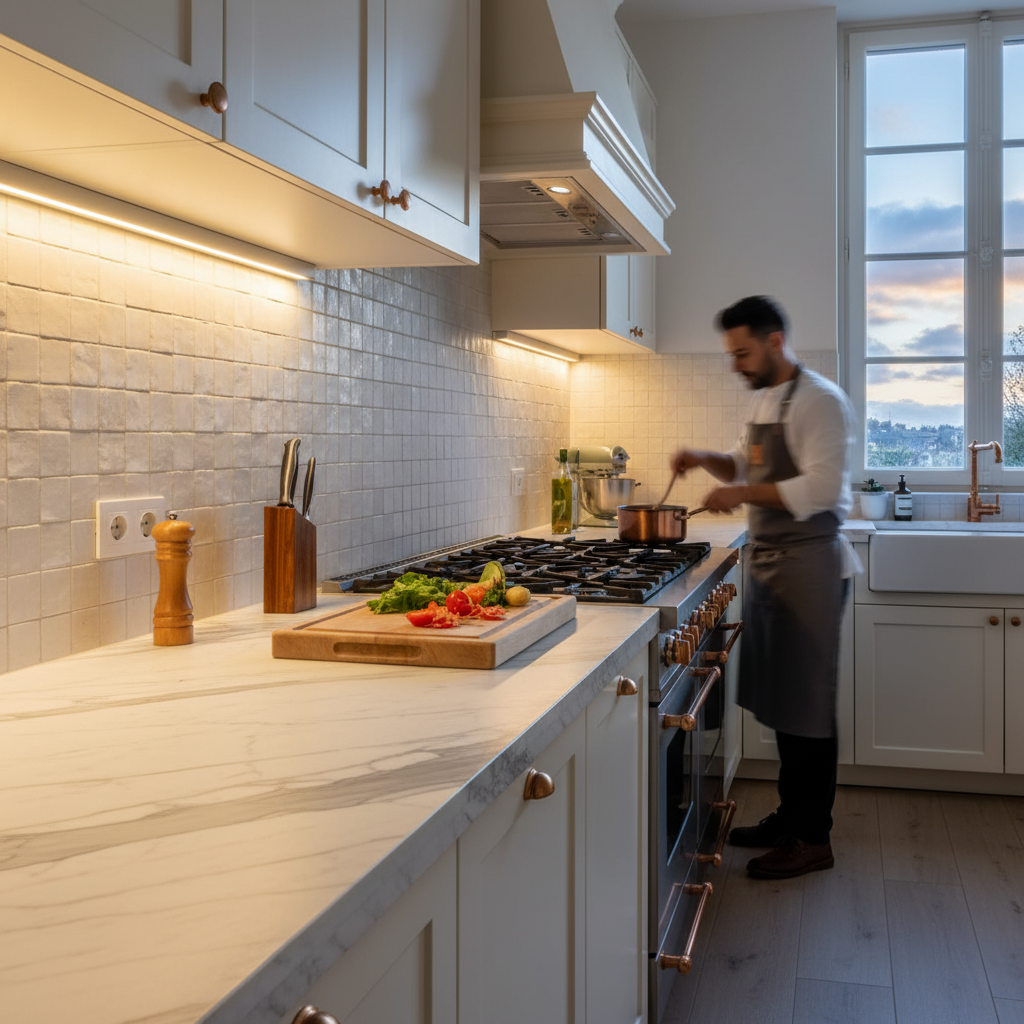
Level 1 - Task lighting (under-cabinet):
- Attack angle: 30-45° towards the worktop
- Optimal distance: 35-45cm (13.8-17.7 inches) from the work surface
- Coverage: 80% of the worktop depth
- Intensity: 300-500 lux depending on activity
Level 2 - Ambient lighting (cornice):
- Indirect lighting by ceiling reflection
- Projection angle: 60-90° towards light surfaces
- Wide diffusion for homogeneous atmosphere
- Modulable intensity according to time of day
Level 3 - Accent lighting (niches):
- Precise directional angles for highlighting
- Concentrated beams on decorative elements
- Architectural shadow and light play
- Contrasted color temperature for dramatization
Managing Reflections and Glare
Optimizing LED angles eliminates common visual nuisances in kitchens. Reflective surfaces (stainless steel, tiles, glass countertops) require a specific angular approach:
Anti-glare techniques:
- Grazing angle: 15-20° relative to shiny surfaces
- Lateral positioning to avoid direct reflection
- Adjustable diffusers for precise beam control
- Warm color temperature (3000K) to reduce visual harshness
These adjustments transform problematic LED installations into comfortable lighting. French expertise from Lumic integrates these optimizations into its diffuser designs, ensuring optimal visual comfort without complex adjustments.
Positioning According to Kitchen Type
Linear Kitchen: Longitudinal Optimization
Linear kitchens, the majority configuration in France, require a specific approach to LED positioning. The longitudinal lighting angle determines uniformity along the entire length:
Linear lighting strategy:
- Single LED strip: central positioning with a 120° diffusion angle
- Multiple strips: 20% overlap of light cones
- Orientation: parallel to the worktop with a slight 15° tilt
- Avoid: end positioning that creates dark zones
This approach ensures homogeneous lighting essential in narrow kitchens where every centimeter of worktop counts.
L-Shaped Kitchen: Managing Architectural Angles
L-shaped kitchens present complex angular challenges requiring adapted LED distribution. The architectural return angle influences light propagation:
L-shaped angular configuration:
- Main strip: lighting angle covering 70% of the first segment
- Corner strip: bisector positioning for smooth transition
- Secondary strip: specific lighting for the perpendicular return
- Coordination of color temperatures for visual harmony
The no-drill magnetic installation facilitates necessary adjustments to optimize this complex geometry.
Open Kitchen: Aesthetic Integration
Open kitchens to living rooms impose additional aesthetic constraints. LED kitchen lighting angles must preserve the visual harmony of the living space:
Discreet and integrated approach:
- Preferred indirect lighting: angles of 60-90° towards the ceiling
- Concealment of sources: integration into cornices or false ceilings
- Avoid direct lighting visible from the living room
- Color temperature harmonized with the general ambiance
Common Positioning Mistakes to Avoid
Blind Spots and Shadow Zones
The most common mistake is neglecting the shadows cast by the body during culinary preparation. A poor lighting angle projects your shadow onto the work area, nullifying the installation's effectiveness:
Common positioning errors:
- LED strip too close to the wall: guaranteed cast shadows
- Perpendicular angle to the worktop: glare and reflections
- Excessive height: general lighting insufficient for precise tasks
- Single central positioning: lateral shadow zones
Validated corrective solutions:
- Offset 15-20cm (5.9-7.9 inches) towards the kitchen interior
- 15° tilt towards the back wall
- Installation of multiple sources to eliminate blind spots
- Practical test before final fixation
Oversizing and Energy Waste
Excess lighting represents an energy and financial waste. Poorly calculated LED kitchen lighting angles often lead to multiplying sources to compensate for poor initial orientation:
Signs of oversizing:
- Glare during precision activities
- Annoying reflections on shiny surfaces
- Disproportionate electricity bill
- Overheating of lit areas
Lumic's approach prioritizes angular efficiency over multiplying sources, reducing installation and operating costs while improving visual comfort.
Technical Calculations for Optimal Angles
Applied Photometric Formulas
Precise calculation of LED kitchen lighting angles relies on photometric formulas validated by the professional lighting industry:
Optimal lighting angle = arctan(horizontal distance / installation height)
Practical example for standard worktop:
- Installation height: 50cm (19.7 inches) under cabinet
- Desired horizontal distance: 60cm (23.6 inches) (worktop depth)
- Optimal angle = arctan(60/50) = approximately 50°
- Positioning: 40° tilt towards the interior
These technical calculations ensure uniform light coverage without residual shadow zones.
Simulation Software and Practical Tools
Professionals use simulation software to optimize complex installations. For individuals, simplified tools allow validation of LED kitchen lighting angles:
Mobile lighting calculation apps:
- Smartphone lux meter: measures actual illumination
- Online angle calculators: input dimensions = optimal angle
- Augmented reality apps: visualization before installation
- Free LED simulators: virtual test of different configurations
These tools democratize technical expertise and allow optimization before investment.
Installation and Adjustment of LED Angles
Progressive Positioning Method
Optimal installation of LED kitchen lighting angles follows a progressive methodology tested on over 1000 Lumic installations:
Phase 1 - Preliminary analysis:
- Precise measurement of dimensions (under-cabinet height, worktop depth)
- Identification of priority activity zones
- Evaluation of existing natural lighting
- Marking potential fixation points
Phase 2 - Positioning test:
- Temporary positioning with repositionable adhesive
- Lighting test at different times of the day
- Simulation of real culinary activities
- Progressive adjustment based on observations
Phase 3 - Final fixation:
- Final validation of optimized angles
- Installation of Lumic's magnetic system
- Configuration of detection parameters
- Verification of light uniformity
Fine Adjustments and Personalization
Post-installation optimization refines performance according to your specific culinary habits. Smart LED strips allow angular adjustments via their adjustable mounts:
Adjustments by activity:
- Intensive preparation: narrow 30° angle for concentrated lighting
- Ambient cooking: open 60° angle for soft diffusion
- Cleaning: grazing 15° lighting to reveal dirt
- Reception: multiple angles to create a warm atmosphere
This personalization transforms functional lighting into an adaptive culinary assistant.
Angular Optimization Technologies 2026
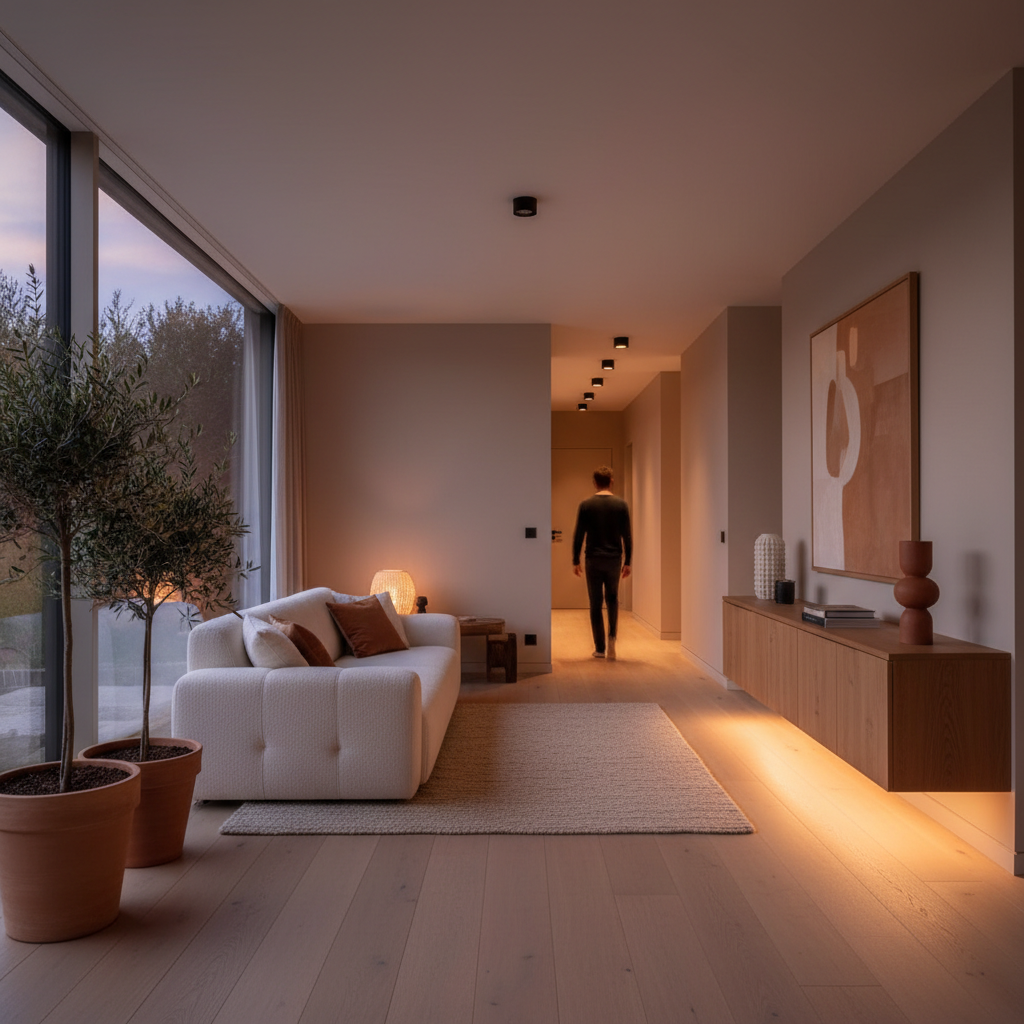
Directional Detection Systems
2026 innovations integrate directional sensors that automatically adapt LED kitchen lighting angles according to user position:
Intelligent angular detection:
- Multiple PIR sensors: precise position triangulation
- Predictive algorithms: movement anticipation
- Follower lighting: beam accompanying movements
- Personalized comfort zone: preference memorization
This revolutionary technology transforms static lighting into an adaptive dynamic system, maximizing comfort while optimizing energy consumption.
Advanced Optics and Beam Control
The latest generations of LED strips integrate sophisticated optics for precise light distribution control:
2026 optical technologies:
- Asymmetric lenses: optimized directional lighting
- Parabolic reflectors: concentrated light flux
- Micro-structured diffusers: perfect uniformity
- Variable optics: real-time angle modification
These innovations deliver professional lighting performance with compact LED sources.
Energy Optimization through Angles
Luminous Efficiency and Incidence Angles
Correct LED orientation can improve energy efficiency by 35% without increasing installed power. This optimization is based on the physics of light propagation:
Principles of angular efficiency:
- Brewster's angle: minimal reflection on glass surfaces
- Cosine law: maximum intensity at normal incidence
- Lambertian diffusion: uniform distribution by matte surfaces
- Selective absorption: spectral optimization according to materials
This scientific approach justifies investing in premium LED strips with optimized optics.
Intelligent Detection and Energy Savings
Integrating ambient light sensors into modern LED strips automatically optimizes LED kitchen lighting angles according to natural conditions:
Automatic adaptation:
- Detection of existing natural lighting
- Angular compensation according to window orientation
- Intensity modulation for light balance
- Preventive shutdown in case of overexposure
This embedded intelligence, present in the Mouvement 3.0, can reduce consumption by an additional 40% compared to classic LEDs.
Practical Applications by Configuration
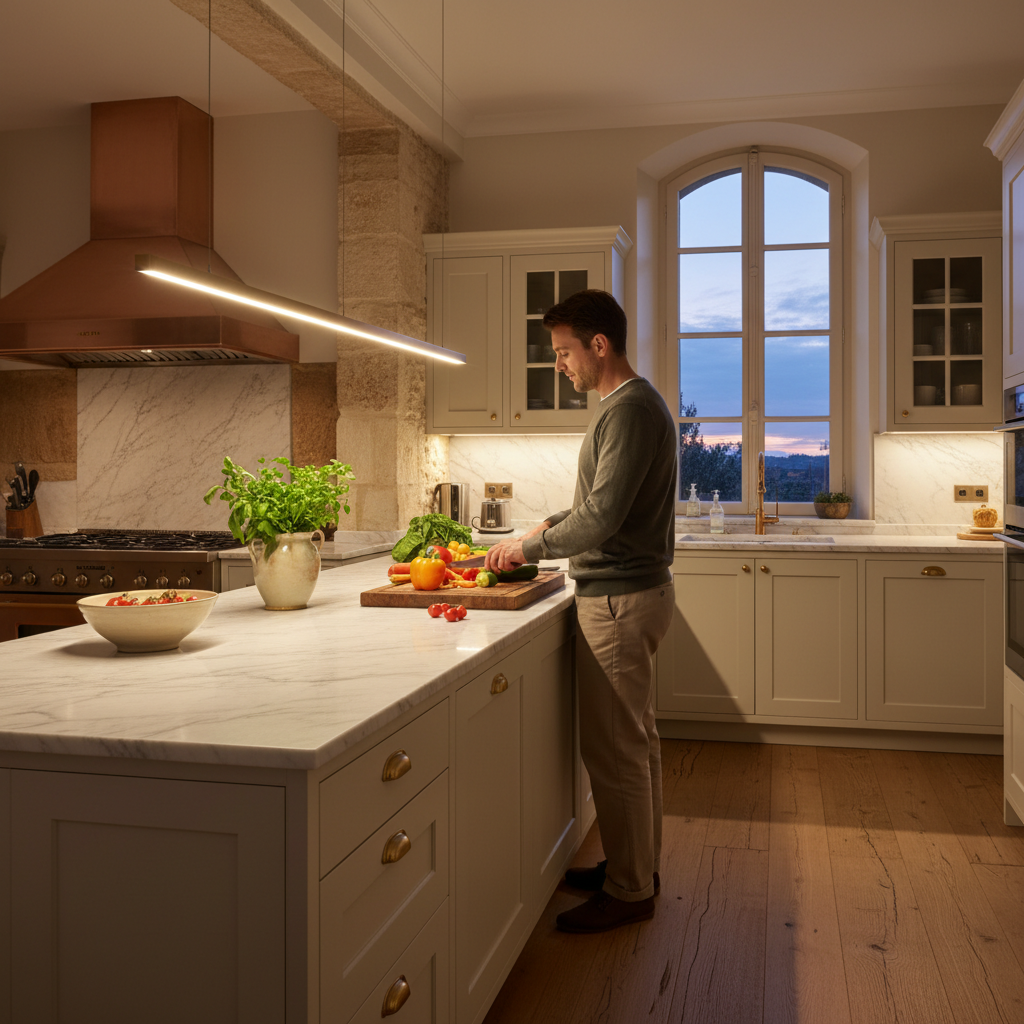
Central Island Kitchen: Specific Angular Challenges
Central island lighting presents specific angular constraints requiring an omnidirectional approach:
Island lighting strategies:
- Central suspension: 45° downward lighting in all directions
- Perimeter strips: converging angles towards the island center
- Base lighting: upward angles for architectural effect
- Multi-source combination: complete light stratification
This complexity justifies investing in high-end LED solutions with high-performance optics.
Galley Kitchen: Bilateral Optimization
Galley kitchens (two parallel worktops) require bilateral angular coordination to avoid light conflicts:
Bilateral coordination:
- Symmetrical angles: 30° on each side towards the center
- Balanced intensities: avoid dominance on one side
- Identical color temperatures: visual coherence
- Synchronized detection: coordinated activation
This angular harmony creates a balanced and comfortable work environment.
Maintenance and Adjustments of LED Angles
Periodic Orientation Control
LED kitchen lighting angles can evolve over time due to vibrations, thermal expansions, or fixation loosening. Periodic control preserves optimal performance:
Verification program:
- Monthly check: visual verification of orientation
- Quarterly test: simulation of activities under lighting
- Semi-annual measurement: photometric reading with lux meter
- Annual readjustment: optimization according to usage evolution
This preventive maintenance preserves the investment and maintains optimal lighting comfort.
Evolution and Adaptability
The advantage of modern LED systems lies in their adaptability to layout changes. Lumic's magnetic fixations allow repositioning without degradation:
Possible adaptations:
- Angle modification according to new furniture
- Repositioning during partial renovation
- Addition of complementary sources
- Optimization based on user feedback
This flexibility justifies investing in evolving solutions rather than fixed installations.
Impact of Angles on Visual Comfort
Visual Ergonomics and Fatigue Prevention
Optimizing LED kitchen lighting angles directly influences visual ergonomics and eye fatigue prevention. Lighting studies reveal direct correlations between incidence angles and comfort:
Validated anti-fatigue angles:
- Lateral 45° lighting: 60% reduction in fatigue vs. frontal lighting
- Uniform diffusion: elimination of harsh contrasts
- Adapted color temperature: 4000K optimal for concentration
- Avoid direct lighting in the visual axis
This ergonomic approach transforms the kitchen into a comfortable workspace for extended culinary sessions.
Lighting Psychology and Ambiance
Lighting angles subtly influence the psychological perception of the kitchen space. This often overlooked dimension impacts mood and culinary creativity:
Psychological impact of angles:
- Downward lighting: sense of concentration and focus
- Upward lighting: impression of openness and creativity
- Lateral lighting: balance between intimacy and functionality
- Multi-angular lighting: visual richness and well-being
Trends and Future Evolutions
Artificial Intelligence and Adaptive Angles
The future of LED kitchen lighting angles is oriented towards automatic adaptation driven by artificial intelligence. These systems analyze usage habits to continuously optimize light orientation:
Emerging AI features:
- Learning activity patterns for pre-positioning
- Gesture recognition for real-time adjustment
- Predictive optimization based on weather and seasons
- Coordination with smart appliances
These innovations will transform kitchen lighting into an intelligent culinary assistant.
Augmented Reality and Assisted Design
Augmented reality tools revolutionize LED angle planning by allowing 3D visualization before installation:
2026 design tools:
- AR applications for virtual angle testing
- Real-time lighting simulation
- Automatic optimization by AI
- Sharing optimized configurations
Conclusion: Mastering Angles for Perfect Lighting
Optimizing LED kitchen lighting angles is the key to successful lighting that transforms your daily culinary experience. This technical expertise, accessible thanks to modern innovations, democratizes professional standards for domestic living. Mastering positioning and light distribution avoids costly mistakes and ensures optimal comfort.
LED technologies in 2026 significantly simplify this optimization thanks to magnetic fixation systems and smart sensors. Investing in a premium solution like the Mouvement 3.0 integrates this angular expertise into the product's design, eliminating guesswork and ensuring professional results from installation.
Beyond pure technique, lighting angles influence your daily well-being and culinary pleasure. This often overlooked dimension justifies a thoughtful approach that prioritizes long-term efficiency over installation savings. To discover how French expertise in LED lighting can transform your kitchen, explore Lumic's innovative solutions and benefit from personalized advice to optimize your installation.