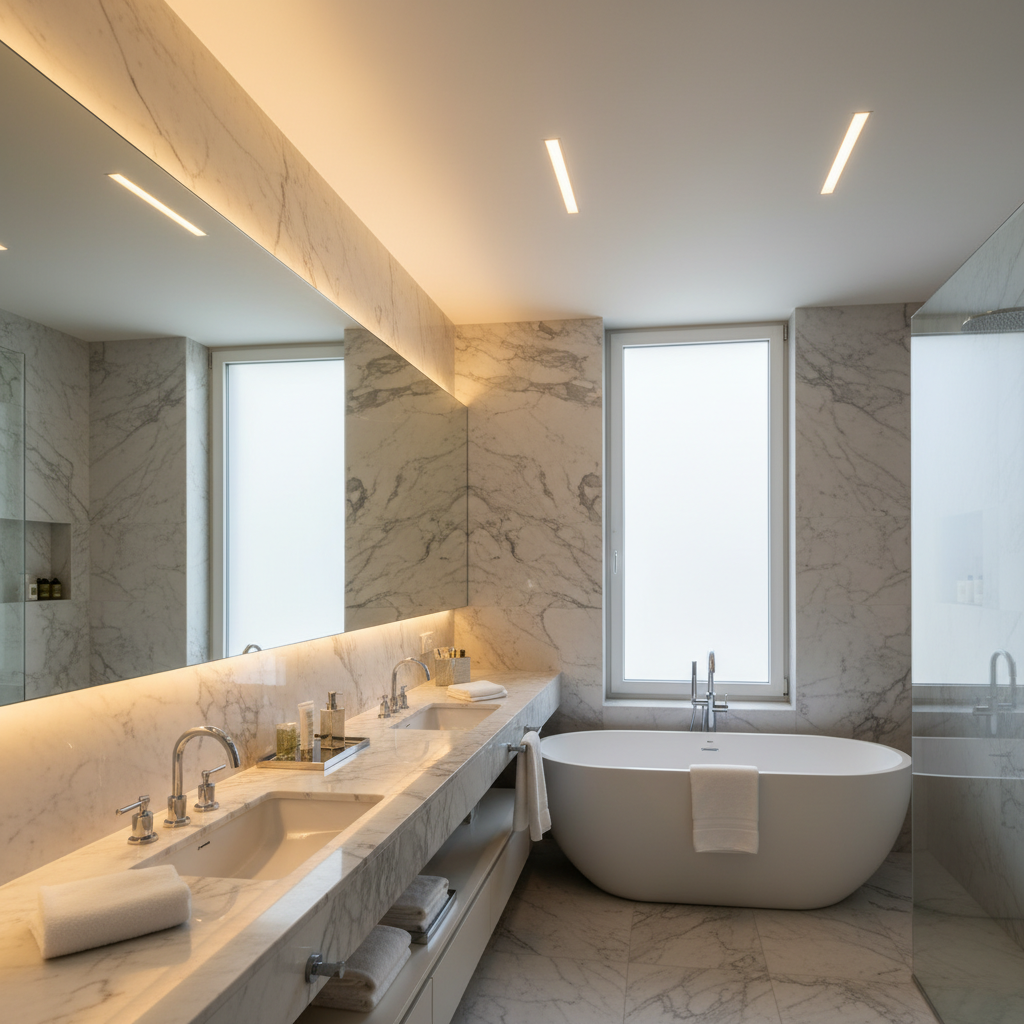
Bathroom LED Lighting: Revolutionize Your Wellness Space in 2026
Bathroom LED lighting radically transforms your daily wellness space by combining safety, energy savings, and modern aesthetics. According to an ADEME 2025 study, 72% of people find their bathroom lighting insufficient, causing eye strain and accident risks during morning and evening routines. This lighting gap not only affects comfort but directly impacts your safety, daily efficiency, and energy bill.
Modern bathrooms demand adaptive lighting capable of switching from precise functional lighting (shaving, makeup) to a relaxing ambiance (bath, relaxation). Bathroom LED lighting perfectly meets this duality with its dimming and color temperature capabilities. The 2026 innovations now include motion detection, enhanced moisture resistance, and simplified installation to create a perfectly adapted lighting environment.
In this comprehensive guide, discover how to choose, install, and optimize the perfect LED lighting for your bathroom. From safety standards to the latest wireless innovations, we explore all facets of this lighting revolution that already equips over 35,000 bathrooms. Smart lighting transforms your bathroom into a true home spa combining functionality and well-being.
Electrical Safety Standards: Understanding Protection Zones
Classification of Electrical Zones in the Bathroom
Electrical safety in the bathroom follows strict rules defined by the NF C 15-100 standard. This French regulation classifies the space into zones according to the risk level of water exposure, determining the types of bathroom LED lighting allowed in each zone. Understanding this classification avoids dangerous installation errors and ensures the compliance of your installation.
Zone 0 (prohibited for any lighting):
- Inside the bathtub or shower tray
- Height: from the floor to the edge or 2.25m (7.38 ft) if open shower
- No electrical equipment allowed
- Protection by very low safety voltage only
Zone 1 (very low voltage 12V max):
- Vertical perimeter around bathtub/shower
- Width: 60cm (23.62 in) from bathtub edge
- Height: 2.25m (7.38 ft) from the floor
- 12V waterproof lighting IPX7 only
Zone 2 (230V waterproof lighting allowed):
- Extension of 60cm (23.62 in) around zone 1
- Minimum IP44 rating required
- Specially designed waterproof LED lighting
- Mandatory 30mA differential protection
Zone 3 (standard lighting with protection):
- Rest of the bathroom beyond 2.40m (7.87 ft) from water points
- Standard LED lighting with minimum IP21 rating
- Maintained differential protection
- Ideal zone for smart lighting and mirror lighting
IP Protection Ratings: Decoding for the Bathroom
The IP (Ingress Protection) rating characterizes the resistance of your bathroom LED lighting against the intrusion of solid and liquid bodies. This certification determines the authorized location and durability of your installation in the specific humid environment.
Decomposition of the IP rating:
- First digit: protection against solids (0 to 6)
- Second digit: protection against liquids (0 to 8)
- IPX4: protection against water splashes (zone 2 minimum)
- IPX5: protection against water jets (intense humid zones)
- IPX7: protection against temporary immersion (zone 1)
Recommendations by installation zone:
- Near sink/basin: minimum IP44 for splashes
- Shower/bathtub area: IP65 for direct water jets
- Bathroom ceiling: IP44 sufficient except for walk-in showers
- Storage niche: IP21 acceptable if protected
Premium LED strip lights often integrate IP65 from the start, allowing installation in all authorized zones without restriction. This versatility simplifies the choice and secures the installation.
Differential Protection and Grounding
The installation of wired bathroom LED lighting requires enhanced electrical protection to prevent any risk of electrocution. The French standard imposes particularly strict safety devices in humid environments.
Mandatory 30mA differential circuit breaker:
- Detection of current leaks to the ground
- Automatic shutdown in less than 30 milliseconds
- Protection against electrocution by indirect contact
- Monthly test recommended by pressing the test button
Equipotential bonding:
- Connection of all metallic masses
- Equalization of electrical potentials
- Prevention of dangerous voltage differences
- Mandatory for metallic luminaires
Modern wireless solutions eliminate these electrical safety constraints by operating at very low voltage (3.7V battery), allowing installation in all zones without special precautions.
Types of Bathroom LED Lighting: Suitable Solutions
Waterproof LED Strip Lights: Versatility and Performance
LED strip lights are the most versatile bathroom LED lighting solution, adapting to all architectural configurations. Their linear format allows homogeneous lighting over large areas, eliminating problematic shadow zones for hygiene and safety.
Optimal applications of LED strip lights:
- Mirror lighting: side installation to eliminate face shadows
- Shower illumination: uniform lighting without hot spots
- Basin lighting: precision for facial care
- General ambiance: soft diffusion for relaxation moments
Essential technical specifications:
- Power: 8-20W depending on length (efficiency 100+ lumens/watt)
- Luminous flux: 800-2000 lumens for main lighting
- CRI (color rendering): minimum 80, ideally 90+ for makeup
- Color temperature: 3000-4000K for optimal visual comfort
- Waterproofing: minimum IP44, IP65 recommended for humid zones
Premium models integrate dimming and adjustable color temperature, allowing adaptation according to activity: technical lighting (4000K, 100%) or relaxing ambiance (3000K, 40%).
Recessed LED Spots: Discreet Elegance
Recessed LED spots offer precise directional lighting while preserving the sleek aesthetics of contemporary bathrooms. This solution is particularly suitable for suspended ceilings and integrated lighting niches.
Specific advantages:
- Total architectural integration: invisible light sources
- Targeted lighting: precise orientation according to needs
- Enhanced waterproofing: standard IP65 protection
- Facilitated maintenance: individual replacement possible
Recommended configuration by zone:
- Sink area: 2-3 spots oriented towards the mirror
- Shower area: 1-2 spots on the ceiling, vertical lighting
- WC area: 1 central spot with motion detection
- Circulation: low-intensity marking spots
The optimal spacing between spots is 1.5-2 meters (4.92-6.56 ft) to avoid excessive contrasts while ensuring sufficient lighting. The embedding depth varies from 60 to 100mm (2.36-3.94 in) depending on the available ceiling thickness.
Flexible LED Strips: Creativity and Adaptability
Flexible LED strips revolutionize decorative lighting in the bathroom by allowing creative installations impossible with rigid solutions. This technology adapts to curved shapes, complex niches, and custom furniture.
Specific creative applications:
- Mirror backlighting: elegant luminous contour
- Niche lighting: highlighting beauty products
- Step marking: securing bathtub access
- Spa ambiance: relaxing indirect lighting
Installation and cutting:
- Possible cutting every 5-10cm (1.97-3.94 in) depending on models
- Waterproof connectors for connections
- Reinforced adhesive resistant to humidity
- Safe low-voltage power supply (12-24V)
LED Mirror Lighting: Advanced Technical Solutions
Optimal Positioning for Mirror Lighting
Mirror lighting is the critical element of a functional bathroom. Incorrect positioning creates annoying shadows that compromise the precision of facial care and shaving. Ergonomic analysis reveals precise rules for optimal lighting.
Lateral lighting (recommended):
- Position: on each side of the mirror at face height
- Distance: 75-100cm (29.53-39.37 in) between the two sources
- Height: 1.70-1.80m (5.58-5.91 ft) from the floor depending on users
- Advantage: total elimination of cast shadows
Top lighting (classic solution):
- Position: above the mirror, centered
- Distance: 20-30cm (7.87-11.81 in) from the wall to avoid reflections
- Width: 60-80% of the mirror width
- Limit: may create shadows under eyes and chin
Peripheral lighting (premium solution):
- LED strip all around the mirror
- Uniform 360° lighting eliminating all shadows
- Spectacular aesthetic effect
- More complex installation but exceptional result
Integrated LED Mirror Technologies
Integrated LED mirrors revolutionize bathroom LED lighting by combining reflective function and light source in a single element. This integration optimizes space while ensuring perfectly adapted lighting.
LED mirrors with peripheral lighting:
- LED strip integrated into the mirror thickness
- Uniform diffusion eliminating hot spots
- Touch control or proximity sensor
- Intensity and color temperature variation
Backlit LED mirrors:
- Indirect lighting through partial transparency
- Elegant halo effect around the mirror
- Cozy ambiance ideal for relaxation
- Optimized energy consumption
Advanced features 2026:
- Integrated anti-fog: clear surface even after a hot shower
- Clock and temperature displayed
- Bluetooth connectivity for ambient music
- Presence detection for automatic activation
Supplementary Lighting and Specific Zones
Supplementary lighting complements the main lighting to create a perfectly balanced luminous environment. These secondary sources provide comfort and safety in specific areas of the modern bathroom.
Specialized shower lighting:
- Recessed ceiling spots with IP65 rating
- Color temperature 4000K for optimal visibility
- Sufficient intensity: 300-500 lux for safety
- Remote control outside the humid zone
Smart night light:
- Marking lighting for nighttime safety
- Motion detection with reduced intensity
- Warm color temperature (2700K) preserving sleep
- Exceptional autonomy in economy mode
Automatic storage lighting:
- Activation upon opening bathroom furniture
- Short wireless strips for medicine cabinets
- Uniform lighting revealing contents
- Installation without furniture modification
Wireless Solutions: Bathroom Installation Revolution
Advantages of Wireless LED Lighting in the Bathroom
Wireless bathroom LED lighting revolutionizes installation by eliminating the specific electrical constraints of humid environments. This freedom transforms lighting layout by allowing optimal positioning without considering existing electrical circuits.
Optimized electrical safety:
- Total elimination of electrocution risks
- Operation at very low voltage (3.7V battery)
- No electrical connection in the humid zone
- Installation allowed in all protection zones
Revolutionary installation simplicity:
- Installation in less than 10 minutes without tools
- No drilling or wiring required
- Easy repositioning according to evolving needs
- Compatible with rental (no permanent modification)
Layout flexibility:
- Positioning test before final fixation
- Adaptation to renovations and decor changes
- Possible temporary installation (seasonal rentals)
- Portable during relocation
This technology is particularly suitable for bathroom renovations where adding electrical circuits is complex and costly. Modern autonomy (4-8 weeks) transforms recharging from a constraint to a simple monthly gesture.
Battery Technologies and Bathroom Autonomy
Autonomy is the main challenge of wireless bathroom LED lighting. Humidity and variable temperature conditions require robust batteries and advanced protection circuits to ensure reliable operation.
High-performance lithium-ion batteries:
- Optimal capacity: 3000mAh for 6+ weeks autonomy
- Moisture protection: fully waterproof casing
- Thermal management: stable operation 5-35°C (41-95°F)
- Charge cycles: 1000+ guaranteed recharges
Autonomy according to bathroom use:
- Standard detection mode: 4-6 weeks (10 activations/day)
- Intensive family use: 3-4 weeks (20+ activations/day)
- Night light mode: 8-12 weeks (occasional activation)
- Continuous punctual mode: 8-12 hours (extended bath, care)
Intelligent energy optimization:
- Ambient light sensor: avoids unnecessary daytime activation
- Adaptive motion detection: adjustment according to habits
- Progressive shutdown: energy saving without discomfort
- Battery indicator: anticipation of necessary recharges
Moisture Resistance and Durability
The bathroom environment particularly tests the resistance of electronic equipment. Water vapor, condensation, thermal variations, and chemical products (perfumes, cosmetics) require reinforced design to ensure durability.
Protection against condensation:
- Food-grade silicone seals
- Breathable membranes evacuating internal condensation
- Electronic circuits protected by conformal coating
- Corrosion-resistant aluminum casing
Resistance to chemical products:
- Coatings resistant to cosmetics and perfumes
- UV-resistant polycarbonate diffusers
- Gold-plated anti-oxidation connectors
- Aging tests in aggressive atmosphere
Durability validation:
- 1000-hour tests in humid chamber (85% RH, 40°C/104°F)
- Repeated thermal cycles -5°C/+50°C (23°F/122°F)
- UV exposure simulating 5 years of use
- Mechanical resistance to vibrations and shocks
Optimal Installation: Technical Guide by Zone
Sink and Basin Area: Precision Lighting
Lighting the sink area requires maximum precision for daily facial care. This area concentrates 70% of bathroom activity and deserves specially optimized lighting to faithfully reveal colors and eliminate unsightly shadows.
Optimal technical configuration:
- Installation height: 1.80-2.00m (5.91-6.56 ft) depending on user height
- Coverage width: exceed by 20cm (7.87 in) on each side of the mirror
- Distance from the wall: 15-25cm (5.91-9.84 in) to avoid direct reflections
- Orientation: slightly inclined downwards (15°)
Recommended luminous power:
- Main lighting: 500-800 lux for maximum precision
- Ambient lighting: 200-300 lux for visual comfort
- Uniformity: variation less than 20% on the usage area
- Glare absence: UGR less than 19
Specific wireless installation:
- Magnetic fixation on mirror or tiles
- Temporary positioning for testing before fixation
- Easy access for periodic recharging
- IP65 protection against sink splashes
Shower Area: Maximum Safety and Waterproofing
Shower lighting combines electrical safety requirements and resistance to extreme conditions. This area requires specially designed bathroom LED lighting for direct exposure to water and steam.
Specific technical constraints:
- Absolute waterproofing: minimum IP67 for direct jets
- Thermal resistance: steam up to 60°C (140°F)
- Mechanical protection: accidental shower product shocks
- Optimal visibility: sufficient lighting for safety
Installation solutions:
- Recessed ceiling spots: maximum protection, vertical lighting
- Wall-mounted waterproof strips: uniform side lighting
- Waterproof LED strips: integrated decorative lighting
- Wireless lighting: total positioning freedom
Specific shower settings:
- High intensity: 400-600 lumens for safety
- Neutral color temperature: 4000K for visibility
- Instant activation: rapid presence detection
- Delayed shutdown: 2-3 minutes after exit
Night Lighting and Smart Night Light
Bathroom night lighting requires a specific approach preserving sleep while ensuring safe movement. This often overlooked function significantly improves family comfort, especially with children or elderly people.
Optimal night light specifications:
- Reduced intensity: 10-30 lumens sufficient for guidance
- Warm color temperature: 2700K preserving melatonin
- Sensitive motion detection: activation upon passage
- Short timing: shutdown after 60-90 seconds
Strategic positioning:
- Low height: 30-50cm (11.81-19.69 in) from the floor for marking
- Avoid glare: indirect lighting preferred
- Critical zones: WC access, bathroom exit
- Autonomous power supply: wireless for total flexibility
Energy Savings and Energy Performance
Consumption Comparison: LED vs Traditional Technologies
Bathroom LED lighting generates substantial energy savings compared to traditional technologies still present in many French homes. This energy transition is particularly profitable in humid rooms where lighting often operates for long hours.
Annual consumption comparative analysis:
| Type of Lighting | Power (W) | Usage/Day (h) | Annual Consumption (kWh) | Annual Cost (€) |
|---|---|---|---|---|
| Halogen spots (×4) | 200W | 3h | 219 kWh | 54.75€ |
| Fluorescent tubes (×2) | 72W | 3h | 79 kWh | 19.75€ |
| LED strips (×2) | 24W | 3h | 26 kWh | 6.50€ |
| LED with detector | 24W | 1h (optimized) | 9 kWh | 2.25€ |
Calculations based on EDF 2026 rate (0.25€/kWh) and standard family usage
Achievable annual savings:
- LED vs halogen: 52.50€/year savings (96% reduction)
- LED vs fluorescent: 17.50€/year savings (89% reduction)
- LED detector vs fixed LED: 4.25€/year additional
- Average payback: 18-24 months depending on initial investment
Energy Optimization by Smart Detection
Detection systems transform bathroom LED lighting into an intelligent assistant that automatically optimizes consumption according to actual usage. This technology can reduce consumption by an additional 60-70% compared to standard LED lighting.
Advanced detection technologies:
- High-sensitivity PIR sensor: detection of subtle movements
- Ambient light sensor: avoids daytime activation
- Steam detection: adaptation to shower use
- Learning algorithms: optimization according to habits
Automatic optimization modes:
- Day mode: activation only if insufficient brightness
- Night mode: reduced intensity (20%) for marking
- Absence mode: total shutdown after 30 minutes
- Economy mode: automatic adaptation according to battery charge
Measured energy impact:
- Lighting time reduction: 65% vs manual use
- Intensity optimization: 25% additional savings
- Seasonal adaptation: 15% optimization according to natural brightness
- Overall savings: up to 78% vs permanent traditional lighting
Energy Certification and Ecological Labels
Energy certifications guide the choice towards the most efficient and sustainable bathroom LED lighting. These labels guarantee minimum performance and direct investment towards optimized solutions.
Mandatory European certifications:
- Minimum energy class A+ (A++ recommended)
- CE marking certifying European compliance
- ErP (Energy-related Products) label for eco-design
- RoHS certification (absence of hazardous substances)
Valuable voluntary labels:
- Energy Star: 25% superior efficiency vs standard
- TCO Certified: durability and environmental impact
- Cradle to Cradle: full circular economy
- Made in France: valorization of local production
Impact of certifications on performance:
- Class A++: guaranteed efficiency 120+ lumens/watt
- Energy Star: 30% consumption reduction vs standard products
- TCO: minimum 50% superior lifespan
- Cumulative savings: 15-25% additional over lifecycle
Design and Aesthetics: Harmonious Integration
Bathroom Design Trends 2026
Modern bathroom LED lighting integrates into contemporary aesthetic trends by prioritizing technological discretion and visual harmony. Bathrooms in 2026 evolve into home spa spaces where lighting becomes an element of well-being as much as function.
Minimalism and streamlining:
- Invisible light sources: indirect lighting preferred
- Sleek lines: ultra-thin strips integrated into architecture
- Matte finishes: elimination of reflections and glare
- Concealed wiring: aesthetics preserved by wireless solutions
Noble materials and enhancing lighting:
- Backlit natural stone: revealing veins and textures
- Wood in the bathroom: highlighted by warm lighting
- Brushed metal: side lighting avoiding parasitic reflections
- Glass and transparencies: sophisticated light plays
Modular ambiances according to moments:
- Energizing wake-up: 5000K, progressive intensity
- Precision care: 4000K, optimal frontal lighting
- Bath relaxation: 2700K, subdued indirect lighting
- Night passage: 2200K, minimal marking
Architectural Integration and Furniture
The integration of bathroom LED lighting into existing or new architecture requires rigorous planning to achieve a harmonious and functional result. This holistic approach transforms lighting into a structuring architectural element.
Integrated furniture lighting:
- Sink furniture with under-counter lighting: levitation effect
- Mirror cabinets with integrated peripheral lighting
- Backlit niches: highlighting decorative objects
- Benches and seats with marking lighting
Discreet recessed solutions:
- Light grooves in false ceilings
- Integrated step and threshold lighting
- LED profiles in tile joints
- Floor lighting through transparency (glass, resin)
Flexibility of wireless solutions:
- Positioning test without commitment
- Adaptation to existing furniture constraints
- Installation without architectural modification
- Possible evolution according to future rearrangements
Maintenance and Durability in Humid Environment
Specific Preventive Maintenance for the Bathroom
The humid environment of the bathroom requires an adapted maintenance protocol to preserve the performance and durability of your bathroom LED lighting. This preventive maintenance can triple the effective lifespan in the most challenging conditions.
Weekly cleaning routine:
- Wiping LED surfaces with a dry microfiber cloth
- Removing limescale and cosmetic product traces
- Checking for condensation absence in casings
- Checking motion detector operation
Monthly in-depth maintenance:
- Complete cleaning with a mild non-abrasive product
- Inspection of seals and fixation points
- Battery performance test (for wireless models)
- Checking color temperature and intensity
Biannual preventive check:
- Measuring luminous performance vs initial specifications
- Inspection of electrical connections (for wired models)
- Waterproofing test by simulating water splashes
- General evaluation and planning replacements
Solving Common Problems in Humid Environment
Malfunctions in the bathroom follow specific patterns related to humidity and usage conditions. Most are resolved by simple preventive interventions before worsening.
Condensation in LED casing:
- Cause: sealing defect or significant thermal gradient
- Immediate solution: complete drying and seal check
- Prevention: improving bathroom ventilation
- Replacement if recurrence: design defect
Degradation of luminous performance:
- Diagnosis: accumulation of limescale and cosmetic residues
- Cleaning: diluted white vinegar then abundant rinsing
- Protection: application of protective wax on diffusers
- Optimization: improving water vapor extraction
Erratic detection in humid environment:
- Frequent cause: water vapor disturbing infrared sensor
- Adjustment: reducing sensitivity during shower
- Positioning: avoid direct vapor jet line
- Alternative: proximity sensor less sensitive to humidity
Innovations 2026: The Future of Bathroom Lighting
Artificial Intelligence and Adaptive Lighting
Artificial intelligence revolutionizes bathroom LED lighting by creating adaptive systems that learn your habits to automatically optimize all lighting parameters. This invisible personalization improves comfort while maximizing energy savings.
Emerging AI features:
- User recognition: adaptation according to family member
- Schedule learning: pre-activation according to routines
- Seasonal adaptation: compensation for natural light variations
- Health optimization: personalized circadian lighting
Circadian bathroom lighting:
- Morning (6 AM-10 AM): 5000K energizing for optimal wake-up
- Daytime (10 AM-6 PM): 4000K neutral for precise activities
- Evening (6 PM-10 PM): 3000K soothing for relaxation transition
- Night (10 PM-6 AM): 2200K minimal preserving sleep
Biological synchronization:
- Melatonin preserved: warm temperatures in the evening
- Cortisol stimulated: cold energizing lighting in the morning
- Individual adaptation: personalized profiles by user
- Well-being monitoring: usage statistics and recommendations
Connectivity and Smart Home Ecosystem
Home automation integration transforms bathroom LED lighting into a component of an intelligent ecosystem coordinating lighting, ventilation, heating, and security. This technological orchestration creates a perfectly controlled and economical environment.
Advanced home automation integrations:
- VMC synchronization: coordinated lighting + ventilation
- Smart thermostat: lighting according to ambient temperature
- Security system: alert lighting in case of intrusion
- Voice assistants: hands-free control during care
Automated scenarios:
- "Wake-up": progressive lighting + heating + ventilation
- "Shower": maximum lighting + VMC + ambient music
- "Relaxation": subdued lighting + stop noisy ventilation
- "Absence": total shutdown + security standby
Centralized control and monitoring:
- Single application for all bathroom equipment
- Real-time energy consumption statistics
- Preventive maintenance alerts for equipment
- Configuration sharing among family members
Emerging Materials and Technologies
Material innovation revolutionizes the durability and performance of bathroom LED lighting in the challenging humid environment. These advances promise even more robust and aesthetic installations.
Hydrophobic nano-coatings:
- Self-cleaning surfaces repelling water and limescale
- 80% reduction in necessary maintenance
- Aesthetic preservation over 10+ years
- Application on LED casings and diffusers
Antibacterial materials:
- Copper or ionic silver coatings
- Elimination of 99.9% bacteria and mold
- Enhanced hygiene without chemical products
- Permanent antimicrobial action durability
High-performance polymers:
- Chemical resistance to cosmetics and perfumes
- UV stability preventing yellowing and weakening
- Flexibility maintained by extreme temperatures
- 95% recyclability at end of life
Professional Installation vs DIY: Decision Guide
Wired Electrical Installation: When to Call a Professional
The installation of wired bathroom LED lighting in zones 1 and 2 generally requires the intervention of a qualified electrician to ensure regulatory compliance and safety. This professional approach is necessary for complex installations or the creation of dedicated circuits.
Interventions requiring a qualified electrician:
- Creation of a new dedicated electrical circuit for the bathroom
- Installation in zones 1 and 2 (immediate proximity to water)
- Connection to electrical panel and differential protection
- Compliance of existing non-compliant installation
Professional intervention costs:
- Diagnosis and estimate: 50-80€ (often free if work is done)
- Simple installation (2-3 points): 150-300€
- Complex installation (dedicated circuit): 300-600€
- Total compliance: 500-1200€ depending on condition
Guarantees and insurance:
- Ten-year warranty on electrical work
- Home insurance compliance guaranteed
- Consuel certificate if circuit creation
- Professional liability in case of problem
DIY Wireless Installation: Freedom and Simplicity
Wireless solutions democratize the installation of bathroom LED lighting by eliminating electrical and regulatory constraints. This autonomous approach is perfectly suited for partial renovations and controlled budgets.
Advantages of autonomous installation:
- Immediate installation: 15-30 minutes depending on configuration
- No electrical risk: secure very low voltage
- Controlled cost: avoids 200-500€ electrician intervention
- Total flexibility: repositioning according to needs
Simplified installation steps:
- Surface cleaning: 90° alcohol for optimal adhesion
- Positioning test: checking detection and lighting zone
- Support fixation: magnetic or adhesive system depending on model
- Initial configuration: battery charge and sensitivity adjustment
- Functionality validation: test in real usage conditions
Necessary tools and skills:
- Material: meter, level, cloth, cleaning alcohol
- Required time: 15-30 minutes per light point
- Skill: no electrical expertise required
- Safety: no risk, installation in complete autonomy
Installation Choice Criteria: Wired vs Wireless
The choice between wired and wireless installation depends on your specific configuration, budget constraints, and performance requirements. This objective analysis guides your decision according to your priorities.
| Criterion | Wired Installation | Wireless Installation | Recommendation |
|---|---|---|---|
| Total cost | 200-600€ (electrician included) | 60-150€ (autonomous) | Wireless economical |
| Luminous power | Unlimited (230V) | Limited (battery) | Wired if high need |
| Durability | 15-25 years | 8-12 years | Wired long term |
| Flexibility | None (fixed) | Total (repositionable) | Wireless evolving |
| Compliance | Strict standards | No constraint | Wireless simplicity |
| Maintenance | Almost none | Periodic recharge | Wired comfort |
Recommendations according to user profile:
- Heavy renovation in progress: prefer wired for integration
- Tenant or tight budget: wireless essential
- Intensive family use: wired for constant power
- Secondary bathroom: wireless largely sufficient
Savings and Profitability: Complete Financial Analysis
Return on Investment Calculation by Segment
Investment in bathroom LED lighting quickly pays off thanks to substantial energy savings and reduced maintenance costs. This detailed financial analysis demonstrates the economic relevance of the LED transition.
Main bathroom (intensive family use):
- Electricity savings: 45-65€/year vs traditional lighting
- Avoided replacements: 25€/year (bulbs, tubes)
- Maintenance reduction: 15€/year (electrician interventions)
- Total annual savings: 85€/year
- Return on investment: 18-30 months depending on solution
Secondary bathroom (moderate use):
- Electricity savings: 20-35€/year
- Avoided replacements: 12€/year
- Total savings: 32-47€/year
- ROI: 24-36 months depending on initial investment
Separate WC with automatic lighting:
- Usage optimization savings: 15-25€/year
- Night comfort and safety: invaluable value
- ROI: 30-42 months, justified by comfort
Impact of Energy Inflation on Profitability
The evolution of French electricity rates significantly enhances the economic attractiveness of bathroom LED lighting. This energy inflation transforms each saved kWh into growing savings, mechanically improving the return on investment.
Projection of electricity rates 2026-2030:
- 2026: 0.25€/kWh (current reference)
- 2027: 0.27€/kWh (+8% energy inflation)
- 2028: 0.29€/kWh (+16% cumulative)
- 2030: 0.33€/kWh (+32% cumulative over 4 years)
Impact on your LED savings:
- 100 kWh/year savings in 2026: 25€
- Same savings in 2030: 33€ (+32% valuation)
- Cumulative savings 2026-2030: 145€ vs 110€ fixed rate
- ROI acceleration: 25% faster over 5 years
This programmed inflation transforms the LED investment from comfort improvement to a particularly attractive financial investment, far surpassing traditional savings accounts.
Financial Aids and Incentives 2026
The French public authorities encourage the transition to efficient bathroom LED lighting through several aid schemes that can significantly reduce the initial investment cost.
MaPrimeRénov' 2026:
- Aid up to 30% of the cost for overall energy renovation
- LED lighting integrated into work packages
- Ceiling: 20,000€ over 5 years per housing
- Conditions: minimum energy gain and capped income
Energy Savings Certificates (CEE):
- Energy supplier bonuses: 10-40€ per LED light point
- Possible accumulation with other public aids
- Simplified procedures: online declaration with invoices
- Automatic validation for class A++ lighting
Complementary regional aids:
- Île-de-France: 100€ energy check for LED equipment
- Occitanie: eco-renovation bonus up to 300€
- Nouvelle-Aquitaine: energy transition aid 200€
- Auvergne-Rhône-Alpes: LED purchase voucher 150€
Buying Guide: Selecting the Optimal LED Lighting
Priority Technical Criteria by Use
Selecting optimal bathroom LED lighting requires analyzing your specific needs according to the main use of each zone. This methodical approach avoids purchase errors and optimizes long-term satisfaction.
Versatile main lighting:
- Power: 15-25W for 6-10m² (64.58-107.64 ft²) bathroom
- Luminous flux: 1200-2000 lumens for general lighting
- Minimum CRI: 80 (ideally 90+ for makeup)
- Color temperature: 3000-4000K or variable
- Dimming: 10-100% variation for adaptability
Specialized mirror lighting:
- Positioning: lateral or peripheral to eliminate shadows
- Required CRI: 90+ for faithful color rendering
- Uniformity: brightness variation less than 15%
- Anti-glare: soft diffusion without hot spots
Ambiance and relaxation lighting:
- Warm color temperature: 2700-3000K relaxing
- Modulable intensity: 5-50% according to desired ambiance
- Indirect diffusion: reflection lighting preferred
- Intuitive control: touch sensor or proximity detection
Budget and Quality Positioning
The French market for bathroom LED lighting is clearly segmented according to quality and innovation levels. This hierarchy guides your choice towards the optimal solution according to your priorities and budget constraints.
Economic segment (25-60€):
- Basic LED strips with IP44 waterproofing
- Simple adhesive installation
- Limited functionalities: manual on/off
- Standard warranty: 2 years manufacturer
- Suitable: secondary bathroom, occasional use
Intermediate segment (60-120€):
- Integrated motion detection with settings
- Reinforced IP65 waterproofing for humid zones
- Intensity and color temperature variation
- Extended warranty: 3-5 years depending on brands
- Suitable: main bathroom, daily use
Premium segment (120-250€):
- Advanced technologies: AI, connectivity, learning
- Revolutionary wireless installation (magnetic)
- Exceptional autonomy: 6-8 weeks without recharge
- Exceptional warranty: 5 years to lifetime depending on components
- Suitable: definitive installation, high requirements
Recommended Brands and Distributors
The selection of the manufacturer and distribution channel directly influences the quality of your bathroom LED lighting and the reliability of after-sales service. This comparative analysis guides towards the safest choices.
Specialized French brands:
- Lumic: wireless innovation, 5-year warranty, responsive French customer service
- Legrand: electrical expertise, complete IP65 range
- Schneider Electric: professional solutions, durability
- Advantages: local service, adaptation to French standards
Established European brands:
- Philips: connected ecosystem, industrial quality
- Osram: advanced LED technology, energy efficiency
- Steinel: motion detection expertise, robustness
- Characteristics: continuous innovation, correct warranties
Distribution and advice:
- Lighting specialists: technical expertise, personalized advice
- DIY superstores: wide choice, competitive prices
- Specialized e-commerce: innovation, dedicated customer service
- Avoid: generic marketplaces without expertise or after-sales service
Maintenance and Performance Optimization
Specific Maintenance for Humid Environment
The maintenance of bathroom LED lighting requires protocols adapted to the specific constraints of the humid environment. This preventive approach can double the effective lifespan and maintain initial luminous performance.
Recommended weekly cleaning:
- Wiping condensation with a dry microfiber cloth
- Removing limescale traces with diluted white vinegar
- Cleaning detection sensors with a dry cotton swab
- Checking for obstruction absence in natural ventilation
Monthly in-depth maintenance:
- Complete cleaning of diffusers and reflectors
- Checking seal waterproofing and fixation points
- Battery performance test (charge level indicator)
- Checking detection and timing settings
Biannual preventive check:
- Measuring luminous performance vs initial specifications
- General inspection of fixations and supports
- Waterproofing test by simulating extreme conditions
- Planning preventive replacements if necessary
Performance and Durability Optimization
Continuous optimization of your bathroom LED lighting preserves initial performance and maximizes the lifespan of your investment. These simple adjustments generate lasting benefits on comfort and energy efficiency.
Adaptive seasonal settings:
- Winter: reduced detection sensitivity (thick clothing)
- Summer: decreased intensity (increased natural brightness)
- Interseasons: optimal standard settings
- Automatic adaptation according to connected models
Battery performance monitoring:
- Optimal charge cycles: recharge at 20% remaining
- Avoid repeated complete discharge (accelerated degradation)
- Storage temperature: 15-25°C (59-77°F) for maximum longevity
- Degradation indicators: reduced autonomy by 30%+
Update and evolution:
- Firmware updates for connected models
- Energy optimizations by improved algorithms
- New features unlocked for free
- Future compatibility with home automation ecosystems
Trends and Future Innovations 2026-2030
Emerging Technologies in Smart Lighting
The future of bathroom LED lighting is oriented towards self-adaptive systems integrating artificial intelligence and multiple environmental sensors. These innovations promise unparalleled comfort and energy efficiency.
Embedded AI and machine learning:
- User recognition by behavioral analysis
- Lighting adaptation according to automatically detected activity
- Predictive energy optimization according to habits
- Invisible personalization gradually improving comfort
Integrated environmental sensors:
- Hygrometer: adaptation according to ambient humidity level
- Thermometer: compensation for temperature variations
- Air quality sensor: adaptation according to ventilation
- Luxmeter: optimization according to variable natural brightness
Integrated health and well-being:
- Therapeutic lighting: winter vitamin D stimulation
- Chromotherapy: soothing or energizing colors
- Biological rhythm synchronization: melatonin preserved
- Well-being monitoring: light exposure statistics
Connectivity and Intelligent Ecosystem
Deep home automation integration transforms bathroom LED lighting into a central component of an intelligent and coordinated home wellness ecosystem.
Connected health integration:
- Synchronization with connected health objects (scale, blood pressure monitor)
- Lighting adaptation according to biometric data
- Personalized reminders: care, medication, appointments
- Data sharing among family for collective optimization
Connected bathroom ecosystem:
- Coordination of smart mirror and ambient lighting
- Automatic synchronization of heating and ventilation
- Optimized hot water management according to presence
- Enhanced security: fall detection, discomfort
Advanced intuitive control:
- Gesture control: hands-free control during care
- Voice recognition resistant to echoes and humidity
- Projection interface: commands on wall surfaces
- Preference learning: automatic anticipation of needs
Conclusion: Transform Your Bathroom with Smart LED Lighting
Bathroom LED lighting represents much more than a simple technical modernization: it is a complete transformation of your daily wellness space that simultaneously improves safety, comfort, and energy efficiency. This lighting revolution democratizes access to spa-quality lighting in every home.
The 2026 innovations reach remarkable maturity that reconciles electrical safety, moisture resistance, and installation simplicity. Wireless solutions definitively eliminate regulatory constraints while offering performances comparable to professional wired installations. This installation freedom revolutionizes the layout of existing bathrooms without heavy work.
Investing in smart bathroom LED lighting quickly pays off through substantial energy savings (45-65€/year) and improved daily comfort. With programmed energy inflation, this profitability will only improve, transforming LED lighting from comfort improvement to an attractive financial investment.
French excellence in LED lighting, embodied by brands like Lumic with their revolutionary wireless technology and exceptional warranty, demonstrates that innovation and reliability can perfectly align. To discover how to transform your bathroom into an intelligent and economical space, explore the latest innovations in LED lighting and benefit from the expertise of a team dedicated to your daily luminous well-being.